

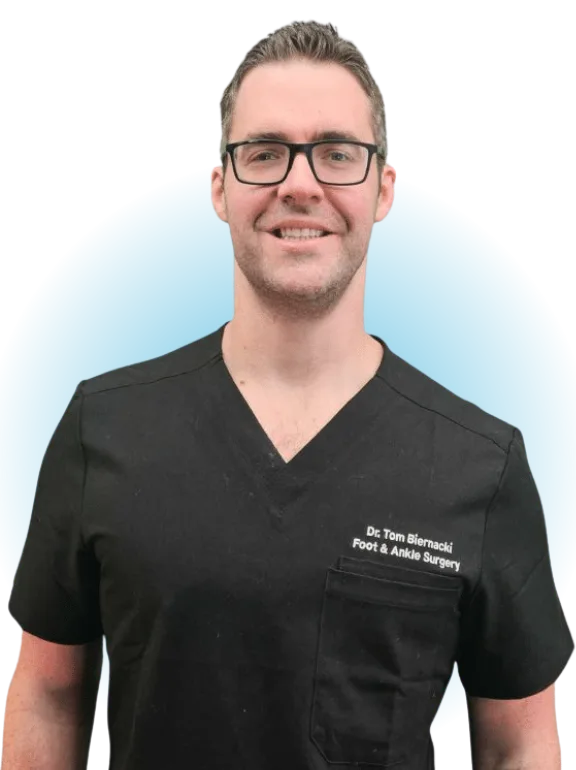
Medically reviewed by Dr. Tom Biernacki, DPM — Board-Certified Podiatric Surgeon — Balance Foot & Ankle, Howell & Bloomfield Township, MI. Last updated April 2026.
Medically reviewed by Dr. Tom Biernacki, DPM, FACFAS — Board-certified podiatric physician specializing in occupational foot conditions at Balance Foot & Ankle, Southeast Michigan.
Quick Answer: Hair stylists and barbers spend 8–12 hours per day on hard salon floors, accumulating 15,000–20,000 steps while bearing 2–3 times their body weight through repetitive pivoting and reaching. This leads to plantar fasciitis, metatarsalgia, varicose veins, lower back pain, and progressive flat feet. Prevention requires supportive shoes with cushioned insoles, anti-fatigue floor mats at each station, graduated compression socks, scheduled sitting breaks, and targeted stretching between clients.
Table of Contents
- The Physical Demands of Salon Work
- Common Foot Conditions in Stylists
- Plantar Fasciitis and Heel Pain
- Forefoot Pain and Metatarsalgia
- Varicose Veins and Venous Insufficiency
- Progressive Flat Feet From Standing
- The Foot-Back Pain Connection
- Best Shoes for Salon Professionals
- Anti-Fatigue Mat Selection
- Between-Client Stretches
- Products That Make the Difference
- Most Common Mistake We See
- Warning Signs to Watch For
- Frequently Asked Questions
- Bottom Line
- Sources
Affiliate disclosure: This page contains affiliate links to products we recommend. We may earn a small commission at no extra cost to you. All recommendations are based on clinical experience treating salon professionals at Balance Foot & Ankle.
Your clients see the art you create — the precision cuts, the perfect color, the significant styles. What they do not see is what those eight to twelve hours on your feet cost you by the end of each day. The aching heels that make your first steps in the morning feel like walking on broken glass, the swollen ankles that barely fit into your shoes by closing time, the lower back pain that follows you home. Salon professionals are among the most common occupational foot patients we treat at Balance Foot & Ankle, and the pattern is remarkably consistent — preventable problems that become chronic because nobody taught you how to protect your feet while building your career.
The Physical Demands of Salon Work
Hairstyling and barbering rank among the most physically demanding standing professions for the lower extremities. Understanding the specific biomechanical demands explains why certain foot conditions are so prevalent in this industry:
- 8–12 hours of continuous standing — Salon professionals average 85–95% of their shift on their feet, compared to 50–60% for retail workers. The prolonged static standing pools blood in the lower extremities, increasing venous pressure by 80–90 mmHg.
- Hard floor surfaces — Tile, concrete, and laminate salon floors have virtually zero shock absorption. Each step transmits 100% of impact force through the foot, ankle, and knee without attenuation.
- Asymmetric posture — Stylists consistently pivot to their dominant side and reach with one arm extended, creating repetitive torsional stress through the foot and ankle that overloads the medial arch and posterior tibial tendon.
- Repetitive pivoting and weight shifting — Moving around the chair requires constant small pivots on the ball of the foot, concentrating shear forces on the metatarsal heads and sesamoid bones.
- Chemical exposure — Hair dyes, relaxers, and cleaning solutions that splash on feet through open shoes can cause contact dermatitis and nail damage.
- Temperature extremes — Standing near heat from blow dryers and flat irons while the lower body remains at floor temperature creates circulation challenges.
Common Foot Conditions in Stylists
In our experience treating hundreds of salon professionals, the following conditions account for the vast majority of foot complaints — and nearly all are preventable or manageable with the right approach:
- Plantar fasciitis — The number-one complaint, affecting an estimated 40–50% of salon workers at some point in their career. The classic “first step morning pain” that improves with walking but returns after prolonged standing.
- Metatarsalgia — Ball-of-foot pain from repetitive forefoot loading during pivoting movements. Often described as “walking on a pebble” under the 2nd or 3rd metatarsal head.
- Varicose veins and venous insufficiency — Prolonged standing increases venous pressure in the legs, stretching vein walls and damaging valves over years. Presents as visible tortuous veins, aching, heaviness, and ankle swelling that worsens throughout the shift.
- Posterior tibial tendon dysfunction — The tendon that supports the medial arch gradually stretches from years of standing, leading to progressive flatfoot deformity. Left untreated, this becomes a surgical problem.
- Hallux valgus (bunions) — Narrow, stylish salon shoes combined with hours of standing accelerate bunion progression in genetically susceptible individuals.
- Morton’s neuroma — Nerve compression between the 3rd and 4th metatarsal heads from narrow toe boxes and repetitive pivoting stress.
Plantar Fasciitis and Heel Pain
Plantar fasciitis is the most common condition we treat in salon workers. The plantar fascia — a thick band of connective tissue running from the heel bone to the toes — functions as a shock-absorbing bowstring that supports the arch during standing and walking. In stylists, the combination of prolonged standing on hard floors and inadequate arch support creates repetitive microtrauma at the fascia’s attachment to the calcaneus (heel bone).
The hallmark symptom is intense heel pain with the first few steps in the morning or after sitting during a lunch break, caused by the fascia tightening during rest and then being suddenly stretched under load. As the condition progresses, the pain persists throughout the work day rather than resolving with activity. Stylists often compensate by shifting weight to the forefoot, which then triggers secondary metatarsalgia — creating a cascading injury pattern.
The good news is that 90% of plantar fasciitis responds to conservative treatment: supportive insoles with structured arch support, calf and plantar fascia stretching, anti-fatigue mats, and activity modification. Only 5–10% of cases require advanced interventions such as shockwave therapy or corticosteroid injection.
Forefoot Pain and Metatarsalgia
The ball of the foot absorbs peak pressure during the constant pivoting and weight-shifting movements that styling requires. Over time, the fat pad beneath the metatarsal heads thins (a natural aging process accelerated by years of repetitive loading), leaving less cushioning between bone and the hard salon floor. Stylists typically describe metatarsalgia as a burning, aching, or “walking on a marble” sensation localized under the 2nd or 3rd metatarsal head.
Contributing factors include narrow-toed shoes that compress the metatarsal heads together, insufficient forefoot cushioning in shoe insoles, and the forward weight shift that occurs when reaching across a client. Treatment focuses on metatarsal pad placement (just proximal to the painful metatarsal heads to redistribute load), shoes with wide toe boxes, and cushioned insoles with forefoot padding.
Varicose Veins and Venous Insufficiency
Standing for 8–12 hours forces the venous system in the legs to work against gravity continuously. The calf muscle pump — which normally propels blood upward during walking — is underused during static standing, causing blood to pool in the lower legs. Over months and years, this sustained venous pressure stretches vein walls and damages the one-way valves that prevent backflow, resulting in varicose veins.
Early signs include aching, heavy-feeling legs by the end of the shift, visible spider veins on the ankles and calves, and ankle swelling that resolves overnight. Progressive venous insufficiency leads to skin changes (darkening around the ankles), chronic edema, and in severe cases, venous ulcers. Graduated compression socks (20–30 mmHg) are the single most effective preventive measure, reducing venous pooling by 30–40% during standing shifts.
Progressive Flat Feet From Standing
The posterior tibial tendon is the primary dynamic support of the medial arch. Years of standing on hard surfaces without adequate arch support gradually overloads this tendon, causing it to stretch, weaken, and eventually fail — a condition called posterior tibial tendon dysfunction (PTTD). This results in progressive flatfoot deformity that alters the biomechanics of the entire lower extremity.
PTTD progresses through four stages, from tendon inflammation (Stage I) to rigid flatfoot deformity with ankle arthritis (Stage IV). Stages I and II respond well to supportive insoles, ankle bracing, and physical therapy. Stages III and IV often require surgical reconstruction. The critical intervention point is early — when arch fatigue and medial ankle pain first appear — because tendon damage is largely irreversible once it progresses past Stage II.
The Foot-Back Pain Connection
Lower back pain is the second most common complaint among salon professionals, and it frequently originates in the feet. Flat feet or unsupported arches cause excessive pronation (inward rolling), which rotates the tibia and femur internally, increasing stress on the knee and hip joints and altering pelvic alignment. This kinetic chain reaction places asymmetric loads on the lumbar spine during the 8–12 hours of standing.
Studies show that structured arch support reduces lower back pain in standing workers by 25–40% — not by changing the spine, but by correcting the biomechanical foundation. Many of our salon patients are surprised that their back pain improves significantly simply by addressing their foot support.
Best Shoes for Salon Professionals
The ideal salon shoe balances professional appearance with biomechanical protection. Based on our clinical experience, these features matter most for all-day standing:
- Closed-toe design — Protects against chemical splashes, dropped scissors, and hot tool burns. Open-toed shoes should be avoided in salon environments.
- Low heel (under 1 inch) — Heels above 1 inch shift body weight forward onto the metatarsal heads and shorten the Achilles tendon. For every inch of heel height, forefoot pressure increases by approximately 22%.
- Wide toe box — Allows natural toe splay during weight bearing. Narrow-toed shoes compress the metatarsal heads, contributing to neuromas, bunions, and metatarsalgia.
- Removable insole — Allows replacement with a supportive aftermarket insole that provides superior arch support and cushioning compared to stock insoles.
- Non-slip outsole — Salon floors become slippery from water, hair products, and cut hair. A textured rubber outsole prevents falls.
- Lightweight construction — A heavy shoe adds cumulative fatigue over 15,000–20,000 steps. Aim for under 12 ounces per shoe.
- Supportive midsole — EVA or polyurethane midsole that does not fully compress under standing body weight. Squishy memory foam feels good initially but bottoms out within hours.
Anti-Fatigue Mat Selection
Anti-fatigue mats reduce the impact of hard salon floors by 40–60%, and studies consistently show they reduce lower extremity fatigue and discomfort during prolonged standing. The ideal mat for salon use has these characteristics:
- Thickness of 3/4 to 1 inch — Thinner mats provide insufficient cushioning; thicker mats create a tripping hazard and can cause instability
- Beveled edges — Prevents tripping when rolling a styling chair on and off the mat
- Closed-cell construction — Resists hair product absorption, water penetration, and bacterial growth
- Anti-microbial surface — Salon floors accumulate hair, chemicals, and moisture; the mat should be easily disinfected
- Appropriate size — Large enough to cover your working radius around the chair (typically 3 feet × 5 feet minimum)
Between-Client Stretches
The five minutes between clients is enough time for targeted stretches that dramatically reduce end-of-day foot pain. These three stretches address the structures most stressed by salon work:
Calf stretch (gastrocnemius and soleus): Stand facing the wall with one foot forward, back leg straight with heel on the ground. Lean forward until you feel a stretch in the back calf. Hold 30 seconds, then bend the back knee slightly to target the soleus (the deeper calf muscle that connects to the Achilles). This stretch prevents Achilles tightening that contributes to plantar fasciitis.
Plantar fascia roll: Place a frozen water bottle or golf ball under the arch of your foot and roll it back and forth for 60 seconds per foot. The rolling motion stretches the plantar fascia while the cold reduces inflammation. This is the single most effective self-treatment for plantar fasciitis between clients.
Toe curls and spreads: While seated (even briefly), curl your toes tightly for 5 seconds, then spread them as wide as possible for 5 seconds. Repeat 10 times per foot. This activates the intrinsic foot muscles that support the arch — muscles that become inhibited during hours of passive standing in shoes.
Products That Make the Difference
DASS Compression Socks — Venous Support All Shift
Standing 8–12 hours causes blood to pool in the lower legs, stretching veins and causing the aching, heavy-leg feeling that stylists know too well. DASS graduated compression socks provide 20–30 mmHg pressure that assists venous return, reducing blood pooling by 30–40%. Wear them from the start of your shift — putting them on after legs are already swollen is significantly less effective. The moisture-wicking fabric keeps feet dry in warm salon environments, and the seamless toe prevents blister formation during hours of standing.
Doctor Hoy’s Natural Pain Relief Gel — End-of-Day Recovery
After a long day behind the chair, Doctor Hoy’s Natural Pain Relief Gel provides camphor-and-menthol cooling that soothes aching arches, sore metatarsals, and tight Achilles tendons without the gastrointestinal risks of daily NSAID use. Apply to the plantar surface, around the heel, and up the calf after each shift. Many of our salon patients keep a tube at their station for mid-day application during breaks.
PowerStep Maxx Insoles — For Flat Feet and Overpronation
Stylists with flat feet or posterior tibial tendon dysfunction need more aggressive arch support than the Pinnacle provides. The PowerStep Maxx features maximum motion control with a deep heel cradle and reinforced medial arch that limits excessive pronation — protecting the posterior tibial tendon from the progressive stretching that years of standing causes. If you have been told you have “falling arches” or have visible flat feet when standing, the Maxx is the better choice.
Foot Petals Insoles — Stylish Shoe Comfort
For salon professionals who wear dressier shoes that cannot accommodate a full-length insole, Foot Petals cushion insoles provide targeted ball-of-foot padding that reduces metatarsal pressure without changing shoe fit. The ultra-thin profile slides into flats, loafers, and fashion-forward salon shoes where bulkier insoles would not fit. Ideal for stylists who need professional appearance without sacrificing comfort.
FLAT SOCKS — Friction-Free Standing Comfort
Hours of subtle pivoting and weight shifting create friction between the sole of the foot and the insole surface. FLAT SOCKS are ultra-thin, seamless insole liners that reduce this friction interface, preventing the hot spots and plantar blisters that develop during long shifts. Layer them on top of your PowerStep insoles for an additional moisture-wicking, friction-reducing barrier.
Most Common Mistake We See
Key Takeaway: A 41-year-old hair stylist came to Balance Foot & Ankle with severe heel pain she had ignored for eight months, hoping it would “work itself out.” She was wearing fashion sneakers with no arch support on a concrete salon floor, standing 10 hours per day six days per week without anti-fatigue mats. By the time she came in, her plantar fasciitis had progressed to a partial plantar fascia tear visible on ultrasound, and she had developed compensatory metatarsalgia in both feet from shifting weight off her painful heels. What would have responded to insoles and stretching eight months earlier now required a corticosteroid injection series, custom orthotics, physical therapy, and three months of modified work schedule. She lost income during recovery that far exceeded the cost of the insoles and anti-fatigue mat that would have prevented the problem entirely. Foot pain in standing professions is not something to push through — it is a signal to change something before it becomes a bigger problem.
Warning Signs to Watch For
Contact your podiatrist or call (810) 819-0008 if you experience any of the following:
- Heel pain that persists for more than 2 weeks despite rest and stretching — early plantar fasciitis responds much better than chronic cases
- Visible flattening of your arch compared to previous years — may indicate posterior tibial tendon dysfunction requiring intervention before it progresses
- Numbness, burning, or tingling in toes — possible nerve compression (tarsal tunnel syndrome or Morton’s neuroma) from prolonged standing
- Progressive varicose veins with leg heaviness — venous insufficiency that benefits from early compression therapy and evaluation
- Ankle swelling that does not resolve overnight — persistent edema may indicate venous insufficiency or deeper circulatory issue
- Pain in the ball of the foot that worsens each week — may indicate metatarsal stress reaction or progressive neuroma
- Inability to stand on tiptoes on one foot — test for posterior tibial tendon integrity; failure suggests tendon damage
- Skin changes around the ankles (darkening, hardening, or non-healing sores) — signs of chronic venous insufficiency requiring medical evaluation
Occupational Foot Treatments at Balance Foot & Ankle
- Plantar Fasciitis Treatment →
- Custom Orthotics →
- Flat Foot Treatment →
- Morton’s Neuroma Treatment →
- Bunion Treatment →
In-Office Treatment at Balance Foot & Ankle
If home treatment isn’t providing relief for your foot and ankle conditions, our podiatry team at Balance Foot & Ankle can help with expert evaluations and advanced in-office care.
Book online 24/7. (810) 206-1402
Frequently Asked Questions
What are the best shoes for hair stylists?
Do anti-fatigue mats really work?
Yes. Studies consistently show that anti-fatigue mats reduce lower extremity discomfort by 40–60% during prolonged standing. The cushioned surface forces subtle micro-movements in the feet and legs that improve circulation and reduce static muscle fatigue. A 3/4-inch to 1-inch closed-cell mat at your station is one of the most cost-effective investments in your career longevity.
How often should I replace salon work shoes?
Replace salon shoes every 6–8 months or sooner if the midsole shows visible compression (the shoe leans to one side when placed on a flat surface) or the heel counter no longer holds the heel firmly. A 10-hour standing shift degrades shoe cushioning roughly 3 times faster than typical walking use. Rotating between two pairs of shoes extends the life of each pair by allowing the midsole foam to recover between shifts.
Should salon workers wear compression socks?
Absolutely. Graduated compression socks (20–30 mmHg) are recommended for anyone standing more than 6 hours per day. They reduce venous pooling, decrease leg fatigue, and help prevent varicose vein development. Put them on before your shift begins — applying compression to already-swollen legs is less effective. Most salon professionals report a dramatic difference in end-of-day leg comfort within the first week.
Does insurance cover podiatrist visits for work-related foot pain?
Yes. Most commercial insurance and Medicare cover podiatric evaluation and treatment of foot conditions regardless of whether they are work-related. If your foot pain is directly caused by workplace conditions, it may also qualify for workers’ compensation coverage. Custom orthotics are often covered when medically necessary and prescribed by a podiatrist.
Bottom Line
Your feet are the foundation of your career. Hair stylists and barbers who invest in proper foot support — supportive shoes with quality insoles, compression socks, anti-fatigue mats, and targeted stretching — can work comfortably for decades instead of burning out from pain in their 30s and 40s. The cost of prevention (insoles, compression, mats) is a fraction of the cost of treatment, lost income, and potential surgery that neglected foot problems eventually demand. Start with the insoles and compression socks — most of our salon patients say they wish they had done it years earlier.
Sources
- Waters TR, Dick RB. Evidence of health risks associated with prolonged standing at work and intervention effectiveness. Rehabil Nurs. 2015;40(3):148-165.
- Orlando AR, King PM. Relationship of demographic variables on perception of fatigue and discomfort following prolonged standing under various floor conditions. J Occup Environ Hyg. 2004;1(10):656-662.
- Redfern MS, Cham R. The influence of flooring on standing comfort and fatigue. AIHAJ. 2000;61(5):700-708.
- Tüchsen F, Hannerz H, Burr H, Krause N. Prolonged standing at work and hospitalisation due to varicose veins. Occup Environ Med. 2005;62(12):847-850.
- King PM. A comparison of the effects of floor mats and shoe in-soles on standing fatigue. Appl Ergon. 2002;33(5):477-484.
Watch: Standing All Day Foot Care Tips
On Your Feet All Day?
Dr. Biernacki treats salon professionals, barbers, nurses, teachers, and other standing workers at Balance Foot & Ankle. If your feet are limiting your career, a hands-on exam plus imaging when needed can identify the cause and get you back to comfortable, productive workdays.
Book Your Evaluation →
Balance Foot & Ankle — Novi, MI — (810) 819-0008
Related Articles
- Marathon Race Day Foot Care →
- Aquatic Therapy for Foot & Ankle Rehab →
- Recovering at Home After Foot Surgery →
- Podiatrist-Recommended Foot Care Products →
Ready to Get Relief?
Book online 24/7 at Balance Foot & Ankle in Howell & Bloomfield Township, MI
4.9★ | 1,200+ Reviews | 3,000+ Surgeries
“flex”,”justifyContent”:”center”}} –>Or call: (810) 206-1402
Dr. Tom’s Recommended Products: See our clinically tested product recommendations for this condition. View Dr. Tom’s recommended products →
When to See a Podiatrist for Occupational Foot Pain
If your job requires standing all day and you are experiencing heel pain, arch fatigue, varicose veins, or swollen feet and ankles, a podiatrist can help with customized solutions. Custom orthotics, compression therapy, and footwear recommendations can transform your workday comfort. At Balance Foot & Ankle, we treat occupational foot problems at our Howell and Bloomfield Township offices.
→ Learn about our plantar fasciitis treatment
→ Book your appointment
→ Call (810) 206-1402
Clinical References
- McCulloch J. Health risks associated with prolonged standing. Work. 2002;19(2):201-205.
- Waters TR, Dick RB. Evidence of health risks associated with prolonged standing at work and intervention effectiveness. Rehabil Nurs. 2015;40(3):148-165. doi:10.1002/rnj.166
- Halim I, Omar AR. A review on health effects associated with prolonged standing in the industrial workplaces. Int J Recent Res Appl Stud. 2012;8(1):14-21.
Insurance Accepted
BCBS · Medicare · Aetna · Cigna · United Healthcare · HAP · Priority Health · Humana · View All →
Howell Office
4330 E Grand River Ave
Howell, MI 48843
Get Directions →
Bloomfield Township Office
43494 Woodward Ave, Suite 208
Bloomfield Township, MI 48302
Get Directions →
Watch: Dr. Tom explains
Podiatrist-recommended products
As an Amazon Associate, Dr. Tom earns from qualifying purchases.
12-hr shift cushioning.
Check price →All-day arch support.
View on Amazon →End-of-shift swelling.
Check price →Premium cushioning.
View on Amazon →Related resources
Ready to solve this? Book today.
Book online 24/7 · Howell & Bloomfield Township · 4.9★ (1,200+ reviews)
☎ (810) 206-1402Book Online →
Dr. Tom Biernacki, DPM is a board-certified foot & ankle surgeon (ABFAS & ABPM) at Balance Foot & Ankle Specialists in Southeast Michigan. With over a decade of clinical experience, he specializes in heel pain, bunions, diabetic foot care, sports injuries, and minimally invasive surgery. Dr. Biernacki is a member of the APMA and ACFAS, and his patient education content on MichiganFootDoctors.com and YouTube has made him one of the most-followed foot & ankle educators on YouTube.