
| Sesamoid Condition | Cause | Pain Pattern | X-ray Finding | MRI/Bone Scan Finding |
|---|---|---|---|---|
| Sesamoiditis | Repetitive stress; overuse; cavus foot; dancer/runner | Dull ache under 1st MTP; worse with push-off; gradual onset | Normal or mild irregularity | Bone marrow edema; periosteal reaction |
| Acute sesamoid fracture | Single traumatic event; fall; jamming big toe | Sudden sharp pain; point tenderness; swelling | Fracture line (linear); compare with contralateral | Fracture gap; surrounding soft tissue edema |
| Stress fracture of sesamoid | Cumulative repetitive loading; running volume increase | Insidious onset; worse with activity; no single event | May appear normal early; sclerosis late | Bone marrow edema; fracture line on MRI before X-ray positive |
| Bipartite sesamoid (normal variant) | Congenital two-part sesamoid (10–33% of people) | Usually asymptomatic; can become painful with overuse | Two rounded smooth fragments (smooth edges differentiate from fracture) | No marrow edema if truly asymptomatic variant |
| Sesamoid AVN (osteonecrosis) | Disrupted blood supply; post-fracture; steroid use | Persistent deep aching; failure to heal; worse with all weight-bearing | Sclerosis; fragmentation; density change | Loss of normal bone signal; necrotic core |
| Sesamoid chondromalacia / OA | Articular cartilage wear; post-inflammatory | Chronic pain; 1st MTP joint stiffness; activity-related flare | Joint space narrowing; osteophytes | Cartilage thinning; subchondral edema |
| Treatment | Indication | Duration | Expected Outcome | Escalation If Failed |
|---|---|---|---|---|
| Dancer’s pad / sesamoid offloading orthotic | Sesamoiditis; bipartite sesamoid pain; mild stress reaction | 6–12 weeks minimum; permanent for recurrent cases | 60–70% resolution with compliant offloading | Custom orthotic + metatarsal bar; cortisone injection |
| Stiff-soled shoe / rocker bottom | All sesamoid conditions — limits 1st MTP dorsiflexion loading | During active symptoms | Immediate load reduction; pain reduction within days | Surgical shoe / walking boot if inadequate |
| CAM boot / non-weight-bearing | Acute fracture; stress fracture; AVN | 6–8 weeks NWB; 4–6 weeks CAM boot after | Fracture healing in 8–12 weeks if blood supply intact | ORIF / sesamoidectomy for non-union |
| Cortisone injection (periosteal / peritendinous) | Sesamoiditis failing conservative care; bipartite pain flare | 1–2 injections; limit due to fat pad atrophy risk | 50–70% pain relief for 3–6 months | PRP injection; surgical sesamoidectomy |
| PRP (platelet-rich plasma) injection | Sesamoiditis / stress reaction; AVN early stage | 1–3 injections | Emerging evidence for bone healing; 60–70% response | Sesamoidectomy |
| Sesamoidectomy (partial or total) | AVN; non-union fracture; chronic refractory sesamoiditis | Outpatient; 6–8 week recovery | 85–90% pain relief; hallux valgus risk with medial sesamoid removal | Reconstructive surgery if HV develops post-op |

Watch: BEST Sesamoiditis Treatment [Sesamoid Bone Pain & Fracture FIX] — MichiganFootDoctors YouTube
Foot pain isn't resolving?
Same-week appointments at Howell & Bloomfield Township
Pain under the ball of the big toe — particularly at the base of the first metatarsal head — has a specific set of causes that are different from general forefoot pain. The sesamoid bones are two small, pea-sized bones embedded within the flexor hallucis brevis tendon that runs under the first metatarsophalangeal joint. They act as pulleys to improve the mechanical advantage of the big toe push-off. When they’re inflamed, fractured, or undergo avascular necrosis, the pain they cause is very specific, very focal, and often very persistent if not managed correctly.
In our clinic, sesamoid injuries are most commonly seen in dancers (especially ballet dancers who spend significant time on relevé), runners with forefoot striking patterns, and athletes in sports requiring explosive push-off (basketball, baseball, tennis). We also see them in patients who’ve simply made a sudden change in footwear — going from supportive shoes to flat sandals creates a dramatic increase in first ray loading that can overload the sesamoids quickly.
What Are the Sesamoid Bones
The sesamoids are two small bones — the medial (tibial) sesamoid and the lateral (fibular) sesamoid — located plantar (underneath) the first metatarsophalangeal (MTP) joint. Unlike most bones, they are embedded within the substance of the flexor hallucis brevis tendon rather than connected to adjacent bones via joints in the traditional sense. Their purpose is to act as a pulley: by displacing the tendon away from the joint axis, they increase the mechanical advantage of the flexor hallucis brevis, making big toe push-off more powerful and efficient.
The medial sesamoid bears more load than the lateral and is consequently injured more often. The blood supply to the sesamoids is limited and enters primarily from the distal end — which means fractures, particularly of the medial sesamoid, have inherent poor healing potential due to watershed blood supply to the proximal fragment. This is why sesamoid fractures are treated more aggressively and for longer than most other small bone fractures.
A bipartite sesamoid — a normal anatomic variant in which the sesamoid has two separate ossification centers that never fused — is present in approximately 10–30% of people. It’s critical to distinguish a bipartite sesamoid from a fracture on imaging, as they look similar on X-ray. Key distinguishing features: bipartite sesamoids are typically bilateral (same finding in both feet), have smooth, well-corticated margins, and the gap between the pieces is rounded rather than jagged.
Sesamoid Conditions — Not All the Same
Several distinct pathologies affect the sesamoids, each requiring different treatment and carrying a different prognosis:
| Condition | What It Is | Typical Treatment | Healing Time |
|---|---|---|---|
| Sesamoiditis | Inflammation of the bone and surrounding tissue, no fracture | Offloading padding, activity restriction, orthotics | 4–6 weeks |
| Stress fracture | Hairline crack from repetitive loading | Non-weight-bearing cast or boot, 8–12 weeks | 8–12 weeks |
| Acute fracture | Complete fracture from single traumatic event | NWB cast, possible surgery if displaced | 10–16 weeks |
| Avascular necrosis (AVN) | Loss of blood supply; sesamoid bone dies | Extended offloading, possible sesamoidectomy | 6+ months or surgery |
| Sesamoid chondromalacia | Cartilage damage on sesamoid articular surface | Offloading, injection, possible sesamoidectomy | Variable |
Symptoms of Sesamoid Pain
The hallmark of sesamoid pain is focal tenderness directly under the first metatarsal head — specifically under the ball of the big toe, not the big toe joint itself or the plantar fascia insertion at the heel. Patients can typically point with one finger to exactly where it hurts, which is diagnostically helpful.
Common symptom features: pain that worsens with barefoot walking, especially on hard floors; pain with push-off during walking or running (late stance/toe-off phase); pain when wearing flat, unsupportive shoes (sandals, flip-flops); worsening with high-impact activities (jumping, sprinting, dancing); and possible mild swelling under the first MTP joint. A clinical finding unique to sesamoid injury: pain is markedly worsened by extending (pulling up) the big toe — this loads the sesamoid apparatus under tension. Pain that is worse with toe extension than with direct pressure is highly suggestive of sesamoid pathology.
Causes and Risk Factors
Sesamoid bone pain results from overloading of the first metatarsal head region. The primary risk factors in our patient population include: athletic activities requiring forceful toe push-off or prolonged time on the ball of the foot (ballet, basketball, baseball, gymnastics, distance running with forefoot strike pattern); sudden footwear changes from cushioned to minimalist or flat shoes; high-arched (cavus) foot which transfers load to the first and fifth metatarsal heads; prominent first metatarsal head that projects more plantarly than usual (plantar-flexed first ray); bony prominences or hyperkeratosis under the sesamoid region; and direct trauma (turf toe with sesamoid involvement or a fall landing on the ball of the foot).
Diagnosis
Weight-bearing X-rays in standard AP, lateral, and sesamoid axial views are the starting point. X-rays identify frank fractures, displacement, and avascular necrosis (sclerosis/fragmentation pattern). However, X-rays miss stress fractures in early stages and cannot distinguish sesamoiditis from stress fracture. X-rays can also appear to show a bipartite sesamoid that is actually a stress fracture — comparison views of the opposite foot help, but are not definitively diagnostic.
MRI is the gold standard for sesamoid pathology. It detects bone marrow edema (sesamoiditis and early stress fracture), AVN (loss of normal marrow signal), cartilage damage, and associated tendon or capsule injury. In any patient with sesamoid pain persisting beyond 4 weeks without clear X-ray diagnosis, we order MRI. Bone scan was historically used but MRI provides superior anatomic detail with no radiation. Diagnostic local anesthetic injection (lidocaine under the sesamoid) confirms the sesamoid as the pain source when multiple forefoot conditions are present simultaneously.
Treatment Options
Dancer’s Padding / Sesamoid Offloading
The cornerstone of sesamoiditis treatment is redirecting plantar pressure away from the sesamoid bones. “Dancer’s padding” is a J-shaped or donut-shaped felt or foam pad that creates a protected zone around — not over — the sesamoid. This single intervention can reduce sesamoid pain dramatically within 1–2 days and forms the foundation of all conservative sesamoid management. The pad is applied to the insole or directly to the foot, with the open center precisely over the tender sesamoid. Correct placement is critical and is something we teach patients in our clinic.

- High Arch Support: PowerStep supination insoles deliver firm, flexible high arch support plus a deep heel cradle for comfort, stability & motion control, helping align feet, reduce pain, and protect against ball & heel pressure.
- All Day Comfort & Support: PowerStep Pinnacle High shoe inserts for women and men use premium dual layer cushioning to deliver heel to toe comfort and responsive bounce back with every step, without going flat.
- Relieves & Helps Prevent Pain: PowerStep Pinnacle High insoles for supination can help alleviate common foot conditions often linked to supination, including plantar fasciitis, Achilles tendonitis, fat pad atrophy, and Morton’s neuroma.
- No Trimming: PowerStep insoles move easily from shoe to shoe. Inserts are sized by shoe size for footwear with removable factory insoles. Designed for walking, running, work & casual dress shoes; pairs well with best walking shoes for women and men.
- Made in the USA: We stand behind our PowerStep Insoles for women and men. Proudly made in the USA & backed by a 30-day money-back guarantee. HSA & FSA Eligible
Activity Modification
All activities that load the sesamoids through toe push-off or forefoot strike must be significantly reduced or eliminated during treatment. This includes running (especially forefoot strike), dancing, jumping, and sports with aggressive directional changes. Low-impact alternatives: cycling (moves push-off to midfoot), swimming, and pool running maintain fitness without sesamoid loading. Return to activity is guided by symptoms — typically 4–6 weeks for sesamoiditis, 8–12 weeks for stress fracture.
Footwear and Orthotic Management
Transition to rigid-soled or stiff-soled shoes during treatment — these prevent the toe extension moment at push-off that stresses the sesamoid. A shoe with a rocker bottom sole is ideal. Custom orthotics with a Morton’s extension cutout (a recess under the first metatarsal head) provide precise offloading and are particularly useful for patients with a plantar-flexed first ray or recurrent sesamoid problems.
Corticosteroid Injection
A carefully placed corticosteroid injection adjacent to the painful sesamoid provides significant short-term pain relief and allows rehabilitation to progress. We use ultrasound guidance for precision. Indicated for sesamoiditis that hasn’t responded adequately to 4–6 weeks of conservative management. Not appropriate for stress fractures — corticosteroids may impair bone healing. Repeat injections are limited (typically no more than 2–3 lifetime) due to potential for tendon weakening and avascular necrosis risk with repeated injections.
Surgical Sesamoidectomy
Surgical removal of one sesamoid (sesamoidectomy) is reserved for: AVN with refractory pain, stress fractures that fail 6+ months of conservative treatment, and acute displaced fractures. The medial sesamoid can be removed without significant functional deficit in most patients. Removing the lateral sesamoid must be done with caution — losing both sesamoids causes hallux valgus deformity. Recovery from sesamoidectomy: 6–8 weeks with gradual return to activity by 3–4 months. Good outcomes in properly selected patients.
For sesamoid evaluation, dancer’s padding fitting, custom orthotic fabrication, and injection therapy in Howell or Bloomfield Township, MI: Call (810) 206-1402 or book at new-patient-information.
Healing Timeline
Sesamoiditis without fracture: with consistent offloading and activity restriction, pain typically improves significantly within 2 weeks and resolves by 4–6 weeks. Incomplete treatment (continuing provocative activities) can perpetuate sesamoiditis for months. Sesamoid stress fracture: 8–12 weeks of strict offloading in a non-weight-bearing cast or CAM boot. The limited blood supply to the sesamoids makes healing slower than other small bones. Complete fracture/AVN: 6 months to 1 year for conservative management, or 3–4 months after sesamoidectomy. Prognosis for AVN managed conservatively is variable — many patients achieve acceptable function, but some require eventual surgery.
⚠️ Warning Signs — Seek Prompt Evaluation
- Big toe ball pain after a specific jumping or push-off injury — possible acute sesamoid fracture; needs same-week X-ray
- Pain not improving after 4 weeks of correct sesamoid offloading — needs MRI to rule out fracture/AVN
- Pain worsening despite rest — possible AVN progression
- Dancer or athlete with chronic big toe pain — sesamoid injury is frequently missed; needs sesamoid-specific X-ray views
- X-ray showing fragmentation of sesamoid — possible AVN; MRI needed urgently
- Numbness in big toe with sesamoid pain — medial plantar nerve branch may be compressed; needs neural evaluation
Recommended Products
PowerStep Pinnacle Insoles — First Ray Offloading Support
PowerStep Pinnacle insoles provide structured arch support that shifts plantar load from the first metatarsal head toward the midfoot arch — directly reducing sesamoid pressure with each step. For sesamoiditis and post-fracture return-to-activity, these provide reliable daily offloading that complements your dancer’s padding. The firm heel cup also prevents excessive pronation, which can increase first ray ground reaction force.
Best For: Sesamoiditis return-to-activity phase, sesamoid stress fracture recovery, patients with flat feet or overpronation as a contributing factor.
Not Ideal For: Use during the acute non-weight-bearing fracture phase. High-cavus feet with prominent first metatarsal may need a custom orthotic with more specific first-ray relief rather than standard insole.
Doctor Hoy’s Natural Pain Relief Gel — Topical Sesamoid Pain Management
During the early weeks of sesamoid treatment, Doctor Hoy’s arnica and camphor gel provides meaningful topical analgesic relief to the plantar forefoot without the GI side effects of oral NSAIDs. Apply directly to the plantar surface of the first MTP joint region 2–3 times daily. Particularly useful for patients who cannot take NSAIDs (kidney issues, blood thinners, GI sensitivity). The camphor provides counter-irritation analgesia; arnica reduces peritendinous inflammation.
Best For: Acute sesamoiditis pain during early offloading period, post-injection tenderness, return-to-activity mild soreness management.
Not Ideal For: Broken or abraded skin under the foot. Not a substitute for offloading — topical analgesia masks pain that should be guiding activity level.
The most dangerous error in sesamoid management is treating a stress fracture as sesamoiditis (inflammation) and continuing low-level activity. Sesamoiditis is appropriate to manage with relative rest and padding; a stress fracture requires strict non-weight-bearing for 8–12 weeks. The clinical distinction often can’t be made on X-ray alone — MRI is needed. When patients “rest for a few weeks, feel a bit better, return to activity, and have the pain come back repeatedly,” stress fracture is almost always the explanation. If you’ve been treating sesamoid pain for more than 4 weeks without clear improvement, MRI is the correct next step — not more time with the same treatment.
Sesamoid Pain Evaluation in Howell & Bloomfield Township
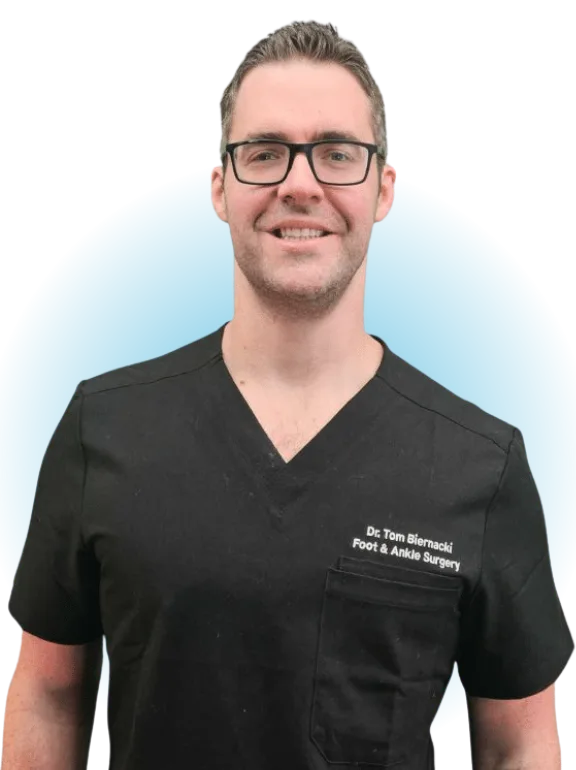
Sesamoid-specific X-ray views, MRI referral, dancer’s padding, custom orthotics, and ultrasound-guided injection. Dr. Tom Biernacki, DPM — board-certified podiatric surgeon.
⭐⭐⭐⭐⭐ 4.9 stars · 1,123 reviews
(810) 206-1402 Book Online →Frequently Asked Questions
How long does sesamoid pain take to heal?
Sesamoiditis without fracture: 4–6 weeks with consistent offloading and activity restriction. Sesamoid stress fracture: 8–12 weeks in a non-weight-bearing boot or cast. Avascular necrosis: 6 months to 1 year for conservative management or 3–4 months post-sesamoidectomy. Patients who continue provocative activities during treatment dramatically extend recovery timelines — the most common cause of prolonged sesamoid pain is inadequate rest compliance.
What is the difference between sesamoiditis and a sesamoid fracture?
Sesamoiditis is inflammation without a fracture — the sesamoid bone is intact. Symptoms improve more quickly with rest (days to a few weeks). A sesamoid stress fracture is a hairline crack requiring strict non-weight-bearing for 2–3 months. The two cannot be reliably distinguished on clinical exam or even standard X-ray — MRI is the definitive test. If sesamoid pain hasn’t improved after 3–4 weeks of rest and offloading, assume fracture until proven otherwise by MRI.
Can I run with sesamoiditis?
Running with active sesamoiditis significantly delays healing and risks fracture. Forefoot strikers load the sesamoid with 3–4× body weight at toe-off; this is exactly the mechanism that caused sesamoiditis in the first place. We recommend zero running during the first 4–6 weeks of treatment. Pool running (deep-water running with flotation belt) and cycling maintain fitness without sesamoid loading. Return to running begins with a gradual walk-to-run program only after 4+ weeks of symptom-free walking.
When should I see a podiatrist for ball-of-big-toe pain?
See a podiatrist if: the pain is directly under the base of the big toe (not the joint itself), is worse with toe extension and push-off, has been present for more than 2 weeks, or occurred after a jumping or push-off injury. Sesamoid injuries are frequently under-diagnosed at urgent care and the ER because sesamoid-specific X-ray views are often not taken. At Balance Foot & Ankle, we take targeted sesamoid views and have MRI referral available for same-week evaluation. Call (810) 206-1402.
Does insurance cover sesamoid treatment?
Yes. Evaluation, X-rays, orthotics, and injection therapy for sesamoid pain are covered by Medicare and most private insurance plans when medically indicated. MRI is typically covered after conservative treatment has been attempted. Sesamoidectomy is a covered surgical procedure. Our team at Balance Foot & Ankle verifies your coverage before your appointment. Call (810) 206-1402.
Sources
- Biedert R, Hintermann B. “Stress fractures of the medial great toe sesamoids in athletes.” Foot Ankle Int. 2003;24(2):137–141.
- McBryde AM Jr, Anderson RB. “Sesamoid foot problems in the athlete.” Clin Sports Med. 1988;7(1):51–60.
- Richardson EG. “Hallucal sesamoid pain: causes and surgical treatment.” J Am Acad Orthop Surg. 1999;7(4):270–278.
- Amaranath J et al. “Diagnosis and management of sesamoid disorders of the first metatarsophalangeal joint.” Foot Ankle Spec. 2016;9(6):533–541. doi:10.1177/1938640016667310
- Dedmond BT, Cory JW, McBryde A Jr. “The hallucal sesamoid complex.” J Am Acad Orthop Surg. 2006;14(13):745–753.
Ready to get relief? Book an appointment at Balance Foot & Ankle or call (810) 206-1402. Same-week appointments available in Howell & Bloomfield Township, MI.
In-Office Treatment at Balance Foot & Ankle
If home treatment isn’t providing relief for your sesamoiditis, our podiatry team at Balance Foot & Ankle can help with same-week evaluations and advanced in-office care.
Same-week appointments available. (810) 206-1402
Our podiatrists treat the underlying cause, not just the symptom. Same-week appointments at our Howell and Bloomfield Township, Michigan offices.
Same-Week Appointments in Howell & Bloomfield Township
Three board-certified podiatric surgeons. 1,123+ five-star reviews. Most insurance accepted.

Dr. Tom Biernacki, DPM is a board-certified foot & ankle surgeon (ABFAS & ABPM) at Balance Foot & Ankle Specialists in Southeast Michigan. With over a decade of clinical experience, he specializes in heel pain, bunions, diabetic foot care, sports injuries, and minimally invasive surgery. Dr. Biernacki is a member of the APMA and ACFAS, and his patient education content on MichiganFootDoctors.com and YouTube has made him one of the most-followed foot & ankle educators on YouTube.