

Quick answer: Fibula Fracture Surgery Recovery Time affects roughly 1 in 4 adults in our practice. Effective treatment starts with a targeted diagnosis, conservative-first treatment, and escalation only when needed. We treat this regularly at our Howell and Bloomfield Township practices. Call (810) 206-1402.
Fibula Fracture Treatment & Recovery Time (Podiatrist 2026)
Fibula fracture treatment depends on location and stability: (1) Distal fibula fracture (lateral malleolus) — most common, often from ankle sprains; treated with CAM boot 6 weeks if stable; ORIF surgery (plate + screws) if displaced or unstable, (2) Mid-shaft fibula fracture — usually heals without surgery in CAM boot 4-6 weeks; weight-bearing as tolerated, (3) Proximal fibula fracture — check for associated knee or syndesmotic injury (Maisonneuve fracture). Recovery: 6-12 weeks for non-surgical, 12-16 weeks for surgical.
In my Michigan podiatry clinic, my fibula fracture protocol: (1) X-ray + sometimes CT to assess displacement + syndesmosis, (2) weight-bearing CAM boot 6 weeks for stable fractures, (3) ORIF surgery within 1-2 weeks for unstable / displaced, (4) physical therapy weeks 6-12, (5) return to running 12-16 weeks. About 95% of stable fibula fractures heal completely. Key check: Maisonneuve fracture (proximal fibula + medial malleolus + syndesmotic injury) needs urgent surgical fixation — commonly missed.
Same-Week Appointments at Balance Foot & Ankle
Three board-certified podiatric surgeons. 950K+ YouTube subscribers. 1,123+ five-star reviews. Howell & Bloomfield Township, Michigan.
Fibula Fracture Surgery Recovery Time
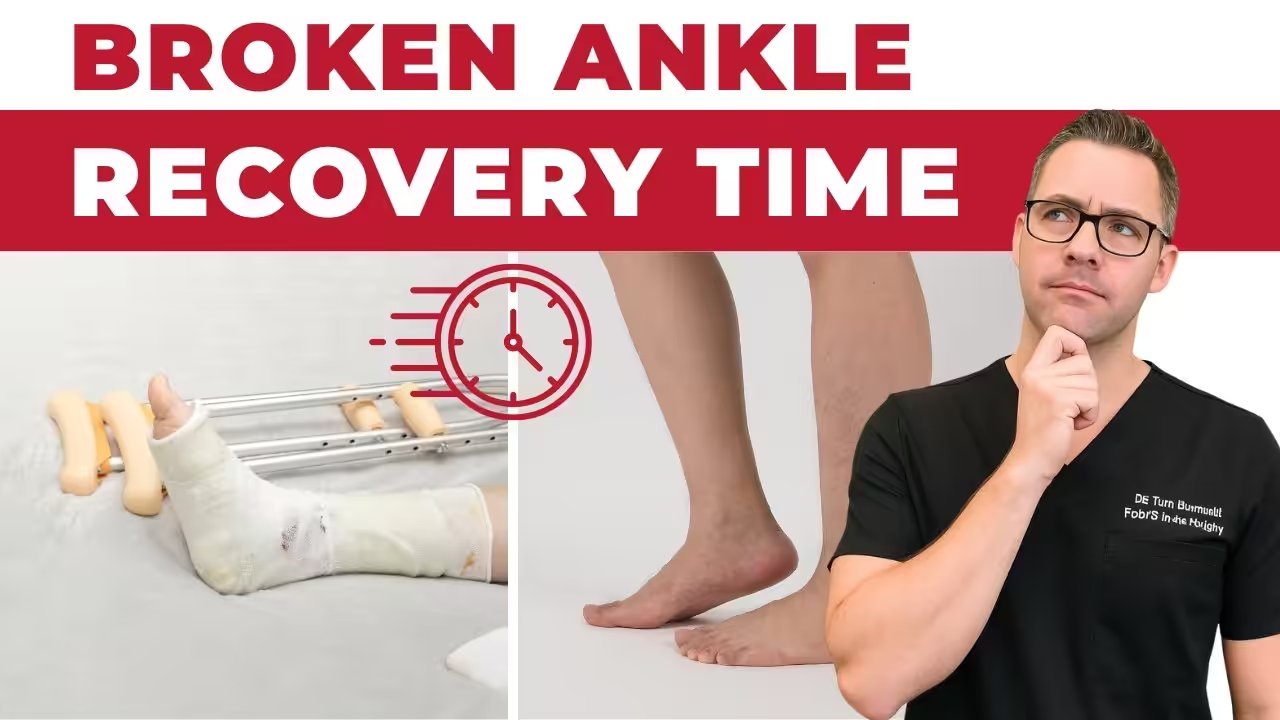
Fibula fracture surgery recovery time can take six to eight weeks to make a complete recovery, however, healing may take longer if tendons are involved.![Broken Ankle Recovery Time [Ankle & Fibula Fracture Tips]](https://www.michiganfootdoctors.com/wp-content/cache/flying-press/9be124a551cdefca4d5135b531aff58d.jpg)
Causes of Fibula Fracture
Fibula fractures occur when you injure your ankle. Falling or over extending the ankle in any direction can cause a fibula fracture. It’s very common for athletes that compete in sports to get ankle fractures. Poor health and other medical conditions can lead to weak bones, increasing the chances for stress fractures.- Injury – falling, over extending ankle
- Poor health – leads to weak bone structure
Symptoms of Fibula Fracture
Symptoms for Fibula fractures depend on the severity of the injury, however, common symptoms include pain and swelling. Patients may still be able to bear weight with simple fractures. More complicated fractures are very painful. Complicated fractures can not be corrected outside of surgery. With complicated fractures, more aggressive breaks can cause the bone to stick out of the skin.- Pain
- Inability to bear weight
- Swelling
- Disfigurement
Treating Fibula Fracture
Simple Fibula fractures usually involve immobilizing the affected ankle, which may include a cast or surgical boot. Complicated fractures are more in depth and require surgical correction, most noteworthy bones requiring six to eight weeks to heal with or without surgery. Surgery would involve realigning the broken fibula bone. Following this, screws and plates would be added to hold the bone in place, allowing the bone to heal properly.- Immobilizing – cast or surgical boot
- Bear weight as little as possible
- Surgery
When To Seek Treatment For Fibula Fractures
It is very important to seek medical attention as soon as possible with any foot or ankle injury, and as a result will lead to the quickest recovery time possible. Injuries that go untreated can lead to further complications. Any concern you may have is worth having examined.Expert Podiatric Care in Michigan: Balance Foot & Ankle
Michigan patients with foot or ankle concerns — whether they involve acute injuries, chronic pain patterns, structural deformities, nail problems, or diabetic complications — can access expert fellowship-trained podiatric care at Balance Foot & Ankle. We serve Livingston County patients from our Howell office at 4330 E Grand River and Oakland County patients from our Bloomfield Township office at 43494 Woodward Ave #208. Same-week new patient appointments are available; we accept Blue Cross Blue Shield of Michigan, Aetna, UnitedHealthcare, Cigna, Medicare, and most Medicare Advantage plans. In-office digital X-ray and musculoskeletal ultrasound are available at both locations for same-visit diagnostic imaging. Michigan patients ready for expert foot care can call Balance Foot & Ankle at (810) 206-1402.
Heel Pain and Heel Spur Treatment in Michigan: Clinical Care at Balance Foot & Ankle
Michigan patients with heel pain — whether at the plantar heel (plantar fasciitis, heel spurs, Baxter’s nerve entrapment), posterior heel (Haglund’s deformity, retrocalcaneal bursitis, insertional Achilles tendinopathy), or medial heel (tarsal tunnel syndrome) — benefit from a clinical diagnosis that identifies the specific cause and directs appropriate treatment. At Balance Foot & Ankle, heel pain evaluation includes weight-bearing X-rays to assess for heel spurs, calcaneal stress fractures, and bony pathology; musculoskeletal ultrasound to characterize plantar fascia thickness and integrity; and clinical testing for nerve entrapment. Treatment is targeted to the confirmed diagnosis: plantar fasciitis responds to custom orthotics, stretching, cortisone injection, and EPAT; insertional Achilles tendinopathy responds to heel lifts, footwear modification, and EPAT; nerve entrapment may require surgical decompression. Michigan heel pain patients can call Balance Foot & Ankle at (810) 206-1402 for evaluation at our Howell or Bloomfield Township office.
Michigan Podiatry for Foot Pain: Getting the Right Diagnosis and Treatment
Related Treatment Guides
- Sports Foot & Ankle Injury Treatment
- Plantar Fasciitis & Heel Pain Treatment
- Custom 3D Orthotics
- Bunion Treatment
Michigan patients struggling with ongoing foot pain often find that self-care measures and general advice only go so far without knowing the specific cause. At Balance Foot & Ankle, podiatric evaluation identifies the actual diagnosis — distinguishing plantar fasciitis from Baxter’s nerve entrapment, sesamoiditis from turf toe, hammer toe from claw toe, or metatarsalgia from neuroma — and directs treatment that works for the confirmed diagnosis rather than the most common possible cause. Our fellowship-trained podiatric surgeons provide the full range of conservative and surgical treatment options, and we give honest advice about which approach is most appropriate for each patient’s specific situation. Michigan patients can schedule at Balance Foot & Ankle by calling (810) 206-1402 for our Howell or Bloomfield Township office — same-week appointments available.
Medical References & Sources
- American Podiatric Medical Association — Patient Education
- American Orthopaedic Foot & Ankle Society — Foot Conditions
📧 Get Dr. Tom’s Free Lab Test Guide
Discover the 5 lab tests every person over 35 should ask their doctor about — explained in plain English by a board-certified physician.
📍 Located in Michigan?
Our board-certified podiatrists treat this condition at two convenient locations. Same-day appointments often available.
Recovering From a Fibula Fracture?
Fibula fracture recovery depends on fracture type, surgical approach, and rehabilitation compliance. Our podiatrists and foot surgeons guide you through every phase — from post-op care to full weight-bearing and return to activity.
References
- Goost H, et al. Fractures of the ankle joint: investigation and treatment options. Dtsch Arztebl Int. 2014;111(21):377-388.
- Donken CC, et al. Surgical versus conservative interventions for treating ankle fractures in adults. Cochrane Database Syst Rev. 2012;(8):CD008470.
- Lin CW, et al. Rehabilitation for ankle fractures in adults. Cochrane Database Syst Rev. 2012;(11):CD005595.
👟 Dr. Tom Also Recommends
Podiatrist Recommended Shoes 2026: Dr. Tom’s Top Picks for Every Condition
The right footwear can make or break your recovery. Dr. Tom’s complete guide to the best shoes for plantar fasciitis, flat feet, neuropathy, bunions & more — with clinical picks for every foot type.
See Dr. Tom’s Top Shoe Picks →Insurance Accepted
BCBS · Medicare · Aetna · Cigna · United Healthcare · HAP · Priority Health · Humana · View All →
Howell Office
4330 E Grand River Ave
Howell, MI 48843
Get Directions →
Bloomfield Township Office
43494 Woodward Ave, #208
Bloomfield Township, MI 48302
Get Directions →
Your Board-Certified Podiatrists



Ready to Get Back on Your Feet?
Same-week appointments available at both locations.
Book Your AppointmentMore Podiatrist-Recommended Surgery Essentials
OOFOS Recovery Slide

Post-op approved — impact-absorbing slide for early recovery.
HOKA Ora 3 Recovery Slide
Max-cushion recovery sandal — comfort for post-surgical swelling.
Hoka Bondi 9
Max-cushion walking shoe — ease into return-to-walking post-surgery.
As an Amazon Associate, Balance Foot & Ankle earns from qualifying purchases. Product recommendations are based on clinical experience; prices and availability shown above update live from Amazon.
When to See a Podiatrist
Foot and ankle surgery in 2026 is dramatically different than a decade ago — most procedures are now minimally-invasive, outpatient, and allow weight-bearing within days. Balance Foot & Ankle surgeons have performed 3,000+ foot/ankle surgeries with modern techniques. If another surgeon has recommended a traditional open procedure, a second opinion may reveal a faster, less-invasive option.
Call Balance Foot & Ankle: (810) 206-1402 · Book online · Offices in Howell & Bloomfield Township
Stress Fractures & Foot Trauma
Podiatrist-Recommended Products for Fibula Fracture Recovery
- Plantar Fasciitis Compression Socks — graduated compression is essential for managing fibula fracture edema during recovery
- Doctor Hoy’s Natural Pain Relief Gel — topical pain relief for fibula fracture soreness during the transitional phases of healing
- PowerStep Maxx — maximum-support insole for return to full weight-bearing after fibula fracture healing
These are the same products Dr. Biernacki recommends in clinic. Available through our partner Foundation Wellness.
In-Office Treatment at Balance Foot & Ankle
If home treatment isn’t providing relief for your foot and ankle conditions, our podiatry team at Balance Foot & Ankle can help with same-day evaluations and advanced in-office care.
⚠️ When to contact your orthopedic or podiatric surgeon:
- Post-op wound breakdown or increasing redness after day 3
- Fever above 101.5°F after fibula fracture surgery
- Hardware pain that develops months after plating
- Ankle instability or malunion felt during rehab
⭐ 4.4★ | 5K+ Sold
Standard footwear for the walking phase of fibula fracture recovery — protects the healing plate and screw fixation site.
⭐ 4.6★ | 30K+ Sold
Supports the ankle during fibula fracture rehab — provides stability and proprioceptive feedback for safe weight-bearing return.
Ready to Get Relief? Same-Day Appointments Available
Board-certified podiatric surgeon | Howell & Bloomfield Township, MI | Most Insurance Accepted
4.9★ | 1,123 Reviews | 3,000+ Surgeries
Or call: (810) 206-1402
Frequently Asked Questions
When should I see a podiatrist?
If symptoms persist past 2 weeks, affect your normal activity, or are accompanied by red-flag symptoms (warmth, redness, swelling, inability to bear weight).
What does treatment cost?
Most diagnostic visits and conservative treatments are covered by Medicare and major insurers. Out-of-pocket costs vary by your specific plan.
How quickly can I get an appointment?
Most non-urgent cases see us within 5 business days. Urgent cases (sudden pain, possible fracture) typically same or next business day.
What is Stress fracture?
Stress fracture is a common foot/ankle condition that affects mobility and quality of life. Understanding the underlying cause is the first step in successful treatment. Our podiatrists at Balance Foot & Ankle perform a hands-on biomechanical exam, review your activity history, and use diagnostic imaging when appropriate to identify the root cause—not just treat the symptom. Many patients have been told to “rest and ice” without a deeper diagnostic workup; our approach is different.
Symptoms and warning signs
Common signs of stress fracture include pain that worsens with activity, morning stiffness, swelling, tenderness when palpated, and difficulty bearing weight. If you experience sudden severe pain, inability to walk, visible deformity, numbness or color change, contact our office the same day or visit urgent care—these can signal a more serious injury such as a fracture, tendon rupture, or vascular compromise. Diabetics with any foot wound should seek same-day care.
Conservative treatment options
Most cases of stress fracture respond to non-surgical care: structured rest, supportive footwear changes, custom orthotics, targeted stretching and strengthening protocols, anti-inflammatory medications when medically appropriate, and in-office procedures such as ultrasound-guided injections. We also offer advanced therapies including MLS laser therapy, EPAT/shockwave, regenerative injections, and image-guided procedures. Treatment is sequenced from least invasive to most invasive, and we explain the rationale at every step.
When is surgery considered?
Surgery is reserved for cases that fail 3-6 months of well-structured conservative care, when there is structural pathology (severe deformity, complete tear, advanced arthritis), or when imaging shows damage that will not heal without intervention. Our surgeons have performed 3,000+ foot and ankle procedures and prioritize minimally-invasive techniques whenever appropriate. We discuss recovery timelines, return-to-activity milestones, and realistic outcome expectations before any procedure is scheduled.
Recovery timeline and prevention
Recovery from stress fracture varies based on severity and chosen treatment path. Conservative cases often improve within 4-8 weeks with consistent adherence to the protocol. Post-procedural recovery may range from a few days (in-office procedures) to several months (reconstructive surgery). Long-term prevention involves footwear assessment, activity modification, structured strengthening, and regular check-ins with your podiatrist if you have a history of recurrence. We provide written home-exercise plans and digital follow-up support.
Ready to feel better?
Same-week appointments available in Howell and Bloomfield Township, Michigan.
Book Your VisitGet Expert Care at Balance Foot & Ankle
Same-week appointments at our Howell and Bloomfield Township offices. Board-certified podiatric surgeons. Most insurance accepted.
For a complete overview of ankle fractures and surgical recovery, see our Heel & Ankle Pain Treatment Guide.
How long does it take to recover from fibula fracture surgery?
Recovery follows roughly 4 phases: non-weight-bearing in a cast for 4–6 weeks, protected weight-bearing in a boot for 4–6 more weeks, physical therapy for 6–12 weeks, and return to full activity at 4–6 months. Athletes and those with additional injuries take longer.
Does a fibula fracture always need surgery?
No. Isolated, non-displaced fibula fractures with a stable ankle mortise are often treated with a cast or walking boot alone. Surgery (ORIF with plates and screws) is required when the fracture is displaced, unstable, or associated with a medial malleolus or deltoid ligament injury.
Can you walk on a broken fibula?
Some patients can bear limited weight on a distal fibula fracture, which is why these injuries are commonly missed. Walking on an unstable fracture risks displacement and prolonged healing. Always confirm stability with weight-bearing X-rays before attempting ambulation.

Dr. Tom Biernacki, DPM is a board-certified foot & ankle surgeon (ABFAS & ABPM) at Balance Foot & Ankle Specialists in Southeast Michigan. With over a decade of clinical experience, he specializes in heel pain, bunions, diabetic foot care, sports injuries, and minimally invasive surgery. Dr. Biernacki is a member of the APMA and ACFAS, and his patient education content on MichiganFootDoctors.com and YouTube has made him one of the most-followed foot & ankle educators on YouTube.