
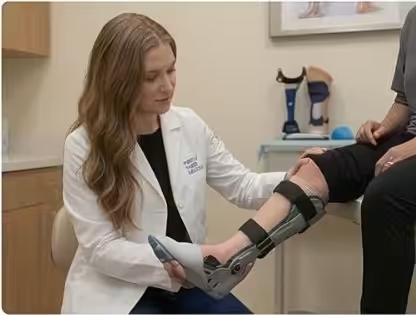
Quick answer: Ankle Brace Types Guide Michigan is a common foot/ankle topic that affects many patients. Effective treatment starts with a targeted diagnosis, conservative-first treatment, and escalation only when needed. We treat this regularly at our Howell and Bloomfield Township practices. Book online, or call (810) 206-1402.
Medically reviewed by Dr. Tom Biernacki, DPM · Board-Certified Podiatric Surgeon · Last reviewed: April 2026 · Editorial Policy
The most important clinical decision with Ankle Brace Types Guide Michigan isn’t which treatment to start with — it’s identifying the correct subtype. That changes everything. Call (810) 206-1402.
Quick Answer
Ankle Brace Types Guide: Lace-Up vs. Rigid vs. Air Stirrup relates to foot pain — typically caused by overuse, footwear, or biomechanics. Most patients improve in 6-12 weeks with conservative care. Same-week appointments in Howell + Bloomfield Township: (810) 206-1402.
Medically reviewed by Dr. Tom Biernacki, DPM — Board-Certified Podiatric Surgeon — Balance Foot & Ankle, Howell & Bloomfield Township, MI. Last updated April 2026.
▶ Watch
Medically Reviewed by Dr. Tom Biernacki, DPM — Board-Certified Podiatrist, Balance Foot & Ankle Specialists, Michigan. Last updated April 2026.
Ankle braces vary dramatically in their biomechanical function, and choosing the wrong type for a given clinical situation leads to either under-protection (causing reinjury) or over-restriction (slowing rehabilitation and weakening stabilizing muscles). At Balance Foot & Ankle in Southeast Michigan, Dr. Tom Biernacki recommends ankle braces based on the diagnosis, phase of recovery, and the patient’s activity level — not based on which brace is most popular or most heavily marketed.
Types of Ankle Braces and Their Indications
Lace-up functional ankle brace (ASO, McDavid 195): the most versatile and most evidence-supported ankle brace for chronic ankle instability and return-to-sport after ankle sprain. Mechanism: figure-8 or bilateral strap design limits inversion (the injurious motion) while preserving plantarflexion/dorsiflexion for normal walking and running gait. Best for: returning to sport after Grade 2–3 ankle sprain; chronic ankle instability patients who want to participate in sport; prevention of ankle sprains in athletes with prior sprain history (reduces re-sprain rate by 50% in RCTs). Fits inside athletic footwear. Not appropriate for: rigid ligament reconstruction (where motion control is more complete), acute Grade 3 sprain requiring immobilization. Air Stirrup (Aircast): rigid medial-lateral malleolar pads with air bladder compression; provides pneumatic compression to reduce swelling alongside stability. Best for: acute Grade 2 sprains (first 4–6 weeks), post-sprain swelling management; good for daily walking during acute recovery. Rigid lace-up or hinged rigid brace: more control than lace-up functional brace; used for chronic severe instability where functional brace is insufficient. Ankle foot orthosis (AFO): custom-molded device for significant instability, foot drop, PTTD stage II; prescription medical device not available OTC. Walking boot (CAM walker): maximum immobilization for acute injuries and post-operative management — replaces a cast in most situations where controlled weight-bearing is permitted. Neoprene sleeve: compression-only with no significant biomechanical stability; appropriate only for mild swelling management, not injury protection.
Evidence on Ankle Braces for Prevention
A 2015 JAMA meta-analysis (the highest quality evidence base for ankle brace prevention) demonstrated: functional lace-up ankle braces reduce ankle sprain incidence by approximately 50% in athletes with a prior sprain history, compared to no brace. Athletes without prior sprain history have smaller (though still statistically significant) benefit. Taping: athletic taping reduces ankle sprain risk comparably to lace-up braces in the first 5 weeks, but loses 40–50% of its restricting effectiveness after 10 minutes of activity as the tape stretches — lace-up braces maintain effectiveness throughout the activity period. Prophylactic bracing does NOT weaken ankles: a concern expressed by many athletes and coaches; research shows no decrease in peroneal strength or proprioception with long-term brace use — the protective benefit is biomechanical restriction of the injurious motion range, not muscle relaxation.
More Podiatrist-Recommended Foot Health Essentials
Hoka Clifton 10


Max-cushion everyday shoe — podiatrist favorite for walking and running.

OOFOS Recovery Slide

Impact-absorbing recovery sandal — wear after long days on your feet.
As an Amazon Associate, Balance Foot & Ankle earns from qualifying purchases. Product recommendations are based on clinical experience; prices and availability shown above update live from Amazon.

When to See a Podiatrist
If foot or ankle pain has been bothering you for more than a few weeks, home care alone may not be enough. Balance Foot & Ankle offers same-week appointments at our Howell and Bloomfield Township clinics — no referral needed in most cases. Bring your current shoes and a short list of symptoms and we’ll build you a treatment plan in one visit.
Call Balance Foot & Ankle: (810) 206-1402 · Book online · Offices in Howell & Bloomfield Township
Frequently Asked Questions
What is the best ankle brace for chronic ankle instability?
For chronic lateral ankle instability in an active patient: a lace-up functional brace (ASO or McDavid 195) is the evidence-supported first choice — it limits inversion while preserving normal walking and running mechanics, fits inside athletic footwear, and maintains its effectiveness throughout activity. For severe instability failing functional bracing: a custom-fit rigid hinged brace (Bledsoe or similar) provides more control. For patients with chronic instability who have failed 3–6 months of bracing and physical therapy: ankle ligament reconstruction (modified Broström) should be discussed — bracing indefinitely is a management strategy, not a cure.
Should I wear an ankle brace all day or only during activity?
For acute ankle sprains (first 2–3 weeks): wearing the Air Stirrup or lace-up brace during all weight-bearing activity — including daily walking — is appropriate. As the ankle improves: transitioning to brace-only during high-risk activities (running, court sports, hiking on uneven terrain) while walking normally without brace promotes proprioceptive retraining. For chronic instability prevention: brace during all sport activities, no brace for routine walking and daily life. Wearing a brace 24/7 for months after an acute injury delays proprioceptive retraining — the goal is to reduce the brace use progressively as rehabilitation progresses.
What ankle brace is best for plantar fasciitis?
For plantar fasciitis, the most appropriate “brace” is a dorsiflexion night splint, not a stability ankle brace — the goal is to maintain stretch on the plantar fascia and Achilles overnight to reduce morning first-step pain. During the day, a supportive orthotic-accommodating shoe is more appropriate than an ankle brace. Pneumatic “walking braces” can provide temporary heel cushioning for severe heel pain but don’t address the biomechanical cause. Lace-up stability ankle braces do nothing to offload the plantar fascia and are not indicated for plantar fasciitis.
Uncertain which ankle support is right for your condition? Contact Balance Foot & Ankle in Southeast Michigan for ankle evaluation and bracing guidance from Dr. Biernacki.
Dr. Tom’s Recommended Products for Ankle Pain & Injuries
📍 Located in Michigan?
Our board-certified podiatrists treat this condition at two convenient locations. Same-day appointments often available.
These are products I personally use and recommend to my patients at Balance Foot & Ankle.
- ASO Ankle Stabilizing Orthosis — Figure-8 straps with bilateral stability columns — the gold standard lace-up ankle brace for return to sport
- McDavid 195 Ankle Brace — Hinged design allows dorsiflexion/plantarflexion while blocking inversion — best for chronic lateral instability
- Doctor Hoy’s Natural Pain Relief Gel 3oz — Menthol-based cryotherapy — penetrates soft tissue to reduce ankle sprain inflammation and acute pain
Affiliate disclosure: As an Amazon Associate, Balance Foot & Ankle earns from qualifying purchases. We only recommend products we trust for our own patients.
Dr. Tom’s Recommended: Natural Topical Pain Relief
This is what I actually use in our clinic at Balance Foot & Ankle.
- Doctor Hoy’s Natural Pain Relief Gel — Natural topical pain relief I use in our clinic. Arnica + camphor formula. Apply directly to the painful area 3-4x daily for fast-acting relief without NSAIDs.
📧 Get Dr. Tom’s Free Lab Test Guide
Discover the 5 lab tests every person over 35 should ask their doctor about — explained in plain English by a board-certified physician.
Affiliate disclosure: As an Amazon Associate, Balance Foot & Ankle earns from qualifying purchases. We only recommend products we trust for our own patients.
Join 950,000+ Learning About Foot Health
Dr. Tom shares honest medical advice, supplement reviews, and treatment guides you won’t find anywhere else.
Subscribe on YouTube →Top-Rated Ankle Braces
- Aircast Air-Stirrup — Gold Standard Ankle Brace
- Zamst A2-DX — Maximum Support for Athletes
- McDavid Lace-Up Ankle Brace — Everyday Stability
Amazon affiliate links — we may earn a small commission at no extra cost to you.
Insurance Accepted
BCBS · Medicare · Aetna · Cigna · United Healthcare · HAP · Priority Health · Humana · View All →
Howell Office
4330 E Grand River Ave
Howell, MI 48843
Get Directions →
Bloomfield Township Office
43494 Woodward Ave, #208
Bloomfield Township, MI 48302
Get Directions →
Your Board-Certified Podiatrists



Ready to Get Back on Your Feet?
Same-week appointments available at both locations.
Book Your AppointmentWatch: Dr. Tom explains

Podiatrist-recommended products
As an Amazon Associate, Dr. Tom earns from qualifying purchases.
Pair ankle brace with arch support for full lower-leg stability.
View on Amazon →Rigid immobilization for Grade 2-3 sprains.
View on Amazon →Post-activity cryotherapy for recurrent instability.
View on Amazon →Topical relief for chronic lateral ankle pain.
View on Amazon →Related resources
Ready to solve this? Book today.
Same-week appointments · Howell & Bloomfield Township · 4.9★ (1,123+ reviews)
☎ (810) 206-1402Book Online →In-Office Treatment at Balance Foot & Ankle
When conservative care isn’t enough, Dr. Tom Biernacki and the team at Balance Foot & Ankle offer advanced, same-day options — including Foot Bracing Howell at our Howell and Bloomfield Township clinics.
Same-day appointments available. Call (810) 206-1402 or book online.
Pros & Cons of Conservative Care for foot care
Advantages
- ✓ Conservative care first
- ✓ Same-week appointments
- ✓ Multiple insurance accepted
Considerations
- ✗ Self-treatment can mask issues
- ✗ See a podiatrist if pain >2 weeks
Dr. Tom’s Recommended Products for foot care
Affiliate disclosure: As an Amazon Associate, Balance Foot & Ankle earns from qualifying purchases. We only recommend products we use with patients.
Footnanny Heel Cream Dr. Tom’s Pick
Best for: Daily moisturizer for cracked heels
Ready to Get Back on Your Feet?
Same-day appointments in Howell + Bloomfield Township. Most insurance accepted. Dr. Tom Biernacki, DPM & team.
Book Today — Same-Day Appointments Available
Call Now: (810) 206-1402
About Your Care Team at Balance Foot & Ankle
Dr. Tom Biernacki, DPM · Board-Certified Foot & Ankle Surgeon. Specializes in conservative-first care, minimally invasive bunion surgery, and complex reconstruction.
Dr. Carl Jay, DPM · Accepting new patients. Specializes in sports medicine, athletic injuries, and routine podiatric care.
Dr. Daria Gutkin, DPM, AACFAS · Accepting new patients. Specializes in surgical reconstruction and pediatric podiatry.
Locations: 4330 E Grand River Ave, Howell, MI 48843 · 43494 Woodward Ave Suite 208, Bloomfield Township, MI 48302
Hours: Mon–Fri 8:00 AM – 5:00 PM · (810) 206-1402
In-Office Treatment at Balance Foot & Ankle
If home treatment isn’t providing relief for your ankle conditions, our podiatry team at Balance Foot & Ankle can help with same-day evaluations and advanced in-office care.
Same-day appointments available. (810) 206-1402
Frequently Asked Questions
When should I see a podiatrist?
If symptoms persist past 2 weeks, affect your normal activity, or are accompanied by red-flag symptoms (warmth, redness, swelling, inability to bear weight).
What does treatment cost?
Most diagnostic visits and conservative treatments are covered by Medicare and major insurers. Out-of-pocket costs vary by your specific plan.
How quickly can I get an appointment?
Most non-urgent cases see us within 5 business days. Urgent cases (sudden pain, possible fracture) typically same or next business day.
Our podiatrists treat the underlying cause, not just the symptom. Same-week appointments at our Howell and Bloomfield Township, Michigan offices.
Ready for Expert Care?
Same-day appointments in Howell & Bloomfield Township, MI.
4.9★ | 1,123 Reviews | 3,000+ Surgeries
Or call: (810) 206-1402

Dr. Tom Biernacki, DPM is a board-certified foot & ankle surgeon (ABFAS & ABPM) at Balance Foot & Ankle Specialists in Southeast Michigan. With over a decade of clinical experience, he specializes in heel pain, bunions, diabetic foot care, sports injuries, and minimally invasive surgery. Dr. Biernacki is a member of the APMA and ACFAS, and his patient education content on MichiganFootDoctors.com and YouTube has made him one of the most-followed foot & ankle educators on YouTube.