
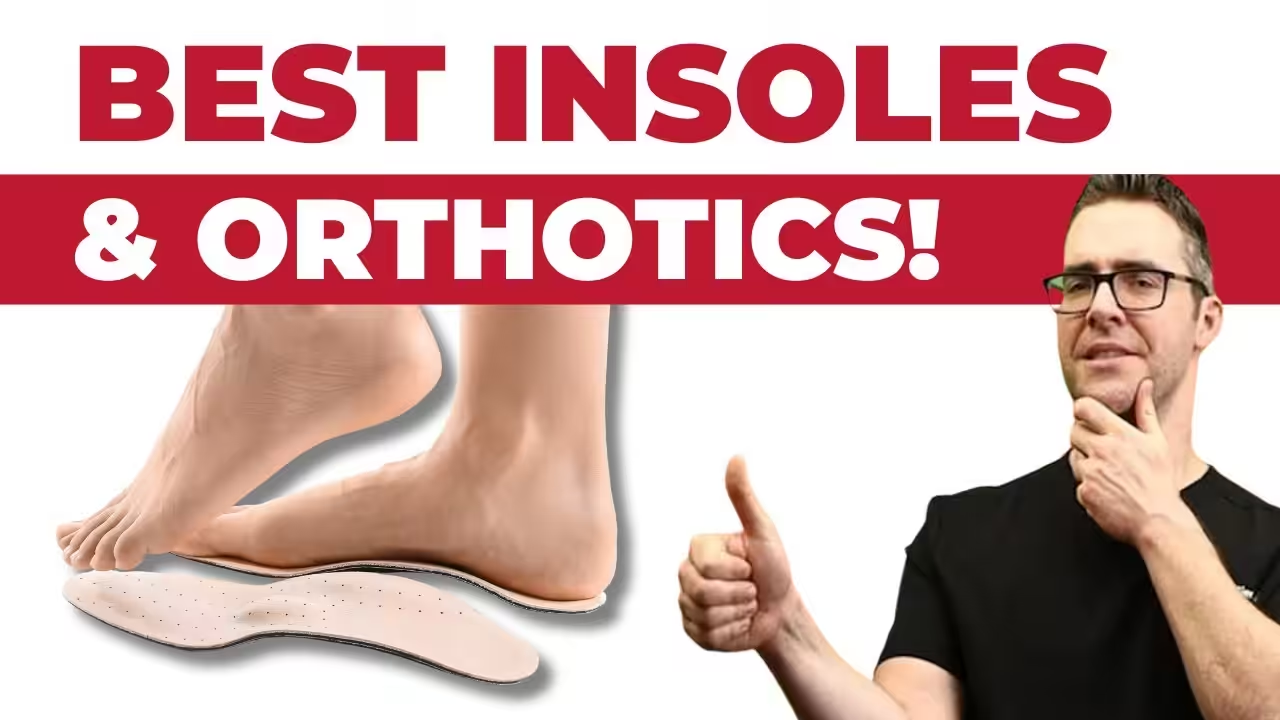
Quick answer: If you have diabetes, Medicare and most insurers cover one pair of therapeutic (“diabetic”) shoes plus three pairs of custom inserts every calendar year when you qualify — because properly fitted footwear is one of the most effective ways to prevent diabetic foot ulcers and amputations. At Balance Foot & Ankle in Howell and Bloomfield Township, we handle the whole process: qualification, fitting, and dispensing. Call (810) 206-1402.
★ 4.9-star rated by Michigan patients on Google · Medicare-credentialed for therapeutic footwear · Same-week appointments
Get fitted for your covered diabetic shoes
We verify your Medicare benefit first · same-week appointments at both Michigan offices
📅 Book Online — Howell
📅 Book Online — Bloomfield
📞 (810) 206-1402
★ 4.9 from 1,123+ Google reviews · Most insurance accepted
Medicare Diabetic Shoes in Howell & Bloomfield Township, MI
Therapeutic shoes aren’t a luxury for people with diabetes — they’re preventive medicine. Reduced sensation and altered pressure put diabetic feet at risk, and the right shoes and custom inserts offload that pressure before it becomes a wound. Best of all, the benefit is usually covered.
What the Medicare therapeutic shoe benefit covers
For qualifying patients, Medicare Part B (and most commercial plans) cover, each calendar year:
- One pair of therapeutic shoes (extra-depth, seamless interior), and
- Three pairs of custom inserts molded to offload your specific pressure points.
These are billed under the diabetic shoe program (HCPCS codes such as A5500 for the shoes and A5512/A5513 for inserts). We verify your coverage before anything is ordered.
What actually makes a shoe a diabetic shoe
The phrase gets used loosely, and most shoes sold as “diabetic” are simply wide and soft. Softness is not the point. A therapeutic shoe is built to stop three specific things: pressure concentrating anywhere on the sole, a seam or edge rubbing skin that cannot feel it rubbing, and the shoe itself deforming a foot that has lost its normal shape. Six features do that work.
- Extra depth. Roughly a quarter to a half inch of additional volume through the toe box and instep, so a removable insert or a custom orthotic can sit inside without stealing the room your toes need. Depth is what makes everything else possible.
- A seamless interior. No stitching, no overlays and no glued edges anywhere the foot touches. A seam you would never notice on a normal foot is enough to start a blister on skin with reduced sensation, and a blister is how most of these problems begin.
- A soft, forgiving upper. Leather or a stretch material that moulds around a bunion, a hammertoe or a Charcot deformity instead of pressing back against it. The shoe should yield to the foot, never the reverse.
- Genuine width, not just a bigger size. True widths run to 6E in men’s and 4E in women’s. Buying a longer shoe to get width is the most common substitution people make, and it leaves the foot sliding forward on every step.
- A firm heel counter. Squeeze the back of the shoe: it should resist. That stiffness controls the rearfoot and stops the foot rolling into the pressure points that ulcerate.
- A removable footbed. It comes out so a custom or heat-moulded insert can go in. This is the part that carries the offloading, and a shoe you cannot open up cannot be adapted as your foot changes.
Worth being blunt about one thing, because it drives most bad purchases: cushioning is not protection. A thickly padded shoe feels reassuring and does very little about the pressure that actually causes damage. Offloading comes from the insert redistributing load and the shoe holding the foot in a stable position. Softness underfoot is comfort, not safety, and the two are easy to confuse when sensation is reduced.
Diabetic shoes, orthopedic shoes and ordinary comfort shoes
These three get treated as one category and they are not. An ordinary comfort shoe is a retail product built to feel good: cushioned, roomy, no medical specification behind it. An orthopedic shoe is built to accommodate or correct a structural problem, which may mean a rigid sole, a rocker, a lift or a custom last, and it is prescribed for the deformity rather than for diabetes. A therapeutic diabetic shoe is a defined category with the six features above, made to a standard, and it is the only one of the three that carries a covered benefit.
The honest version of the advice is this: if you have diabetes but normal protective sensation, no deformity, no history of ulceration and no callus building anywhere, you may not need a therapeutic shoe at all. A well-fitted ordinary shoe in the correct width may be entirely adequate, and an examination will tell you which situation you are in. The risk is not diabetes by itself. It is diabetes plus a foot that has stopped reporting what is happening to it.
Do you qualify for the covered benefit?
You generally qualify if you have diabetes and at least one related foot condition — such as neuropathy, poor circulation, foot deformity, calluses that could lead to ulcers, or a history of foot ulcer or amputation. It also requires that the physician managing your diabetes documents the need; we coordinate that paperwork with your doctor.
How the process works
- Evaluation & qualification — we assess your feet and confirm coverage; your managing physician signs the required statement.
- Fitting — we measure and fit therapeutic shoes and take impressions for your custom inserts.
- Dispensing — we make sure the fit is right and show you how to wear and inspect them.
Getting the fit right
Most therapeutic shoes that fail do so because of how they were fitted, not how they were made. Five rules cover almost all of it.
- Measure late in the day, standing. Feet swell over the course of a day and spread under body weight. A shoe fitted first thing in the morning while sitting down will be tight by the evening, which is exactly when it matters.
- Fit the larger foot. Almost nobody is symmetrical. Fit to the bigger one and accommodate the smaller with the insert or an extra sock, never the other way round.
- Fit with the insert already in place. The shoe has to be judged with whatever is going inside it. Trying it on over the factory footbed, then swapping in a custom orthotic later, removes depth you have already committed to.
- Wear the socks you actually wear. A thick cushioned sock and a thin dress sock are close to a half size apart in practice.
- Length is not width. If the shoe pinches across the ball of the foot, the answer is a wider last, not a longer shoe. Going up in length to buy width leaves the foot sliding forward and loads the toes on every step.
Breaking them in safely
A new therapeutic shoe is not broken in the way an ordinary shoe is. On a foot with reduced sensation, “wearing it in” is how a pressure point becomes a wound without ever hurting.
- One to two hours on the first day, indoors, and no longer.
- Take them off and look. Any redness that is still visible twenty minutes after the shoe comes off means the shoe needs adjusting, not more wearing. That is the single most useful test in this whole process.
- Add about an hour a day as long as the skin stays clear, until you are in them for a full day.
- Check every day once they are in full use — the whole sole, the heel, and between every pair of toes, which is the area people skip and a common site for a problem to start.
- If the skin breaks, call rather than wait. A small area of broken skin treated in the first days is a minor problem. The same area three weeks later may not be.
Why professional fitting matters
A diabetic shoe only protects you if it actually fits your foot and accepts inserts molded to your pressure points. A professionally fitted pair with custom inserts does what an off-the-shelf shoe can’t — and the covered benefit means it usually costs you little to nothing. (See diabetic foot care.)
Why patients choose Balance Foot & Ankle
Dr. Tom Biernacki, Dr. Carl Jay, and Dr. Daria Gutkin are board-certified, Medicare-credentialed for therapeutic footwear, and rated 4.9 stars by Michigan patients on Google. We handle the qualification and paperwork so the benefit is simple to use.
Visit us — two Michigan offices
Balance Foot & Ankle — Howell
4330 E Grand River Ave, Howell, MI 48843
Livingston County · (810) 206-1402
Mon–Fri 9:00 AM–4:30 PM · Free on-site parking
Balance Foot & Ankle — Bloomfield
43494 Woodward Ave #208, Bloomfield Township, MI 48302
Oakland County · (810) 206-1402
Mon–Fri 9:00 AM–4:30 PM · Serving Bloomfield Township, Birmingham, Troy & West Bloomfield
Check your diabetic shoe benefit →
Frequently asked questions
Do I need a prescription for Medicare diabetic shoes?
Yes — the physician managing your diabetes must document that you need therapeutic shoes, and a podiatrist prescribes and fits them. We coordinate this paperwork for you.
What does it actually cost me?
For qualifying patients, Medicare covers 80% after your deductible, and secondary insurance often covers the rest — so many patients pay little to nothing. We verify your specific coverage first.
Can I use the benefit to buy shoes at Amazon?
No. The benefit requires a qualified supplier to fit and dispense the shoes and custom inserts and to bill correctly — that fitting is what makes them protective.
Will the shoes be stylish?
Modern therapeutic shoes look like regular athletic or casual shoes — far from the bulky “orthopedic” look of the past. We carry options most people are happy to wear.
How often do I get new shoes?
The benefit renews each calendar year for qualifying patients: one pair of shoes and three pairs of inserts annually.
Do you offer same-week appointments?
Yes — same-week appointments are usually available at both our Howell and Bloomfield Township offices, and the visit can cover both the foot examination and verification of whether you qualify for the covered benefit, so you are not making two trips to answer one question.
What if I do not qualify?
Then you buy a good shoe in the right width and the right depth, which is a far better outcome than it sounds. Not qualifying generally means your feet are not showing the risk factors the benefit exists to address. The fitting advice above applies either way.
Do diabetic shoes actually prevent amputations?
Not directly, and anyone claiming otherwise is overselling. The chain runs the other way: appropriate footwear and offloading reduce the chance of developing a foot ulcer, and a foot ulcer precedes the large majority of diabetes-related lower-limb amputations. A shoe that stops an ulcer forming has interrupted that sequence at the only point where it is cheap to interrupt. That is the honest case for them, and it is a strong one.
How long does a pair last?
Plan on about a year of regular wear, and judge it by the insert rather than the upper. The footbed compresses and stops redistributing pressure long before the shoe looks worn out, which is why inserts are replaced more often than shoes. A shoe that still looks presentable can be doing none of the work it was bought for.
Can I wear my own orthotics in them?
Usually yes, and that is much of the reason for the extra depth and the removable footbed. Bring the orthotics to the fitting so the shoe is sized around them. An orthotic added afterwards to a shoe fitted without it will make the shoe too tight in the one dimension that matters.
Are they only for older adults?
No. The criterion is what your feet are doing, not your age. A person in their thirties with reduced protective sensation, a deformity or a previous ulcer has more reason to be in a therapeutic shoe than someone thirty years older whose sensation and foot shape are intact.
Related: Diabetic shoes help prevent ulcers; if you already have a wound, see our diabetic wound care.
More questions patients ask
Can I use the benefit to buy diabetic shoes at Amazon?
No. The benefit requires a qualified supplier to fit, dispense, and bill for the shoes and custom inserts; that fitting is what makes them protective.
Will the diabetic shoes be stylish?
Modern therapeutic shoes look like regular athletic or casual shoes, not the bulky orthopedic look of the past.
How often do I get new diabetic shoes?
The benefit renews each calendar year for qualifying patients: one pair of shoes and three pairs of inserts annually.
Still have a question about coverage or cost? Book online and we will check your benefits before your visit: Book in Howell · Book in Bloomfield Township. Prefer to talk it through first? Call (810) 206-1402.