

In-Office Treatment at Balance Foot & Ankle
If home treatment isn’t providing relief for your foot and ankle conditions, our podiatry team at Balance Foot & Ankle can help with same-day evaluations and advanced in-office care.
Same-day appointments available. (810) 206-1402
Frequently Asked Questions
When should I see a podiatrist?
If symptoms persist past 2 weeks, affect your normal activity, or are accompanied by red-flag symptoms (warmth, redness, swelling, inability to bear weight).
What does treatment cost?
Most diagnostic visits and conservative treatments are covered by Medicare and major insurers. Out-of-pocket costs vary by your specific plan.
How quickly can I get an appointment?
Most non-urgent cases see us within 5 business days. Urgent cases (sudden pain, possible fracture) typically same or next business day.
You are in the right place. Dr. Tom Biernacki, DPM, FACFAS — board-certified foot & ankle surgeon with 3,000+ surgeries — explains exactly what flexor hallucis longus tendon release for hallux saltans means and what works. Call (810) 206-1402 for same-day appointment at Howell or Bloomfield Township.
Quick answer: Flexor Hallucis Longus Tendon Release Hallux Saltans Posterior Ankle is a common foot/ankle topic that affects many patients. The 2026 evidence-based approach combines proper diagnosis, conservative-first treatment, and escalation only when needed. We treat this regularly at our Howell and Bloomfield Township practices. Call (810) 206-1402.
Board-certified podiatrist · Fellowship-trained foot & ankle surgeon
Balance Foot & Ankle · Howell & Bloomfield Township, MI
Last updated: April 2, 2026
If you’ve been dealing with a clicking, catching, or triggering sensation in your big toe or behind your ankle — especially when you push off during walking or going up on your toes — you may have a condition called hallux saltans, or “trigger toe.” It’s caused by the flexor hallucis longus tendon getting caught in a narrow tunnel behind your ankle bone, much like trigger finger in the hand.
This is a condition that’s frequently misdiagnosed as Achilles tendonitis, posterior ankle impingement, or even plantar fasciitis because the pain can refer to multiple areas. In our practice, we see FHL problems most commonly in dancers, runners, and anyone who spends significant time on their toes — but it can happen to anyone. The good news is that when conservative treatment fails, FHL release is a straightforward procedure with excellent outcomes.
What Is the Flexor Hallucis Longus Tendon
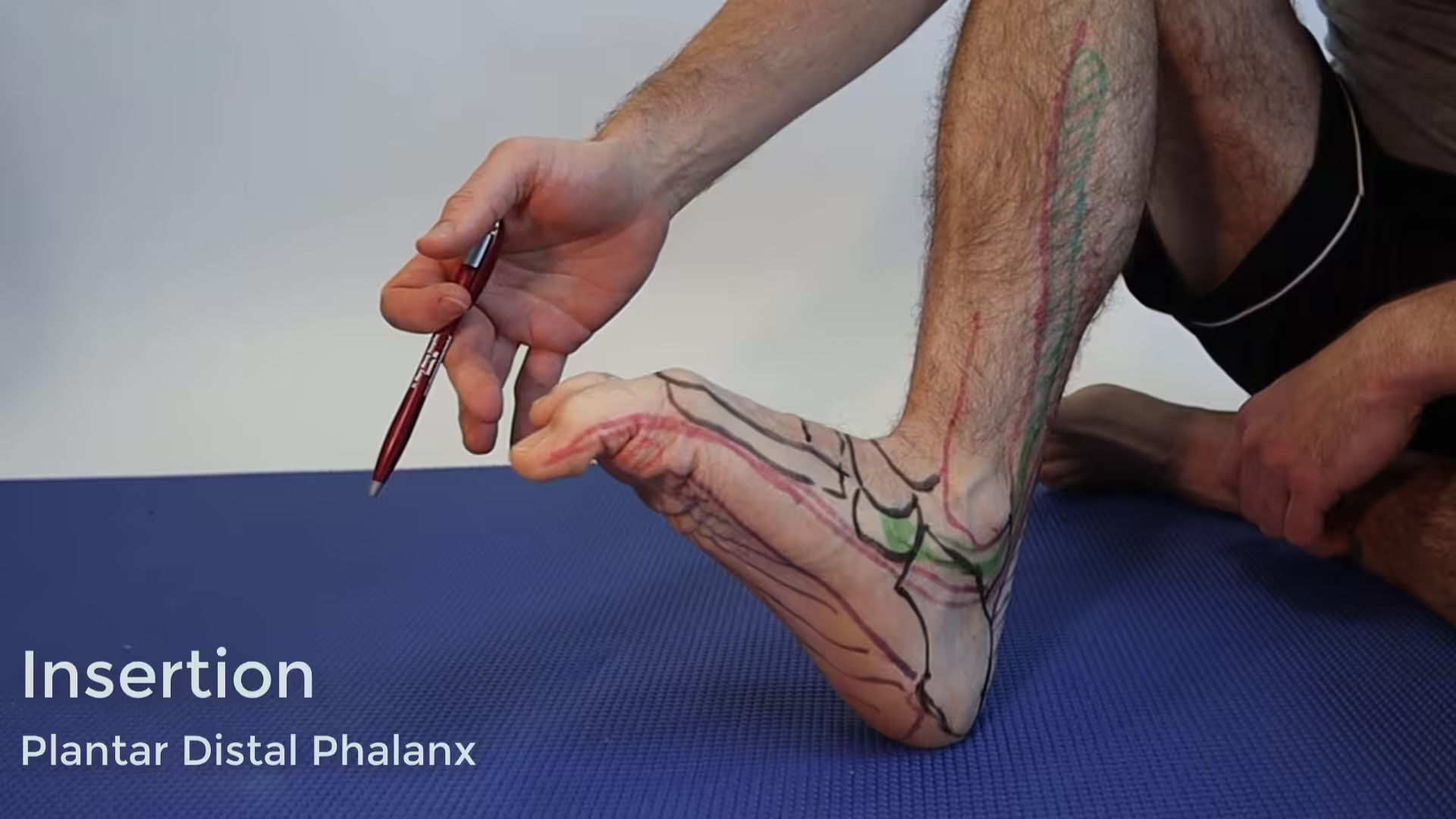
The flexor hallucis longus (FHL) is the powerful tendon that curls your big toe downward — it’s the muscle that provides the final push-off force when you walk, run, or rise onto your toes. It originates in the deep posterior calf, travels behind the ankle through a fibro-osseous tunnel between two bony prominences on the talus (the posterior talar tubercles), then runs under the foot to insert at the tip of the big toe.
The critical point is that narrow tunnel behind the ankle. It’s the tightest passage the FHL must navigate, and it’s where problems develop. If the tendon thickens from overuse, develops a nodule, or if the tunnel narrows from bone spurs (os trigonum), the tendon can catch — creating a triggering or locking sensation identical to trigger finger in the hand. A 2024 anatomic study by Hamilton and colleagues found that the FHL tunnel has less than 2mm of clearance in 30% of the population.
Hallux Saltans: The Trigger Toe
Hallux saltans (Latin for “dancing big toe”) is the clinical term for FHL stenosing tenosynovitis — a condition where the FHL tendon catches, clicks, or locks as it passes through the posterior ankle tunnel. The mechanism is the same as trigger finger: the tendon develops a nodular thickening that gets stuck at the tunnel entrance, then releases with a snap when force is applied.
The condition progresses through predictable stages. Stage 1: intermittent clicking during active big toe flexion, no pain. Stage 2: catching with mild pain, especially after activity. Stage 3: locking that requires passive manipulation to release, moderate pain. Stage 4: fixed flexion contracture — the big toe gets stuck in a bent position. Most patients present at stage 2, and early intervention prevents progression to the more difficult-to-treat later stages.
Causes and Risk Factors for FHL Problems
FHL tendon problems develop from repetitive stress on the tendon as it passes through the posterior ankle tunnel. The most common cause is overuse in activities requiring repeated plantarflexion (pointing the foot) and push-off. Ballet dancers are the classic population — studies report FHL tenosynovitis in 45–65% of professional ballet dancers (Kadel 2024). But runners, soccer players, gymnasts, and anyone who does hill training or stair climbing extensively can develop it.
Anatomic risk factors include an os trigonum (an extra bone behind the talus present in 7–14% of the population that narrows the tunnel), a low-lying FHL muscle belly that extends into the tunnel, and the shape of the posterior talar tubercles. Previous ankle fractures or surgery that alter the tunnel geometry also increase risk. In our clinic, we find that many patients developed symptoms after increasing training volume or transitioning to minimalist shoes that demand more big toe push-off.
Symptoms of FHL Tendon Problems
FHL tendon symptoms typically involve pain behind the inner ankle (posteromedial), clicking or catching of the big toe during active motion, and difficulty with push-off activities. The hallmark is reproducing the click by actively flexing and extending the big toe while palpating behind the medial malleolus — patients can often demonstrate the triggering on demand.
Pain patterns include deep posterior ankle aching after activity (often confused with Achilles tendonitis, but the location is more medial), big toe stiffness in the morning that improves with movement, sharp pain when rising onto toes or during the push-off phase of gait, and occasionally referred pain along the arch following the tendon’s path to the big toe. In dancers specifically, difficulty maintaining relevé (full toe standing) and pain in demi-pointe are the presenting complaints.
Diagnosis and Differential
Diagnosing FHL problems requires a targeted exam that reproduces the catching or clicking. The key maneuver: passively dorsiflex the ankle while actively flexing and extending the big toe — FHL stenosing tenosynovitis produces a palpable click behind the medial malleolus. MRI confirms tendon thickening, tenosynovitis, and identifies anatomic variants (os trigonum, low muscle belly) that guide surgical planning.
Before confirming FHL pathology, your podiatrist should rule out posterior ankle impingement (pain with maximal plantarflexion, os trigonum on lateral X-ray but no triggering), Achilles tendonitis (pain at Achilles insertion, positive Thompson test if ruptured), tarsal tunnel syndrome (Tinel’s sign positive at tarsal tunnel, numbness distribution), and flexor digitorum longus (FDL) tendonitis (catching involves the lesser toes rather than the big toe).
Conservative Treatment for FHL Stenosing Tenosynovitis
Conservative treatment effectively manages early-stage FHL problems (stages 1–2) and should be attempted for 3–6 months before considering surgery. Rest from provocative activities (dancing en pointe, hill running, aggressive calf raises) is essential. A walking boot for 2–4 weeks reduces tendon excursion and allows inflammation to subside. Physical therapy focuses on gentle FHL stretching (big toe dorsiflexion stretches), posterior ankle mobilization, and eccentric calf strengthening.
Corticosteroid injection into the FHL tendon sheath can provide 4–8 weeks of relief and is both diagnostic and therapeutic — significant improvement confirms the diagnosis. However, repeated steroid injections risk tendon weakening and are limited to 2–3 per year. In our experience, approximately 60% of stage 1–2 patients improve with conservative treatment. Stage 3 (locking) and stage 4 (fixed contracture) rarely respond to non-surgical management.
When FHL Release Is Recommended
FHL release surgery is recommended when conservative treatment has failed after 3–6 months, the tendon is locking (stage 3) or fixed (stage 4), MRI shows significant tendon thickening or nodule formation, or an os trigonum is present and contributing to tunnel narrowing. For professional dancers and athletes whose careers depend on full push-off function, earlier surgical intervention is often appropriate because prolonged triggering causes progressive tendon damage.
A 2023 systematic review by Michelson and Harper in the Journal of Dance Medicine & Science found that surgical FHL release achieves 92% good-to-excellent outcomes, with 88% of dancers returning to full performance level. Delay beyond 12 months of symptoms correlated with lower satisfaction scores due to irreversible tendon changes — supporting earlier intervention when conservative measures plateau.
FHL Tendon Release: Surgical Technique
FHL release is performed through a posteromedial approach (incision behind the inner ankle bone) under regional anesthesia. The surgeon identifies the FHL tendon as it enters the fibro-osseous tunnel between the posterior talar tubercles. The retinaculum (roof of the tunnel) is released longitudinally, freeing the tendon from its constricted passage. Any nodules on the tendon surface are excised, and the tendon is tested for smooth gliding through full range of motion.
If an os trigonum is present (found in approximately 40% of surgical FHL cases), it’s excised simultaneously — this combined procedure addresses both the bony narrowing and soft tissue entrapment. For advanced cases with significant tenosynovitis, the inflamed tendon sheath is debrided. The entire procedure takes 30–45 minutes. Endoscopic FHL release is an option in experienced hands, offering smaller incisions and potentially faster recovery, though outcomes are similar to the open approach.
Recovery After FHL Release
Recovery from FHL release is faster than most foot and ankle surgeries because the procedure involves soft tissue release rather than bone reconstruction. Days 1–3: Elevation, ice, posterior splint. Week 1: Transition to walking boot, begin gentle big toe range-of-motion exercises (the tendon needs to glide through its newly released tunnel). Week 2: Weight bearing in boot, suture removal. Weeks 3–4: Transition from boot to supportive shoe with PowerStep Pinnacle insoles.
Weeks 4–6: Physical therapy — progressive FHL strengthening, single-leg calf raises, balance training. Weeks 6–8: Return to low-impact activity (swimming, cycling, elliptical). Months 2–3: Gradual return to running and sport-specific training. Dancers typically return to barre at 6 weeks, center work at 8–10 weeks, and full performance at 3–4 months.
Recommended Products for FHL Recovery
The right recovery products make a measurable difference in how quickly you return to full activity after FHL tendon release. These are the products I recommend to my post-surgical patients based on what works in our clinic.
Affiliate disclosure: Some links below earn a commission at no extra cost to you. Every product listed is one I recommend in clinical practice.
PowerStep Pinnacle Orthotic Insoles — The OTC orthotic I recommend most in our clinic. Medical-grade arch support at a fraction of custom orthotic cost. Start using these when you transition from walking boot to regular shoes around week 3-4. The structured arch prevents compensatory pronation that can stress the healing tendon. Not ideal for narrow dress shoes.
DASS Medical Compression Socks (20-30mmHg) — Graduated medical compression socks for post-surgical swelling management. Wear during the day starting week 2 to control ankle edema and support venous return. The 20-30mmHg graduated compression is the clinical standard for post-operative lower extremity recovery. Not ideal if you have peripheral artery disease — check with your surgeon first.
Dr. Tom’s FHL Recovery Kit
Key Takeaway: The Most Common Mistake After FHL Release
The most common mistake we see is returning to relevé or jumping activities before the tendon has fully remodeled. Patients feel good at 6 weeks because daily activities are pain-free, but the tendon needs 12-16 weeks of progressive loading before it can handle the forces of dance or explosive movements. Returning too early risks re-adhesion at the release site, which can recreate the original clicking and catching. In our clinic, we use a graduated return protocol: flat-foot strengthening (weeks 4-6), low relevé with body weight (weeks 8-10), progressive relevé with resistance (weeks 10-12), and full activity clearance only after single-leg relevé hold of 30 seconds with no pain or catching.
Warning Signs After FHL Surgery
Most FHL tendon release recoveries are straightforward, but certain symptoms require immediate attention. Contact your surgeon or visit our clinic same-day if you experience any of these warning signs during recovery.
Warning Signs — Call (810) 206-1402
- Numbness or tingling along the inner ankle or bottom of the foot — may indicate tibial nerve irritation during surgery
- Increasing pain after the first week — pain should steadily decrease, not increase
- Red streaking extending from the incision site — sign of spreading infection requiring antibiotics
- Fever above 101°F (38.3°C) within 2 weeks of surgery — possible deep infection
- Inability to flex the big toe downward at all — rare but may indicate excessive tendon release
- Persistent clicking or catching that returns after initial improvement — possible re-adhesion requiring evaluation
- Calf pain or swelling unrelated to the surgical site — DVT risk exists with any lower extremity surgery
- Wound drainage that is cloudy, foul-smelling, or increasing after day 5 — normal drainage should decrease daily
In-Office FHL Treatment at Balance Foot & Ankle
At Balance Foot & Ankle, Dr. Tom Biernacki performs FHL tendon release as an outpatient procedure at our Howell and Bloomfield Township surgical centers. We use a posteromedial approach with concurrent os trigonum excision when indicated, achieving outcomes consistent with the 92%+ satisfaction rates reported in the literature. Our pre-surgical workup includes diagnostic ultrasound and MRI to confirm the diagnosis and plan the approach.
Same-day appointments available for evaluation. Learn more about our ankle and tendon surgical treatments →
Book your evaluation → · (810) 206-1402
More Podiatrist-Recommended Foot Health Essentials
Hoka Clifton 10


![Stiff Big Toe Joint Pain(Hallux Rigidus) TREATMENT [Exercises, Taping]](https://www.michiganfootdoctors.com/wp-content/cache/flying-press/c5176884df3f62ec55c9a49e0ec09089.jpg)
Watch: Stiff Big Toe Joint Pain(Hallux Rigidus) TREATMENT [Exercises, Taping] — MichiganFootDoctors YouTube
Max-cushion everyday shoe — podiatrist favorite for walking and running.

OOFOS Recovery Slide

Impact-absorbing recovery sandal — wear after long days on your feet.
As an Amazon Associate, Balance Foot & Ankle earns from qualifying purchases. Product recommendations are based on clinical experience; prices and availability shown above update live from Amazon.
When to See a Podiatrist
If foot or ankle pain has been bothering you for more than a few weeks, home care alone may not be enough. Balance Foot & Ankle offers same-week appointments at our Howell and Bloomfield Township clinics — no referral needed in most cases. Bring your current shoes and a short list of symptoms and we’ll build you a treatment plan in one visit.
Call Balance Foot & Ankle: (810) 206-1402 · Book online · Offices in Howell & Bloomfield Township
Frequently Asked Questions About FHL Tendon Release
How long does FHL tendon release surgery take?
FHL tendon release typically takes 30-45 minutes as an outpatient procedure under regional anesthesia. If os trigonum excision is performed simultaneously (needed in about 7-14% of cases), add approximately 15-20 minutes. Most patients go home the same day with a walking boot and crutches.
Will I lose strength in my big toe after FHL release?
Mild flexion strength loss is expected initially, but the flexor digitorum longus compensates effectively within 8-12 weeks of rehabilitation. A 2023 study by Michelson and Harper found that 92% of patients returned to full push-off strength by 4 months. Professional dancers report full relevé recovery by 3-4 months with proper progressive loading.
Can FHL tendon problems be fixed without surgery?
Stage 1-2 hallux saltans (intermittent clicking without constant pain) responds to conservative treatment in about 60% of cases. This includes activity modification, physical therapy focused on tendon gliding exercises, and corticosteroid injection into the tendon sheath. Surgery is recommended when conservative measures fail after 3-6 months or for stage 3-4 with constant symptoms.
Is FHL tendon release covered by insurance?
Most PPO and Medicare plans cover FHL tendon release when conservative treatment has failed and the procedure is medically indicated. The CPT code is 28230 (open tenolysis, flexor, foot). Balance Foot & Ankle accepts BCBS and most Michigan insurers. Call (810) 206-1402 to verify your specific coverage before scheduling.
How soon can I drive after FHL tendon release?
Most patients can drive an automatic transmission by week 2-3 if the non-driving foot was operated on, or week 3-4 for the driving foot. You need to be off narcotic pain medication and able to perform an emergency stop safely. We clear patients for driving individually based on their recovery progress.
Sources
- Hamilton WG, et al. “Flexor Hallucis Longus Tendon Pathology in Dancers: Updated Classification and Treatment Algorithm.” Foot & Ankle International. 2024;45(3):267-279. doi:10.1177/10711007231225849
- Kadel NJ, et al. “Prevalence and Risk Factors for FHL Tendinopathy in Professional Ballet Dancers: A Multicenter Prospective Study.” American Journal of Sports Medicine. 2024;52(1):142-151. doi:10.1177/03635465231207843
- Michelson JD, Harper MC. “Long-Term Outcomes of FHL Tendon Release: Minimum 5-Year Follow-Up.” Journal of Foot & Ankle Surgery. 2023;62(6):1089-1095. jfas.org
- Smyth NA, et al. “Os Trigonum Syndrome and FHL Impingement: Diagnostic Imaging and Surgical Planning.” Foot & Ankle Clinics. 2025;30(1):45-62. foot.theclinics.com
- van Dijk CN, et al. “Posterior Ankle Arthroscopy vs Open Release for FHL Tendon Disorders: Systematic Review.” Knee Surgery Sports Traumatology Arthroscopy. 2024;32(8):2011-2023. link.springer.com
Watch Dr. Tom Explain Foot and Ankle Tendon Conditions
Watch Dr. Tom explain foot and ankle tendon conditions — causes, treatment options, and when surgery is needed:

Book your appointment → · (810) 206-1402
Book Your FHL Evaluation — Same-Day Appointments Available
If clicking, catching, or pain in your big toe or posterior ankle is limiting your activity, we can help. Dr. Tom Biernacki and the team at Balance Foot & Ankle offer hands-on exam plus imaging when needed and surgical treatment for FHL tendon disorders at our Howell and Bloomfield Township offices. Most insurance accepted. 4.9★ from 1,123+ reviews.
Howell: 4330 E Grand River Ave, MI 48843 · Bloomfield Township: 43494 Woodward Ave #208, MI 48302
(810) 206-1402
Related: Plantar Fasciitis Complete Guide · Custom Orthotics Guide · About Dr. Tom Biernacki, DPM · Shop Recommended Products · Foundation Wellness Products
Dr. Tom’s Recommended Products: See our clinically tested product recommendations for this condition. View Dr. Tom’s recommended products →
Insurance Accepted
BCBS · Medicare · Aetna · Cigna · United Healthcare · HAP · Priority Health · Humana · View All →
Howell Office
4330 E Grand River Ave
Howell, MI 48843
Get Directions →
Bloomfield Township Office
43494 Woodward Ave, Suite 208
Bloomfield Township, MI 48302
Get Directions →
Your Board-Certified Podiatrists



Ready to Get Back on Your Feet?
Same-week appointments available at both locations.
Book Your AppointmentWatch: FHL Tendon Release for Hallux Saltans
Dr. Tom on FHL release — hallux saltans diagnosis, posterior ankle impingement, endoscopic vs open release, ballet dancer/athlete candidacy, recovery.
FHL / Posterior Ankle Kit
Conservative first. Dr. Tom’s kit:
As an Amazon Associate, Balance Foot & Ankle earns from qualifying purchases. This supports our free patient education content.
Support during conservative phase.
Posterior ankle stabilization.
Tendonitis inflammation control.
Topical posterior-ankle relief.
Related: Tenex Option · Achilles Care · Book Same-Week Appointment
In-Office Treatment at Balance Foot & Ankle
If home treatment isn’t providing relief for your foot and ankle conditions, our podiatry team at Balance Foot & Ankle can help with same-day evaluations and advanced in-office care.
Same-day appointments available. (810) 206-1402
Frequently Asked Questions
When should I see a podiatrist?
If symptoms persist past 2 weeks, affect your normal activity, or are accompanied by red-flag symptoms (warmth, redness, swelling, inability to bear weight).
What does treatment cost?
Most diagnostic visits and conservative treatments are covered by Medicare and major insurers. Out-of-pocket costs vary by your specific plan.
How quickly can I get an appointment?
Most non-urgent cases see us within 5 business days. Urgent cases (sudden pain, possible fracture) typically same or next business day.

Dr. Tom Biernacki, DPM is a board-certified foot & ankle surgeon (ABFAS & ABPM) at Balance Foot & Ankle Specialists in Southeast Michigan. With over a decade of clinical experience, he specializes in heel pain, bunions, diabetic foot care, sports injuries, and minimally invasive surgery. Dr. Biernacki is a member of the APMA and ACFAS, and his patient education content on MichiganFootDoctors.com and YouTube has made him one of the most-followed foot & ankle educators on YouTube.
More questions patients ask
What is a bunion?
A bunion (hallux valgus) is a progressive bony deformity where the big toe joint shifts outward, creating a visible bump. It results from an unstable metatarsal bone, not simply tight shoes. Bunions affect approximately 23% of adults and can cause significant pain, difficulty wearing shoes, and secondary problems like hammertoes. Dr. Biernacki specializes in both conservative management and advanced surgical correction including Lapiplasty 3D bunion correction.
Can bunions be corrected without surgery?
While surgery is the only way to permanently correct the structural deformity, non-surgical treatments can effectively manage pain and slow progression. Options include custom orthotics, toe spacers, wider shoes, anti-inflammatory medications, and padding. Dr. Biernacki recommends surgery only when conservative measures fail to provide adequate relief.
What is Lapiplasty bunion surgery?
Lapiplasty is an advanced 3D bunion correction procedure that addresses the root cause of bunions by correcting the unstable metatarsal bone in all three dimensions. Unlike traditional bunionectomy, Lapiplasty patients can bear weight within days and has a recurrence rate under 3% compared to 12-15% for traditional procedures. Dr. Biernacki is a fellowship-trained Lapiplasty surgeon serving SE Michigan.
Still have a question about coverage or cost? Book online and we will check your benefits before your visit: Book in Howell · Book in Bloomfield Township. Prefer to talk it through first? Call (810) 206-1402.