
Quick answer: Treatment for cavus foot treatment follows a stepwise approach: 1) conservative care first (rest, ice, supportive footwear, OTC anti-inflammatories), 2) physical therapy and targeted exercises, 3) in-office treatments (injections, custom orthotics) if conservative fails at 4-6 weeks, 4) surgery for refractory cases. Most patients resolve at step 1 or 2. Call (810) 206-1402.
Medically reviewed by Dr. Tom Biernacki, DPM · Board-Certified Podiatric Surgeon · Last reviewed: April 2026 · Editorial Policy
Related Conditions
Quick Answer
Cavus Foot (High Arch): Causes, Problems It Causes, and Trea relates to foot pain — typically caused by overuse, footwear, or biomechanics. Most patients improve in 6-12 weeks with conservative care. Appointments in Howell + Bloomfield Township: (810) 206-1402.
✅ Medically reviewed by Dr. Tom Biernacki, DPM — Board-certified podiatrist specializing in foot & ankle surgery. View credentials.
What Is Cavus Foot (High Arch)?
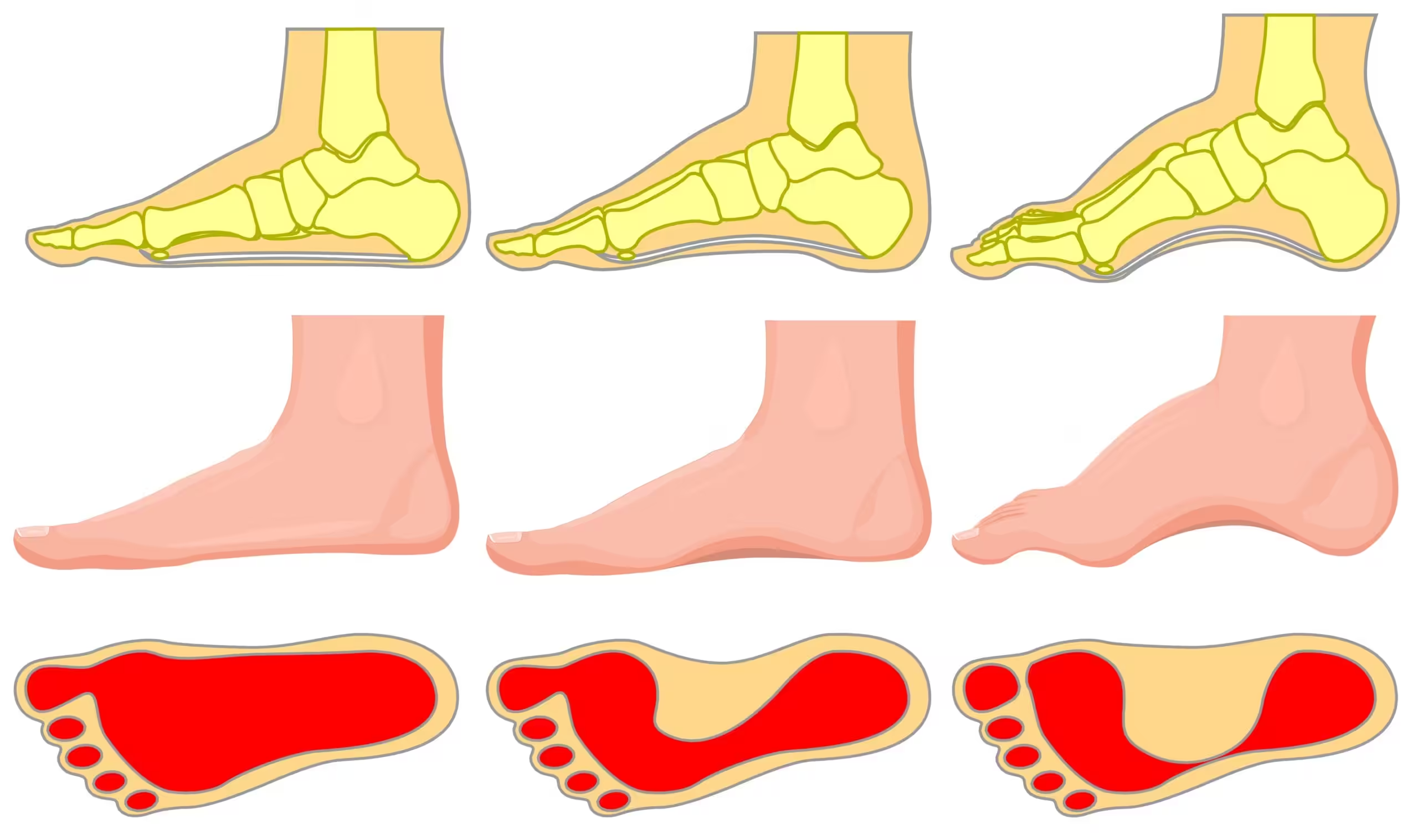
Cavus foot (pes cavus) is a structural foot deformity characterized by an abnormally high arch that does not flatten with weight-bearing. Unlike flat feet—which are common, usually benign, and rarely symptomatic—cavus foot is often associated with significant clinical problems. The elevated arch places abnormal stress on the forefoot and hindfoot, leading to calluses under the metatarsal heads, heel pain, lateral ankle instability, peroneal tendon problems, and stress fractures. The rigid arch also limits the foot’s ability to absorb impact, transferring greater load to surrounding structures.
Cavus foot has two broad categories: flexible (the arch partially reduces with loading) and rigid (no reduction with weight-bearing). Rigid cavus deformity is more clinically significant and harder to treat. Severity ranges from mild high-arch feet that cause only cosmetic concern to severe deformity with claw toes, plantar fascia contracture, and near-complete loss of shock absorption.
Neurological Causes: Why a Full Workup Is Essential
Progressive or bilateral cavus foot deformity—particularly when accompanied by weakness, muscle wasting, sensory changes, or balance problems—should prompt neurological evaluation. Approximately 60–70% of cavus feet have an identifiable neurological cause, most commonly Charcot-Marie-Tooth disease (CMT, hereditary motor and sensory neuropathy), the most common inherited peripheral neuropathy. Other neurological causes include spinal cord abnormalities (syringomyelia, tethered cord), Friedreich’s ataxia, and polio sequelae.
In cavus foot with a neurological etiology, the deformity is typically progressive—it worsens over time as the neurological condition evolves. Identifying the underlying cause affects not only foot treatment but also medical management, genetic counseling (CMT is inherited), and assessment for other neurological complications. Any patient with a newly identified cavus foot should be asked about family history, weakness, and sensory changes, and referred for neurological evaluation if indicated.
Problems Caused by Cavus Foot
The high arch creates characteristic load distribution problems. The heel and forefoot bear disproportionate weight while the midfoot is unloaded. Painful plantar calluses develop under the 1st and 5th metatarsal heads (the lateral forefoot prominences). Hammertoes and claw toes form as intrinsic muscle weakness and extensor tendon tightness pull the toes into flexion. Lateral ankle instability is common—the hindfoot varus (heel tilted inward) inherent in cavus foot places the ankle in a mechanically unstable position. Peroneal tendon tears and stress fractures of the 5th metatarsal are significantly more common in cavus foot patients.
Treatment: Conservative and Surgical
Conservative management focuses on symptom control and load redistribution. Extra-depth, wide-toe-box footwear accommodates claw toe deformities and reduces forefoot pressure. Custom orthotics with metatarsal pads offload plantar prominences and provide lateral wedging to correct hindfoot varus. Ankle bracing addresses lateral instability. Physical therapy addresses peroneal and intrinsic muscle strengthening where neurologically possible.
Surgery for symptomatic cavus foot addresses the underlying structural deformity rather than just symptoms. Common procedures include: plantar fascia release to reduce arch contracture, metatarsal osteotomies to plantarflex elevated metatarsal heads, calcaneal osteotomy to correct hindfoot varus, peroneus longus to brevis tendon transfer (in CMT, the peroneus longus is overactive and plantarflexes the 1st ray—transferring it to the brevis corrects the deformity), and hammertoe corrections. For the most severe cases with rigid deformity and arthritis, triple arthrodesis (fusion of the subtalar, talonavicular, and calcaneocuboid joints) corrects alignment at the cost of hindfoot motion.
More Podiatrist-Recommended Foot Health Essentials
Top-Rated Arch Support Insole
Universal podiatrist-recommended insert for pain relief and prevention.
Foot Massage Ball
Daily 3-minute roll reduces most forms of foot and heel pain.
Moisture-Wicking Sock
Prevents fungus, blisters, and odor — the basics matter.
As an Amazon Associate, Balance Foot & Ankle earns from qualifying purchases. Product recommendations are based on clinical experience; prices and availability shown above update live from Amazon.

When to See a Podiatrist
If foot or ankle pain has been bothering you for more than a few weeks, home care alone may not be enough. Balance Foot & Ankle offers online booking 24/7 at our Howell and Bloomfield Township clinics — no referral needed in most cases. Bring your current shoes and a short list of symptoms and we’ll build you a treatment plan in one visit.
Call Balance Foot & Ankle: (810) 206-1402 · Book online · Offices in Howell & Bloomfield Township
Frequently Asked Questions
Are high arches worse than flat feet?
In terms of clinical problems, cavus (high-arch) feet are associated with more serious complications than flat feet in most cases. While flat feet rarely cause significant problems beyond arch and heel pain, cavus feet cause ankle instability, stress fractures, peroneal tendon tears, claw toes, and plantar calluses—and may be the first sign of an underlying neurological condition. Additionally, cavus deformity is often progressive (especially when neurological in origin), while most adult flat feet are stable. That said, many people with high arches have no significant symptoms and function well with supportive footwear alone.
What kind of shoes are best for high arches?
Cavus feet require shoes with substantial cushioning (the foot lacks natural shock absorption), a wide and deep toe box to accommodate claw toes, and a rigid shank (sole) that prevents excessive forefoot rolling. Running shoe categories labeled “neutral cushioning” (without motion control features designed for flat feet) are generally appropriate. Shoes with good heel counter support reduce lateral ankle instability. Custom orthotics with metatarsal pads and a lateral wedge are frequently more impactful than footwear alone for controlling symptoms. Avoid flat, unsupported shoes (ballet flats, flip-flops) that provide no cushioning or forefoot offloading.
Can high arches be corrected without surgery?
Conservative treatment cannot correct the structural high-arch deformity—it can only manage symptoms and compensate for the altered mechanics. Custom orthotics, supportive footwear, and bracing reduce pain and protect against secondary complications (instability, stress fractures) but do not change the arch height. For mild-to-moderate cavus feet without severe complications, this symptomatic management is appropriate and effective for most patients. Surgical correction is considered for progressive deformity, recurrent complications (repeated ankle sprains, stress fractures), or pain that significantly limits function despite conservative care. The underlying neurological cause (if present) will continue to drive progression regardless of foot treatment.
Medical References & Sources
- American Orthopaedic Foot & Ankle Society — Cavus Foot
- PubMed Research — Cavus Foot Etiology and Treatment
- PubMed Research — Cavus Foot Surgical Outcomes
Dr. Tom Biernacki, DPM is a board-certified podiatric surgeon at Balance Foot & Ankle in Howell and Bloomfield Township, Michigan. He evaluates and treats cavus foot deformity with custom orthotics, lateral ankle stabilization, and surgical reconstruction including calcaneal osteotomy, tendon transfers, and hammertoe correction.
Join 950,000+ Learning About Foot Health
Dr. Tom shares honest medical advice, supplement reviews, and treatment guides you won’t find anywhere else.
Subscribe on YouTube →📍 Located in Michigan?
Our board-certified podiatrists treat this condition at two convenient locations. Book online 24/7 at either office.
Medically Reviewed by: Dr. Tom Biernacki, DPM — Board-Certified Podiatrist, Balance Foot & Ankle Specialists
Insurance Accepted
BCBS · Medicare · Aetna · Cigna · United Healthcare · HAP · Priority Health · Humana · View All →
Howell Office
4330 E Grand River Ave
Howell, MI 48843
Get Directions →
Bloomfield Township Office
43494 Woodward Ave, #208
Bloomfield Township, MI 48302
Get Directions →
Pros & Cons of Conservative Care for foot care
Advantages
- ✓ Conservative care first
- ✓ Book online 24/7
- ✓ Multiple insurance accepted
Considerations
- ✗ Self-treatment can mask issues
- ✗ See a podiatrist if pain >2 weeks
Dr. Tom’s Recommended Products for foot care
Affiliate disclosure: As an Amazon Associate, Balance Foot & Ankle earns from qualifying purchases. We only recommend products we use with patients.
Footnanny Heel Cream Dr. Tom’s Pick
Best for: Daily moisturizer for cracked heels
Ready to Get Back on Your Feet?
Appointments in Howell + Bloomfield Township. Most insurance accepted. Dr. Tom Biernacki, DPM & team.
Call Now: (810) 206-1402
In-Office Treatment at Balance Foot & Ankle
If home treatment isn’t providing relief for your foot and ankle pain, our podiatry team at Balance Foot & Ankle can help with expert evaluations and advanced in-office care.
Book online 24/7. (810) 206-1402
VitaMedica Arnica Gel
Arnica gel plus 15 plant compounds for sore feet, plantar fasciitis flares and post-activity soreness. Apply a thin layer to the sore area.
Shop VitaMedica Arnica Gel →Ready for Expert Care?
Appointments in Howell & Bloomfield Township, MI.
4.9★ | 1,200+ Reviews | 3,000+ Surgeries
Or call: (810) 206-1402
