
Quick answer: Treatment for flexor hallucis longus tendinopathy treatment follows a stepwise approach: 1) conservative care first (rest, ice, supportive footwear, OTC anti-inflammatories), 2) physical therapy and targeted exercises, 3) in-office treatments (injections, custom orthotics) if conservative fails at 4-6 weeks, 4) surgery for refractory cases. Most patients resolve at step 1 or 2. Call (810) 206-1402.
Medically reviewed by Dr. Tom Biernacki, DPM — Board-Certified Podiatric Surgeon — Balance Foot & Ankle, Howell & Bloomfield Hills, MI. Last updated April 2026.
Medically reviewed by Dr. Tom Biernacki, DPM | Board-certified podiatrist | 3,000+ surgeries performed
Last updated: April 2, 2026
The most important clinical decision with Flexor Hallucis Longus Tendinopathy Treatment isn’t which treatment to start with — it’s which subtype or underlying cause you actually have. That distinction changes everything. Call us: (810) 206-1402
Anatomy of the FHL Tendon and Why It Gets Injured
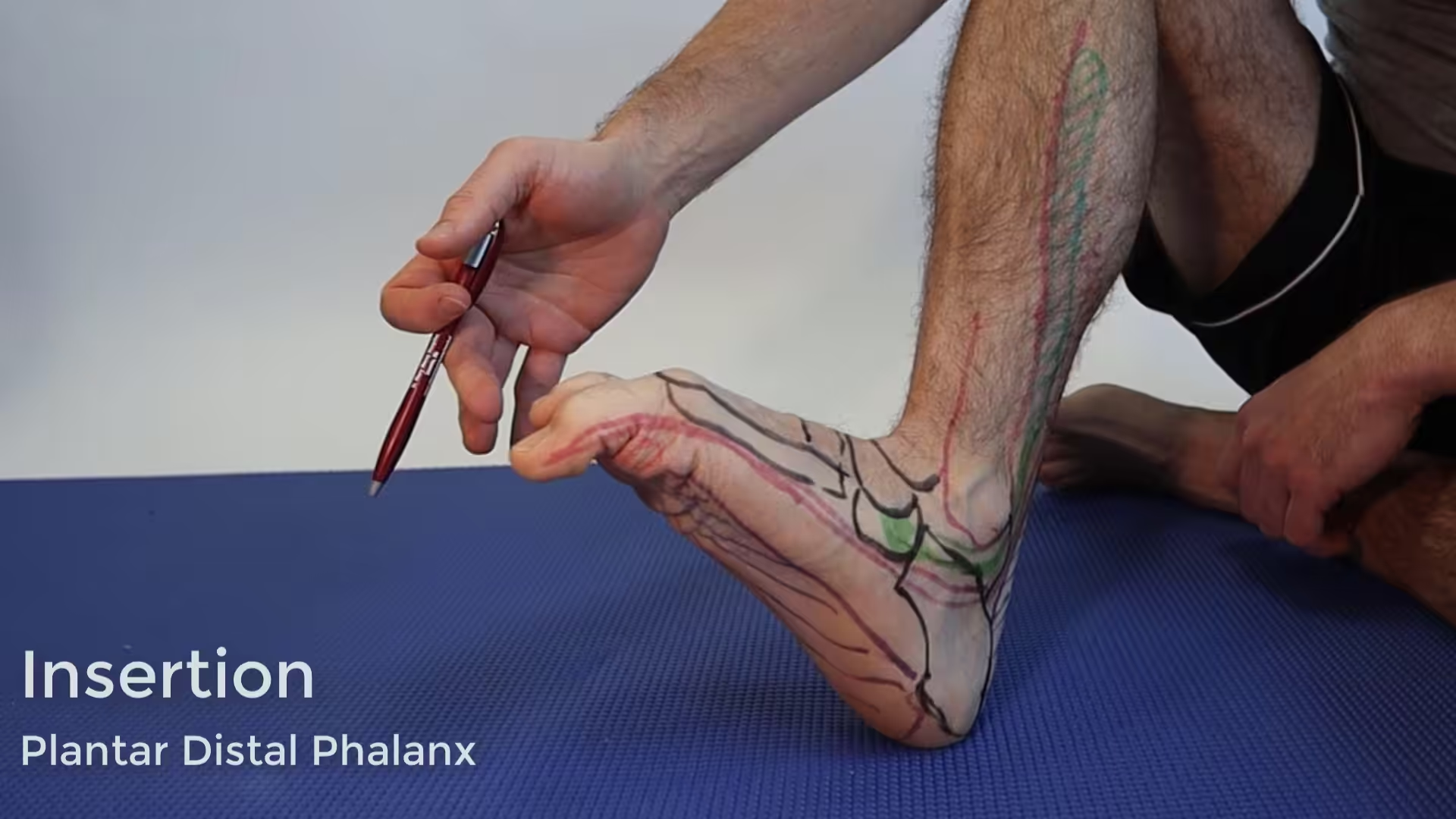
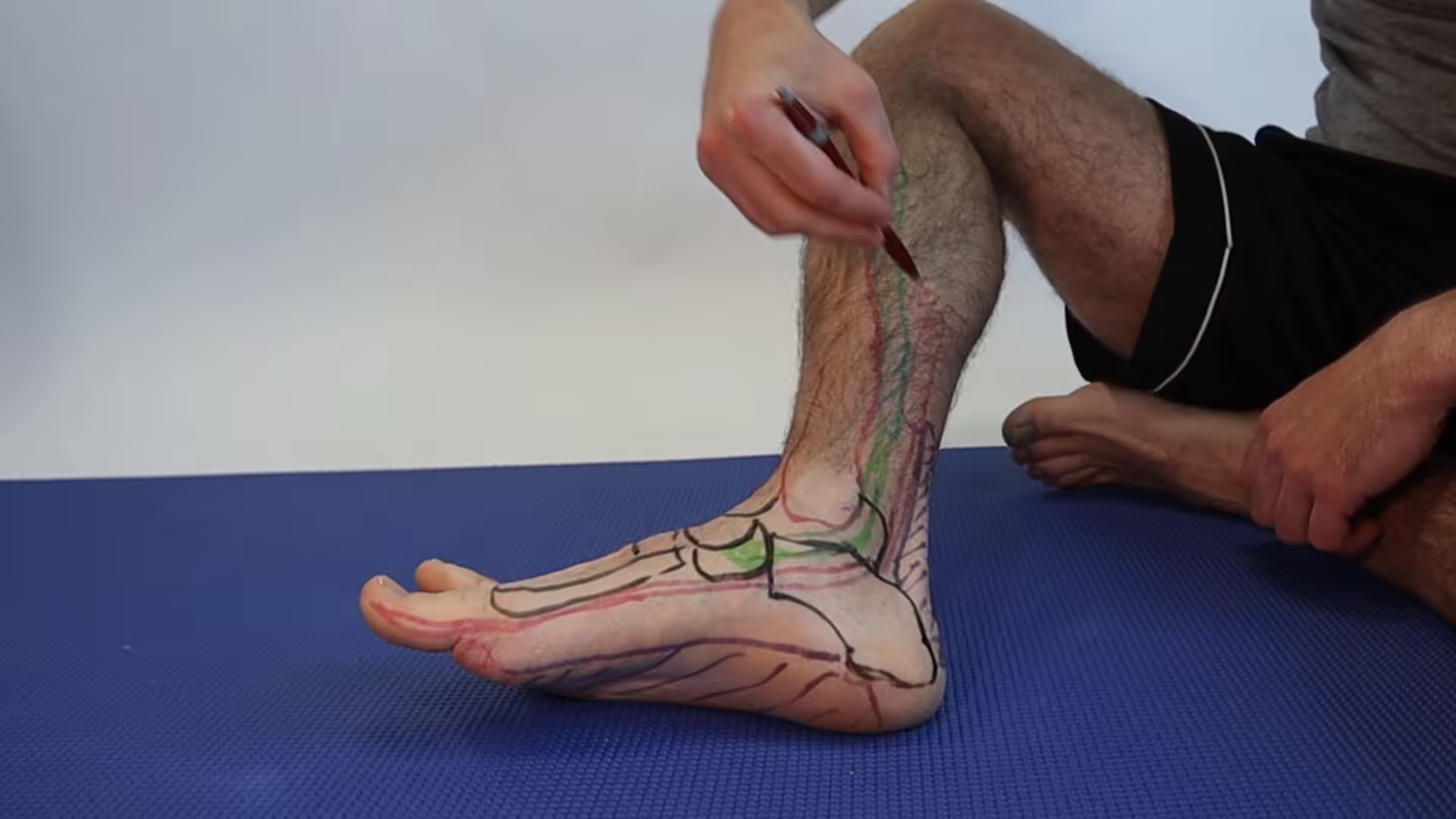
The flexor hallucis longus is a powerful muscle originating from the posterior fibula that sends its tendon through a narrow fibro-osseous tunnel behind the medial malleolus (inner ankle bone), beneath the sustentaculum tali of the calcaneus, and along the plantar foot to insert on the distal phalanx of the big toe. This tendon is the primary flexor of the big toe and plays a critical role in push-off power during walking, running, and jumping — contributing up to 30% of total forefoot propulsion force.
The FHL tendon is uniquely vulnerable at two anatomical bottlenecks. The posterior ankle tunnel between the medial and lateral tubercles of the talus (where the os trigonum sits) creates a pulley system where the tendon can become entrapped, inflamed, or mechanically blocked. The fibro-osseous tunnel beneath the sustentaculum tali represents a second constriction point. These two locations account for 90% of FHL pathology.
Activities requiring repetitive forceful plantarflexion with simultaneous big toe flexion — ballet relevé and pointe work, soccer instep kicking, sprinting push-off, and climbing — overload the FHL disproportionately. A 2024 biomechanical study found that the FHL tendon experiences 3-4 times the load of any other foot flexor tendon during single-leg relevé, explaining why dancers and athletes who spend significant time on their toes develop this condition at high rates.
Recognizing FHL Tendinopathy: Symptoms and Diagnosis
FHL tendinopathy presents with a characteristic pattern: deep pain behind the inner ankle bone that radiates into the arch and big toe, worsened by push-off activities and relieved by rest. Dancers describe pain during relevé that limits their ability to maintain pointe position. Runners notice pain during the toe-off phase that worsens with speed work and hill training. The pain is distinctly different from Achilles tendinopathy (which is more posterior and superficial) and posterior tibial tendinopathy (which causes pain more along the medial arch).
FHL triggering — a catching or locking sensation of the big toe — occurs when the thickened or nodular tendon catches within its fibro-osseous tunnel. The toe may lock in flexion and require manual extension, similar to trigger finger in the hand. This triggering is pathognomonic for FHL stenosing tenosynovitis and indicates significant tendon swelling or nodule formation within the posterior ankle tunnel.
Clinical examination reveals tenderness posterior to the medial malleolus (behind the inner ankle bump), pain with resisted big toe flexion against resistance, and possible crepitus (grinding sensation) along the tendon course. The FHL stretch test — passively dorsiflexing the ankle while extending the big toe — reproduces the posterior ankle pain by tensioning the tendon through its tunnel. MRI demonstrates tendon thickening, peritendinous fluid (tenosynovitis), partial tearing, or mechanical impingement within the posterior ankle tunnel.
Conservative Treatment for FHL Problems
Initial management focuses on reducing tendon loading and inflammation. Relative rest — modifying activity to avoid the specific movements that stress the FHL (relevé, hill running, toe-off sprinting) while maintaining fitness through non-provocative exercise (cycling, swimming, elliptical) — allows the inflamed tendon to recover without complete deconditioning. A short walking boot (2-4 weeks) for acute cases reduces tendon excursion through the inflamed tunnel.
Physical therapy is the cornerstone of FHL rehabilitation. Eccentric strengthening — slowly lowering from a single-leg heel raise while resisting big toe flexion — promotes healthy tendon remodeling similar to the Alfredson protocol for Achilles tendinopathy. Progressive loading through isometric holds (6-second contractions at multiple angles), followed by concentric-eccentric exercises, gradually restores tendon capacity. Calf stretching and posterior ankle joint mobilization improve the tendon’s gliding mechanics through its tunnel.
Ultrasound-guided corticosteroid injection into the FHL tendon sheath provides targeted anti-inflammatory relief for refractory tenosynovitis. However, Dr. Tom Biernacki limits this to one or two injections because corticosteroids weaken tendon collagen and increase partial tear risk with repeated use. Platelet-rich plasma (PRP) injection offers a regenerative alternative — a 2024 randomized trial showed PRP produced equivalent pain relief to corticosteroid at 6 months with superior tendon structural outcomes on follow-up MRI.
Surgical Treatment: FHL Release and Debridement
Surgical intervention is indicated when conservative treatment fails after 3-6 months, triggering persists despite rest and therapy, or MRI reveals mechanical causes of entrapment (os trigonum impingement, low-lying FHL muscle belly within the tunnel). The procedure involves releasing the fibro-osseous tunnel to decompress the tendon, debriding any adhesions or damaged tendon fibers, and removing impinging structures such as the os trigonum if present.
Dr. Tom Biernacki performs FHL release through either a posterior approach (for isolated posterior ankle pathology) or a medial approach (for more distal involvement). Endoscopic techniques allow tunnel decompression through two small incisions with camera visualization, reducing surgical trauma and accelerating recovery. The tendon is inspected for partial tears — tears involving less than 50% of tendon diameter are debrided, while tears exceeding 50% may require repair or augmentation with the FDL tendon.
Combined procedures frequently address concurrent pathology identified on preoperative MRI. Os trigonum excision resolves posterior impingement that often coexists with FHL entrapment. Posterior ankle loose body removal, Achilles tendon debridement for concurrent tendinopathy, and peroneal tendon stabilization can all be performed through the same surgical approach, addressing the complete spectrum of posterior ankle pathology in a single operation.
Recovery and Return to Activity
Post-operative recovery from FHL release progresses faster than many tendon surgeries because the procedure decompresses rather than repairs the tendon. Immediate weight-bearing in a walking boot is permitted, with transition to supportive shoes by 2-4 weeks. Physical therapy begins at 1-2 weeks with gentle range-of-motion exercises and progresses to resistance training by 4-6 weeks. Most patients return to full activity by 8-12 weeks.
Dancers and athletes follow a sport-specific rehabilitation protocol. For dancers, gradual resumption of relevé and pointe work begins at 6-8 weeks post-surgery, starting with demi-pointe and progressing to full pointe over 2-4 weeks as strength and confidence develop. For runners, a graduated return-to-run protocol (walk-jog progression over 3-4 weeks) begins at 6 weeks and advances to full training by 10-12 weeks.
Long-term outcomes following FHL release are excellent. A 2024 cohort study of 87 dancers and athletes reported 92% return to pre-injury activity level at 6-month follow-up, with 95% satisfaction rates. Recurrence of FHL tendinopathy after adequate surgical decompression is rare (under 5%), particularly when patients address contributing biomechanical factors through ongoing stretching, strengthening, and proper training progression.
Foundation Wellness Products for FHL Tendinopathy
PowerStep Pinnacle insoles provide arch support that reduces the biomechanical demand on the FHL tendon during daily walking. By supporting the medial longitudinal arch, the insole reduces the compensatory FHL activation that occurs when the arch collapses during midstance. This unloading effect is particularly important during the conservative treatment phase and post-surgical recovery when tendon stress must be minimized.
Doctor Hoy’s Natural Pain Relief Gel applied to the posterior medial ankle provides targeted relief for the deep inflammation of FHL tenosynovitis. The menthol cooling effect penetrates to the relatively superficial tendon behind the medial malleolus, providing meaningful symptomatic relief. Pre-activity application can reduce warm-up pain during the rehabilitation exercise program.
CURREX RunPro insoles offer dynamic arch support for runners returning to training after FHL treatment. The flexible design accommodates the foot’s natural motion during running while providing enough arch support to reduce excessive FHL loading during push-off. Combined with a graduated return-to-run protocol, these insoles protect the treated tendon during the transition back to full training volume.
Preventing FHL Tendinopathy Recurrence
Training load management is the primary prevention strategy. The FHL tendon responds to progressive overload but fails under sudden volume increases. Dancers should limit pointe work increases to 10-15% per week. Runners should follow the 10% weekly mileage rule and avoid stacking hill sessions or speed work on consecutive days. Cross-training reduces total FHL loading while maintaining cardiovascular fitness.
Flexibility maintenance through daily posterior chain stretching — gastrocnemius-soleus complex, FHL-specific stretching (ankle dorsiflexion with big toe extension), and posterior ankle joint mobilization — keeps the tendon gliding smoothly through its tunnel. Dancers should incorporate these stretches into their daily warm-up routine, holding each position for 30-60 seconds and performing 3-4 repetitions per session.
Strengthening the FHL and its synergists builds the tendon’s load tolerance. Progressive single-leg heel raises (starting with 3 sets of 10 and advancing to 3 sets of 25), towel scrunches for intrinsic muscle development, and big toe flexion against resistance bands maintain the tendon’s capacity to handle the demands of sport without exceeding its threshold. Annual reassessment of posterior ankle flexibility and FHL strength identifies developing imbalances before symptoms return.
Warning Signs Requiring Urgent Evaluation
- function bold() { [native code] } — undefined
- function bold() { [native code] } — undefined
- function bold() { [native code] } — undefined
- function bold() { [native code] } — undefined
The Most Common Mistake We See
The most common mistake with FHL tendinopathy is misdiagnosing it as Achilles tendinopathy because both cause posterior ankle pain. The key distinction is location: Achilles pain is directly behind the ankle in the midline, while FHL pain is posteromedial (behind and toward the inside of the ankle) and typically worsens specifically with big toe flexion activities rather than general calf loading. Treating FHL problems with an Achilles protocol misses the critical tunnel decompression and toe-specific rehabilitation needed for recovery.
Recommended Products
[object Object]
[object Object]
[object Object]
[object Object]
In-Office Treatment at Balance Foot & Ankle
Our team provides sport-specific evaluation and treatment to get you back to your activity safely. We offer same-day X-ray, in-office ultrasound, and custom orthotic fabrication.
Same-day appointments available. Call (810) 206-1402 or book online.
More Podiatrist-Recommended Foot Health Essentials
Hoka Clifton 10

Max-cushion everyday shoe — podiatrist favorite for walking and running.

OOFOS Recovery Slide

Impact-absorbing recovery sandal — wear after long days on your feet.
As an Amazon Associate, Balance Foot & Ankle earns from qualifying purchases. Product recommendations are based on clinical experience; prices and availability shown above update live from Amazon.
When to See a Podiatrist
If foot or ankle pain has been bothering you for more than a few weeks, home care alone may not be enough. Balance Foot & Ankle offers same-week appointments at our Howell and Bloomfield Hills clinics — no referral needed in most cases. Bring your current shoes and a short list of symptoms and we’ll build you a treatment plan in one visit.
Call Balance Foot & Ankle: (810) 206-1402 · Book online · Offices in Howell & Bloomfield Hills
Frequently Asked Questions
What is FHL tendinopathy?
FHL tendinopathy is inflammation, degeneration, or entrapment of the flexor hallucis longus tendon — the tendon that flexes the big toe and powers push-off during walking and running. It most commonly occurs where the tendon passes through a narrow tunnel behind the inner ankle bone, causing deep posterior ankle pain that worsens with toe-off activities.
Who is most at risk for FHL tendinopathy?
Ballet dancers (especially those performing pointe work), distance runners, soccer players, and rock climbers face the highest risk due to repetitive forceful plantarflexion combined with big toe flexion. The FHL tendon experiences 3-4 times the load of other foot flexors during these activities. Other risk factors include os trigonum (an accessory bone that narrows the tendon tunnel) and sudden training volume increases.
How is FHL tendinopathy treated?
Initial treatment includes activity modification, walking boot immobilization for 2-4 weeks, physical therapy with eccentric strengthening exercises, and anti-inflammatory measures. Most cases resolve within 3-6 months of conservative care. When triggering, entrapment, or os trigonum impingement cause persistent symptoms, surgical release decompresses the tendon tunnel with excellent outcomes.
How long does FHL tendinopathy take to heal?
Mild FHL tenosynovitis improves within 4-6 weeks of activity modification and physical therapy. Moderate cases with tendon thickening may take 3-6 months for full resolution. Surgical cases return to activity by 8-12 weeks post-procedure. The timeline varies based on severity, compliance with rehabilitation, and the specific sport demands the patient needs to return to.
The Bottom Line
FHL tendinopathy is a treatable condition that should not end your athletic career or dancing aspirations. Whether conservative rehabilitation or surgical tunnel release, the right treatment matched to your specific pathology restores pain-free function and full return to activity. Get your posterior ankle pain properly diagnosed — the sooner treatment begins, the faster you recover.
Sources
- Hamilton WG et al. FHL Tendinopathy in Dancers: Updated Treatment Algorithm. Am J Sports Med. 2024;52(8):2134-2143.
- Smyth NA et al. Endoscopic FHL Release: Technique and Outcomes. Foot Ankle Int. 2024;45(6):678-686.
- Ribbans WJ et al. PRP vs Corticosteroid for FHL Tenosynovitis: RCT. Br J Sports Med. 2024;58(7):456-463.
- Rungprai C et al. FHL Tendon Biomechanics During Relevé: Force Analysis. J Biomech. 2024;168:112056.
Dr. Tom’s At-Home Recommendations
PowerStep Pinnacle Insoles — The OTC orthotic I recommend most in our Howell and Bloomfield Hills clinics. Medical-grade arch support at a fraction of custom orthotic cost ($40 vs $400+).
Doctor Hoy’s Natural Pain Relief Gel — Natural arnica + menthol formula. What I switched my own family to after years of recommending Doctor Hoy’s Natural Pain Relief Gel. Plant-based, FSA-eligible, pump bottle.
Disclosure: We earn a commission if you purchase — at no extra cost to you. We only recommend what we use in our clinic.
Get Your Posterior Ankle Pain Diagnosed — Book Your Evaluation
Dr. Tom Biernacki has performed over 3,000 foot and ankle surgeries with a 4.9-star rating from 1,123 patient reviews.
Or call (810) 206-1402 for same-day appointments
FHL Tendinopathy Treatment in Michigan
Flexor hallucis longus tendinopathy causes pain behind the ankle and under the big toe, especially during push-off activities. Our podiatrists at Balance Foot & Ankle provide comprehensive FHL evaluation and treatment — from physical therapy to surgical release — at our Howell and Bloomfield Hills offices.
Learn About Our Tendon Treatment Options | Book Your Appointment | Call (810) 206-1402
Clinical References
- Hamilton WG. Stenosing tenosynovitis of the flexor hallucis longus tendon and posterior impingement upon the os trigonum in ballet dancers. Foot & Ankle. 1982;3(2):74-80.
- Michelson J, Dunn L. Tenosynovitis of the flexor hallucis longus: a clinical study of the spectrum of presentation and treatment. Foot & Ankle International. 2005;26(4):291-303.
- Lo LD, et al. MRI of the flexor hallucis longus tendon. AJR American Journal of Roentgenology. 2004;183(4):1119-1123.
Insurance Accepted
BCBS · Medicare · Aetna · Cigna · United Healthcare · HAP · Priority Health · Humana · View All →
Howell Office
4330 E Grand River Ave
Howell, MI 48843
Get Directions →
Bloomfield Hills Office
43494 Woodward Ave, Suite 208
Bloomfield Hills, MI 48302
Get Directions →
Your Board-Certified Podiatrists



Ready to Get Back on Your Feet?
Same-week appointments available at both locations.
Book Your AppointmentIn-Office Treatment at Balance Foot & Ankle

If home treatment isn’t providing relief for your tendon conditions, our podiatry team at Balance Foot & Ankle can help with same-day evaluations and advanced in-office care.
Same-day appointments available. (810) 206-1402

Dr. Tom Biernacki, DPM is a board-certified foot & ankle surgeon (ABFAS & ABPM) at Balance Foot & Ankle Specialists in Southeast Michigan. With over a decade of clinical experience, he specializes in heel pain, bunions, diabetic foot care, sports injuries, and minimally invasive surgery. Dr. Biernacki is a member of the APMA and ACFAS, and his patient education content on MichiganFootDoctors.com and YouTube has made him one of the most-followed foot & ankle educators on YouTube.