
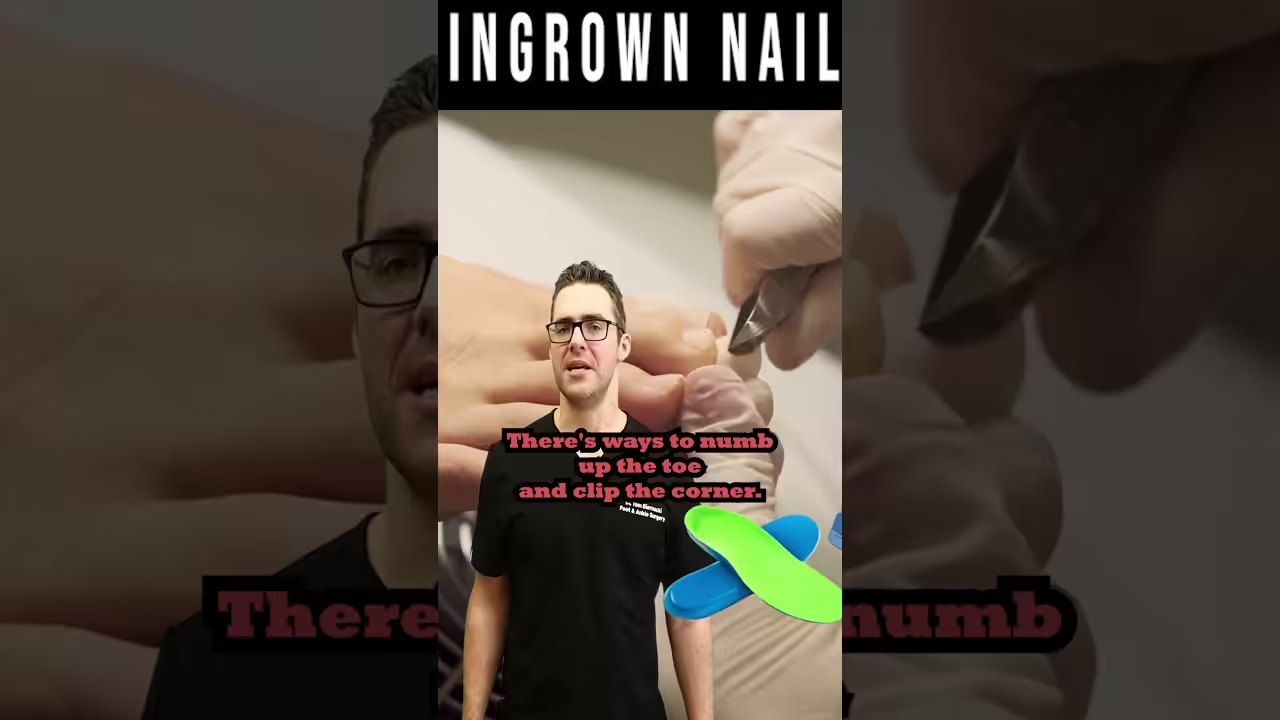
Quick answer: How to trim toenails correctly the right way: 1) prepare the area properly, 2) use the correct technique demonstrated by a podiatrist, 3) avoid the common mistakes that worsen the problem. We see complications in clinic from improper home care. The full step-by-step guide below shows the right method. Call (810) 206-1402.
The most important clinical decision with How To Trim Toenails Correctly isn’t which treatment to start with — it’s identifying the correct subtype. That changes everything. Call (810) 206-1402.
Dr. Tom’s Top Toenail Fungus Picks (2026)
Medically reviewed by Dr. Tom Biernacki, DPM
Board-certified podiatric surgeon | Balance Foot & Ankle
Last reviewed: May 2026
Affiliate disclosure: As an Amazon Associate, Balance Foot & Ankle earns from qualifying purchases.
Related Conditions
Quick Answer
How to Trim Toenails Correctly 2026 relates to toenail conditions — typically caused by fungal infection or trauma. Most patients improve in 6-12 months for nail regrowth with conservative care. Same-week appointments in Howell + Bloomfield Township: (810) 206-1402.
✅ Medically reviewed by Dr. Tom Biernacki, DPM — Board-Certified Podiatrist · Last updated April 6, 2026
How to Trim Toenails Correctly 2026
Toenail Care — More Than Cosmetic
Proper toenail care is one of the simplest and most impactful preventive foot health practices available. Incorrectly trimmed toenails are among the leading causes of ingrown toenails — a painful and often recurring condition that can lead to infection, abscess, and in diabetic or immunocompromised patients, serious complications. Yet surveys consistently show that a majority of adults trim their toenails incorrectly, either cutting too short, rounding the corners, or using technique that predisposes to ingrowth and nail damage.
The Correct Toenail Trimming Technique
The correct technique for trimming toenails is straightforward but different from fingernail trimming. Use sharp, clean nail clippers specifically designed for toenails — thicker nail clippers than fingernail clippers. Cut the nail straight across, following the natural shape of the toe. Do not curve the corners downward to follow the toe tip curvature — this is the primary cause of ingrown nails. Leave approximately 1 to 2 mm of white nail edge visible beyond the nail bed. Do not cut nails so short that the skin at the sides of the nail is exposed or the nail bed is visible at the front edge.
Frequency and Timing
Most adults need to trim toenails every 6 to 8 weeks, though this varies based on growth rate. Toenails grow more slowly than fingernails — approximately 1.5 mm per month compared to 3 mm for fingernails. Trimming after bathing or soaking, when nails are slightly softened, is easier and reduces the risk of the nail splintering or cracking. Never cut nails when dry if they are thick or brittle — the force required increases the risk of uneven cuts and nail damage. For thick nails from onychomycosis or age-related changes, a nail file used after trimming smooths edges effectively.
Tools Matter
Using proper tools makes toenail care easier and safer. A quality toenail clipper with a straight cutting edge (rather than curved) makes straight cuts natural. Nail nippers are better than standard clippers for thick or curved nails. A nail file or emery board smooths rough edges after clipping. All tools should be cleaned and dried after use — nail implements stored damp develop bacterial and fungal contamination. For diabetic patients or those with reduced hand strength or flexibility, podiatric-grade nail care instruments and professional trimming at podiatry appointments eliminates the injury risk of self-trimming.
When to See a Podiatrist for Nail Care
Self-trimming is appropriate for most healthy adults with normal nails and adequate hand function. Professional toenail care is indicated for: diabetes (any nail trauma is a potential serious complication); thickened, hardened, or curved nails that are difficult to cut safely; active ingrown toenail with pain, redness, or drainage; toenail fungus requiring debridement of accumulated nail material; elderly patients with reduced flexibility who cannot safely reach their feet; and any patient on blood thinners where a nick from nail cutting requires medical management.
Nail Polish and Toenail Health
Nail polish, particularly darker colors, can mask the early signs of toenail fungus, melanoma under the nail, and other nail changes that would otherwise prompt early treatment. Taking regular breaks from nail polish and inspecting the natural nail during polish-free periods allows early detection of changes. If toenail discoloration is present when polish is removed, have it evaluated before reapplying. Formaldehyde-containing nail hardeners can cause nail brittleness and separation (onycholysis) with prolonged use — choose formaldehyde-free formulations for regular use.
Ingrown Toenails: When to Seek Professional Treatment
Improper toenail trimming is the leading cause of ingrown toenails — but even correct technique cannot prevent every ingrown nail in patients with curved nail plate anatomy, hyperhidrosis-related nail softening, or shoes that apply lateral pressure to the great toe. Recognizing when an ingrown nail requires professional intervention versus home management is important: home management is appropriate for early Stage 1 ingrown nails with mild pain and no infection signs (redness, warmth, drainage, or swelling beyond simple lateral nail groove tenderness). Warm water soaks, proper border nail trimming, and cotton or dental floss placement under the nail corner to encourage outward growth are appropriate home measures.
Professional treatment is required when: the nail border is deeply embedded with significant tissue granulation (proud flesh), making safe home trimming impossible; signs of infection are present (purulent discharge, increasing redness, warmth, swelling); recurrence has occurred despite correct home technique, suggesting the nail plate curvature or width is the root cause; or the patient has diabetes, neuropathy, or peripheral vascular disease — in whom any ingrown nail is a potential limb-threatening wound. In-office partial nail avulsion under digital block anesthesia provides immediate relief and allows full visualization and management of the affected border. Permanent partial matrixectomy — chemical or surgical destruction of the matrix cells responsible for the problematic border — achieves a 95%+ permanent cure rate for chronic recurrent ingrown nails and is a minor, well-tolerated in-office procedure. At Balance Foot & Ankle in Howell and Bloomfield Township, we provide same-day or next-day evaluation for painful ingrown toenails and perform permanent correction for recurrent cases.
Michigan patients can access expert ingrown toenail treatment in Michigan at Balance Foot & Ankle. Our board-certified podiatrists serve Howell (4330 E Grand River) and Bloomfield Township (43494 Woodward Ave #208). Schedule an appointment online or call (810) 206-1402 for same-week availability.
Related Patient Guides
- Ingrown Toenail Treatment: Home Care & Permanent Fix
- Toenail Health: What Your Nails Reveal
- Diabetic Foot Care: Daily Routine & Warning Signs
Insurance Accepted
BCBS · Medicare · Aetna · Cigna · United Healthcare · HAP · Priority Health · Humana · View All →
Howell Office
4330 E Grand River Ave
Howell, MI 48843
Get Directions →
Bloomfield Township Office
43494 Woodward Ave, #208
Bloomfield Township, MI 48302
Get Directions →
Your Board-Certified Podiatrists



Ready to Get Back on Your Feet?
Same-week appointments available at both locations.
Pros & Cons of Conservative Care for toenail conditions
Advantages
- ✓ Most cases resolve at home
- ✓ Same-week appointments available
- ✓ Permanent fix exists
Considerations
- ✗ Recurrence common without prevention
- ✗ Diabetics need professional care
Dr. Tom’s Recommended Products for toenail conditions
Affiliate disclosure: As an Amazon Associate, Balance Foot & Ankle earns from qualifying purchases. We only recommend products we use with patients.
Tolcylen Antifungal Solution Dr. Tom’s Pick
Best for: Most effective topical for fungus
Ready to Get Back on Your Feet?
Same-day appointments in Howell + Bloomfield Township. Most insurance accepted. Dr. Tom Biernacki, DPM & team.
Book Today — Same-Day Appointments Available
Call Now: (810) 206-1402
About Your Care Team at Balance Foot & Ankle
Dr. Tom Biernacki, DPM · Board-Certified Foot & Ankle Surgeon. Specializes in conservative-first care, minimally invasive bunion surgery, and complex reconstruction.
Dr. Carl Jay, DPM · Accepting new patients. Specializes in sports medicine, athletic injuries, and routine podiatric care.
Dr. Daria Gutkin, DPM, AACFAS · Accepting new patients. Specializes in surgical reconstruction and pediatric podiatry.
Locations: 4330 E Grand River Ave, Howell, MI 48843 · 43494 Woodward Ave Suite 208, Bloomfield Township, MI 48302
Hours: Mon–Fri 8:00 AM – 5:00 PM · (810) 206-1402
In-Office Treatment at Balance Foot & Ankle

If home treatment isn’t providing relief for your foot and ankle pain, our podiatry team at Balance Foot & Ankle can help with same-day evaluations and advanced in-office care.
Same-day appointments available. (810) 206-1402
Doctor Hoy’s Natural Pain Relief Gel
Natural topical pain relief I use in our clinic. Arnica + camphor formula — apply directly to the area 3–4x daily. ($20–25)
Ready for Expert Care?
Same-day appointments in Howell & Bloomfield Township, MI.
4.9★ | 1,123 Reviews | 3,000+ Surgeries
Or call: (810) 206-1402
