
Quick answer:Healthy toenails are smooth, pink, and firmly attached. Changes like thickening, yellowing, crumbling, lifting, or dark streaks can signal fungus, injury, or an underlying medical condition. This guide explains what normal and problem nails look like and when to see a podiatrist. Call (810) 206-1402.
The most important clinical decision with Toenail Health Guide isn’t which treatment to start with — it’s identifying the correct subtype. That changes everything. Call (810) 206-1402.
Dr. Tom’s Top Toenail Fungus Picks (2026)
Medically reviewed by Dr. Tom Biernacki, DPM
Board-certified podiatric surgeon | Balance Foot & Ankle
Last reviewed: May 2026
Affiliate disclosure: As an Amazon Associate, Balance Foot & Ankle earns from qualifying purchases.
In This Article
- Dr. Tom’s Top Toenail Fungus Picks (2026)
- What Healthy Toenails Look Like
- Toenail Changes and What They Mean
- Toenail Fungus: The Most Common Nail Problem
- How to Care for Your Toenails
- When to See a Podiatrist About Your Toenails
- Your Board-Certified Podiatrists
- More Podiatrist-Recommended Foot Health Essentials
- Pros & Cons of Conservative Care for toenail conditions
- Dr. Tom’s Recommended Products for toenail conditions
- What is Foot pain?
- Symptoms and warning signs
- Conservative treatment options
- When is surgery considered?
- Recovery timeline and prevention
Related Conditions
Toenail Health Guide: What Your Toenails Tell You About Your Health
Your toenails are more than just cosmetic — they are a window into your overall health. Changes in nail color, thickness, shape, and texture can signal everything from fungal infections and nutritional deficiencies to serious systemic conditions like diabetes, heart disease, and autoimmune disorders. Learning to read your nails helps you catch problems early.
What Healthy Toenails Look Like
- Smooth, uniform surface without pitting or ridging
- Translucent to pinkish color (pink nail bed visible through translucent nail plate)
- Well-defined, white lunula (half-moon) at the base
- Consistent thickness — not too thick or too thin
- No discoloration, lifting, or separation from the nail bed
- Properly curved shape — not curling under or overly curved
Toenail Changes and What They Mean
| Nail Change | Possible Causes | Action Needed |
|---|---|---|
| Yellow, thickened, brittle nails | Onychomycosis (fungal infection) — most common cause | See podiatrist for testing and treatment |
| Greenish-black nails | Pseudomonas bacterial infection (often under nail or in lifted area) | Prompt evaluation |
| Dark streak under nail (subungual hematoma) | Trauma (blood pooling under nail); if non-traumatic, exclude melanoma | Traumatic: watch and wait; non-traumatic: immediate evaluation |
| Pitting (small depressions) | Psoriasis (nail psoriasis affects 80-90% of those with skin psoriasis) | Dermatology/rheumatology evaluation |
| Horizontal ridges (Beau’s lines) | Systemic illness, severe stress, nutritional deficiency (zinc, protein) | Identify and address underlying cause |
| Spoon nails (concave/curved upward) | Iron deficiency anemia; hemochromatosis; heart disease | Blood work; medical evaluation |
| White nails (leukonychia) | True white (paint-like): trauma; Terry’s nails: liver disease, heart failure, diabetes | If generalized, systemic evaluation |
| Clubbing (nail curves around fingertip) | Chronic low oxygen: lung disease, heart disease, liver disease | Urgent medical evaluation |
| Nail lifting from bed (onycholysis) | Trauma, fungal infection, psoriasis, thyroid disease, reaction to nail polish | Evaluation; avoid prolonged water exposure |
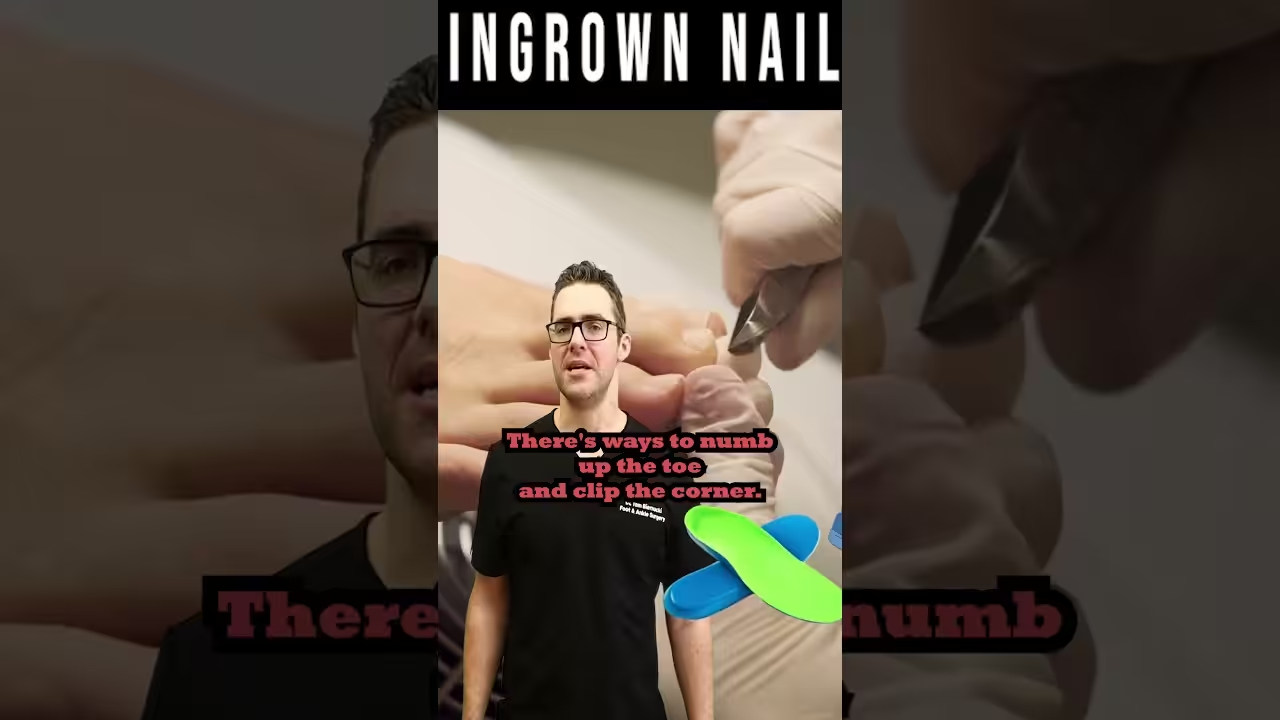
| Ingrown toenail | Improper cutting, tight shoes, hereditary nail curvature, trauma | Home care or podiatrist depending on severity |
Toenail Fungus: The Most Common Nail Problem
Onychomycosis (toenail fungus) affects approximately 10% of the general population, rising to 20-30% in those over 60. The infection causes:
- Yellow, brown, or white discoloration beginning at the nail tip or sides
- Progressive thickening and brittleness
- Crumbling texture that leaves debris under the nail
- Separation of nail plate from nail bed
- Mild to no pain — many people don’t realize they have it until it spreads
Toenail fungus does not resolve without treatment. Treatment options range from prescription topical antifungals (efinaconazole, tavaborole) to oral medications (terbinafine) to MLS laser therapy — the latter being the most effective with fewest side effects.
How to Care for Your Toenails
Proper Trimming Technique
- Trim straight across — not curved — to prevent ingrown nails
- Trim to the tip of the toe, not shorter
- Smooth sharp edges with a nail file (also in one direction)
- Trim after bathing when nails are softer
- Use dedicated toenail clippers (larger and straighter than fingernail clippers)
- Diabetics and those with poor circulation: have a podiatrist trim nails professionally to prevent accidental cuts
Preventing Fungal Infections
- Wear moisture-wicking socks; change daily or when damp
- Allow shoes to dry fully between wearings (rotate shoes)
- Wear shower shoes in public pools, locker rooms, and gym showers
- Keep feet clean and dry, especially between toes
- Treat athlete’s foot (tinea pedis) promptly — it frequently spreads to nails
- Disinfect nail clippers regularly with alcohol
Nail Polish and Pedicures
- Avoid nail polish on nails with suspected fungal infection — it traps moisture and can worsen infection
- If getting salon pedicures, bring your own instruments or verify salon uses hospital-grade disinfection
- Gel or acrylic nail overlays dramatically increase fungal infection risk and make treatment more difficult
- Take nail polish breaks to allow nails to breathe
When to See a Podiatrist About Your Toenails
- Discoloration, thickening, or texture change that doesn’t resolve with home care
- Dark streak under a nail without clear traumatic cause
- Ingrown toenail with pain, redness, swelling, or drainage
- Nail change associated with rash or joint symptoms (suggests psoriatic arthritis)
- You have diabetes — any nail abnormality warrants prompt evaluation
- Nail changes that appear in multiple nails simultaneously (suggests systemic cause)
A podiatrist can clinically diagnose most nail conditions and, when needed, perform nail clipping culture or biopsy to confirm fungal infection or exclude nail psoriasis. Regular podiatric visits are particularly important for diabetics, who require professional nail care as part of their diabetes management.
Related Patient Guides
- Toenail Fungus Treatment Options: Complete Guide
- Ingrown Toenail Home Treatment Guide
- MLS Laser Therapy for Toenail Fungus
- Diabetic Foot Care Daily Routine
- 12 Signs You Need to See a Podiatrist
- Ingrown Toenail Treatment: Home Care & Permanent Fix
Insurance Accepted
BCBS · Medicare · Aetna · Cigna · United Healthcare · HAP · Priority Health · Humana · View All →
Howell Office
4330 E Grand River Ave
Howell, MI 48843
Get Directions →
Bloomfield Township Office
43494 Woodward Ave, #208
Bloomfield Township, MI 48302
Get Directions →
Your Board-Certified Podiatrists



Ready to Get Back on Your Feet?
Same-week appointments available at both locations.
Pros & Cons of Conservative Care for toenail conditions
Advantages
- ✓ Most cases resolve at home
- ✓ Same-week appointments available
- ✓ Permanent fix exists
Considerations
- ✗ Recurrence common without prevention
- ✗ Diabetics need professional care
Dr. Tom’s Recommended Products for toenail conditions
Affiliate disclosure: As an Amazon Associate, Balance Foot & Ankle earns from qualifying purchases. We only recommend products we use with patients.
Tolcylen Antifungal Solution Dr. Tom’s Pick
Best for: Most effective topical for fungus
Ready to Get Back on Your Feet?
Same-day appointments in Howell + Bloomfield Township. Most insurance accepted. Dr. Tom Biernacki, DPM & team.
Book Today — Same-Day Appointments Available
Call Now: (810) 206-1402
About Your Care Team at Balance Foot & Ankle
Dr. Tom Biernacki, DPM · Board-Certified Foot & Ankle Surgeon. Specializes in conservative-first care, minimally invasive bunion surgery, and complex reconstruction.
Dr. Carl Jay, DPM · Accepting new patients. Specializes in sports medicine, athletic injuries, and routine podiatric care.
Dr. Daria Gutkin, DPM, AACFAS · Accepting new patients. Specializes in surgical reconstruction and pediatric podiatry.
Locations: 4330 E Grand River Ave, Howell, MI 48843 · 43494 Woodward Ave Suite 208, Bloomfield Township, MI 48302
Hours: Mon–Fri 8:00 AM – 5:00 PM · (810) 206-1402
In-Office Treatment at Balance Foot & Ankle
If home treatment isn’t providing relief for your foot and ankle conditions, our podiatry team at Balance Foot & Ankle can help with same-day evaluations and advanced in-office care.
Same-day appointments available. (810) 206-1402
Ready for Expert Care?
Same-day appointments in Howell & Bloomfield Township, MI.
4.9★ | 1,123 Reviews | 3,000+ Surgeries
Or call: (810) 206-1402
