
★ 4.9 Stars · 1,123+ Reviews · Balance Foot & Ankle Michigan
Ingrown Toenail Treatment
Board-certified podiatrists in Howell & Bloomfield Hills, MI. 4.9★ rated · Same-week appointments · Most insurance accepted · (810) 206-1402.
Medically reviewed by Dr. Tom Biernacki, DPM, FACFAS — Board-certified podiatric surgeon. Ingrown toenail specialist, Balance Foot & Ankle Michigan. Updated 2026.
Ingrown Toenail Treatment: Quick Answer
Our ingrown toenail treatment Michigan program offers same-day nail edge removal for immediate pain relief and permanent nail matrixectomy to prevent recurrence. Ingrown toenail treatment at Balance Foot & Ankle is performed with local anesthesia — patients walk out pain-free. Available in Howell & Bloomfield Hills, MI. Call (810) 206-1402.
In This Article
- Permanent Ingrown Toenail Treatment: Nail Matrixectomy
- Ingrown Toenail Treatment in Michigan
- Symptoms of an Ingrown Toenail
- What Causes Ingrown Toenails?
- Ingrown Toenail Treatment Options
- When to See a Podiatrist
- Why Choose Balance Foot & Ankle Specialists?
- Frequently Asked Questions
- Related Conditions We Treat
- Get Same-Day Ingrown Toenail Relief
- Your Board-Certified Podiatrists
- Ingrown Toenail Products
Table of Contents
Permanent Ingrown Toenail Treatment: Nail Matrixectomy
For patients with recurrent ingrown toenails, permanent ingrown toenail treatment using chemical matrixectomy is the definitive solution. After numbing the toe, we remove the problematic nail edge and apply phenol to destroy the nail matrix cells that produce that portion of the nail — permanently preventing regrowth of the ingrown edge.
Permanent ingrown toenail treatment with phenol matrixectomy has a 95%+ success rate. The procedure takes 15-20 minutes, requires no stitches, and patients return to normal activities within days. This is the gold standard ingrown toenail treatment for chronic sufferers.
When to Seek Ingrown Toenail Treatment Immediately
Do not delay ingrown toenail treatment if you have diabetes, poor circulation, or signs of infection (pus, spreading redness, warmth, or fever). Diabetic patients with ingrown toenails face a risk of serious wound infection and should seek ingrown toenail treatment within 24 hours of onset.
Does ingrown toenail treatment hurt? We use local anesthesia for all in-office ingrown toenail treatment procedures. Patients feel pressure during the procedure but no pain. After the anesthesia wears off, mild soreness for 24-48 hours is normal and easily managed with OTC pain relievers.
How long does ingrown toenail treatment take? Basic ingrown toenail treatment takes 15-30 minutes. Permanent matrixectomy ingrown toenail treatment takes 20-30 minutes. You can drive yourself home and resume most activities the same day.
Will insurance cover ingrown toenail treatment? Yes — most insurance plans, including Medicare, cover medically necessary ingrown toenail treatment. We verify your benefits before your appointment. Call (810) 206-1402 for same-day ingrown toenail treatment in Howell or Bloomfield Hills, MI.
Get Same-Day Ingrown Toenail Treatment Michigan
Walk-in and same-day appointments in Howell & Bloomfield Hills, MI.
Or call: (810) 206-1402

Board-Certified Podiatrist & Foot Surgeon · Last Updated: April 2026
2026 Update · Medically reviewed by Dr. Tom Biernacki, DPM, Board-Certified Podiatric Surgeon · Last updated: April 2026
Ingrown Toenail Treatment in Michigan
Same-day relief from ingrown toenail pain at Balance Foot & Ankle Specialists. From simple nail trimming to permanent correction — our board-certified podiatrists treat all severity levels at our Howell and Bloomfield Hills offices.
Book Today — Same-Day Appointments Available
Call Now: (810) 206-1402
Board-Certified DPMs
Same-Day Relief
2 Michigan Locations
Insurance Accepted
Key Facts
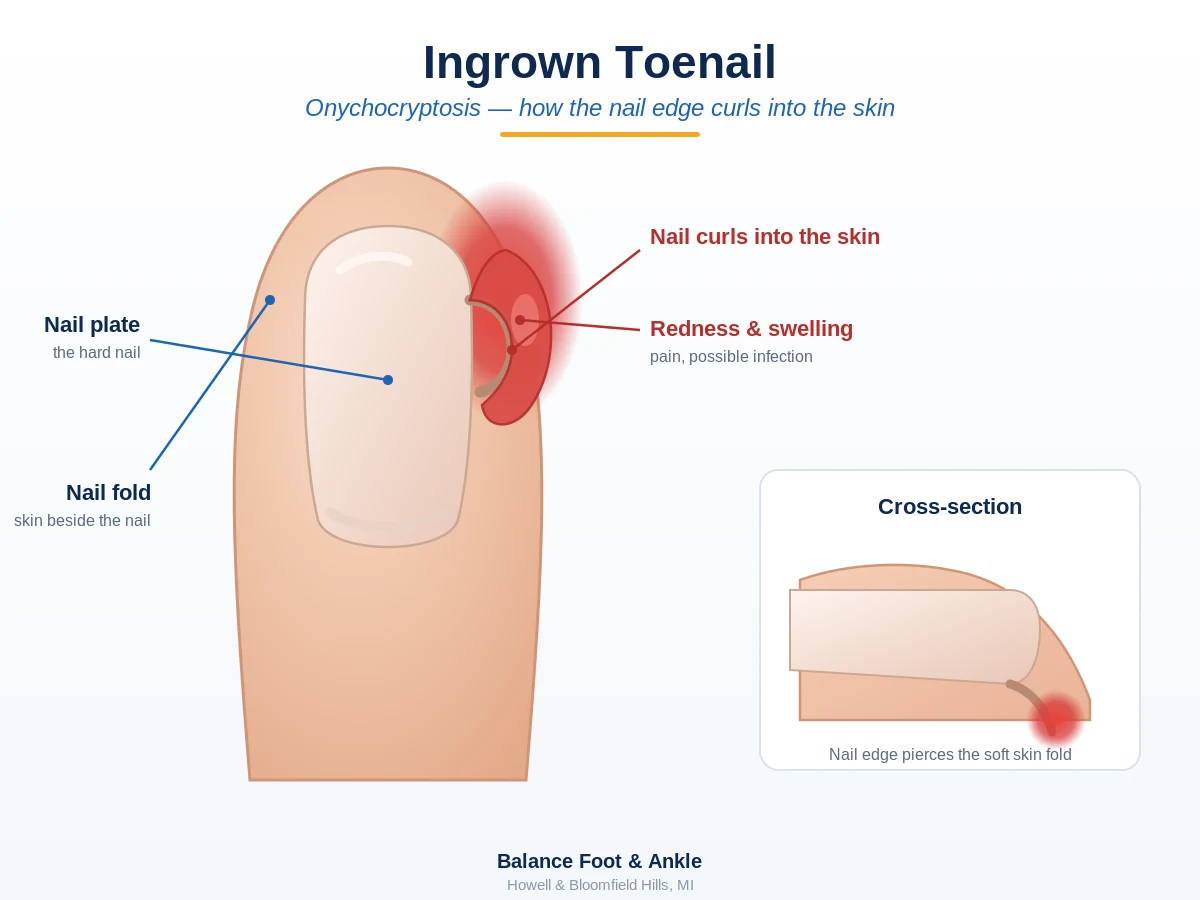
An ingrown toenail occurs when the nail edge grows into the surrounding skin, causing pain, swelling, and potential infection. At Balance Foot & Ankle Specialists, we offer same-day treatment ranging from conservative nail care to permanent nail correction (matrixectomy) with a 95%+ success rate. Most procedures take 15 minutes under local anesthetic with minimal downtime. Diabetic patients should never attempt home treatment — seek professional care immediately.
Symptoms of an Ingrown Toenail
Ingrown toenails most commonly affect the big toe. Recognizing symptoms early leads to faster, less invasive treatment:
- Pain and tenderness — along one or both sides of the nail, often worsening with footwear pressure
- Redness and swelling — around the nail edge, indicating inflammation
- Warmth to the touch — the affected skin may feel warm compared to surrounding areas
- Drainage of pus or fluid — a sign of infection requiring immediate professional care
- Difficulty walking — pain that changes your gait or prevents normal shoe wear
Left untreated, ingrown toenails can lead to serious skin and bone infections, especially in patients with diabetes or poor circulation. Early treatment prevents complications and reduces recovery time.
What Causes Ingrown Toenails?
Understanding the root cause helps prevent recurrence after treatment. The most common causes include:
- Improper nail trimming — cutting nails too short or at an angle instead of straight across is the #1 preventable cause
- Tight or narrow footwear — shoes that compress the toes force the nail into the skin
- Naturally curved or wide nails — genetic nail shape makes some people prone to ingrown nails throughout life
- Toe injury or trauma — stubbing, dropping objects on, or repetitive athletic impact can damage nail growth
- Thick or fungal nails — patients with toenail fungus are at higher risk because thickened nails exert more pressure on surrounding skin
Your podiatrist will identify your specific risk factors during your evaluation and create a plan to prevent future ingrown nails.
Ingrown Toenail Treatment Options
Our treatment approach depends on the severity of your ingrown toenail and whether infection is present. We follow a stepwise approach — starting conservatively and advancing only if needed.
Step 1: Conservative Care (Mild Cases)
For early-stage ingrown toenails without infection:
- Proper nail trimming technique — we demonstrate the correct straight-across cut
- Warm water soaks — to soften the skin and reduce inflammation
- Nail edge lifting — gently guiding the nail away from the skin with cotton or dental floss
- Footwear changes — open-toe or wider shoes to eliminate pressure on the affected nail
This approach works best for patients who catch the problem early and have no underlying medical conditions that impair healing.
Step 2: Partial Nail Avulsion (Nail Edge Removal)
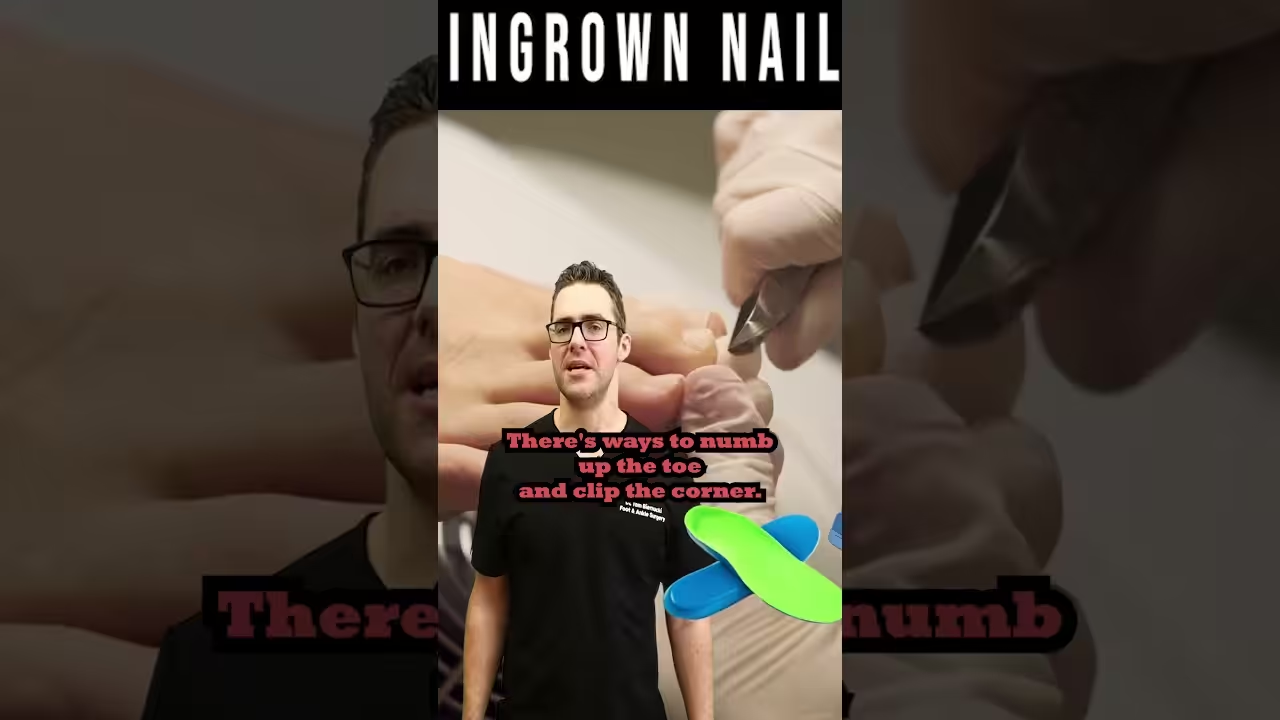
The most common in-office procedure for ingrown toenails. After applying a local anesthetic, the doctor removes the problematic edge of the nail. The procedure takes about 15 minutes, provides immediate relief, and requires minimal downtime. Most patients return to normal footwear within a few days.
This procedure addresses the current ingrown nail but does not permanently prevent recurrence on its own.
Step 3: Permanent Nail Correction (Matrixectomy)
For recurrent ingrown toenails, we permanently narrow the nail by removing the nail edge and applying a chemical (phenol) or using a surgical technique to prevent that portion of the nail from regrowing. This is a highly effective, permanent solution with a success rate over 95%.
The nail still looks cosmetically normal — it is simply slightly narrower. Recovery is straightforward with proper wound care at home. For detailed recovery information, see our ingrown toenail surgery recovery guide.
Important: Diabetic Patients
Patients with diabetes or peripheral vascular disease require special care for ingrown toenails. Poor circulation and impaired wound healing mean that even a minor ingrown toenail can progress to serious infection. We recommend diabetic patients never attempt home treatment for ingrown toenails and seek professional care at the first sign of problems. Learn more about our comprehensive diabetic foot care program.
Don’t Suffer Through Ingrown Toenail Pain
Most ingrown toenails can be treated the same day you call. Walk-in appointments often available at both locations.
Book Today — Same-Day Appointments Available
Call Now: (810) 206-1402
When to See a Podiatrist
Don’t delay care if you notice any of the following:
- Pain that is increasing despite home treatment
- Visible pus or discharge from the nail area
- Red streaking extending from the toe (sign of spreading infection)
- Fever — indicates systemic infection requiring urgent care
- Diabetes or circulation problems — any ingrown toenail symptom warrants professional evaluation
Early professional treatment prevents infection, reduces pain faster, and avoids the need for more invasive procedures. Walk-in appointments are often available at our Howell and Bloomfield Hills offices.
Why Choose Balance Foot & Ankle Specialists?
- Board-certified podiatrists — Dr. Tom Biernacki, Dr. Carl Jay, and Dr. Daria Gutkin perform ingrown toenail procedures daily
- Same-day treatment — most ingrown toenails are treated the day you call, no weeks-long wait
- 15-minute office procedure — partial nail avulsion provides immediate relief with minimal downtime
- 95%+ permanent cure rate — matrixectomy eliminates recurring ingrown toenails for good
- Diabetic nail care specialists — safe, careful procedures for patients with diabetes and circulation concerns
- Two convenient locations — Howell and Bloomfield Hills, both accepting same-day appointments
- Insurance-friendly — we accept Medicare, BCBS, United Healthcare, Aetna, Cigna, Humana, Priority Health, HAP, and most major plans
Frequently Asked Questions
How do I know if my ingrown toenail is infected?
Signs of infection include increased redness spreading beyond the nail edge, warmth, significant swelling, pus or fluid draining from the nail fold, and sometimes fever. An infected ingrown toenail requires prompt professional treatment — antibiotics alone are rarely enough without also addressing the nail. See a podiatrist the same day if you notice these symptoms.
Can I treat an ingrown toenail myself at home?
For very mild, early-stage ingrown toenails, soaking in warm water, keeping the area clean, and gently lifting the nail edge may provide temporary relief. However, attempting to cut away the nail yourself frequently makes the problem worse and increases infection risk. If the nail has already broken through the skin or you have diabetes, see a podiatrist rather than attempting home treatment.
Does ingrown toenail removal hurt?
The procedure itself is performed under local anesthetic, so you should feel only pressure, not pain, during nail removal. The injection of anesthetic causes brief discomfort similar to a dental injection. After the anesthetic wears off, mild soreness is normal and well-managed with over-the-counter pain relievers. Most patients return to normal activities the same day or the next day.
Will my ingrown toenail come back after treatment?
A simple nail trimming or partial avulsion may need to be repeated if the underlying nail shape or trimming habits aren’t corrected. The permanent procedure (matrixectomy) has a success rate over 95% — after this treatment, the ingrown nail portion does not regrow. We discuss which option is best based on your history of recurrences and nail characteristics.
Does Medicare or insurance cover ingrown toenail removal?
Ingrown toenail removal is typically covered by Medicare and most insurance plans when performed for a medical indication (pain, infection, or inability to walk comfortably). Coverage for routine nail care without a medical indication may be limited. Our team verifies your specific benefits before treatment so there are no surprises.
Related Conditions We Treat
Ingrown toenails often occur alongside other nail and foot conditions. Our podiatrists diagnose and treat the full range of related problems:
Dr. Tom’s Pick: DASS Medical Compression Socks
Medical-grade 15-20 mmHg graduated compression. DASS socks are the brand I recommend most to patients with swollen feet, poor circulation, and post-surgery recovery. Graduated compression means tightest at the ankle, gradually releasing up the leg — promoting upward venous blood flow.
View DASS Compression Socks on Amazon →
Affiliate disclosure: As an Amazon Associate, Balance Foot & Ankle earns from qualifying purchases.
Get Same-Day Ingrown Toenail Relief
Expert ingrown toenail treatment from board-certified podiatrists. Walk-in and same-day appointments frequently available at both Michigan locations.
Book Today — Same-Day Appointments Available
Call Now: (810) 206-1402
Our Locations
Howell Office
4330 E Grand River Ave
Howell, MI 48843
(810) 206-1402 · Fax: (810) 206-1402
Mon–Fri: 9:00 AM – 4:30 PM
Bloomfield Hills Office
43494 Woodward Ave #208
Bloomfield Hills, MI 48302
(810) 206-1402 · Fax: (810) 206-1402
Mon–Fri: 9:00 AM – 4:30 PM
Sources
- A systematic review and meta-analysis of randomised controlled trials of surgical treatments for ingrown toenails. PubMed, 2023. pubmed.ncbi.nlm.nih.gov/37674170
- Evaluation of the Recurrence Rate of Ingrown Toenail After a 45-Second Matrix Cauterization With Phenol. PubMed, 2024. pubmed.ncbi.nlm.nih.gov/38954750
- Ingrown Toenail Management. StatPearls, PubMed, 2023. pubmed.ncbi.nlm.nih.gov/31361106
“Dr. Tom fixed my ingrown toenail in minutes. I was dreading it but barely felt a thing. Walking pain-free the next day!”
— Sarah M., Ingrown Toenail Patient
What to Expect at Your Appointment
Examination & Assessment
Your podiatrist evaluates the ingrown nail, checks for infection, and discusses your symptoms and history.
Numbing & Treatment
We apply local anesthesia for a pain-free procedure. The ingrown nail border is carefully removed in minutes.
Aftercare Instructions
You receive wound care instructions, follow-up scheduling, and guidance on preventing recurrence.
Related Treatments You May Need
Your Expert Podiatrists
Serving Patients Across Southeast Michigan
Balance Foot & Ankle provides expert podiatric care from two convenient locations. Our Howell office serves patients from Brighton, Hartland, Fowlerville, Pinckney, Fenton, Hamburg, Whitmore Lake, South Lyon, and throughout Livingston County. Our Bloomfield Hills office serves Birmingham, Troy, West Bloomfield, Pontiac, Farmington Hills, Southfield, Royal Oak, Clarkston, Lake Orion, Rochester Hills, Waterford, Commerce Township, Novi, and Walled Lake across Oakland County.
Your Board-Certified Podiatrists


Ready to Get Back on Your Feet?
Same-week appointments available at both locations.
Board-certified care at both Michigan locations
Book your visit today
Most insurance accepted · On-site X-ray · Board-certified podiatrists
What is the fastest way to cure an ingrown toenail in Michigan?
In-office matrixectomy at our Howell or Bloomfield Hills office — under 15 minutes, local anesthesia, walking out in your shoes same day.
How do I know if my ingrown toenail needs a doctor?
If you have redness, swelling, drainage, or cannot trim the nail safely, see a podiatrist. Infected ingrown toenails require professional treatment.
Does insurance cover ingrown toenail removal in Michigan?
Yes — most major insurance plans including Medicare and Blue Cross cover ingrown toenail procedures when medically necessary.
Ingrown Toenail Products
Mild ingrown toenails can be managed at home with the right tools. Infected or severe cases need a podiatrist visit.
Podiatrist-Recommended Toenail Care
Fungus, ingrown, brittle — home care that actually works.
Toenail, Wart & Skin Hub
All skin & nail care products in one place.
Podiatrist-Recommended Pain Relief
Topical NSAIDs, lidocaine, and natural options compared.
Watch: Ingrown Toenail Treatment
Ingrown Toenail Care Kit
Post-procedure or early-stage ingrown nail care. Dr. Tom’s kit:
As an Amazon Associate, Balance Foot & Ankle earns from qualifying purchases. This supports our free patient education content.
Pre-procedure topical relief.
Post-procedure swelling.
Reduces nail pressure during healing.
Shoe pressure protection during regrowth.
Related: Fungal Nail Treatment · Toenail Problems · Book Same-Week Appointment