

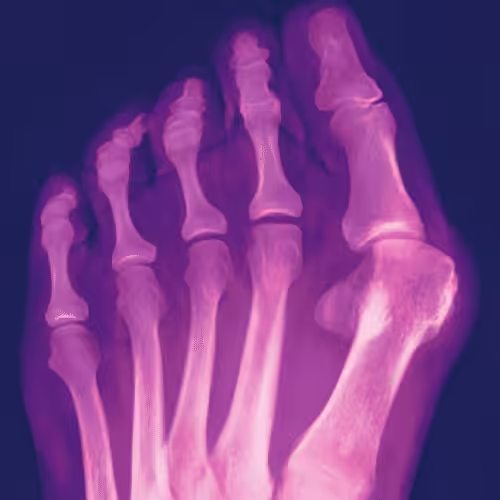
A bunion is a progressive misalignment of the big-toe joint that widens the forefoot and causes pain, rubbing, and difficulty with shoes. Surgery realigns the joint instead of shaving the bump. After many modern corrections you can walk in a surgical boot within days and return to regular shoes in roughly 6 to 8 weeks. We perform the full workup, imaging, and surgery locally in Livingston and Oakland counties.
Ready to discuss your bunion treatment options? View consultation appointments at Howell (4330 E Grand River Ave) or Bloomfield Township (43494 Woodward Ave, Suite 208). Choose New or Existing, then a date and an available time. If no appointments appear for the selected day, check another date or call (810) 206-1402 for help. The Bloomfield Township location appears as Bloomfield Hills Office in the scheduler. Online booking is for an office visit; it does not schedule surgery. Referral, authorization and costs depend on your specific plan and the care you receive. Read our insurance information and self-pay options.
★ 4.9 Stars · 1,193+ Reviews · Board-Certified Michigan Podiatrists
Discuss your bunion treatment options
Bunion consultations in Howell and Bloomfield Township
A consultation helps you discuss your symptoms, goals and treatment options, including conservative care and whether surgery is appropriate. Call (810) 206-1402 to ask which office and clinician suit your consultation, or view appointment options at either location.

Medically Reviewed by Dr. Tom Biernacki, DPM, FACFAS
Board-Certified Podiatrist & Foot Surgeon · Last Updated: April 2026
Best Bunion Surgery
in Howell & Bloomfield Township, Michigan
If you’re struggling with a painful bunion that makes walking, standing, or even wearing shoes uncomfortable, you’re not alone—and you don’t have to live with the pain. At Balance Foot & Ankle Specialist, we specialize in treating bunions with the latest surgical techniques to help you get back on your feet, pain-free and confident.
Why early treatment matters
Bunions can do more than cause a bump on your big toe—they lead to real, lasting discomfort. Over time, they can affect your ability to move, stay active, or simply enjoy your day without foot pain. What starts as minor irritation can quickly escalate into joint stiffness, swelling, and long-term mobility issues.
That’s why early treatment matters. While non-surgical options can provide short-term relief, surgical bunion correction can realign your toe joint, eliminate pain, and restore your natural movement. Our experienced podiatrists will work with you to determine the best treatment option—so you can walk, move, and live with comfort again.
When Is Bunion Surgery Needed?
Bunion surgery is typically recommended when non-surgical treatments—like custom orthotics, padding, or lifestyle changes—no longer provide relief. If you’re experiencing consistent pain, swelling, or trouble walking, it may be time to consider surgical correction. Our podiatrists will assess your condition and determine if surgery is the best step toward long-term relief.
Our Surgical Approach
At Balance Foot & Ankle Specialist, we use advanced surgical techniques matched to your foot structure. From minimally invasive bunionectomy to realignment procedures, our goal is to correct the deformity, relieve pressure, and restore natural function with minimal downtime and scarring.
Benefits of Bunion Surgery
Long-lasting pain relief
Improved joint alignment and foot function
Ability to return to normal footwear and daily activities
Our expert care ensures optimal healing and long-term results.
What to Expect – Before, During & After Surgery
Before surgery, we’ll perform a full exam, take imaging, and explain your treatment plan.
During surgery, we use precise techniques to realign bones and remove excess tissue.
After surgery, you’ll receive a customized recovery plan, including follow-ups, footwear guidance, and physical therapy if needed. Most patients return to walking comfortably within weeks.
Watch: Bunion Surgery Explained by Dr. Tom Biernacki
Dr. Tom Biernacki compares traditional bunionectomy with Lapiplasty® and shares tips for a faster recovery (21 min).
Bunion surgery recovery, week by week
With minimally invasive correction you can usually put weight on the foot in a surgical boot right away; your surgeon will tell you before surgery which timeline applies to you. A traditional osteotomy is slower: typically 4 to 6 weeks without weight on the foot, athletic shoes at 8 to 12 weeks and running at 4 to 6 months.
- Days 1–3: keep the foot elevated about 22 hours a day and ice every 2 hours while awake. The nerve block usually lasts 18 to 36 hours, then you switch to oral pain medication.
- Days 4–7: most patients are off opioid pain medication and walking in the boot.
- Weeks 2–6: progressive walking; physical therapy begins and we fit custom orthotics.
- Weeks 6–8: out of the boot and into athletic shoes.
- Months 3–5: running and return to sport.
- Months 5–6: full clearance, including dress shoes.
Driving: usually 1 to 2 weeks after left-foot surgery, and 3 to 4 weeks after right-foot surgery in an automatic (4 to 6 weeks for a manual). Work: desk work at 1 to 2 weeks, standing jobs at 4 to 6 weeks, heavy labor at 12 to 16 weeks. Plan on 12 to 20 physical therapy sessions over 3 to 6 months; doing the therapy is the biggest predictor of a good result.
Bunion Surgery Cost and Insurance Coverage
Most insurance plans, including Medicare, Blue Cross Blue Shield, United Healthcare, and Aetna, cover bunion surgery when conservative treatments have been documented as unsuccessful and the procedure is deemed medically necessary. Prior authorization is typically required.
Typical costs with insurance include your specialist copay ($20 to $60 per visit), plus deductible and coinsurance for the surgical procedure itself. Many patients reach their out-of-pocket maximum with bunion surgery, meaning their insurance covers 100 percent of remaining care for the year. For self-pay patients, view our self-pay pricing options.
Our team verifies your insurance benefits and provides a detailed cost estimate before scheduling surgery. Call (810) 206-1402 to verify your coverage.
Why Choose Balance Foot & Ankle Specialist in Howell & Bloomfield Township?
With board-certified podiatrists, advanced surgical tools, and compassionate care, Balance Foot & Ankle Specialist is your trusted partner in foot health. We tailor every treatment to your needs and support you every step of the way—from consultation to recovery.
View Howell consultation appointments
Dr. Tom Biernacki DPM
(Podiatrist, Wound Care, Foot & Ankle Specialist)
Dr. Tom Biernacki, DPM, is a highly respected and experienced podiatrist proudly serving patients in Howell, Michigan, and throughout Oakland County. With a strong commitment to personalized patient care, Dr. Biernacki specializes in diagnosing and treating many foot and ankle conditions, including chronic foot pain, sports injuries, diabetic foot care, and structural deformities. His practice offers comprehensive services such as routine foot care, advanced wound care, and both non-surgical and surgical solutions for complex issues affecting the lower extremities. Known for his compassionate approach and attention to detail, Dr. Biernacki works closely with each patient to create a customized treatment plan that ensures the best possible outcome.
Dr. Carl Jay DPM
(Podiatric Surgeon & Foot Doctor)
Dr. Carl Jay is a board-certified foot and ankle surgeon and proud partner at Balance Foot & Ankle. After completing his residency at the Genesys Regional Medical Center program, he took his talents to Texas. There he covered trauma call, treated complex wounds in the Wound Care Center, and cared for many patients in private practice, from diabetic limb preservation to sports medicine.
Dr. Jay certainly enjoyed practicing in the Lone Star State. (I mean that amazing warm weather and sunshine.)Family brought him back to Michigan.
Now serving the Detroit Metro area, Dr. Jay brings advanced treatment modalities and years of surgical and clinical experience to every patient encounter. He’s passionate about delivering expert, compassionate care that helps people move better and live better.
What Our Patients Say About Bunion Surgery
I suffered with bunion pain for years before finally scheduling surgery with Dr. Biernacki. The minimally invasive approach meant less pain and faster recovery than I expected. I was back in my shoes in six weeks and wish I had done it sooner.
— Michelle R., Howell
Dr. Tom explained everything clearly and made me feel completely comfortable about my bunion surgery. The whole team was professional and caring. My foot looks and feels amazing now.
— Patricia L., Brighton
Bunion Surgery FAQ
When should I have bunion surgery?
Bunion surgery is appropriate when the bunion causes daily pain, limits the shoes you can wear, or is progressing visibly on X-ray, and when non-surgical measures (wide shoes, toe spacers, orthotics, activity modification) have not been enough. Cosmetic deformity alone is not a medical indication. We walk you through the weight-bearing X-ray measurements so the decision is objective, not cosmetic.
Is bunion surgery safe?
Yes. It is a common, well-studied procedure when it is performed by a qualified foot and ankle surgeon. We review your health, your X-rays and risk factors such as smoking and diabetes before recommending it.
What is minimally invasive bunion surgery?
Minimally invasive bunion surgery uses small incisions (typically 3 to 5 millimeters) and specialized instruments to realign the bone and correct the deformity. Benefits include less post-operative pain, smaller scars, faster recovery, and the ability to walk sooner after surgery compared to traditional open bunionectomy techniques.
How is Lapiplasty® different from traditional bunion surgery?
Older “shave-the-bump” procedures corrected only the visible bulge and had a meaningful recurrence rate. Lapiplasty® is a brand-name system for a Lapidus-type fusion: it realigns the first metatarsal at its base in all three planes and holds the joint with titanium plates, so it treats the unstable joint rather than the bump. In our practice, Lapiplasty is performed by Dr. Carl Jay; Dr. Biernacki and Dr. Gutkin do not perform it. When a bunion needs surgery, we recommend the correction that fits your joint after X-rays and a fair trial of shoes, padding and orthotics.
How long is recovery after bunion surgery?
Most patients walk in a surgical boot within days of minimally invasive correction and move into athletic shoes at about 6 to 8 weeks. You can usually drive 1 to 2 weeks after left-foot surgery and 3 to 4 weeks after right-foot surgery. A traditional osteotomy means about 4 to 6 weeks without weight on the foot. Running usually returns at 3 to 5 months and full sport at 4 to 6 months; the exact timeline depends on the correction, your bone quality and how closely you follow the post-op plan. See the week-by-week timeline above.
Can I walk after bunion surgery?
Usually, yes. After minimally invasive correction, most patients walk in a surgical boot or post-op shoe within days rather than spending weeks off the foot. A traditional osteotomy usually means 4 to 6 weeks without weight on the foot.
Can bunions come back after surgery?
Recurrence is less likely when the correction realigns the joint at the root of the deformity rather than just shaving the bump. It is not zero: smoking, poorly controlled diabetes and not following the post-op plan are the main risk factors we can influence. Supportive footwear and custom orthotics after surgery further reduce the chance of recurrence.
Does bunion surgery leave a scar?
There is a scar, but modern techniques keep it small; minimally invasive correction uses incisions of about 3 to 5 millimeters. We focus on both function and appearance.
Does insurance cover bunion surgery in Michigan?
Most plans, including Medicare and Blue Cross Blue Shield of Michigan, cover bunion surgery when it is medically necessary: the bunion causes significant pain, limits daily activities, or has not improved with conservative care such as wider shoes, padding or orthotics. Prior authorization is usually required. Our team verifies your benefits, handles the pre-authorization and gives you an out-of-pocket estimate before a surgery date is set.
How quickly can I get an appointment?
For a routine bunion consultation, view appointment options in the Howell or Bloomfield Township scheduler. Choose New or Existing, then a date and an available time. If your selected day has no appointments, check another date or call (810) 206-1402 for help. For urgent appointment requests, call our office to discuss availability. Online booking is for an office visit; surgery is arranged separately after evaluation.
More on bunions and bunion surgery
- Foot rehab after bunion surgery — exercises and physical therapy by phase
- Minimally invasive foot surgery — bunion and hammertoe
- Bunion treatment — conservative care first, then surgery
- What causes bunions? — the real reasons they develop
- Hammertoe — often corrected at the same time as a bunion
- Shoes after bunion surgery — what to wear in each recovery phase
Two Convenient Locations
View consultation appointment options at either office
Howell Office
4330 E Grand River AveHowell, MI 48843
Phone: (810) 206-1402
Hours: Mon–Thu 9:00 AM–4:30 PM, Fri 9:00 AM–2:30 PM
View Howell Office →Bloomfield Township Office
43494 Woodward Ave #208Bloomfield Township, MI 48302
Phone: (810) 206-1402
Hours: Mon–Thu 9:00 AM–4:30 PM, Fri 9:00 AM–2:30 PM
View Bloomfield Office →Serving Patients Across Southeast Michigan
Balance Foot & Ankle provides expert podiatric care from two convenient locations. Our Howell office serves patients from Brighton, Hartland, Fowlerville, Pinckney, Fenton, Hamburg, Whitmore Lake, South Lyon, and throughout Livingston County. Our Bloomfield Township office serves Birmingham, Troy, West Bloomfield, Pontiac, Farmington Hills, Southfield, Royal Oak, Clarkston, Lake Orion, Rochester Hills, Waterford, Commerce Township, Novi, and Walled Lake across Oakland County.
Sources
- A Multi-Dimensional Systematic Review of Minimally Invasive Bunion Surgery (MIBS). PubMed, 2025. pubmed.ncbi.nlm.nih.gov/40283587
- A New Paradigm for Failed Bunions with Minimally Invasive Methods. PubMed, 2024. pubmed.ncbi.nlm.nih.gov/39550086
- Current concepts of fourth-generation minimally invasive and open hallux valgus surgery. PubMed, 2024. pubmed.ncbi.nlm.nih.gov/39740690
- Torkki M, Malmivaara A, Seitsalo S, Hoikka V, Laippala P, Paavolainen P. Surgery vs orthosis vs watchful waiting for hallux valgus: a randomized controlled trial. JAMA. 2001;285(19):2474-2480. doi:10.1001/jama.285.19.2474
- Fraissler L, Konrads C, Hoberg M, Rudert M, Walcher M. Treatment of hallux valgus: a systematic review. EFORT Open Rev. 2016;1(9):295-302. doi:10.1302/2058-5241.1.000005
- Nix S, Smith M, Vicenzino B. Prevalence of hallux valgus in the general population: a systematic review and meta-analysis. J Foot Ankle Res. 2010;3:21. PubMed
- Easley ME, Trnka HJ. Current concepts review: hallux valgus part II—operative treatment. Foot Ankle Int. 2007;28(6):748-758. PubMed
- American Academy of Orthopaedic Surgeons. Bunions—OrthoInfo. AAOS
Our podiatrists treat the underlying cause, not just the symptom. View appointment options at our Howell and Bloomfield Township, Michigan offices.
Request an appointment
If a bunion is painful or making shoes difficult to wear, we can evaluate it and go over your options. Call (810) 206-1402 or request a callback using the form below. Our team will call you within one business day. This form requests a callback and does not reserve an appointment or schedule surgery.
We see patients at our Howell and Bloomfield Township offices.