
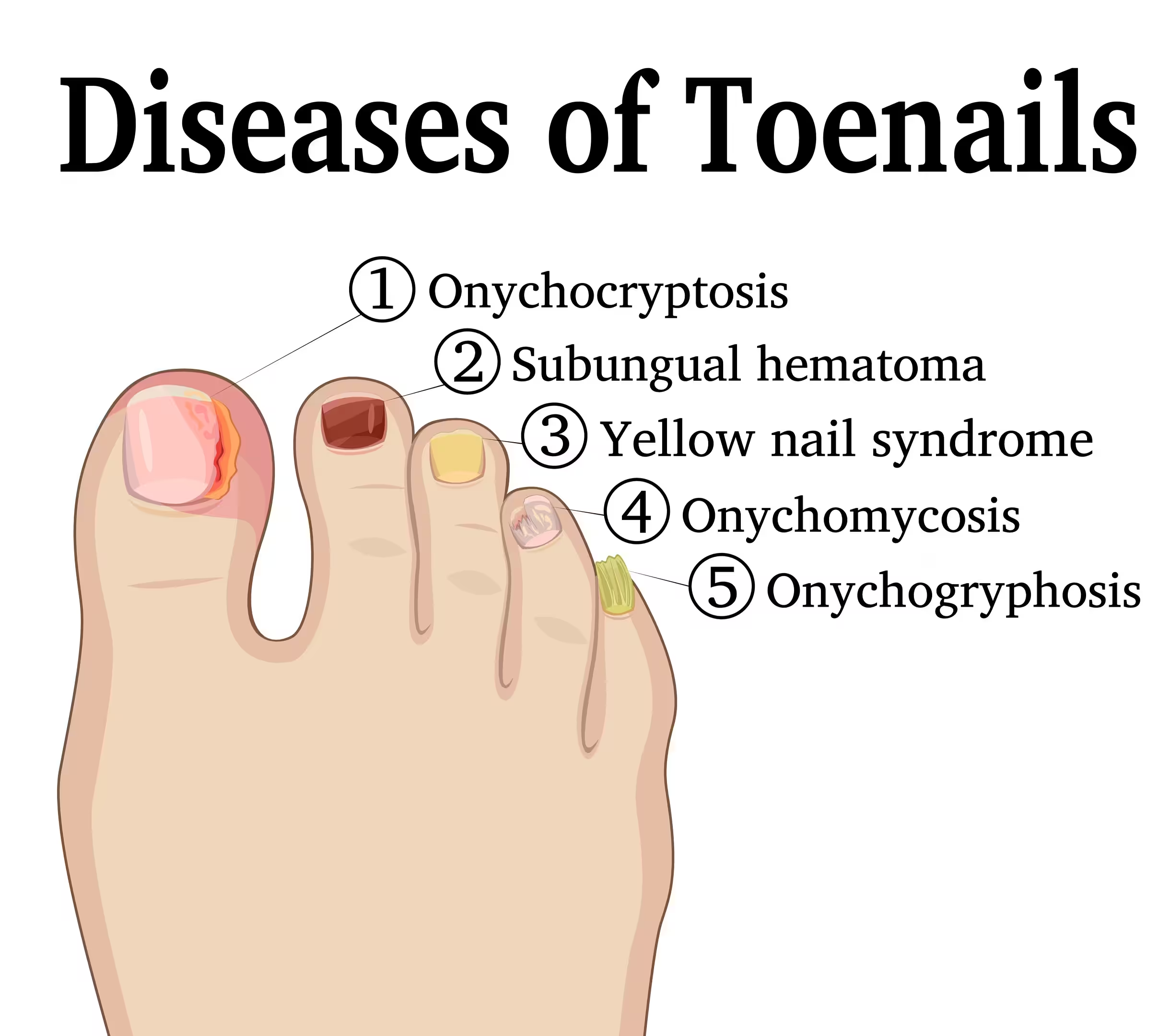
Quick answer:A subungual hematoma is blood trapped under the nail after an injury. When pain is severe, a podiatrist can relieve it with trephination — a tiny hole to drain the blood. The nail may loosen or fall off and regrows over several months, and a significant injury should be checked for a fracture. Call (810) 206-1402.
Medically reviewed by Dr. Tom Biernacki, DPM — Board-Certified Podiatric Surgeon — Balance Foot & Ankle, Howell & Bloomfield Township, MI. Last updated April 2026.
▶ Watch
Medically Reviewed by Dr. Tom Biernacki, DPM — Board-Certified Podiatrist, Balance Foot & Ankle Specialists, Michigan. Last updated April 2026.
A subungual hematoma — bleeding beneath the nail plate from direct trauma, repetitive microtrauma from running, or crushing injury — is one of the most painful acute nail conditions encountered in podiatric practice. Appropriate management depends on hematoma size, time elapsed since injury, and whether nail plate disruption warrants exploration for underlying nail bed laceration.
The most important clinical decision with Subungual Hematoma Nail Trephination Nail Loss Guide isn’t which treatment to start with — it’s identifying the correct subtype. That changes everything. Call (810) 206-1402.
Mechanisms of Injury
Acute subungual hematoma results from direct impact (dropping a heavy object, kicking a fixed object) that ruptures the subungual blood vessels between the distal phalanx and the nail plate. Repetitive microtrauma hematoma — “runner’s toe” or “black toenail” — accumulates gradually from the nail plate impacting the toe box with each footstrike, particularly in shoes with inadequate toe box depth or during prolonged downhill running that drives the toes forward. The great toenail and second toenail are most commonly affected.
When to Trephinate
Trephination (decompression of the hematoma by creating a small hole through the nail plate) is indicated when: hematoma covers more than 25–50% of the nail plate area, pain is severe, and presentation is within 48 hours of acute injury before clot organization. The procedure uses a heated wire (electrocautery), rotary drill, or 18-gauge needle to create a small opening through the nail plate over the hematoma — releasing the accumulated blood and immediately relieving pressure and pain. Post-trephination care includes cleansing, protective dressing, and daily wound inspection for infection signs. Trephination is unnecessary for small hematomas (<25%) or those older than 48–72 hours, where observation and nail protection are appropriate.
Nail Plate Disruption and Nail Bed Laceration
Complete nail avulsion at the time of injury requires exploration of the nail bed for laceration — particularly for injuries with hematoma involving more than 50% of the nail area, which has a high correlation with underlying nail bed laceration. Nail bed lacerations are repaired with 6-0 absorbable suture to restore the smooth nail bed surface that guides normal nail regrowth. The original nail plate is replaced as a biological splint over the repair or a non-adherent nonadherent dressing is used if the original plate is damaged beyond reuse.
Nail Regrowth and Prognosis
Toenail regrowth following complete nail loss proceeds at approximately 1–1.5mm per month from the nail matrix — requiring 12–18 months for complete great toenail regrowth. Patients should expect nail plate dystrophy (ridging, thickening, color change) in the new nail during the regrowth period. Permanent nail dystrophy results from nail matrix damage — a risk with severe crush injuries, deep lacerations involving the matrix, or repeated trauma to the same nail. Protective nail splints and wider toe box footwear during regrowth prevent repeated microtrauma during the vulnerable period.
Nail Injury Care at Balance Foot & Ankle
Dr. Biernacki at Balance Foot & Ankle provides trephination, nail bed laceration repair, and nail avulsion procedures with same-day appointments for acute nail injuries. Evaluation and management of runner’s toe and chronic nail microtrauma from footwear fit issues are also available. Call (810) 206-1402 for a same-week or urgent nail injury evaluation.
Nail Injury Care — Balance Foot & Ankle
Serving Southeast Michigan from our Bloomfield Township and Howell offices.
📞 (810) 206-1402 |
📧 Get Dr. Tom’s Free Lab Test Guide
Discover the 5 lab tests every person over 35 should ask their doctor about — explained in plain English by a board-certified physician.
📍 Located in Michigan?
Our board-certified podiatrists treat this condition at two convenient locations. Same-day appointments often available.

Insurance Accepted
BCBS · Medicare · Aetna · Cigna · United Healthcare · HAP · Priority Health · Humana · View All →
Howell Office
4330 E Grand River Ave
Howell, MI 48843
Get Directions →
Bloomfield Township Office
43494 Woodward Ave, #208
Bloomfield Township, MI 48302
Get Directions →
Your Board-Certified Podiatrists



Ready to Get Back on Your Feet?
Same-week appointments available at both locations.
Book Your AppointmentMore Podiatrist-Recommended Foot Health Essentials
Hoka Clifton 10


Max-cushion everyday shoe — podiatrist favorite for walking and running.

OOFOS Recovery Slide

Impact-absorbing recovery sandal — wear after long days on your feet.
As an Amazon Associate, Balance Foot & Ankle earns from qualifying purchases. Product recommendations are based on clinical experience; prices and availability shown above update live from Amazon.

When to See a Podiatrist
If foot or ankle pain has been bothering you for more than a few weeks, home care alone may not be enough. Balance Foot & Ankle offers same-week appointments at our Howell and Bloomfield Township clinics — no referral needed in most cases. Bring your current shoes and a short list of symptoms and we’ll build you a treatment plan in one visit.
Call Balance Foot & Ankle: (810) 206-1402 · Book online · Offices in Howell & Bloomfield Township
Pros & Cons of Conservative Care for foot care
Advantages
- ✓ Conservative care first
- ✓ Same-week appointments
- ✓ Multiple insurance accepted
Considerations
- ✗ Self-treatment can mask issues
- ✗ See a podiatrist if pain >2 weeks
Dr. Tom’s Recommended Products for foot care
Affiliate disclosure: As an Amazon Associate, Balance Foot & Ankle earns from qualifying purchases. We only recommend products we use with patients.
Footnanny Heel Cream Dr. Tom’s Pick
Best for: Daily moisturizer for cracked heels
Ready to Get Back on Your Feet?
Same-day appointments in Howell + Bloomfield Township. Most insurance accepted. Dr. Tom Biernacki, DPM & team.
Book Today — Same-Day Appointments Available
Call Now: (810) 206-1402
About Your Care Team at Balance Foot & Ankle
Dr. Tom Biernacki, DPM · Board-Certified Foot & Ankle Surgeon. Specializes in conservative-first care, minimally invasive bunion surgery, and complex reconstruction.
Dr. Carl Jay, DPM · Accepting new patients. Specializes in sports medicine, athletic injuries, and routine podiatric care.
Dr. Daria Gutkin, DPM, AACFAS · Accepting new patients. Specializes in surgical reconstruction and pediatric podiatry.
Locations: 4330 E Grand River Ave, Howell, MI 48843 · 43494 Woodward Ave Suite 208, Bloomfield Township, MI 48302
Hours: Mon–Fri 8:00 AM – 5:00 PM · (810) 206-1402
Podiatrist-Recommended Products After Nail Trephination
- Doctor Hoy’s Natural Pain Relief Gel — soothing topical gel for post-procedure nail bed discomfort after drainage
- Foot Petals Tip Toes — toe protection sleeves that cushion the tender nail bed from shoe pressure during healing
- CURREX RunPro — running insole that reduces the impact forces causing recurrent subungual hematoma
These are the same products Dr. Biernacki recommends in clinic. Available through our partner Foundation Wellness.
Visit Balance Foot & Ankle — Same-Day Appointments Available
Our podiatry team serves patients throughout Michigan including Howell, Brighton, and Bloomfield Township. If you’re dealing with heel pain, ingrown toenails, or a foot injury, we have same-day appointment availability.
Same-day appointments available. (810) 206-1402
Frequently Asked Questions
How long does it take a toenail to grow back?
6-12 months for a full big toenail. Smaller toenails 4-6 months. Speed varies with age, circulation, and nutrition.
Will this affect other nails?
Trauma affects only the injured nail. Fungal infection can spread without treatment. Systemic causes affect multiple nails simultaneously.
Should I cover the nail or leave it open?
Cover with a breathable bandage during work or activity. Leave open at night for healing. Keep dry and clean.

Dr. Tom Biernacki, DPM is a board-certified foot & ankle surgeon (ABFAS & ABPM) at Balance Foot & Ankle Specialists in Southeast Michigan. With over a decade of clinical experience, he specializes in heel pain, bunions, diabetic foot care, sports injuries, and minimally invasive surgery. Dr. Biernacki is a member of the APMA and ACFAS, and his patient education content on MichiganFootDoctors.com and YouTube has made him one of the most-followed foot & ankle educators on YouTube.