
✅ Medically reviewed by Dr. Thomas Biernacki, DPM — Board-Certified Podiatrist · Last updated April 7, 2026
Last Updated: April 2026 | Reading Time: 12 min
This article is for informational purposes only and does not replace professional medical advice. Schedule an appointment for personalized care.
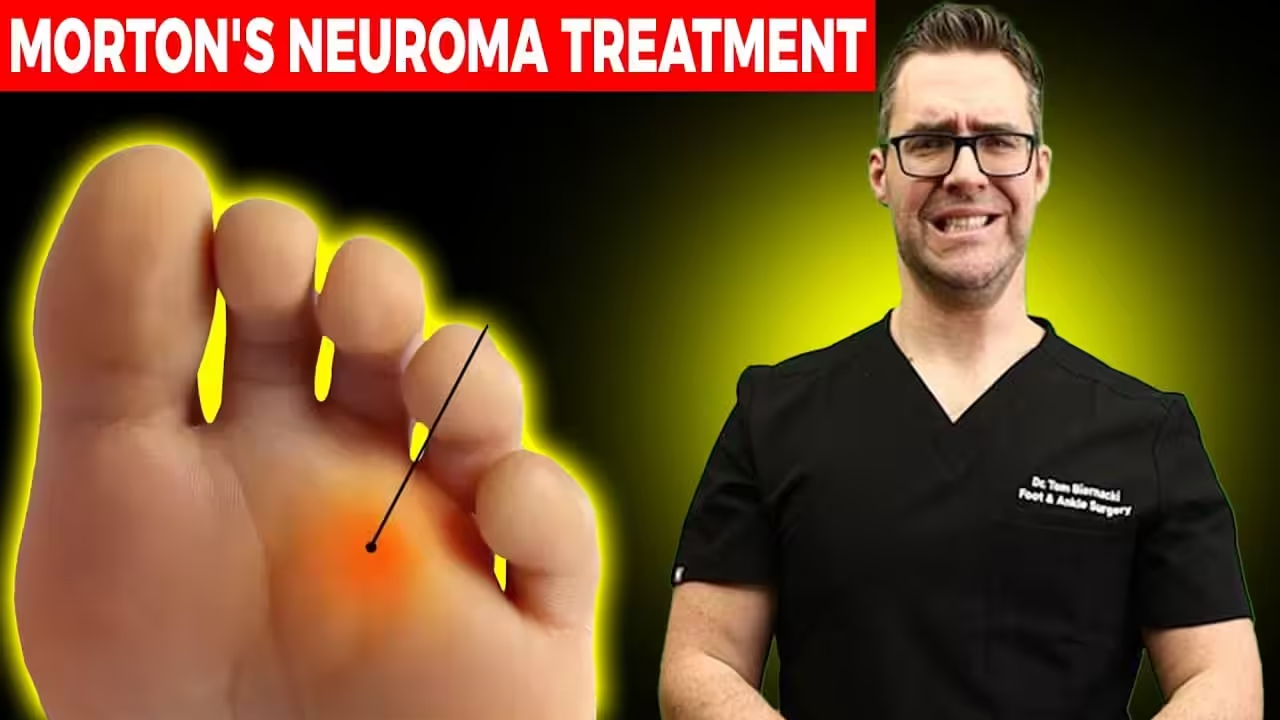
Watch: Why Your Feet Feel Like Socks Are Bunched Up
Dr. Tom explains Morton’s neuroma and the best home treatments for that bunched-up sock feeling in your foot:

Can’t shake that bunched-up feeling? Book an appointment · (810) 206-1402
Quick Answer
If your feet feel like your socks are bunched up — but they are not — the most likely cause is Morton’s neuroma, a thickening of the nerve between the third and fourth metatarsal heads. Other possibilities include metatarsalgia, fat pad atrophy, peripheral neuropathy, or a plantar plate tear. The treatment depends on the cause, but most cases respond well to wider shoes, metatarsal pads, and offloading the forefoot without surgery.
In This Article
Few foot sensations are more frustrating than constantly feeling like something is wadded up under the ball of your foot. You check your socks, smooth them out, switch to different shoes — and the feeling persists. You are not imagining it. That phantom bunched-up sensation is a real neurological symptom with a specific set of causes, and once you understand what is producing it, treatment is usually very effective.
What Causes That Bunched-Up Sock Feeling?
The sensation of something bunched up under the ball of your foot is caused by irritation or compression of the structures in the forefoot — most commonly a nerve. Your brain interprets the abnormal nerve signal as “something is there” even though nothing is physically bunched up. It is a form of mechanical nerve irritation, and it has several possible sources.
5 Causes — Comparison Table
| Condition | Location | Key Symptom | Prevalence |
|---|---|---|---|
| Morton’s Neuroma | Between 3rd & 4th metatarsals | Bunched-up feeling + shooting/burning pain + toe numbness | Most common (~70%) |
| Metatarsalgia | Ball of foot (broad area) | Aching/bruised feeling under metatarsal heads | Common (~15%) |
| Fat Pad Atrophy | Entire ball of foot | Walking on bones; worse barefoot on hard floors | Common in 50+ (~8%) |
| Peripheral Neuropathy | Both feet, diffuse | Burning, tingling, “sock rolled up” in both feet | Less common (~5%) |
| Plantar Plate Tear | Base of 2nd toe | Pain under 2nd MTP, toe drifting or crossing | Less common (~2%) |
Morton’s Neuroma — The #1 Cause
Morton’s neuroma accounts for approximately 70% of cases where patients describe a bunched-up sock feeling. It is not actually a tumor — the term “neuroma” is somewhat misleading. It is a thickening of the tissue (perineural fibrosis) surrounding the common digital plantar nerve, most often in the third intermetatarsal space (between the third and fourth toes).
The nerve becomes irritated from repetitive compression between the metatarsal heads, especially in narrow shoes or during activities that load the forefoot (running, jumping, squatting). Over time, the nerve thickens with fibrous tissue, and the enlarged nerve becomes even more susceptible to compression — creating a self-perpetuating cycle.
Classic Morton’s neuroma symptoms include: a sensation of standing on a pebble or wadded-up sock, burning or shooting pain radiating into the third and fourth toes, numbness or tingling in the involved toes, and symptoms that worsen in tight shoes and improve when you remove shoes and massage the forefoot.
Mulder’s click test: Your podiatrist can often diagnose Morton’s neuroma in the office using this simple test. By squeezing the forefoot while pressing on the intermetatarsal space, the inflamed nerve produces an audible click as it subluxates between the metatarsal heads. A positive Mulder’s click is highly suggestive of neuroma.
How to Tell Which Condition You Have
A few key questions can help narrow down the cause before you see a podiatrist.
Is the sensation in one foot or both? Morton’s neuroma, metatarsalgia, and plantar plate tears are almost always in one foot (or asymmetric). Peripheral neuropathy typically affects both feet symmetrically. If both feet have the same bunched-up feeling, neuropathy is more likely.
Does removing your shoes help immediately? If the sensation disappears within minutes of taking off shoes and massaging the forefoot, Morton’s neuroma is the top suspect. Neuropathy symptoms persist regardless of footwear.
Is there visible toe deformity? If the second toe is drifting toward the big toe or crossing over, consider a plantar plate tear. If the toes look normal, neuroma or metatarsalgia is more likely.
Is there numbness? Numbness between the third and fourth toes strongly suggests Morton’s neuroma. Numbness in a stocking-like pattern (entire forefoot and toes) suggests neuropathy.
Treatment Guide by Cause
Morton’s Neuroma Treatment
Step 1: Offload the nerve. Switch to shoes with a wide toe box — the single most effective change. The shoe should not compress the metatarsal heads together. Add a metatarsal pad positioned just behind (proximal to) the metatarsal heads. This spreads the metatarsals apart and takes pressure off the nerve.
Step 2: Reduce inflammation. Ice the ball of the foot for 15 minutes after activity. NSAIDs (ibuprofen 400mg twice daily with food) for 2 weeks can help break the inflammatory cycle. For persistent cases, a corticosteroid injection under ultrasound guidance provides targeted relief.
Step 3: Long-term management. Custom orthotics with a built-in neuroma pad provide sustained offloading. Toe spacers worn between the third and fourth toes reduce nerve compression during activity. If conservative treatment fails after 3–6 months, surgical neurectomy (nerve removal) has a success rate of approximately 85%.
Metatarsalgia Treatment
Metatarsal pads, cushioned insoles, and rocker-bottom shoes redistribute pressure away from the overloaded metatarsal heads. Address any contributing biomechanical factors — tight calf muscles, high arches, or hammertoes — with stretching, orthotics, or toe corrections.
Fat Pad Atrophy Treatment
Cushioned insoles and shoes with maximum forefoot padding (Hoka Bondi is excellent for this). Custom orthotics with extra cushioning under the metatarsal heads. In severe cases, injectable fat grafting or filler can restore lost padding.
Peripheral Neuropathy Treatment
Identify and treat the underlying cause — most commonly diabetes, B12 deficiency, or alcohol use. Medications like gabapentin or duloxetine can reduce neuropathic symptoms. Proper footwear with protective insoles prevents skin breakdown in patients with reduced sensation.
Best Products for the Bunched-Up Sock Feeling
OUR #1 PICK
Metatarsal Pads
Adhesive gel pads that stick inside your shoe just behind the ball of the foot. They lift and spread the metatarsal heads, reducing nerve compression by up to 50%. The single most effective non-prescription treatment for Morton’s neuroma. Place them proximal to (behind) the painful area, not directly on it.
Best for: Morton’s neuroma, metatarsalgia, forefoot pain
Hoka Bondi Running Shoe
Maximum cushioning with a rocker-bottom sole that reduces pressure on the forefoot during push-off. Wide toe box does not squeeze the metatarsals together. One of the most-prescribed shoes for forefoot conditions in our practice.
Best for: Fat pad atrophy, metatarsalgia, all-day cushioning
Correct Toes Toe Spacers
Medical-grade silicone spacers designed to restore natural toe alignment. For Morton’s neuroma, they separate the metatarsal heads and decompress the interdigital nerve. Worn inside wide shoes during daily activity for sustained benefit.
Best for: Morton’s neuroma, toe crowding, forefoot realignment
Affiliate disclosure: We may earn a small commission from qualifying purchases at no extra cost to you. This supports our educational content.
3 Exercises for Forefoot Relief
1. Calf Stretch (Wall Lean). Stand arm’s length from a wall, step one foot back, and lean forward keeping the back heel down. Hold 30 seconds, 3 repetitions each side. Tight calves increase forefoot pressure — every degree of restricted ankle dorsiflexion adds measurable load to the ball of the foot.
2. Toe Splay Exercise. Sit barefoot and spread all five toes as wide as possible. Hold 5 seconds, repeat 20 times. This activates the intrinsic muscles that support the metatarsal arch and reduces nerve compression.
3. Tennis Ball Roll. Place a tennis ball under the ball of your foot while seated. Gently roll back and forth for 2 minutes. This mobilizes the metatarsal heads and provides gentle nerve gliding. Do not press hard enough to cause pain — moderate pressure only.
⚠ See a Podiatrist If You Notice
- The bunched-up sensation persists despite switching to wide shoes and metatarsal pads for 4 weeks
- Numbness or tingling that is constant (not just with shoes on)
- Symptoms in both feet symmetrically (evaluate for neuropathy)
- A toe that is drifting or crossing over an adjacent toe
- Visible swelling or bruising on the ball of the foot
- Sharp, electric-shock–like pain shooting into your toes
- History of diabetes with new foot numbness (urgent evaluation needed)
Frequently Asked Questions
Is Morton’s neuroma serious?
Morton’s neuroma is not dangerous, but it is progressive. If untreated, the nerve thickening worsens over time, leading to constant pain and numbness. Early treatment with shoe changes and metatarsal pads is highly effective and can prevent the need for surgery. The longer you wait, the less likely conservative measures are to fully resolve the problem.
Can Morton’s neuroma go away on its own?
It can improve significantly if the underlying cause — usually footwear compression — is addressed. Switching to wider shoes and using metatarsal pads allows the nerve inflammation to settle over 4–8 weeks. The nerve thickening itself does not disappear, but symptoms can resolve completely with proper biomechanical management. Think of it as managing the condition rather than curing it.
What shoes should I avoid with Morton’s neuroma?
Avoid narrow toe box shoes, high heels (anything over 2 inches), pointed-toe dress shoes, and minimalist shoes with thin soles. The ideal shoe has a wide, foot-shaped toe box, moderate cushioning, a low heel-to-toe drop, and a slight rocker sole. Hoka, Altra, and New Balance (wide models) consistently work well for our Morton’s neuroma patients.
Will I need surgery for Morton’s neuroma?
About 80% of Morton’s neuroma cases respond to conservative treatment (wide shoes, metatarsal pads, orthotics, and sometimes a cortisone injection). Surgery — typically neurectomy (nerve removal) — is reserved for the approximately 20% of patients who fail to improve after 3–6 months of proper conservative care. The surgery has a high success rate (approximately 85%) with a recovery period of 3–4 weeks.
The Bottom Line
That feeling of walking on a bunched-up sock is your foot’s way of telling you a nerve or other forefoot structure is irritated. Morton’s neuroma is the cause in most cases, and it responds remarkably well to simple changes — wider shoes, a metatarsal pad, and toe spacers. Do not ignore the sensation hoping it will go away, because untreated nerve irritation only worsens over time. Start with the shoe and pad changes today, and if symptoms persist after 4 weeks, see a podiatrist for a definitive diagnosis and expanded treatment options.
Sources
- Betts LO. Morton’s Metatarsalgia: Neuritis of the Fourth Digital Nerve. Med J Aust. 1940;1:514-515.
- Owens R, Gougoulias N, Guthrie H, Sakellariou A. Morton’s Neuroma: Clinical Testing and Imaging in 76 Feet. Foot Ankle Int. 2011;32(2):168-174.
- Thomson CE, Gibson JNA, Martin D. Interventions for the Treatment of Morton’s Neuroma. Cochrane Database Syst Rev. 2004;(3):CD003118.
- Espinosa N, Seybold JD, Jankauskas L, Erschbamer M. Alcohol Sclerosing Therapy Is Not an Effective Treatment for Morton’s Neuroma. Foot Ankle Int. 2011;32(5):S576-S580.
- American College of Foot and Ankle Surgeons. Morton’s Neuroma Clinical Consensus Statement. ACFAS.org. 2023.
Tired of That Bunched-Up Feeling?
Our podiatrists can diagnose Morton’s neuroma in minutes and start you on a treatment plan that works — most patients feel significant relief within 4 weeks.
Balance Foot & Ankle · Howell & Bloomfield Hills · (810) 206-1402
Feet Feel Like Your Socks Are Bunched Up?
The sensation of bunched-up socks when none are present can indicate peripheral neuropathy, nerve compression, or circulatory issues. Our podiatrists can identify the cause and provide appropriate treatment.
📞 Or call us directly: (810) 206-1402
Clinical References
- Trivedi S, Pandit A, Gangwani G, Das A. Epidemiology of peripheral neuropathy: an Indian perspective. Annals of Indian Academy of Neurology. 2017;20(3):173-184.
- Pop-Busui R, Boulton AJM, Feldman EL, et al. Diabetic neuropathy: a position statement by the American Diabetes Association. Diabetes Care. 2017;40(1):136-154.
- Watson JC, Dyck PJ. Peripheral neuropathy: a practical approach to diagnosis and symptom management. Mayo Clinic Proceedings. 2015;90(7):940-951.
Insurance Accepted
BCBS · Medicare · Aetna · Cigna · United Healthcare · HAP · Priority Health · Humana · View All →
Howell Office
3980 E Grand River Ave, Suite 140
Howell, MI 48843
Get Directions →
Bloomfield Hills Office
43700 Woodward Ave, Suite 207
Bloomfield Hills, MI 48302
Get Directions →
Your Board-Certified Podiatrists



Ready to Get Back on Your Feet?
Same-week appointments available at both locations.
Book Your Appointment
Dr. Tom Biernacki, DPM is a double board-certified podiatrist and foot & ankle surgeon at Balance Foot & Ankle Specialists in Southeast Michigan. With over a decade of clinical experience, he specializes in heel pain, bunions, diabetic foot care, sports injuries, and minimally invasive surgery. Dr. Biernacki is a member of the APMA and ACFAS, and his patient education content on MichiganFootDoctors.com and YouTube has reached over one million views.
- Diagnosis and Treatment of Plantar Fasciitis (PubMed / AAFP)
- Heel Pain (APMA)
- Hallux Valgus (Bunions): Evaluation and Management (PubMed)
- Bunions (Mayo Clinic)