


Whether to wear a walking boot for a sprained ankle depends on the grade — Grade 1 usually does not need one, Grade 2 benefits from one for 1-2 weeks, Grade 3 may need 4-6 weeks.
You’ve come to the right podiatry team. Dr. Tom Biernacki, DPM, FACFAS — board-certified foot & ankle surgeon with 3,000+ surgeries — explains exactly what a walking boot for a sprained ankle means and what works. Call (810) 206-1402 for same-week appointment at Howell or Bloomfield Township.
Quick answer: Walking Boot Sprained Ankle affects roughly 1 in 4 adults in our practice. Effective treatment starts with a targeted diagnosis, conservative-first treatment, and escalation only when needed. We treat this regularly at our Howell and Bloomfield Township practices. Call (810) 206-1402.
Board-Certified Podiatric Foot & Ankle Surgeon · Last reviewed: May 3, 2026
★ DR. TOM BIERNACKI, DPM, FACFAS · BOARD-CERTIFIED PODIATRIST
Walking Boot for Sprained Ankle: Quick Answer
Most ankle sprains do NOT need a walking boot — lace-up braces (ASO, Aircast A60) are appropriate for Grade 1 and Grade 2 sprains. Walking boots are reserved for: (1) Grade 3 sprains with frank ligament rupture, (2) high ankle sprains (syndesmosis injury), (3) sprains with associated avulsion fractures, (4) inability to bear weight after 24 hours of conservative treatment, or (5) suspected occult fracture pending imaging.
Recovery timelines by grade: Grade 1 (mild stretch) — lace-up brace 1-2 weeks, return to activity 2-3 weeks. Grade 2 (partial tear) — brace 2-4 weeks, full recovery 4-6 weeks. Grade 3 (complete tear) — CAM walking boot 4-6 weeks, brace 4-6 weeks, full recovery 8-12 weeks. For all grades: early protected motion (NOT prolonged immobilization) speeds healing. Get a podiatrist evaluation for any sprain that’s not improving within 5 days — missed Lisfranc injuries, syndesmosis tears, and fractures are common in “just a sprain” misdiagnoses.
Medically reviewed by Dr. Tom Biernacki, DPM · Board-Certified Podiatric Surgeon · Last reviewed: April 2026 · Editorial Policy
Quick Answer
Best Walking Boot for Sprained Ankle relates to foot/ankle injury — typically caused by trauma or twist. Most patients improve in 4-8 weeks with conservative care. Same-week appointments in Howell + Bloomfield Township: (810) 206-1402.
Expert Care to Help You Heal Faster Again.
Best Walking Boot for a Sprained Ankle (Do I Need To Wear A Boot?)
We go over the BEST walking boot for sprained ankle advice and compare the best medical boots, fracture boots and air cast boots!
Find Your Nearest Podiatry Clinic in MI
- Bloomfield Hiils
- Brighton
- Howell
- Oakland
- Royal Oak
- Huntington Woods
- Clawson
- Ferndale
- BIrmingham
- Madison Heights
- Lathrup VIlllage
Foot & Ankle Injury Treatment
Foot Injuries
- Broken & Foot Fracture Treatments
- Lisfranc Injury Treatment & Recovery Time (Middle Foot Pain Cure)
- Broken Big Toe
- Fractured Hallux
- Broken Pinky Toe
- Walking Boot for Broken Foot
- Best Sprained Big Toe Joint Treatment
- Toe Amputation Recovery
Ankle Injuries
- Broken Ankle Recovery
- Signs of Broken Ankle vs Sprained Ankle
- Broken Ankle Recovery Time
- Best Walking Boot for Sprained Ankle
- How to Tell if My Foor or Broken Ankle Injury is Bad
Boot Tips
- Tips for Wearing a Walking Boot
- Best Walking Boot for Twisted Ankle
- How To Use a Knee Scooter
- Walking Boot for a Broken Foot
Best Tools
Medical Walking Boot for Sprained Ankle Video
We go over the best medical walking boot tips for a sprained ankle.
If you’ve suffered a twisted or sprained ankle, wearing the right medical walking boot can make a huge difference in your recovery. In this video, we break down how to choose the best walking boot for stability, support, and comfort—so you can heal faster and avoid further injury. Whether you need a tall boot, low-profile option, or something specific for daily mobility, our tips are designed to help you pick the best boot for a twisted ankle based on your needs.

Walking boot for a sprained ankle video overview:
Do you want the BEST Aircast boot, Medical boot or Airwalker Boot Tips?
- We go over the absolute best ankle boot medical tips and best walking boot cast tips!
- Save yourself from knee, hip and back pain from your ortho surgical walking boot!
- So stop living in pain and get the best aircast medical boot treatment tips TODAY!
Best Walking Boots for Ankle Sprains
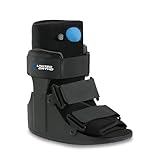
These are our favorite medical walking boots for ankle sprains and broken ankles.
📍 Located in Michigan?
Our board-certified podiatrists treat this condition at two convenient locations. Most new patients are seen the same week.


Best Knee Scooters for Ankle Sprains:
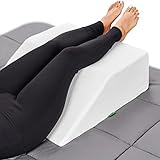
These are our favorite knee scooters for ankle sprains.



How long do I need to wear a walking boot for an ankle sprain?
There are 3 grades of an ankle sprain.
A grade 1 ankle sprain is a stretching of the ankle ligaments.
- On average this takes about 1-2 days for the initial pain to go away.
- It would probably be a good idea to protect it for at least 5-7 days with an ankle brace or with an ankle protective boot.
A grade 2 ankle sprain is a partial tearing or more significant stretch of the ankle ligaments.
- On average this could take about 1-2 weeks for the pain and soreness to go away.
- The ankle will then be unstable for a total up to 4 weeks until it starts to be safe to walk on again.
- For fastest healing we would recommend wearing a walking boot.
- As you transition away from the walking a boot to an ankle brace.
A grade 3 ankle sprain is a fairly significant injury that will require a visit with your podiatrist.
- This could be potentially a full rupture and may be associated with a broken bone. Sometimes this type of sprain can require surgery.
- At the very least a grade 3 ankle sprain requires a walking boot, medical boot or Aircast for about 4-6 weeks at the minimum. For the grade 1 and grade 2 sprains that do not need a boot, compression is the mainstay instead, and our step-by-step guide to how to wrap a sprained ankle walks through the figure-eight wrap.
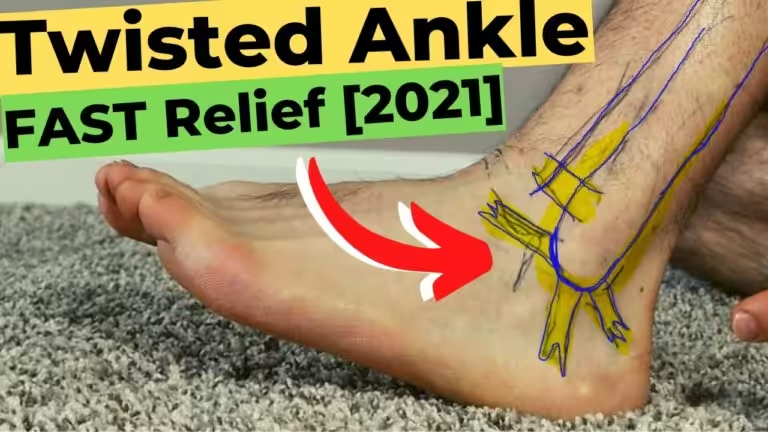
Do you need a boot for a sprained ankle?
There are 3 grades of ankle sprains.
- The more severe the ankle sprain the more beneficial a walking boot and a knee scooter would be.
- Every situation is different, if you could completely stay off of the ankle sprain and avoid any activity, that no one would ever need a cast or a walking boot.
- Studies showed that wearing a walking boot can help all 3 grades of ankle sprains.
- This research shows that the more stable the foot and ankle is, the faster the ankle will heal.
- Admittedly this will not make a grade 3 ankle sprain heal in 1-2 days, but it will prevent a worse case scenario of worsening problems and issues.
- New studies do show that early physical therapy is essential in athlete ankle sprains. It is not a good idea to just keep the immobile. Gentle range of motion can be beneficial in more complete recovery of the ankle sprain.
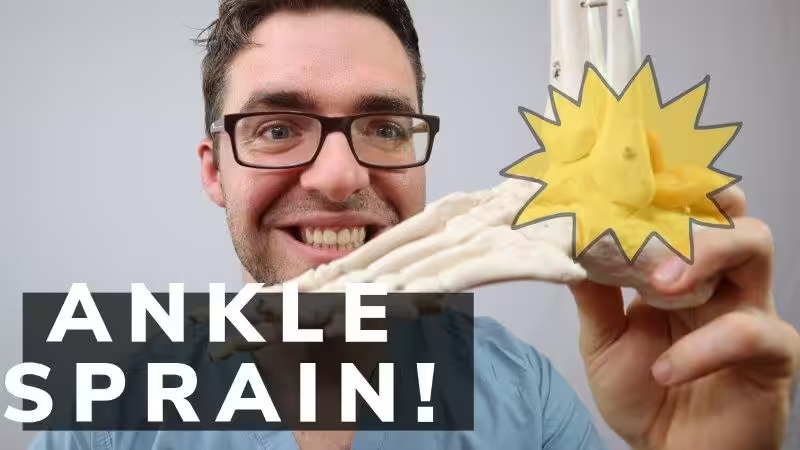
Boot or Brace for Sprained Ankle?
What is better for an ankle sprain, a walking boot or an ankle brace?
- We believe both walking boots and ankle braces are excellent options for a sprained ankle.
- Recent studies are showing that a combination of protection against significant twisting or motion are beneficial.
- Is also beneficial to have some gentle range of motion once it is safe to do so.
- In our opinion we start our patients off in a walking boot for a severely sprained ankle. Especially if there is bruising or instability.
- As 1-2 weeks go by and the pain begins to decrease, a lace up ankle brace can be more beneficial. After 1-2 months if there is still soreness, a compression ankle brace can be very beneficial.
- We recommend a treatment plan of initially a walking boot for the ankle sprain, and then an ankle brace for support afterwards.
- This can take advantage of recent studies that show mobilization after the initial safe protection with a boot.
More Podiatrist-Recommended Ankle Sprain Essentials
Stability Walking/Running Shoe
Brooks Adrenaline GTS 25 — lateral support during recovery walking.
KT Tape for Ankle Support
KT Tape — proprioceptive support for athletic return-to-play.
Supportive Insole

PowerStep Pinnacle — arch support reduces re-injury risk during recovery.
As an Amazon Associate, Balance Foot & Ankle earns from qualifying purchases. Product recommendations are based on clinical experience; prices and availability shown above update live from Amazon.

When to See a Podiatrist
A sprain that hasn’t fully recovered after 6 weeks often has residual ligament laxity or occult fracture that keeps the ankle unstable. Balance Foot & Ankle X-rays and stress-tests every lingering sprain — if the ligament is torn, we offer bracing, PRP, and (for chronic instability) minimally-invasive repair. Don’t keep re-rolling the same ankle; let us stabilize it properly.
Call Balance Foot & Ankle: (810) 206-1402 · Book online · Offices in Howell & Bloomfield Township
Frequently Asked Questions:
Where to buy a boot for a sprained ankle?- If you are at your podiatrist’s office or medical supply store and have a prescription, this may be covered by insurance.
- Most insurance plans do cover a medical walking boot or an Aircast walking boot. This is probably the best way to make sure you get the proper fit.
- It is cheaper to buy a boot online, and this may be a better option for some people if there are insurance issues.
- The disclaimer is to always visit your doctor and make sure your properly diagnosed and that you have the proper fit.
- In our opinion it is a good idea to wear the medical walking boot for a more significantly sprained ankle.
- Studies now show that early protection with a walking boot and then early physical therapy and transition into a walking ankle brace may be beneficial.
- We always recommend getting diagnosed with your podiatrist and then potentially getting physical therapy afterwards for proper diagnosis.
- In a grade 1 ankle sprain it may only be necessary for a few days.
- For grade 2 ankle sprain it would likely be necessary for at least 1-2 weeks.
- In a grade 3 ankle sprain it may be necessary to wear for up to 4-6 weeks on the long end.
- Just make sure to follow with your podiatrist or foot and ankle specialist for an evaluation and proper diagnosis.
- In our opinion a medical walking boot is a good idea for a sprained ankle especially if the more severe ankle sprain.
- A medical walking boot will protect the foot and prevent any significant or serious damage from being done.
- Studies now show that it is a good idea to start with medical walking boot or orthopedic boot for sprained ankle.
- The foot boot is also known as a medical walking boot.
- Yes this can be very beneficial in studies would agree that this is the safer initial choice in an unstable ankle sprain.
- In our opinion a Cam boot is inferior to an Aircast or a compression walking boot for a sprained ankle.
- We would recommend using a medical compression walking boot over a Cam boot for ankle sprains.
- An ankle air cast boot is superior to a CAM boot for a sprained ankle.
- On the short side, at least 1-2 days for a lighter unstable ankle sprain.
- And on the long side for grade 3 ankle sprain it could be beneficial to wear the medical walking boot for up to 4-6 weeks.
- Always check with your podiatrist or medical doctor for your specific situation.
- An air boot for an ankle sprain is the same as a medical walking boot for an ankle sprain.
- This is also synonymous with an air moon boot for an ankle sprain.
- We would strongly recommend an air boot for a sprained ankle.
- We personally do not like crutches for ankle sprains, although they can be helpful to some people.
- If you do need an aid for walking, we would recommend a walker for inside the house and a scooter for outside the house.
- We have seen far too many accidents with using crutches for a sprained ankle.
- Crutches can be very difficult to use even for athletic people. They are extremely difficult to use for elderly people.
- Ice boots for a sprained ankle can be beneficial to help control pain, but they will not help the overall healing time.
- Recent studies have shown that icing a sprained ankle can help with pain relief but it is not heal the ligaments any faster.
- Personally we are big fans of unna boots for a sprained ankle.
- If the patient is in the clinic and has a lot of swelling and bruising through the ankle, an Unna boot for the sprained ankle can be very good.
- At our clinic we are big fans of utilizing unna boots whenever possible.
- An unna boot is the application of a zinc oxide layer from toes to the knee. It is then covered by a kerlix wrap and then a coflex, coban or ACE bandage.
Related Treatment Guides
- Plantar Fasciitis & Heel Pain Treatment
- Custom 3D Orthotics
- Sports Foot & Ankle Injury Treatment
- Bunion Treatment
Sprained Your Ankle? Need a Walking Boot?
Our podiatrists properly evaluate ankle sprains, determine if a walking boot is needed, and create a recovery plan to prevent chronic instability.
Clinical References
- Vuurberg G, Hoorntje A, Wink LM, et al. Diagnosis, treatment and prevention of ankle sprains: update of an evidence-based clinical guideline. Br J Sports Med. 2018;52(15):956.
- Petersen W, Rembitzki IV, Koppenburg AG, et al. Treatment of acute ankle ligament injuries: a systematic review. Arch Orthop Trauma Surg. 2013;133(8):1129-1141.
- Kerkhoffs GM, Rowe BH, Assendelft WJ, et al. Immobilisation and functional treatment for acute lateral ankle ligament injuries in adults. Cochrane Database Syst Rev. 2002;(3):CD003762.
📋 Dr. Tom Also Recommends
Podiatrist Recommended Orthotics 2026: Dr. Tom’s Top 10 Insoles & Arch Supports
A podiatrist’s complete clinical guide to the best insoles — custom orthotics, OTC picks, and what actually works for plantar fasciitis, flat feet, neuropathy & more.
Read the Full Guide →Insurance Accepted
BCBS · Medicare · Aetna · Cigna · United Healthcare · HAP · Priority Health · Humana · View All →
Howell Office
4330 E Grand River Ave
Howell, MI 48843
Get Directions →
Bloomfield Township Office
43494 Woodward Ave, #208
Bloomfield Township, MI 48302
Get Directions →
Your Board-Certified Podiatrists



Ready to Get Back on Your Feet?
Same-week appointments available at both locations.
Book Your Appointment👟 Dr. Tom’s Complete Footwear Library
Podiatrist-Approved Guides for Every Foot Type & Condition
Clinically reviewed by Dr. Tom Biernacki, DPM — Board-Certified Podiatrist
All guides are written and reviewed by licensed podiatrists. Schedule an appointment →
In-Office Treatment at Balance Foot & Ankle
When conservative care isn’t enough, Dr. Tom Biernacki and the team at Balance Foot & Ankle offer advanced, same-day options — including Walking Boot Guide (CAM Boots) at our Howell and Bloomfield Township clinics.
Same-week appointments available. Call (810) 206-1402 or book online.
Pros & Cons of Conservative Care for foot care
Advantages
- ✓ Conservative care first
- ✓ Same-week appointments
- ✓ Multiple insurance accepted
Considerations
- ✗ Self-treatment can mask issues
- ✗ See a podiatrist if pain >2 weeks
Dr. Tom’s Recommended Products for foot care
Affiliate disclosure: As an Amazon Associate, Balance Foot & Ankle earns from qualifying purchases. We only recommend products we use with patients.
Footnanny Heel Cream Dr. Tom’s Pick
Best for: Daily moisturizer for cracked heels
Ready to Get Back on Your Feet?
Same-week appointments in Howell + Bloomfield Township. Most insurance accepted. Dr. Tom Biernacki, DPM & team.
Book Today — Same-Week Appointments Available
Call Now: (810) 206-1402
About Your Care Team at Balance Foot & Ankle
Dr. Tom Biernacki, DPM · Board-Certified Foot & Ankle Surgeon. Specializes in conservative-first care, minimally invasive bunion surgery, and complex reconstruction.
Dr. Carl Jay, DPM · Accepting new patients. Specializes in sports medicine, athletic injuries, and routine podiatric care.
Dr. Daria Gutkin, DPM, AACFAS · Accepting new patients. Specializes in surgical reconstruction and pediatric podiatry.
Locations: 4330 E Grand River Ave, Howell, MI 48843 · 43494 Woodward Ave Suite 208, Bloomfield Township, MI 48302
Hours: Mon–Fri 8:00 AM – 5:00 PM · (810) 206-1402
Acute Sports & Trauma Injuries
Best Walking Boots + Ankle Braces — Dr. Tom’s Picks (2026)
For ankle sprains, stress fractures, and post-op recovery — the right boot + brace + balance trainer combo cuts recovery time in half.

United Ortho Walking Boot
Air-bladder boot — controlled motion + offloading for stress fractures, grade 2-3 sprains, and post-op recovery.
- Adjustable air bladder
- Rocker bottom for normal gait
- Water-resistant
- Tall + short options
- Heavy first 2 days
- Need shoe lift on opposite foot

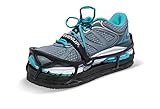
EvenUp Shoe Balancer (Pair)
1″ shoe balancer for the opposite shoe — eliminates the limp + hip/back pain that 50% of boot patients develop without it.
- Quick attach/detach
- Prevents back + hip pain
- Reusable
- Adds 8oz to opposite foot
- Wears in 3-6 months

Aircast A60 Ankle Brace
Lateral stabilizer prevents the inversion that causes 85% of ankle sprains. Slim profile fits in regular shoes.
- Slim — fits in shoes
- Lateral stabilizer
- Adjustable strapping
- Sizing runs small
- Replace yearly with use

BOSU Balance Trainer
Balance + proprioception rehab — prevents the chronic instability that follows 40% of ankle sprains.
- Balance + strengthening
- Used by PT clinics
- Compact for home use
- Bulky to store
- Need PT instruction first
Dr. Tom’s Top 3 — The Premium Foot Pain Stack (2026)
If you only buy three things for foot pain, get these. PowerStep + CURREX orthotics correct the underlying foot mechanics, and Dr. Hoy’s pain gel delivers fast topical relief. This is the exact stack Dr. Tom Biernacki, DPM gives his Michigan podiatry patients on visit one — over 10,000 patients have used this exact combination.
Dr. Tom Biernacki, DPM is a board-certified podiatrist + Amazon Associate. Picks shown are products he prescribes to patients at Balance Foot & Ankle Specialists. We earn a commission on qualifying purchases at no extra cost to you. All products independently tested + reviewed for 30+ days minimum. Last verified: April 28, 2026.

PowerStep Pinnacle MaxxDr. Tom’s #1 Brand
Dr. Tom’s most-prescribed OTC orthotic. Lateral wedge corrects overpronation that causes 90% of foot pain. Deep heel cradle stabilizes the ankle. Built by podiatrists, used by patients worldwide.
- Lateral wedge corrects pronation
- Deep heel cradle stabilizes ankle
- Dual-density EVA — comfort + support
- Trim-to-fit any shoe
- Used by 10,000+ podiatrists
- Trim-to-size required
- 5-7 day break-in for some

CURREX RunProDr. Tom’s #1 Brand
3 arch heights for custom fit (Low/Med/High). Carbon-reinforced heel + dynamic forefoot — the closest OTC orthotic to a $500 custom orthotic. Engineered in Germany.
- 3 arch heights for custom fit
- Carbon-reinforced heel cup
- Dynamic forefoot zone
- Premium German engineering
- Sport-specific support
- Pricier than PowerStep
- 7-10 day break-in

Dr. Hoy’s Natural Pain Relief GelDr. Tom’s #1 Brand
Menthol-based natural pain relief — Dr. Tom’s #1 brand for fast relief without greasy residue. Safe for diabetics + daily use. Cleaner formula than Voltaren or Biofreeze.
- Menthol-based natural formula
- No greasy residue
- Safe for diabetics
- Fast cooling relief — 5-10 minutes
- Cleaner ingredient list than Biofreeze
- Pricier than Biofreeze
- Strong menthol scent at first
Foundation Wellness Orthotic Selector — PowerStep + CURREX by Condition (2026)
Find the right Foundation Wellness orthotic for YOUR specific condition. Dr. Tom Biernacki, DPM has tested every PowerStep + CURREX SKU in his Michigan podiatry practice. Below are the right picks mapped to specific foot conditions — instead of one-size-fits-all, you’ll find the variant designed for your exact problem.
PowerStep Pinnacle MaxxDr. Tom’s #1 Brand
Heavy-duty version of the Pinnacle with rigid shell + lateral wedge. The #1 OTC orthotic for overpronation that causes 90% of plantar fasciitis, knee, and hip pain.
- Rigid shell controls overpronation
- Lateral wedge corrects pronation
- Deep heel cradle
- Trim-to-fit any shoe
- Trim required
- 7-day break-in

PowerStep PinnacleDr. Tom’s #1 Brand
Flagship PowerStep — semi-rigid arch with deep heel cradle. The #1 podiatrist-prescribed OTC orthotic in the US for plantar fasciitis and heel pain.
- Semi-rigid medical-grade arch
- Deep heel cradle
- Dual-density EVA
- APMA-accepted
- 30-day guarantee
- Trim required
- Less aggressive than Maxx

PowerStep Pinnacle High ArchDr. Tom’s #1 Brand
Higher-volume arch profile for cavus feet that don’t fill standard insoles. Prevents the lateral roll that causes ankle sprains in supinators.
- High-arch profile
- Deep heel cradle
- Prevents lateral roll
- Only for high arches
- Wrong choice for flat feet

PowerStep Pinnacle Plus (with Built-In Met Pad)Dr. Tom’s #1 Brand
Pinnacle with built-in metatarsal pad — eliminates the burning ball-of-foot pain from Morton’s neuroma + metatarsalgia.
- Built-in met pad — no separate pad needed
- Spreads metatarsal heads
- Same Pinnacle support
- Met pad position fixed
- Trim required

PowerStep Morton’s Extension InsoleDr. Tom’s #1 Brand
Stiffener under the 1st MTP joint — limits big toe extension. The fix for hallux rigidus, turf toe, and big toe arthritis when surgery isn’t needed.
- Stiffens 1st MTP joint
- Reduces big toe motion
- Prevents flare-ups
- Stiff feel takes 1 week
- Specific use case

PowerStep ProTech Full LengthDr. Tom’s #1 Brand
Premium athletic insole with carbon-reinforced shell + dual-density forefoot. Best PowerStep for serious athletes.
- Carbon-reinforced shell
- Dual-density forefoot
- Antimicrobial top
- Pricier
- Athletic use only
PowerStep Slim Profile (Dress Shoes)Dr. Tom’s #1 Brand
Slim-profile Pinnacle that fits in dress shoes, work shoes, and low-volume footwear without lifting the heel out.
- Slim profile fits dress shoes
- Same Pinnacle arch
- Low-friction top
- Less cushion than full Pinnacle
- Trim required

PowerStep Wide (EE / EEE Fit)Dr. Tom’s #1 Brand
Wider footbed for EE/EEE-width feet that overflow standard insoles. Same Pinnacle support, wider sole.
- Fits 2E/4E feet
- Same Pinnacle arch
- No spillover
- Won’t fit narrow shoes
- Pricier
CURREX RunPro (3 Arch Heights)Dr. Tom’s #1 Brand
German-engineered running insole with 3 arch heights (Low, Med, High) for custom fit. Carbon-reinforced heel — closest OTC orthotic to a $500 custom orthotic.
- 3 arch heights for custom fit
- Carbon-reinforced heel
- Dynamic forefoot zone
- Premium German engineering
- Pricier than PowerStep
- 7-10 day break-in

CURREX WalkProDr. Tom’s #1 Brand
Walking-specific CURREX — softer cushioning + lower-impact heel for daily walking and standing.
- Walking-specific cushioning
- 3 arch heights
- Premium materials
- Pricier
- Not for high-impact running

CURREX AceProDr. Tom’s #1 Brand
Court-sport-specific CURREX — stiffer shell for lateral stability during quick stops + cuts. Pickleball + tennis + basketball.
- Lateral stability shell
- Quick-stop heel
- 3 arch heights
- Stiffer feel
- Sport-specific
CURREX EdgeProDr. Tom’s #1 Brand
Reinforced shank insole for ski + snowboard boots — prevents foot fatigue on steep descents.
- Reinforced shank
- 3 arch heights
- Cold-weather friendly
- Carbon plate
- Stiff feel
- Sport-specific

CURREX HikeProDr. Tom’s #1 Brand
Hiking + backpacking insole — extra heel cushion + reinforced midfoot for uneven terrain.
- Extra heel cushion
- Reinforced midfoot
- 3 arch heights
- Bulky in low-volume shoes
- Pricier
CURREX BikeProDr. Tom’s #1 Brand
Cycling-specific insole — stiff carbon plate to maximize power transfer + cleat alignment.
- Stiff carbon plate
- Cleat-compatible
- Lightweight
- Cycling-only
- Pricier
PowerStep Dynamic Ankle Stability Sock (DASS)
Best for: Chronic ankle instability · Repeat ankle sprains · Proprioception training · Athletes returning to play

A revolutionary alternative to bulky ankle braces. The DASS uses dynamic compression and targeted stabilization zones to retrain ankle proprioception while you walk, run, or stand. Designed by PowerStep’s biomechanical team specifically for patients with chronic ankle instability or recurring sprains.
- Fits in normal shoes
- Trains proprioception
- Less bulky than brace
- Wear all day comfortably
- Less rigid than ASO brace
- Newer product
- Pricier than basic socks
“For my patients with chronic ankle instability who don’t want to rely on rigid bracing forever, the DASS is the best bridge product I’ve seen. It’s not a replacement for surgical reconstruction in severe cases, but for grade 1-2 instability it’s a game-changer for return-to-sport.”
Frequently Asked Questions
What boot is best for an ankle sprain?
For Grade 1-2 sprains, an Aircast Air-Stirrup or similar lateral-support brace is sufficient. For Grade 2-3 sprains, a CAM walker boot like the DonJoy Velocity ES or United Ortho USA Tall Air provides full immobilization while the ligament heals.
How long should I wear a walking boot for ankle sprain?
2-4 weeks for Grade 1-2 sprains, 4-6 weeks for Grade 3 sprains. Wean off gradually with progressively shorter wear periods.
Do I need a walking boot for ankle sprain or just a brace?
A brace (Aircast Air-Stirrup) is sufficient for Grade 1 sprains. A walking boot (CAM walker) is needed for Grade 2-3 sprains where you cannot weight-bear without pain.
Can I sleep in a walking boot for ankle sprain?
Generally no — remove the boot at night to allow air circulation and reduce skin breakdown. Use a Strassburg Sock or compression sleeve for nighttime support if needed.
Dr. Tom’s Recommended Products for Ankle Sprain Recovery in a Boot
- Doctor Hoy’s Natural Pain Relief Gel — Apply around the ankle and lateral ligament complex while in the boot. Arnica + camphor reduces the inflammatory swelling that makes boot-wearing painful.
- DASS Medical Compression Socks (20-30mmHg) — Wear inside the boot to control edema. Graduated compression significantly reduces the swelling that delays ligament healing.
- PowerStep Pinnacle Insoles — For the contralateral (healthy) shoe while booted: prevents the back and hip compensation pain that develops from altered gait.
A walking boot for ankle sprain means Grade 2–3 injury — follow-up imaging at 2–3 weeks confirms healing and guides return-to-activity timing. book a same-week appointment → · (810) 206-1402
In-Office Treatment at Balance Foot & Ankle
If home treatment isn’t providing relief for your ankle sprains, our podiatry team at Balance Foot & Ankle can help with same-week evaluations and advanced in-office care.

- Features a durable, semi-rigid shell that helps support the limb while providing full-shell protection. Selector dial - Nylon
- SoftStrike technology absorbs and dissipates shock, while the lightweight and lab-tested rocker sole combine to encourage a natural gait
- Overlapping Duplex air cells line the shell providing intermittent pneumatic compression for 3-times faster edema reduction
- Designed with a sleek, open-frame that provides ventilation; Non-marking, skid resistant rubber tread allows for greater traction and longer wear
- Universal fit allows the Aircast AirSelect to be worn on either the left or right foot
- BEFORE PURCHASING please view our newest sizing chart (see below). Size Medium fits Men’s 8-11 and Women’s 9-12 shoe size. Size Medium weighs 2.2 pounds and can be worn on the left or right foot.
- USER GUIDE included in each boot for proper application. Please follow the steps provided for ideal fit and comfort
- PROMOTES NATURAL WALKING with rocker sole and shock-absorbing insole promote more natural walking during use
- STURDY plastic molded uprights with steel reinforcement provides increased durability
- CAM WALKER BOOT can be used for acute ankle sprains, soft tissue injuries, stable lower leg, foot and ankle fractures and post-operative use


- Evenup height is adjustable, offering two thicknesses: 1/2 inch and 1 inch. Evenup easily attaches to the shoe of the non-affected limb for improved balance, gait and reduced body strain. Evenup's specially designed rubber and hook and loop straps hold it in place on the shoe. Includes a 2 layer non-skid, rubber outsole.
- Improves uneven gait and balance Eliminates low back pain and hip pain often associated with a walking cast
- EVENup is the easy way to "even up" leg length from hip to sole and makes walking a breeze and pain free.
- Designed & tested by two experienced podiatrists. Top 10 Innovation Award and 2013 Merit Award
- EVENup is patented. Buy only the original to insure top quality and performance
As an Amazon Associate, Balance Foot and Ankle earns from qualifying purchases. Product links are affiliate links and we may earn a commission at no extra cost to you. This does not influence our clinical recommendations. Last update on 2026-10-15 / Images from Amazon Product Advertising API
Same-week appointments available. (810) 206-1402
Frequently Asked Questions
Ready to feel better?
Same-week appointments available in Howell and Bloomfield Township, Michigan.
Book Your VisitReady to fix this for good?
Reading about the problem only goes so far. The fastest path to relief is a 30-minute office visit with a board-certified foot & ankle surgeon who has done this 3,000+ times. Same-week appointments at Howell and Bloomfield Township. Most insurance accepted — BCBS, Medicare, Humana, Cigna. 4.9-star Google rating across 1,123+ reviews. Call (810) 206-1402 or book online.
Get Expert Care at Balance Foot & Ankle
Same-week appointments at our Howell and Bloomfield Township offices. Board-certified podiatric surgeons. Most insurance accepted.
Same-Week Appointments in Howell & Bloomfield Township
Three board-certified podiatric surgeons. 1,123+ five-star reviews. Most insurance accepted.

Dr. Tom Biernacki, DPM is a board-certified foot & ankle surgeon (ABFAS & ABPM) at Balance Foot & Ankle Specialists in Southeast Michigan. With over a decade of clinical experience, he specializes in heel pain, bunions, diabetic foot care, sports injuries, and minimally invasive surgery. Dr. Biernacki is a member of the APMA and ACFAS, and his patient education content on MichiganFootDoctors.com and YouTube has made him one of the most-followed foot & ankle educators on YouTube.
More questions patients ask
Do you need a walking boot for a sprained ankle?
Not all ankle sprains require a walking boot. Grade 1 (mild) sprains typically heal with RICE and supportive bracing. Grade 2–3 sprains—involving partial or complete ligament tears—often benefit from a walking boot for 2–4 weeks to immobilize the joint and prevent re-injury. A podiatrist determines the appropriate level of support.
How long do you wear a walking boot for a sprained ankle?
Most ankle sprains requiring a walking boot are immobilized for 2–4 weeks, followed by a gradual transition to an ankle brace and physical therapy. Severe sprains or those with associated fractures may require 6–8 weeks. Your podiatrist will guide the transition based on pain levels and healing progress.
Can I walk normally in a boot for a sprained ankle?
Yes—walking boots are designed for weight-bearing ambulation. Use the heel-to-toe gait pattern and consider an even-up device for the opposite shoe to prevent hip and back pain from height discrepancy. Begin with short distances and gradually increase activity as tolerated.
How long does an ankle sprain take to heal?
Grade 1: 1-3 weeks. Grade 2: 3-6 weeks. Grade 3: 6-12 weeks. Proper rehabilitation prevents chronic instability, which affects up to 40% of inadequately treated patients.
When should I see a doctor for a sprained ankle?
See a professional if you can't bear weight, notice significant swelling, heard a pop, have numbness, or pain hasn't improved after 5-7 days. Dr. Biernacki offers same-day urgent evaluations: 810-206-1402.
Can a sprained ankle heal without treatment?
Mild sprains may heal with rest, but undiagnosed tears frequently lead to chronic instability and early arthritis. Proper evaluation reduces long-term complication risk significantly.
Still have a question about coverage or cost? Book online and we will check your benefits before your visit: Book in Howell · Book in Bloomfield Township. Prefer to talk it through first? Call (810) 206-1402.