

Ready to be seen? Book a real appointment time online, 24/7 — Howell or Bloomfield Township. Takes about a minute, 24/7.
Quick answer: A broken big toe (fractured hallux) causes immediate, sharp pain at the toe joint or along the bone, followed by swelling, bruising, and difficulty bearing weight or wearing a shoe. Most non-displaced fractures heal in 4–6 weeks with buddy taping, a stiff-soled shoe, and activity modification. Displaced fractures, fractures involving the joint, or those that fail to heal may require a walking boot or surgery. See a podiatrist for imaging and a definitive treatment plan.
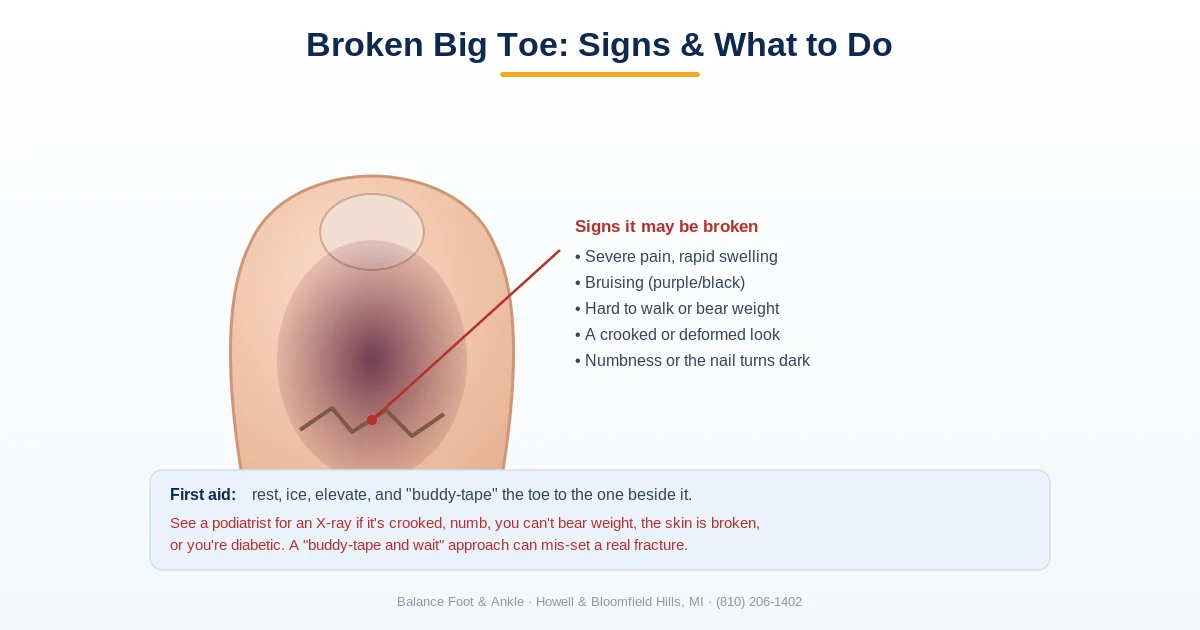
You stubbed your toe on the bed frame at 3 AM, and now it is swollen, bruised, and every step sends a jolt of pain through your foot. Is it broken? Almost certainly — the big toe is the most commonly fractured toe in the foot. In our Howell and Bloomfield Township podiatric offices, we see big toe fractures regularly and the news is usually reassuring: most heal well with straightforward conservative treatment, provided the fracture is evaluated and managed correctly from the start.
Anatomy: What Can Break in the Big Toe?
Medically reviewed by Dr. Tom Biernacki, DPM
Board-certified podiatric surgeon | Balance Foot & Ankle
Last reviewed: May 2026
The big toe (hallux) contains two bones:
- Proximal phalanx: The longer bone that connects to the metatarsal at the first metatarsophalangeal (MTP) joint. This is the most commonly fractured bone in the big toe.
- Distal phalanx: The smaller bone at the tip of the toe, beneath the toenail. Fractures here often involve the toenail itself (subungual hematoma is common alongside a distal phalanx fracture).
Additionally, the two sesamoid bones under the first metatarsal head can fracture — a sesamoid fracture is distinct from a phalangeal fracture but produces similar big toe pain. And avulsion fractures — small fragments pulled off by a ligament or tendon insertion — can occur at the base of the proximal phalanx during forced twisting injuries.
Key takeaway: The big toe bears approximately 40–50% of the body’s total push-off force during walking. An untreated or poorly treated big toe fracture — especially one that heals in a malunited position — can permanently alter gait mechanics, accelerate hallux rigidus (big toe joint arthritis), and cause chronic forefoot pain. Getting an X-ray and proper treatment after a big toe injury is not optional.
Symptoms: How to Know If Your Big Toe Is Broken
The classic presentation after a big toe injury:
- Immediate, severe pain at the moment of injury — often described as the worst toe pain of their life
- Rapid swelling within minutes to hours, extending to the ball of the foot
- Bruising (ecchymosis) that develops over 12–48 hours, often spreading under the skin toward the arch
- Tenderness to direct palpation over the fracture site — touching the bone hurts
- Pain with any loading — standing, walking, wearing shoes
- Possible deformity — the toe appears angulated or rotated in displaced fractures
- Subungual hematoma — dark blood under the toenail if the distal phalanx is involved
A commonly cited myth: “if you can move it, it’s not broken.” This is false. Many fractured toes retain some range of motion, especially in the first hours before full swelling develops. The ability to wiggle a toe does not exclude fracture. X-ray is the only reliable way to confirm or exclude a big toe fracture.
Types of Big Toe Fractures
Non-displaced fractures are the most common type — the bone cracks but the fragments remain in proper alignment. These heal reliably with conservative management: buddy taping, a stiff-soled surgical shoe, and protected weight-bearing. No surgery required.
Displaced fractures have bone fragments that have shifted out of alignment. Mild displacement (under 2mm) in the shaft of the phalanx can often be treated conservatively if it does not affect the joint. More significant displacement — especially angulation or rotation — requires reduction (realignment) under local anesthesia, followed by buddy taping or splinting to maintain position while healing.
Key takeaway: An intra-articular fracture — one where the fracture line passes through the metatarsophalangeal joint surface — is significantly more serious than a shaft fracture. Even a 1–2mm step-off in the joint surface dramatically increases the risk of post-traumatic hallux rigidus (arthritis). These fractures require careful evaluation and sometimes surgical fixation to restore a smooth joint surface.
Distal phalanx tuft fractures — the “burst” fracture pattern from axial impact (dropping something on the toe) — occur at the very tip of the bone. They are typically managed with buddy taping and a protective shoe. The toenail must be evaluated: a large subungual hematoma overlying a distal phalanx fracture may be drained for pain relief, and any nail avulsion requires wound care to prevent infection.
Avulsion fractures at the base of the proximal phalanx result from turf-toe-type mechanisms — forced hyperextension of the MTP joint with the foot planted. The ligament pulls off a small bone fragment. Most avulsion fractures heal with conservative care, but large fragments involving significant joint surface warrant surgical fixation evaluation.
Treatment: What We Do in Our Clinic
After X-ray confirms fracture type and alignment, treatment follows a clear protocol:
Key takeaway: Buddy taping a broken big toe — securing it to the second toe with foam padding between them — provides excellent functional splinting for non-displaced phalangeal fractures. The second toe acts as a natural stabilizer. Change the tape every 2–3 days and keep it dry. Most patients can walk comfortably in a stiff-soled shoe within a few days of beginning buddy taping.
Surgical shoe / stiff-soled shoe: A rigid post-op shoe keeps the toe from flexing during the toe-off phase of gait, dramatically reducing pain and preventing fracture displacement during healing. Most patients tolerate walking in this shoe within a day or two of the injury. Normal shoes can typically resume at 4–6 weeks once bony healing is confirmed on follow-up X-ray.
Closed reduction for displaced fractures: Under local digital block anesthesia (2 injections at the toe base — the toe is fully numb within minutes), we use traction and manipulation to restore anatomic alignment. Post-reduction X-ray confirms position. The toe is then buddy-taped and splinted to maintain alignment during healing.
Surgery is required for: significantly displaced or comminuted (multiple fragment) fractures, intra-articular fractures with step-off, open fractures, and sesamoid fractures with displacement. The most common surgical approach uses small screws or Kirschner wires (K-wires) to hold fragments in anatomic alignment. Recovery time for surgical cases extends to 8–12 weeks.
⚠️ Big toe fractures requiring urgent evaluation
- Significant displacement or angulation visible — bone is obviously out of position
- Open fracture — bone is visible through broken skin, requires emergency care
- Neurovascular compromise — the toe is cold, pale, or numb beyond normal swelling
- Diabetic patient with any big toe fracture — high risk of Charcot and infection complications
- Intra-articular fracture on X-ray — involvement of the joint surface warrants orthopedic or podiatric surgery consultation
- Fracture associated with a high-energy mechanism (sports collision, vehicle accident) — rule out Lisfranc injury and other associated fractures
Healing Time and Return to Activity
For non-displaced phalangeal fractures — the majority of big toe breaks — the typical recovery timeline:
- Days 1–3: Pain and swelling peak. Rest, ice (20 minutes on, 40 off), elevation, and anti-inflammatory medication. Buddy tape in place. Surgical shoe for ambulation.
- Week 1–2: Pain diminishes significantly. Continued buddy taping and surgical shoe. Light walking for daily activities is tolerable for most patients.
- Weeks 3–4: Most patients transition to a wider, stiff-soled athletic shoe. Running and impact activities remain restricted.
- Weeks 4–6: Follow-up X-ray confirms healing. If bony bridging is evident, gradual return to normal shoes and low-impact activity.
- Week 6–8: Return to most athletic activities for uncomplicated fractures. High-impact sport (running, jumping) may take 8–10 weeks total.
MOST COMMON MISTAKE WE SEE
The most common mistake with a broken big toe is assuming it can always be treated at home with buddy taping. While distal phalange fractures often do well conservatively, proximal phalange fractures — especially those near the MTP joint — can cause long-term stiffness and arthritis if not properly immobilized. More critically, an intra-articular fracture (one that enters the 1st MTP joint) requires X-ray to assess alignment; if displaced, it may need surgical fixation. Any big toe fracture in a diabetic patient warrants same-day professional evaluation because the risk of complications from delayed healing is significantly elevated.
DIFFERENTIAL DIAGNOSIS — CONDITIONS THAT MIMIC BROKEN BIG TOE
- Gout flare of the 1st MTP joint — sudden severe pain, redness, warmth; often no trauma history; uric acid elevated; dramatic response to colchicine within 12–24 hours
- Sesamoid fracture — pain under the ball of the foot near the big toe; X-ray shows sesamoid fragment; often from repetitive stress, not single event
- Hallux rigidus (arthritis) — stiffness and pain with big toe extension; no acute fracture; limited dorsiflexion on exam; X-ray shows joint space narrowing
- Turf toe (plantar plate sprain) — hyperextension injury of the 1st MTP joint; pain on the bottom of the joint; plantar tenderness; no bony fracture
- Subungual hematoma — blood under the toenail after trauma; nail appears black/blue; the toe itself may not be fractured even with significant nail injury
RED FLAGS — SEE A PODIATRIST URGENTLY
- Visible deformity or rotation of the toe
- Inability to bear any weight after the injury
- Rapidly progressive swelling with severe redness and warmth (could indicate gout or infection)
- Any big toe injury in a diabetic patient
- Big toe fracture that is not improving with buddy taping after 2 weeks
Call (810) 206-1402 or book online — most urgent presentations seen same or next business day.
Considering surgery? If a broken big toe is badly displaced, fails to heal, or stays painful for weeks, it may need a surgical evaluation. Our board-certified foot & ankle surgeons in Howell and Bloomfield Township can advise whether an operation is warranted — most toe fractures are not.
Frequently Asked QuestionsCan I walk on a broken big toe? In a stiff-soled surgical shoe, yes — most patients can walk for daily activities from the first day after injury with a non-displaced fracture. Walking barefoot or in flexible shoes is painful and risks displacement of the fracture. The key is the footwear: rigid sole prevents the metatarsophalangeal joint from flexing, which is what generates pain and displacement risk during toe-off.
Do I need to go to the ER for a broken big toe? For most closed (skin intact), non-displaced big toe fractures, a same-day or next-day podiatrist appointment is appropriate rather than an ER visit. Exceptions requiring emergency care: open fracture (bone through skin), severe deformity, suspected vascular compromise (cold/pale/numb toe), or high-energy mechanism with concern for associated foot/ankle injury.
How do I know if my big toe fracture healed correctly? Follow-up X-ray at 4–6 weeks assesses bony bridging and alignment. A healed fracture shows callus formation across the fracture line. Malunion (healing in a non-anatomic position) may not be symptomatic immediately but can accelerate hallux rigidus — which is why proper initial management and follow-up imaging matter, even for “simple” fractures.
The Bottom Line
Most broken big toes heal without surgery in 4–6 weeks with buddy taping and a stiff-soled shoe. The important minority — displaced fractures, intra-articular fractures, open fractures — require more intensive management to prevent long-term problems. Every big toe fracture warrants an X-ray to determine which category it falls into. Assuming “it’s just a toe, it’ll heal on its own” risks malunion, arthritis, and chronic pain from a fracture that a 15-minute office visit could have managed correctly from day one.
We have same-day availability at our Howell and Bloomfield Township offices for acute foot injuries including big toe fractures. We take X-rays, reduce displaced fractures, and send you home with a clear care plan and follow-up schedule — all in one visit.
Sources
- Armagan OE, Shereff MJ. Injuries to the toes and metatarsals. Orthop Clin North Am. 2001;32(1):1-10.
- Coughlin MJ, Saltzman CL, Anderson RB. Mann’s Surgery of the Foot and Ankle. 9th ed. Elsevier; 2014. Chapter on phalangeal fractures.
- Hatch RL, Hacking S. Evaluation and management of toe fractures. Am Fam Physician. 2003;68(12):2413-2418.
- O’Malley MJ, Hamilton WG, Munyak J. Fractures of the distal shaft of the fifth metatarsal. Am J Sports Med. 1996;24(2):240-243.
- van Vliet-Koppert ST, Cakir H, van Lieshout EM, et al. Demographics and functional outcome of toe fractures. J Foot Ankle Surg. 2011;50(3):307-310.
Ready to Get Relief?
Same-day appointments available in Howell & Bloomfield Township, MI
4.9★ | 1,123 Reviews | 3,000+ Surgeries
Or call: (810) 206-1402
How long does a broken big toe take to heal?
Most broken big toes heal in 4-6 weeks with buddy taping and a stiff-soled shoe. Severely displaced fractures or injuries near the joint may require a walking boot and 6-8 weeks of protected weight bearing.
Do I need a cast for a broken big toe?
Most hallux fractures do not require a cast. Buddy taping, a stiff-soled shoe or post-op shoe, and activity restriction is usually sufficient. A walking boot is recommended for unstable or displaced fractures.
When should I see a podiatrist for a broken toe?
See a podiatrist if your toe is visibly deformed, the pain is severe, there is significant bruising or swelling, or if you cannot bear weight. X-rays confirm the fracture type and guide treatment decisions.
For a complete clinical overview: tips for wearing a walking boot comfortably — Dr. Biernacki DPM explains how to manage leg length differences and knee pain during recovery.
In-Office Treatment at Balance Foot & Ankle
Stress fractures require imaging to determine severity — X-ray misses early stress reactions; MRI catches them reliably. Treatment ranges from a walking boot for 6–8 weeks to non-weight-bearing with a bone stimulator for high-risk sites. See stress fracture treatment →
📋 Dr. Tom Biernacki, DPM, FACFAS answers:
A broken big toe typically causes immediate sharp pain, rapid swelling, bruising under and around the toe, and significant difficulty bearing weight. Unlike a sprain, the pain is usually severe at the fracture site and worsens with any pressure or movement. An X-ray is the only definitive way to confirm a fracture. If you hear a snap or crack, have visible deformity, or cannot walk normally, see a podiatrist within 24–48 hours — most big toe fractures heal well with early treatment, but displaced fractures may need realignment to prevent long-term joint problems.
Footwear While a Broken Big Toe Heals
A stiff-soled shoe limits painful bending of a fractured big toe and protects it while it heals. See our podiatrist-recommended shoes and supportive orthotics, and have any suspected fracture confirmed by a podiatrist.

Specialist For This Condition
Dr. Carl Jay, DPM is the Balance Foot & Ankle reconstructive surgeon other doctors refer to when a complex fracture, malunion, or post-fracture reconstruction is involved. Fellowship-trained in complex foot and ankle reconstruction. Call (810) 206-1402 to schedule a consultation at the Howell or Bloomfield Township office.
Worried your big toe might actually be broken? Don’t guess — our Howell podiatrists take digital X-rays right in the office, so most patients leave their first visit knowing whether it’s fractured and exactly how to treat it.
Think you broke your big toe?
A broken big toe walked on wrong can cause lasting joint pain — it’s worth an x-ray. In Michigan? we can image and treat it same-week. Same-week visits in Howell & Bloomfield Township, most insurance accepted.
📅 Book an Appointment 📞 (810) 206-1402★ 4.9 from 1,123+ Google reviews · Same-week visits · We verify your insurance free — most visits are just a copay.
Related: Wondering how much the big toe matters for walking? See can you walk without a big toe and how it affects balance and gait.
Book an appointment with a podiatrist
A broken big toe is not the minor injury it is usually assumed to be. It carries much of your body weight at push-off, and a fracture that heals out of position can cause pain and arthritis for years afterwards, which early imaging prevents. Balance Foot & Ankle sees patients at two offices — Howell in Livingston County, and Bloomfield Township in Oakland County.
Call (810) 206-1402 or use the form below and our team will find you an appointment time.

Dr. Tom Biernacki, DPM is a board-certified foot & ankle surgeon (ABFAS & ABPM) at Balance Foot & Ankle Specialists in Southeast Michigan. With over a decade of clinical experience, he specializes in heel pain, bunions, diabetic foot care, sports injuries, and minimally invasive surgery. Dr. Biernacki is a member of the APMA and ACFAS, and his patient education content on MichiganFootDoctors.com and YouTube has made him one of the most-followed foot & ankle educators on YouTube.
More questions patients ask
How do I know if my big toe is broken?
Signs of a broken big toe include immediate pain after trauma, swelling, bruising, tenderness to touch, difficulty walking, and a visible deformity. Unlike a sprain, fractures often cause bone-specific tenderness along the toe. An X-ray is needed to confirm whether the bone is fractured and whether it is displaced.
How is a broken big toe treated?
Treatment depends on whether the fracture is displaced or non-displaced. Non-displaced big toe fractures are typically treated with buddy taping, a stiff-soled shoe or walking boot, and rest for 4–6 weeks. Displaced fractures may need surgical realignment. A podiatrist should evaluate and manage all big toe fractures to prevent malunion.
How do you tell if your big toe is broken?
Signs of a broken big toe: severe pain with weight-bearing, immediate swelling and bruising, visible deformity, inability to bend the toe, audible crack at injury moment. Distinguishing fracture from sprain requires X-ray. See a podiatrist within 24-48 hours for evaluation if you suspect a broken big toe.
Can you walk on a broken big toe?
Walking on a stable, nondisplaced big toe fracture is generally allowed in a stiff-soled post-op shoe or walking boot. Avoid pushing off through the toe. Displaced fractures require non-weight-bearing initially. Continued walking on a worsening fracture risks malunion. Get an X-ray to determine if you can safely walk.
How do I know if my big toe is broken or just bruised?
A broken big toe typically causes immediate severe pain, rapid swelling, bruising within hours, and difficulty bending or bearing weight. A bruised toe has milder swelling and full range of motion. Only an X-ray can definitively confirm a fracture.
When should I see a podiatrist for a broken big toe?
See a DPM immediately if the toe is visibly crooked, the skin is broken, there is numbness, or pain is severe. Same-day appointments available at Balance Foot & Ankle — (810) 206-1402 — Howell & Bloomfield Township, MI.
Still have a question about coverage or cost? Book online and we will check your benefits before your visit: Book in Howell · Book in Bloomfield Township. Prefer to talk it through first? Call (810) 206-1402.