

Medically reviewed by Dr. Tom Biernacki, DPM — Board-Certified Podiatric Surgeon — Balance Foot & Ankle, Howell & Bloomfield Hills, MI. Last updated April 2026.
Bunion Surgery Recovery: What Michigan Patients Can Expect
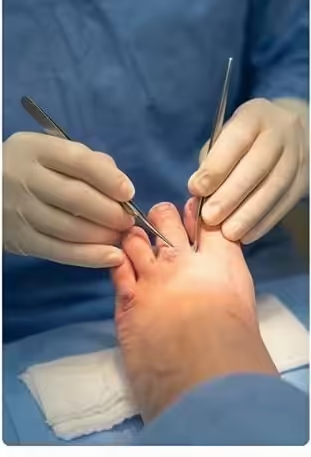
Bunion surgery recovery in 2025 is faster and less restrictive than it was a decade ago, thanks to improved fixation techniques and minimally invasive approaches. The most common procedure — Austin (Chevron) osteotomy with screw fixation — allows protected weight-bearing almost immediately and full recovery in 8–12 weeks for most patients. This guide covers the realistic week-by-week recovery timeline, what you must do, and common questions from Michigan patients at Balance Foot & Ankle.
Week-by-Week Bunion Surgery Recovery Timeline
Day 1–3 (Post-op): You leave the surgical center in a surgical boot or post-operative shoe — not a cast. Most patients can bear weight immediately with the boot, though gait is slow and intentional. Elevation and ice (15 min on/45 min off) are critical the first 72 hours to control swelling. Pain is managed with prescribed medication for the first 2–5 days, then transitions to over-the-counter pain reliever for most patients. Keep the surgical dressing dry — no showering directly on the foot until the first follow-up visit.
Week 1–2: First post-operative office visit typically at 1 week — dressing is changed, sutures assessed. Swelling peaks around days 3–5 then gradually decreases. Most patients work from home or desk jobs by week 2. Driving is NOT permitted with the surgical boot on the right foot (brake foot) — left foot surgery or patients using their left foot only can often resume driving with a left-foot-only modification. Continue elevation when sitting or lying down.
Week 3–6: Transition from surgical boot to a wide, stiff-soled shoe (e.g., a “bunion shoe” or extra-wide athletic shoe) typically begins at 4–6 weeks depending on X-ray healing assessment. Swelling continues to decrease but is normal for months. Return to work in most jobs (including standing jobs with a wide shoe) typically by weeks 4–8. No running, jumping, or impact activities yet.
Week 6–12: Return to regular shoes — typically begins at 8–10 weeks when the osteotomy shows X-ray healing. Athletic shoes are usually comfortable at 10–12 weeks. Narrow or dress shoes may require 4–6 months as swelling fully resolves. Physical therapy for range of motion, toe flexion/extension exercises, and gait rehabilitation typically begins at week 6–8. Return to low-impact exercise (cycling, swimming) usually at week 8–10.
3–6 months: Running, court sports, and high-impact activities for most patients. Final resolution of all swelling — especially at the end of the day — takes 3–6 months. The corrected toe will look better but will still have some bruising/discoloration under the skin until 3–4 months post-op. Long-term outcomes are excellent: approximately 90% of patients are satisfied with their bunion surgery outcome at 1 year.
Lapidus Bunion Surgery Recovery (Tarsometatarsal Fusion)
The Lapidus procedure (tarsometatarsal joint fusion) is used for more severe or hypermobile bunions. Recovery is longer than Austin osteotomy: non-weight-bearing for 6–8 weeks (strict NWB to protect the fusion), then protected weight-bearing in a boot for 2–4 more weeks; return to regular shoes at 12–16 weeks; full activity at 4–6 months. The Lapidus procedure has a lower recurrence rate than Austin osteotomy for appropriate candidates, which is why the longer recovery may be worthwhile in specific cases. Dr. Biernacki discusses which procedure is best for your deformity severity and lifestyle at your consultation.
Recovery Tips from Dr. Biernacki
Elevation is non-negotiable for the first 2 weeks: foot above the level of the heart reduces swelling and pain dramatically. Do the exercises: post-operative toe range-of-motion exercises starting at 2 weeks prevent stiffness that is much harder to address later. Wide shoe selection: prepare before surgery — buy a wide-toe-box athletic shoe one size larger than normal to have ready for week 4–6. Time your surgery strategically: if you need to return to standing work or are very active, schedule surgery 10–12 weeks before you want to be fully recovered. Winter months work well for patients who want to be back to full activity by spring/summer.
Schedule Your Bunion Surgery Consultation
Dr. Tom Biernacki performs Austin osteotomy, Lapidus bunion fusion, and minimally invasive bunion correction at Balance Foot & Ankle in Howell and Bloomfield Hills. Call (810) 206-1402 to schedule. For information about bunion surgery costs and insurance coverage, see our bunion surgery insurance guide or our podiatrist insurance and costs Michigan page.
Frequently Asked Questions
When can I drive after bunion surgery?
For right foot bunion surgery: you cannot safely drive until you are out of the surgical boot and have full control of the brake pedal — typically 4–6 weeks post-op with Austin osteotomy, 8–10 weeks with Lapidus. For left foot bunion surgery in an automatic transmission vehicle: many patients can drive starting at 1–2 weeks using only the left foot on the gas pedal, provided their left foot is pain-free and they have practiced in a safe environment. Always have your surgeon clear you to drive before doing so. Dr. Biernacki clears each patient to drive at their post-operative visit when the clinical criteria are met.
Can I have bunion surgery on both feet at the same time?
Bilateral bunion surgery (both feet at once) is rarely performed because it eliminates the ability to use either foot for ambulation during early recovery. Most surgeons — including Dr. Biernacki — recommend separating bilateral bunion corrections by at least 3 months so the first foot is sufficiently healed before operating on the second. The exception is very mild corrections in patients with caregiver support and wheelchair access for the full recovery period. Staggering procedures also allows you to benefit from the first surgery’s outcome before committing to the second side.
Will my bunion come back after surgery?
Bunion recurrence after surgery is uncommon but possible. Austin osteotomy has a recurrence rate of approximately 5–10% at 5–10 years for correctly selected patients. Lapidus procedure (TMT fusion) has a lower recurrence rate (~2–5%) and is preferred for severe or hypermobile bunions. Factors that increase recurrence risk: resuming narrow, pointed-toe footwear; significant underlying joint laxity (hypermobility); and performing surgery before skeletal maturity (in adolescents). Custom orthotics worn in properly fitted shoes after recovery reduce the mechanical stress on the corrected first ray and help prevent recurrence over time.
Dr. Tom Biernacki, DPM is a board-certified podiatric surgeon at Balance Foot & Ankle in Howell and Bloomfield Hills, Michigan. He performs Austin osteotomy, Lapidus bunion fusion, and minimally invasive bunion correction with comprehensive post-surgical care and rehabilitation.
Dr. Tom’s Recommended Products for Bunions
📍 Located in Michigan?
Our board-certified podiatrists treat this condition at two convenient locations. Same-day appointments often available.
These are products I personally use and recommend to my patients at Balance Foot & Ankle.
- Correct Toes Toe Spacers — Silicone spacers realign toes to natural position — reduces bunion pain and slows deformity progression
- NatraCure Gel Toe Separator and Bunion Guard — Gel cushion with integrated spacer — immediate pain relief for bunion friction against shoe box
- New Balance 928v3 Walking Shoe — Wide toe box with ROLLBAR stability — gives the bunion room while controlling overpronation that worsens deviation
Affiliate disclosure: As an Amazon Associate, Balance Foot & Ankle earns from qualifying purchases. We only recommend products we trust for our own patients.
Dr. Tom’s Recommended Insoles
PowerStep is the brand I prescribe most — medical-grade OTC support without the custom orthotic price tag.
- PowerStep Pinnacle Insoles — The OTC orthotic I recommend most — medical-grade arch support at a fraction of custom orthotic cost. Works in most shoes.
- PowerStep Maxx Insoles — For severe arch pain or flat feet — maximum correction and support when Pinnacle isn’t enough.
📧 Get Dr. Tom’s Free Lab Test Guide
Discover the 5 lab tests every person over 35 should ask their doctor about — explained in plain English by a board-certified physician.
Affiliate disclosure: As an Amazon Associate, Balance Foot & Ankle earns from qualifying purchases. We only recommend products we trust for our own patients.
Join 950,000+ Learning About Foot Health
Dr. Tom shares honest medical advice, supplement reviews, and treatment guides you won’t find anywhere else.
Subscribe on YouTube →Medically Reviewed by: Dr. Tom Biernacki, DPM — Board-Certified Podiatrist, Balance Foot & Ankle Specialists
Planning for Bunion Surgery?
Understanding what to expect before, during, and after bunion surgery helps ensure the best outcome. Our board-certified podiatric surgeons use the latest minimally invasive techniques for faster recovery.
Clinical References
- Trnka HJ. “Percutaneous and minimally invasive bunion surgery.” Foot and Ankle Clinics, 19(3):427-435, 2014.
- Barg A et al. “Minimally invasive chevron-Akin for correction of hallux valgus.” Foot and Ankle Clinics, 25(1):1-20, 2020.
- Fraissler L et al. “Return to sports and daily activity after hallux valgus surgery.” Foot and Ankle International, 37(12):1307-1314, 2016.
Insurance Accepted
BCBS · Medicare · Aetna · Cigna · United Healthcare · HAP · Priority Health · Humana · View All →
Howell Office
3980 E Grand River Ave, Suite 140
Howell, MI 48843
Get Directions →
Bloomfield Hills Office
43700 Woodward Ave, Suite 207
Bloomfield Hills, MI 48302
Get Directions →
Your Board-Certified Podiatrists



Ready to Get Back on Your Feet?
Same-week appointments available at both locations.
Book Your Appointment
Dr. Tom Biernacki, DPM is a double board-certified podiatrist and foot & ankle surgeon at Balance Foot & Ankle Specialists in Southeast Michigan. With over a decade of clinical experience, he specializes in heel pain, bunions, diabetic foot care, sports injuries, and minimally invasive surgery. Dr. Biernacki is a member of the APMA and ACFAS, and his patient education content on MichiganFootDoctors.com and YouTube has reached over one million views.
- Diagnosis and Treatment of Plantar Fasciitis (PubMed / AAFP)
- Heel Pain (APMA)
- Hallux Valgus (Bunions): Evaluation and Management (PubMed)
- Bunions (Mayo Clinic)
Recommended Products from Dr. Tom