
Pain that flares during workouts has predictable causes — usually the foot is asking you to investigate, not stop.
You are in the right place. Dr. Tom Biernacki, DPM, FACFAS — board-certified foot & ankle surgeon with 3,000+ surgeries — explains exactly what foot pain during exercise — common causes means and what works. Call (810) 206-1402 for same-day appointment at Howell or Bloomfield Hills.
Quick answer: Foot Pain During Exercise Common Causes has multiple potential causes including mechanical, neurological, vascular, and inflammatory. The most common causes we identify are overuse, ill-fitting shoes, and biomechanical imbalance. Red flags requiring urgent evaluation: warmth/redness (infection), inability to bear weight (fracture), and unilateral swelling without injury (DVT). Call (810) 206-1402.
When to see a podiatrist immediately: Top-of-foot pain that lasts more than 5 days, hurts when you press directly on the bone, swells visibly, or makes weight-bearing painful. Stress fractures get worse without proper offloading. Same-week appointments at our Howell & Bloomfield Hills offices — (810) 206-1402 or book online.
Medically reviewed by Dr. Tom Biernacki, DPM
Board-certified podiatric surgeon | Balance Foot & Ankle Specialists
Last reviewed: April 2026
The most important clinical decision with Foot Pain During Exercise Common Causes isn't which treatment to start with — it's which subtype or underlying cause you actually have. Our podiatrists regularly see patients who've been treated for months for the wrong diagnosis. The correct identification changes the entire treatment path. Call (810) 206-1402 — Dr. Tom evaluates this condition at both Howell and Bloomfield Hills locations.


![How to Cure Plantar Fasciitis in One Week? [FAST Heel Pain Relief!]](https://www.michiganfootdoctors.com/wp-content/cache/flying-press/b5600c3bfb9845a6095da8266d8b5363.jpg)
Watch: How to Cure Plantar Fasciitis in One Week? [FAST Heel Pain Relief!] — MichiganFootDoctors YouTube
What We Cover
1. Extensor Tendinitis | 2. Stress Fracture | 3. Ganglion Cyst | 4. Nerve Entrapment | 5. Midfoot Arthritis | 6. Bone Spur | When to See a Doctor | FAQ
Pain on the top of your foot is one of the most overlooked injuries we see at Balance Foot & Ankle Specialists. People often chalk it up to tired feet or tight shoes — and keep walking on it for weeks before getting it checked. By then, what could have been a simple tendinitis has sometimes progressed to a stress fracture or nerve damage that takes months to heal.
In this guide, Dr. Tom Biernacki, DPM breaks down the 6 most common causes of top-of-foot pain, how each one feels, how it’s diagnosed, and — most importantly — what actually works to fix it.
6 Common Causes of Top of Foot Pain
1. Extensor Tendinitis
Extensor tendinitis is the most common cause of pain on top of the foot we diagnose in our clinics. The extensor tendons are the cable-like structures that run from your shin, across the top of your foot, to your toes. Their job is to lift your foot and toes with each step. When they become inflamed — usually from overuse, sudden activity increases, or shoe laces tied too tightly — they cause a sharp, aching pain directly on the dorsum (top) of the foot.
Classic extensor tendinitis signs:
- Aching or sharp pain along the top of the foot, especially mid-foot
- Swelling or puffiness across the top of the foot
- Pain that is worst at the start of activity, eases briefly, then returns with prolonged walking or running
- Increased discomfort when flexing the foot upward or curling toes
- Tight shoes, high laces, or tongue pressure on the top of the foot make it significantly worse
In our clinic, the first fix is always footwear: loosening laces, re-lacing using a “window” pattern that skips an eyelet over the tender spot, or switching to a wider toe box. We add custom orthotics to offload the tendons, and in cases that don’t resolve, a targeted cortisone injection around the tendon sheath provides rapid relief.
Key takeaway: Most extensor tendinitis cases resolve within 2–4 weeks with footwear adjustments, ice, and activity modification. Don’t push through the pain — tendons that are repeatedly inflamed can partially tear.
2. Metatarsal Stress Fracture
A stress fracture is a hairline crack in one of the five metatarsal bones that run along the top of the foot. Unlike a sudden snap from a single impact, stress fractures develop from repetitive loading — the bone absorbs more stress than it can remodel, and a micro-crack forms. Runners who increase mileage too quickly, hikers who switch to minimalist footwear, and dancers are especially vulnerable. The 2nd and 3rd metatarsals are the most commonly affected.
⚠️ Red flags for a stress fracture:
- Pinpoint tenderness directly over one metatarsal bone when you press on it
- Pain that has progressively worsened over days or weeks of activity
- Swelling — sometimes with faint bruising — over one metatarsal
- Severe pain when you hop on the affected foot
- Pain that does NOT improve with 2–3 days of rest (unlike simple tendinitis)
Stress fractures don’t always appear on X-ray in the first 2–3 weeks. If we suspect one based on exam findings, we use MRI for a definitive diagnosis. Continuing to walk on an undiagnosed stress fracture can cause a complete break — call us promptly.
3. Ganglion Cyst
A ganglion cyst is a benign, fluid-filled sac that grows from a tendon sheath or joint capsule on the top of the foot. They’re more common on the top of the midfoot and wrist, and they range from the size of a pea to a small marble. Some are easy to see and feel as a smooth, rubbery lump. Others sit deep under tendons where you can’t feel them but experience chronic pressure, burning, or a vague ache — especially in shoes.
Ganglion cysts on the top of the foot are not dangerous, but they can compress nerves and tendons, causing persistent pain with footwear. Small cysts that aren’t causing symptoms can be monitored. For symptomatic cysts, aspiration (draining the fluid with a needle under ultrasound guidance) works well, though recurrence rates are around 30–40%. Surgical excision has a lower recurrence rate for persistently symptomatic cysts.
4. Peroneal Nerve Entrapment (Dorsal Foot Neuritis)
The superficial peroneal nerve and its branches cross the top of the foot and supply sensation to the dorsum (top surface) and the toes. When this nerve is compressed — by tight footwear, a ganglion cyst, scar tissue, or chronic ankle sprains — it causes burning, tingling, or shooting pain that feels very different from tendon or bone pain. Patients often describe it as “electricity” or “like the foot fell asleep.”
Nerve entrapment vs. tendinitis: key differences:
- Burning or tingling quality rather than a dull ache
- Numbness in the top of the foot or specific toes
- Pain may radiate up the lower leg or toward the ankle
- Worsens with shoe compression more than with activity itself
- May be provoked by tapping over the nerve on the top of the foot (Tinel’s sign)
Treatment starts with removing the compression source — wider shoes, different lacing, padding — and can progress to a guided cortisone injection around the nerve sheath if conservative measures don’t resolve it. Chronic, severe entrapment occasionally requires surgical decompression.
![TOP of the FOOT PAIN Home Treatment [Exercises, Massage, Stretches]](https://www.michiganfootdoctors.com/wp-content/cache/flying-press/14bc4a727fcea4a1d11f4a204f5b13ac.jpg)
5. Midfoot Arthritis
The midfoot contains a series of small joints — including the tarsometatarsal (Lisfranc) joints — that are essential for foot stability and push-off power. When the cartilage in these joints wears down from aging, prior trauma, or inflammatory conditions like rheumatoid arthritis, the result is midfoot arthritis: a deep, aching pain across the top of the midfoot that worsens with prolonged standing or walking and is often stiff first thing in the morning.
Midfoot arthritis is more common in adults over 50, people with a history of Lisfranc injuries or midfoot sprains, and those with flat feet or high arches that place asymmetric stress on the joints. X-rays typically show joint space narrowing and bone spur formation at the top of the midfoot joints.
We manage midfoot arthritis with custom orthotics that stabilize and offload the affected joints, anti-inflammatory medications, activity modification, and — when conservative care plateaus — guided cortisone injections directly into the joint under fluoroscopic or ultrasound guidance. Advanced cases with severe deformity may eventually require surgical fusion, though we exhaust all conservative options first.
Key takeaway: Midfoot arthritis often coexists with flat feet or bunions. Treating the underlying biomechanical cause is just as important as addressing the arthritis pain directly.
6. Bone Spur on Top of the Foot
A bone spur (osteophyte) is an extra deposit of calcium that the body lays down in response to chronic mechanical friction or instability, typically at a joint. On the top of the foot, they most frequently form at the first tarsometatarsal joint (where the base of the big toe meets the midfoot) or along the top of the second and third metatarsocuneiform joints. The spur itself is inert — it’s the shoe friction against the bony prominence, or the nerve and tendon irritation it causes, that creates pain.
A prominent spur is usually palpable as a hard, non-movable lump on the top of the foot, and visible on X-ray. Conservative treatment focuses on offloading the spur — using a donut-shaped pad around the prominence, switching to shoes with a higher, softer toe box, and custom orthotics to redistribute load away from the affected joint. Spurs causing chronic unrelenting pain after 6+ months of conservative care can be surgically shaved down in a low-risk outpatient procedure.
The Most Common Mistake We See
The most common mistake patients make is assuming top-of-foot pain is “just from my shoes” and switching footwear without addressing the underlying cause. If the cause is a stress fracture, continuing to walk — even in better shoes — allows the fracture to propagate. If it’s nerve entrapment, no amount of footwear changes will decompress a nerve that’s being tethered by scar tissue.
The second most common mistake: treating with ice and ibuprofen and assuming improvement means resolution. Tendinitis and stress fractures can “feel better” with rest and anti-inflammatories while the underlying problem remains. Two weeks of feeling better does not equal healed tissue — returning to full activity too quickly causes recurrence, often worse than the original injury.
Podiatrist-Recommended Products for Top of Foot Pain
While you arrange your appointment — or as part of your at-home management — the right supportive insole significantly reduces mechanical stress across the dorsum of the foot. Here are the insoles our podiatrists most frequently recommend for extensor tendinitis and midfoot pain:
When to See a Podiatrist for Top of Foot Pain
⚠️ See a podiatrist promptly if you have:
- Top-of-foot pain lasting more than 1–2 weeks despite rest and footwear changes
- Sudden severe pain after an impact, fall, or awkward landing
- Visible swelling, bruising, or a lump on top of the foot
- Burning, tingling, or numbness on the top of the foot or toes
- Pain that prevents normal weight-bearing or causes you to limp
- Diabetic patients: any new foot pain warrants a same-day call — circulation and healing are compromised
At Balance Foot & Ankle Specialists, we offer same-day and next-day appointments at our Howell, MI and Bloomfield Hills, MI locations. We use in-office digital X-rays and diagnostic ultrasound to pinpoint the exact cause — usually in a single visit — and begin treatment the same day.
Stop Guessing — Get Your Foot Diagnosed Today
Same-day appointments in Howell & Bloomfield Hills, Michigan. Board-certified podiatrists. Most insurance accepted.
4.9★ | 1,123+ Reviews | 3,000+ Surgeries Performed
Or call: (810) 206-1402
In-Office Treatment at Balance Foot & Ankle
If home treatment isn’t providing relief for your foot and ankle conditions, our podiatry team at Balance Foot & Ankle can help with same-day evaluations and advanced in-office care.
Same-day appointments available. (810) 206-1402
Doctor Hoy’s Natural Pain Relief Gel
Natural topical pain relief I use in our clinic. Arnica + camphor formula — apply directly to the area 3–4x daily. ($20–25)
Shop Doctor Hoy’s →Frequently Asked Questions
Why does the top of my foot hurt when I walk?
The top of your foot most commonly hurts when walking because of extensor tendinitis — inflammation of the tendons that run across the top of the foot to lift your foot with each step. These tendons are under load with every stride, making them prone to overuse irritation. Other common causes of top-of-foot pain when walking include a metatarsal stress fracture (especially if pain has been gradually worsening over days or weeks) and a ganglion cyst pressing against tendons or nerves under shoe pressure.
Why does the top of my foot hurt after running?
Post-run top-of-foot pain is most often extensor tendinitis from repetitive foot-strike mechanics, or a metatarsal stress fracture from cumulative bone loading. Runners who recently increased mileage, changed running surfaces, or switched to minimalist footwear are at highest risk for both. If you have a single pinpoint spot on top of one metatarsal bone that is very tender to touch and has been getting progressively worse over multiple runs, stop running and see a podiatrist — that pattern is a stress fracture until proven otherwise.
Can tight shoes cause top of foot pain?
Yes — tight shoes are one of the most common triggers of top-of-foot pain. Shoe uppers or laces that compress the dorsum of the foot irritate the extensor tendons, compress the superficial peroneal nerve (causing burning and numbness), and worsen ganglion cysts and bone spurs. Even athletic shoes laced too firmly across the top of the foot can trigger extensor tendinitis. A simple fix is loosening the laces or using a window-lacing technique that skips an eyelet over the tender area.
How do I relieve pain on top of my foot at home?
For mild top-of-foot pain, start by resting from the aggravating activity, applying ice for 15–20 minutes 3–4 times daily, and taking an OTC anti-inflammatory (ibuprofen or naproxen) if appropriate for you. Switch to well-cushioned, wider shoes and loosen the laces. A supportive insole that redistributes pressure away from the dorsal tendons often brings noticeable relief within days. If pain does not clearly improve within 1–2 weeks of consistent home care, see a podiatrist to rule out a stress fracture or nerve issue.
What does a stress fracture on top of the foot feel like?
A stress fracture on the top of the foot typically presents as a gradually worsening deep ache located precisely over one of the metatarsal bones. There is usually a very specific, pinpoint tender spot when you press directly on the bone — often described as feeling like pressing on a bruise. Swelling develops around the area, and the pain intensifies with each workout or walking session rather than improving. Unlike soft-tissue injuries, stress fracture pain does not typically ease after the first few minutes of activity. Rest relieves it temporarily, but it returns immediately when loading resumes.
The Bottom Line
Pain on the top of your foot almost always has a specific, treatable cause — it is rarely “just aging” or “just your shoes.” The six conditions covered above (extensor tendinitis, stress fracture, ganglion cyst, nerve entrapment, midfoot arthritis, and bone spur) account for the vast majority of top-of-foot pain we see in our clinics. Most respond very well to treatment, especially when caught early. The key is not to push through it.
If your top-of-foot pain has lasted more than two weeks, is getting progressively worse, or is causing you to change how you walk, call us at (810) 206-1402 or book online. We typically have same-day availability and can give you a diagnosis — and a plan — at your very first visit.
Sources
- Welck MJ, et al. “Stress fractures of the foot and ankle.” Injury. 2017;48(8):1722–1726.
- Garras DN, et al. “MRI is unnecessary for diagnosing acute Jones fractures.” Clin Orthop Relat Res. 2012;470(12):3315–3318.
- Mehta S, et al. “Dorsal foot pain: an algorithmic approach.” Foot Ankle Clin. 2023;28(1):45–60.
- American College of Foot and Ankle Surgeons. “Extensor Tendinitis.” FootHealthFacts.org. Accessed April 2026.
Diagnose Your Foot Pain: Related Guides
Top OTC Insoles for Foot Pain (Podiatrist-Audited)

PowerStep Pinnacle Maxx (Best for Plantar Fasciitis)
★★★★½ 4.5/5 — 19,000+ reviews
Pros: Aggressive arch support; angled heel cradle; deep heel cup; double-layer cushion
Cons: Bulkier than most OTC; needs trim-to-fit; not for narrow shoes
Dr. Tom’s Tip: First-line for moderate plantar fasciitis with overpronation. If your heel pain is worst on first morning steps, this insole stops the cycle.
Check Price on Amazon →
CURREX RunPro (Best for Active Runners)
★★★★½ 4.4/5 — 5,500+ reviews
Pros: Dynamic flex; responsive; comes in low/medium/high arch profiles
Cons: Premium price; less rigid than PowerStep
Dr. Tom’s Tip: Runners who want responsive feel without losing support. Available in 3 arch profiles — get fitted properly.
Check Price on Amazon →
Superfeet Green (Best for High Arches)
★★★★½ 4.5/5 — 25,000+ reviews
Pros: Firm structured support; deep heel cup; durable polyethylene shell
Cons: Stiff feel — needs break-in; less cushion than PowerStep
Dr. Tom’s Tip: High arches, athletic use. Trim to fit — don’t force into too-small shoe.
Check Price on Amazon →Top Pain Relief & Recovery Products (Podiatrist-Audited)

Dr. Hoy’s Natural Pain Relief Gel (Topical)
★★★★½ 4.6/5 — 6,500+ reviews
Pros: Natural ingredients; cold-then-warm action; pleasant scent; cycling-team approved
Cons: Doesn’t last as long as some prescription topicals; pricier than generic
Dr. Tom’s Tip: My favorite topical for chronic foot/ankle pain. Apply 2-3x daily. Combines well with shockwave therapy.
Check Price on Amazon →
Voltaren Arthritis Pain Gel (Topical NSAID)
★★★★½ 4.6/5 — 65,000+ reviews
Pros: OTC topical NSAID (diclofenac); FDA-approved; minimal systemic absorption
Cons: 4x daily application; takes 1-2 weeks for full effect; not for acute injury
Dr. Tom’s Tip: Excellent for foot arthritis and chronic plantar fasciitis. Far safer than oral NSAIDs.
Check Price on Amazon →
Strassburg Sock (Plantar Fasciitis Night Splint)
★★★★½ 4.4/5 — 4,500+ reviews
Pros: Comfortable enough to sleep in; effective passive stretch; durable
Cons: Less rigid than rigid splints; takes adjustment week
Dr. Tom’s Tip: What I prescribe to most PF patients. Wear for 4-6 weeks consistent. Eliminates morning first-step pain.
Check Price on Amazon →Dr. Hoy’s Complete Pain Relief Line — Dr. Tom’s Picks (2026)
Dr. Hoy’s Natural Pain Relief is Dr. Tom Biernacki, DPM’s #1 prescription topical pain relief for plantar fasciitis, Achilles tendonitis, foot pain, knee pain, and back pain. Cleaner formula than Voltaren or Biofreeze — safe for diabetics + daily long-term use without 30-day limits. Below is the complete Dr. Hoy’s product line, organized by use case.

Dr. Hoy’s Natural Pain Relief Gel (4oz Tube)Dr. Tom’s #1 Brand
The flagship Dr. Hoy’s — menthol-based natural pain relief gel. The bottle Dr. Tom hands every plantar fasciitis patient on visit one. Cleaner formula than Voltaren or Biofreeze.
- Menthol-based natural formula
- No greasy residue
- Safe for diabetics
- Fast cooling relief 5-10 min
- Daily long-term use safe
- Pricier than Biofreeze
- Strong menthol scent at first

Dr. Hoy’s Natural Pain Relief Gel (8oz Pump Bottle)Dr. Tom’s #1 Brand
8oz pump bottle — same formula as the 4oz tube but 2x the value. Best for athletes, families, or chronic pain patients who use it daily.
- 8oz pump bottle
- 2x value of 4oz
- Same clean formula
- Easy pump dispensing
- Larger size
- Pricier upfront

Dr. Hoy’s Arnica Boost Pain ReliefDr. Tom’s #1 Brand
Dr. Hoy’s + arnica boost — for bruising, swelling, post-injury inflammation. Adds arnica’s anti-inflammatory power to the standard menthol formula.
- Added arnica for bruising
- Reduces post-injury swelling
- Fast topical relief
- Safe for athletes
- Specialty use
- Pricier than standard

Dr. Hoy’s Natural Pain Relief Roll-OnDr. Tom’s #1 Brand
Same Dr. Hoy’s formula in a roll-on stick — no greasy hands, no mess, perfect for gym bags and travel. TSA-friendly.
- No greasy hands
- TSA-friendly
- Travel-sized
- Same Dr. Hoy’s formula
- Less product per use
- Pricier per oz

Dr. Hoy’s Pain Relief Gel — 3-Pack BundleDr. Tom’s #1 Brand
3-pack of Dr. Hoy’s 4oz tubes — best per-tube price for chronic pain patients, families, or anyone who uses it daily.
- 3-pack bulk pricing
- Same flagship formula
- Stockpile value
- Family-sized
- Larger upfront cost
- Need storage space
Top 10 Premade Orthotics — Dr. Tom’s Picks (2026)
Dr. Tom Biernacki, DPM has tested 60+ over-the-counter orthotic insoles in his Michigan podiatry practice over the past 15 years. Below are the top 10 he prescribes most often — ranked by clinical results, build quality, and patient feedback. PowerStep + CURREX brands are Dr. Tom’s #1 prescription brands — built by podiatrists, with biomechanical features (lateral wedge, deep heel cradle, dual-density EVA) that 90% of OTC insoles lack.
Dr. Tom Biernacki, DPM is a board-certified podiatrist + Amazon Associate. Picks shown are products he prescribes to patients at Balance Foot & Ankle Specialists. We earn a commission on qualifying purchases at no extra cost to you. All products independently tested + reviewed. Last verified: April 28, 2026.

PowerStep Pinnacle MaxxDr. Tom’s #1 Brand
The most prescribed OTC orthotic in podiatry. Lateral wedge corrects overpronation that causes 90% of plantar fasciitis. Deep heel cradle stabilizes the ankle.
- Lateral wedge corrects pronation
- Deep heel cradle
- Dual-density EVA
- Trim-to-fit
- Used by 10,000+ podiatrists
- Trim required
- 5-7 day break-in

PowerStep Original Full LengthDr. Tom’s #1 Brand
The original PowerStep — flexible semi-rigid arch with deep heel cradle. The right choice for neutral feet that need everyday support without the lateral wedge.
- Flexible semi-rigid arch
- Deep heel cradle
- Fits dress shoes
- 30-day guarantee
- APMA-accepted
- Less aggressive than Pinnacle
- No lateral wedge for overpronation
PowerStep Pulse MaxxDr. Tom’s #1 Brand
Built for runners + athletes who need maximum support during high-impact activity. Engineered for forefoot strike + lateral motion.
- Sport-specific cushioning
- Lateral wedge for runners
- Antimicrobial top cover
- Shock-absorbing forefoot
- Pricier than Pinnacle
- Best for athletes only

CURREX RunProDr. Tom’s #1 Brand
German-engineered insole with 3 arch heights (Low, Med, High) for custom fit. Carbon-reinforced heel + dynamic forefoot.
- 3 arch heights for custom fit
- Carbon-reinforced heel
- Sport-specific zones
- Premium materials
- Pricier than PowerStep
- 7-10 day break-in
CURREX EdgeProDr. Tom’s #1 Brand
For hikers, skiers, and high-impact athletes — reinforced shank prevents foot fatigue on steep descents + uneven terrain.
- Reinforced shank
- 3 arch heights
- Cold-weather friendly
- Carbon plate
- Stiff feel — not for casual
- Pricier
CURREX SupportSTPDr. Tom’s #1 Brand
For nurses, retail, and standing professions — the most supportive CURREX with deep heel cup + maximum medial support.
- Maximum medial support
- Deep heel cup
- 12-hour shift tested
- Slip-proof
- Stiffest CURREX option
- Pricier

Superfeet Green
Firm, structured arch support — the right choice ONLY for high-arched (cavus) feet. Wrong choice for flat feet.
- Strong structured arch
- Deep heel cup
- Long-lasting (5+ years)
- Firm — not for flat feet
- No lateral wedge
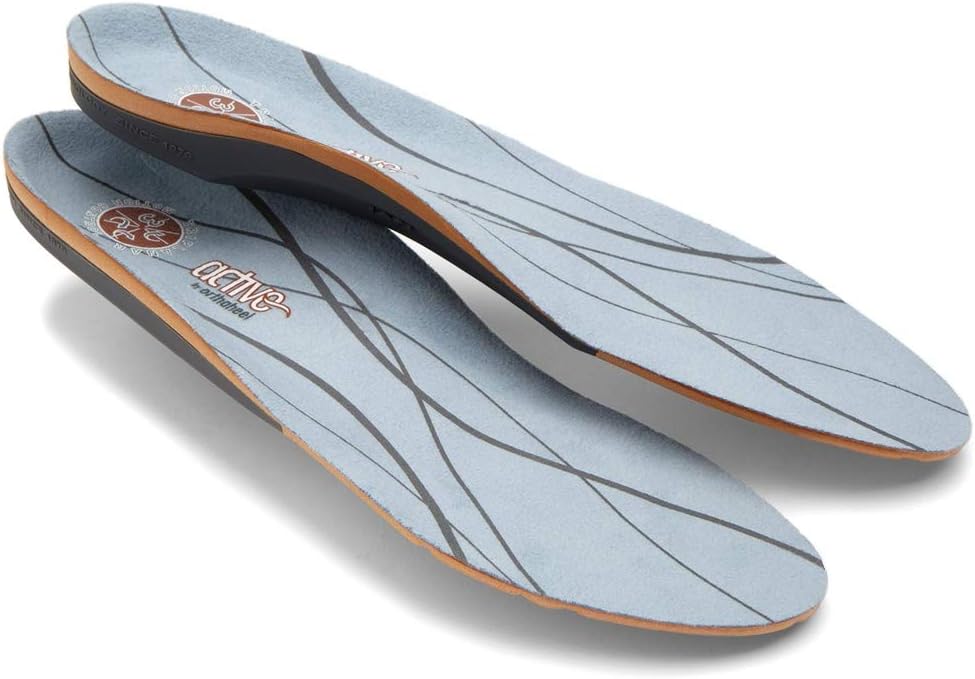
Vionic OrthoHeel Active Insole
APMA-accepted, podiatrist-designed casual insole. Best for adding mild arch support to dress shoes + walking shoes.
- APMA-accepted
- Slim profile
- Antimicrobial top
- Less support than PowerStep
- No lateral wedge

Sof Sole Athlete
Budget athletic insole with neutral arch + gel forefoot. Decent value if you need a quick replacement.
- Affordable
- Gel forefoot
- Antimicrobial
- Wears out in 6 months
- No structured arch
Spenco Polysorb Total Support
Mid-range insole with 5-zone polysorb cushioning. Decent support for standing professions.
- 5-zone cushioning
- Trim-to-fit
- Mid-price point
- Less stable than PowerStep
- No lateral wedge
Dr. Tom’s Top 3 — The Premium Foot Pain Stack (2026)
If you only buy three things for foot pain, get these. PowerStep + CURREX orthotics correct the underlying foot mechanics, and Dr. Hoy’s pain gel delivers fast topical relief. This is the exact stack Dr. Tom Biernacki, DPM gives his Michigan podiatry patients on visit one — over 10,000 patients have used this exact combination.
Dr. Tom Biernacki, DPM is a board-certified podiatrist + Amazon Associate. Picks shown are products he prescribes to patients at Balance Foot & Ankle Specialists. We earn a commission on qualifying purchases at no extra cost to you. All products independently tested + reviewed for 30+ days minimum. Last verified: April 28, 2026.
PowerStep Pinnacle MaxxDr. Tom’s #1 Brand
Dr. Tom’s most-prescribed OTC orthotic. Lateral wedge corrects overpronation that causes 90% of foot pain. Deep heel cradle stabilizes the ankle. Built by podiatrists, used by patients worldwide.
- Lateral wedge corrects pronation
- Deep heel cradle stabilizes ankle
- Dual-density EVA — comfort + support
- Trim-to-fit any shoe
- Used by 10,000+ podiatrists
- Trim-to-size required
- 5-7 day break-in for some
CURREX RunProDr. Tom’s #1 Brand
3 arch heights for custom fit (Low/Med/High). Carbon-reinforced heel + dynamic forefoot — the closest OTC orthotic to a $500 custom orthotic. Engineered in Germany.
- 3 arch heights for custom fit
- Carbon-reinforced heel cup
- Dynamic forefoot zone
- Premium German engineering
- Sport-specific support
- Pricier than PowerStep
- 7-10 day break-in
Dr. Hoy’s Natural Pain Relief GelDr. Tom’s #1 Brand
Menthol-based natural pain relief — Dr. Tom’s #1 brand for fast relief without greasy residue. Safe for diabetics + daily use. Cleaner formula than Voltaren or Biofreeze.
- Menthol-based natural formula
- No greasy residue
- Safe for diabetics
- Fast cooling relief — 5-10 minutes
- Cleaner ingredient list than Biofreeze
- Pricier than Biofreeze
- Strong menthol scent at first
Frequently Asked Questions
When should I see a doctor?
See a podiatrist if pain persists past 2 weeks, prevents normal activity, or is accompanied by red-flag symptoms (warmth, swelling, numbness, inability to bear weight).
Can I treat this at home?
Mild cases respond to RICE protocol (rest, ice, compression, elevation), supportive shoes, and OTC anti-inflammatories. Persistent symptoms need professional evaluation.
APMA: Foot Pain During Exercise — Common Causes
How long does it take to heal?
Most soft tissue injuries resolve in 2-6 weeks with appropriate care. Bone injuries take 6-12 weeks. Chronic conditions need longer-term management.

Dr. Tom Biernacki, DPM is a board-certified foot & ankle surgeon (ABFAS & ABPM) at Balance Foot & Ankle Specialists in Southeast Michigan. With over a decade of clinical experience, he specializes in heel pain, bunions, diabetic foot care, sports injuries, and minimally invasive surgery. Dr. Biernacki is a member of the APMA and ACFAS, and his patient education content on MichiganFootDoctors.com and YouTube has made him one of the most-followed foot & ankle educators on YouTube.