
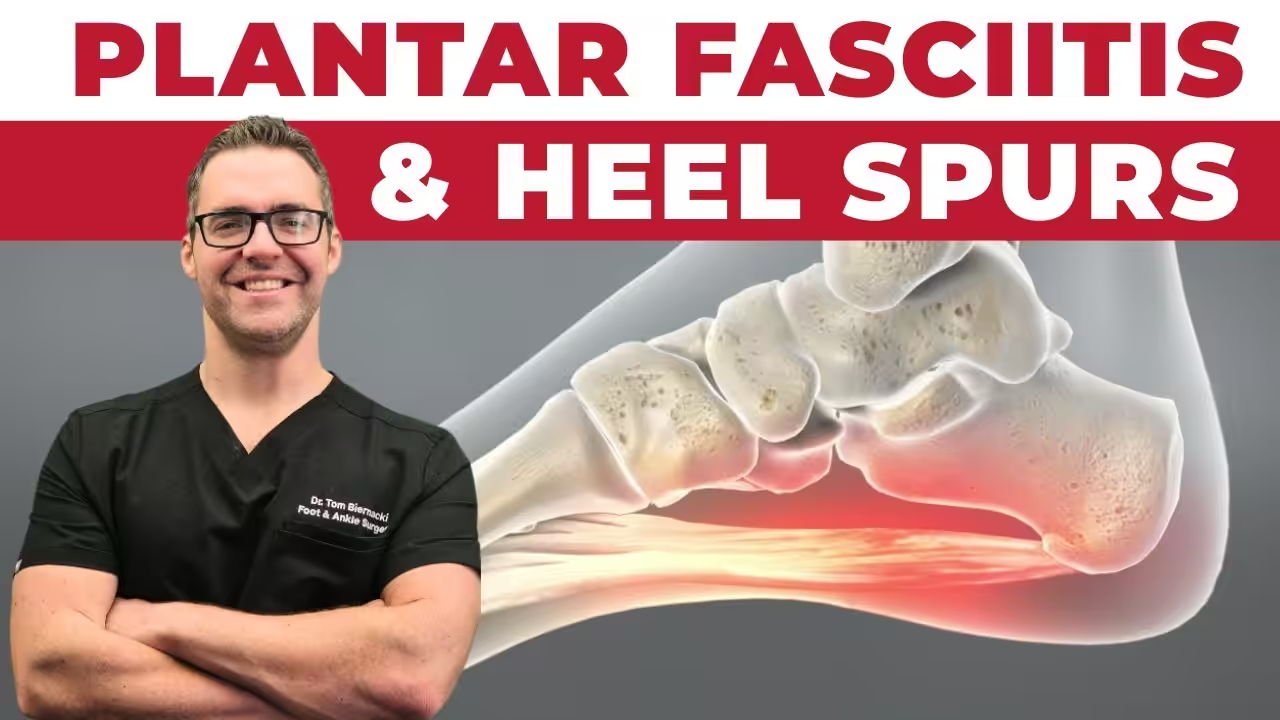
✅ Medically reviewed by Dr. Thomas Biernacki, DPM — Board-Certified Podiatrist · Last updated April 6, 2026
High Heels and Long-Term Foot Damage: What Years of Heel Wear Really Does
High Heels and the Foot: The Long-Term Reality
High-heeled shoes are worn by millions of women daily and are deeply embedded in professional and social dress expectations. The discomfort many wearers experience is widely accepted as a normal cost of fashion. What is less understood — and rarely discussed when purchasing decisions are made — is the cumulative biomechanical harm that regular high heel wear inflicts on the foot, ankle, knee, and spine over years and decades.
What Happens to Your Foot in a Heel
Even a 2-inch heel shifts approximately 60 percent of body weight onto the forefoot. A 3-inch heel shifts 75 percent or more. The metatarsal heads — designed to share load with the heel — bear forces they were not engineered to sustain continuously. The toes are compressed into the narrowing toe box, forced into flexion against a slope, and deprived of the space needed for normal splaying during push-off. The ankle is locked in sustained plantarflexion, shortening the Achilles tendon and calf musculature over time.
Short-Term Effects
Metatarsalgia — forefoot pain under the ball of the foot — is the most immediate consequence. Blisters from shoe friction, toe crowding causing corn formation at the interphalangeal joints, and general foot fatigue after prolonged wear are universal in regular high-heel wearers. The altered gait mechanics required to walk in heels increase energy expenditure and fatigue the lower leg musculature.
Long-Term Structural Consequences
Bunion formation and progression is accelerated by narrow-toe-box heels that chronically force the big toe toward the second. The first MTP joint is subjected to abnormal valgus stress with every step. Hammertoe deformity develops as the toes are repeatedly forced into flexion inside the toe box — over years, the flexor tendons shorten and the deformity becomes structural. Morton neuroma develops from chronic compression of the intermetatarsal nerves in the tight toe box. Calf muscle and Achilles tendon shortening is a documented consequence of regular heel wear. Women who wear heels daily for years develop measurably reduced Achilles flexibility — and when they switch to flat shoes, the now-shortened tendon is suddenly overloaded, producing plantar fasciitis and Achilles tendinopathy. Knee osteoarthritis risk is increased — the elevated heel increases the valgus moment at the knee, accelerating medial compartment cartilage wear in genetically susceptible individuals.
Mitigating the Damage
The safest recommendation is to minimize heel height — shoes with heels below 1.5 inches dramatically reduce forefoot loading compared to 3 and 4 inch heels. Wider toe boxes, even on heeled shoes, preserve more normal toe position. Metatarsal pads worn inside heeled shoes redistribute some forefoot pressure. Stretching the Achilles and calf after wearing heels, and spending time in flat, supportive footwear on non-dress days, counteracts some of the calf shortening effects. Alternating heel heights day to day avoids the cumulative loading that comes from wearing the same shoes every day.
When Damage Is Already Done
Women who have worn heels for decades and now have bunions, hammertoes, or chronic forefoot pain benefit from transitioning gradually to lower, wider shoes rather than switching abruptly to completely flat shoes — the shortened Achilles needs time to accommodate. Custom orthotics manage plantar fasciitis and metatarsalgia. For structural deformities that cause persistent pain, surgical correction with subsequent footwear modification provides lasting relief.
Recovering from High Heel Damage: Podiatric Rehabilitation for Michigan Women
Michigan women who have worn high heels consistently for years — and who are now experiencing bunions, hammertoes, ball-of-foot pain, or shortened Achilles tendons — have rehabilitation options that can meaningfully improve their foot function and comfort. At Balance Foot & Ankle, we develop individualized treatment plans for women recovering from chronic high heel use: progressive Achilles tendon stretching programs to address contracture, custom orthotics that redistribute pressure from overloaded forefoot areas, footwear transition guidance that allows gradual adaptation to lower heels without abrupt tendon overload, and surgical correction of bunions and hammertoes when deformity has progressed beyond conservative management. The foot changes from long-term high heel use are not irreversible — early intervention produces better outcomes than waiting until deformity is severe. Michigan women concerned about the long-term effects of high heel wear can call Balance Foot & Ankle at (810) 206-1402 for evaluation at our Howell or Bloomfield Hills office.
Related Treatment Guides
- Custom Orthotics & Footwear
- Plantar Fasciitis & Heel Pain Treatment
- Sports Foot & Ankle Injury Treatment
- Bunion Treatment
Michigan patients experiencing foot or ankle problems can schedule an appointment at Balance Foot & Ankle — with locations in Howell (4330 E Grand River) and Bloomfield Hills (43494 Woodward Ave #208). Call (810) 206-1402 for same-week availability.
Medical References & Sources
- American Podiatric Medical Association — Patient Education
- American Orthopaedic Foot & Ankle Society — Foot Conditions
Dr. Tom’s Pick: Women’s Shoe Comfort Inserts
📍 Located in Michigan?
Our board-certified podiatrists treat this condition at two convenient locations. Same-day appointments often available.
For women who want comfort without giving up their shoes — Foot Petals cushions work in heels, flats, and sandals.
- Foot Petals Heavenly Heelz — Cushioned heel insert for pumps and heels — eliminates slipping and ball-of-foot pain in dress shoes.
- Foot Petals Tip Toes — Metatarsal cushion for the toe box — stops forefoot pain in heels and narrow shoes.
📧 Get Dr. Tom’s Free Lab Test Guide
Discover the 5 lab tests every person over 35 should ask their doctor about — explained in plain English by a board-certified physician.
Affiliate disclosure: As an Amazon Associate, Balance Foot & Ankle earns from qualifying purchases.
Join 950,000+ Learning About Foot Health
Dr. Tom shares honest medical advice, supplement reviews, and treatment guides you won’t find anywhere else.
Subscribe on YouTube →Medically Reviewed by: Dr. Tom Biernacki, DPM — Board-Certified Podiatrist, Balance Foot & Ankle Specialists
Experiencing Foot Pain from Heels?
Long-term heel wear can cause lasting structural changes. Our podiatrists can evaluate the damage and create a recovery plan to restore comfortable function.
Clinical References
- Cronin NJ, et al. “Long-term use of high-heeled shoes alters the neuromechanics of human walking.” Journal of Applied Physiology. 2012;112(6):1054-1058.
- Borchgrevink GE, et al. “High-heeled shoes and musculoskeletal problems.” BMJ Open. 2016;6(1):e010053.
- Barnish MS, Barnish J. “High-heeled shoes and musculoskeletal injuries: a narrative systematic review.” BMJ Open. 2016;6(1):e010053.
Insurance Accepted
BCBS · Medicare · Aetna · Cigna · United Healthcare · HAP · Priority Health · Humana · View All →
Howell Office
3980 E Grand River Ave, Suite 140
Howell, MI 48843
Get Directions →
Bloomfield Hills Office
43700 Woodward Ave, Suite 207
Bloomfield Hills, MI 48302
Get Directions →
Your Board-Certified Podiatrists



Ready to Get Back on Your Feet?
Same-week appointments available at both locations.
Book Your Appointment
Dr. Tom Biernacki, DPM is a double board-certified podiatrist and foot & ankle surgeon at Balance Foot & Ankle Specialists in Southeast Michigan. With over a decade of clinical experience, he specializes in heel pain, bunions, diabetic foot care, sports injuries, and minimally invasive surgery. Dr. Biernacki is a member of the APMA and ACFAS, and his patient education content on MichiganFootDoctors.com and YouTube has reached over one million views.
Frequently Asked Questions
Can I see a podiatrist for heel pain without a referral?
How long does plantar fasciitis take to heal?
Should I walk on my heel if it hurts?
What does a podiatrist do for heel pain?
Recommended Products from Dr. Tom