
Medically reviewed by Dr. Tom Biernacki, DPM — Board-Certified Podiatric Surgeon — Balance Foot & Ankle, Howell & Bloomfield Hills, MI. Last updated April 2026.
Medically reviewed by Dr. Tom Biernacki, DPM
Board-certified podiatric surgeon | Balance Foot & Ankle
Last reviewed: April 2026
Treatment at Balance Foot & Ankle: Morton's Neuroma Treatment →
Quick answer: A Lisfranc injury is a fracture or dislocation of the tarsometatarsal joint complex in the midfoot. Displaced injuries require surgical fixation — either screw fixation or bridge plating — to restore midfoot alignment and prevent chronic pain and arthritis.
In this guide:
What Is a Lisfranc Injury?
 tarsometatarsal joint surgical repair podiatrist Howell MI” class=”wp-image-57352″ width=”1200″ height=”630″ loading=”eager” fetchpriority=”high” decoding=”async”/>
A Lisfranc injury involves disruption of the ligament complex and bone articulations of the tarsometatarsal joint — the row of joints connecting the metatarsal bones of the forefoot to the midfoot tarsal bones. The Lisfranc ligament specifically connects the first cuneiform to the base of the second metatarsal, forming the structural cornerstone of the transverse arch. When this complex is disrupted — whether by direct crush injury, indirect rotational mechanism, or hyperplantar flexion — the midfoot loses structural integrity and the forefoot can displace from the midfoot entirely.
Lisfranc injuries are commonly missed in emergency department settings because subtle displacement on non-weight-bearing radiographs can appear nearly normal. Any patient with midfoot swelling and tenderness after a foot injury who has not had weight-bearing radiographs specifically assessed for Lisfranc diastasis may have an inadequately diagnosed injury. At Balance Foot & Ankle, we maintain a high index of suspicion for this injury pattern and obtain appropriate imaging to prevent the consequences of delayed treatment.
Diagnosis

Weight-bearing radiographs — not supine X-rays — are essential for diagnosing subtle Lisfranc injuries. On weight-bearing views, diastasis greater than 2 millimeters between the first and second metatarsal bases, or step-off at any tarsometatarsal joint, indicates ligamentous disruption. CT scanning defines fracture geometry and comminution that influences surgical planning. MRI is most sensitive for isolated ligamentous injuries without fracture and for quantifying the extent of soft tissue disruption. Stress radiographs under anesthesia or fluoroscopy may be used when static imaging is equivocal.
Signs of a possible Lisfranc injury requiring urgent evaluation:
- Inability to bear weight on the midfoot after a twisting injury
- Bruising on the bottom of the foot (plantar ecchymosis)
- Swelling across the top of the midfoot that worsens rapidly
- Pain that increases with push-off or standing on tiptoes
- Widening between the first and second toes compared to the other foot
Surgical Treatment
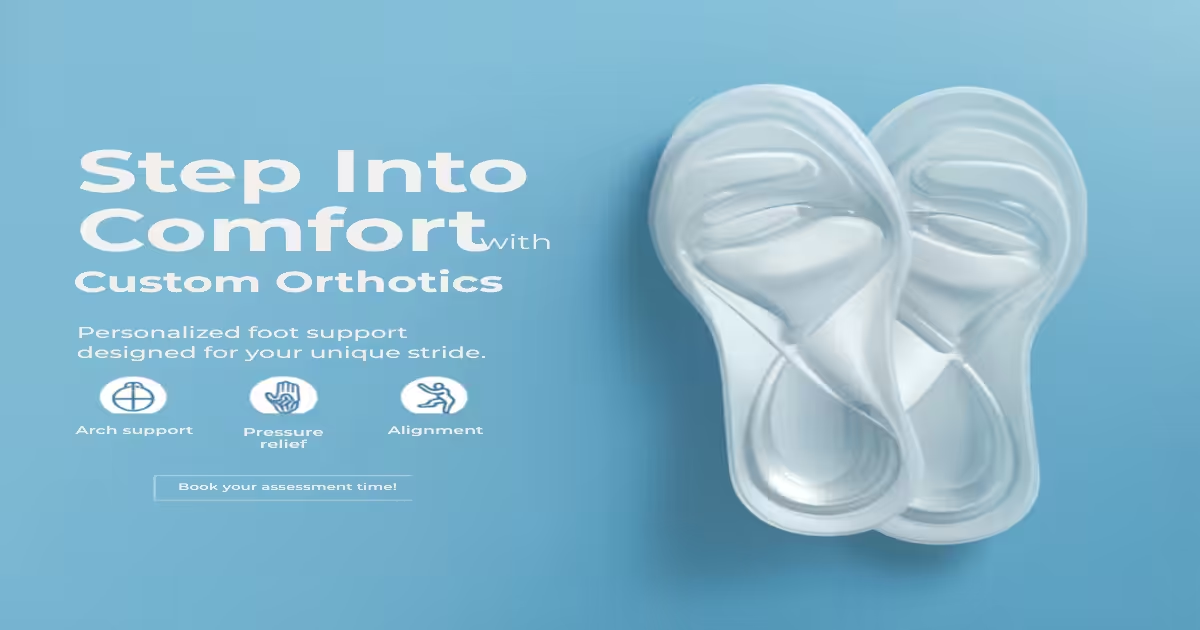 custom orthoticss and walking boot” class=”wp-image-57391″ width=”800″ height=”450″ loading=”lazy” decoding=”async”/>
Unstable Lisfranc injuries — those with diastasis or displacement on imaging — require surgical stabilization. Open reduction and internal fixation uses screws, bridge plates, or a combination to restore alignment and hold the reduced position while ligamentous healing occurs. Temporary fixation screws may be removed at 3 to 4 months to allow restoration of joint motion in cases where cartilage remains intact.
Primary arthrodesis — immediate fusion of the involved tarsometatarsal joints — is increasingly preferred for purely ligamentous injuries without fracture, as the joints that bear the greatest forces (first, second, and third tarsometatarsal) have limited motion in normal function and reliable fusion produces predictable, durable outcomes. Long-term comparative studies show equivalent or superior functional outcomes with primary fusion compared to ORIF for ligamentous Lisfranc injuries. Recovery requires non-weight-bearing for 6 to 8 weeks, progressive weight bearing over 3 to 4 months, and return to full activity by 6 to 12 months depending on injury severity.
Recovery Products After Lisfranc Surgery
In our clinic, we recommend these products for Lisfranc injury recovery:
BraceAbility Walking Boot — Essential during the protected weight-bearing phase. The rigid sole prevents midfoot motion while allowing controlled ambulation as healing progresses.
Powerstep Pinnacle Insoles — Transition support when returning to shoes after hardware removal. The semi-rigid arch cradle supports the reconstructed tarsometatarsal joint complex.
SB SOX Compression Socks — Midfoot swelling persists for months after Lisfranc surgery. Graduated compression worn daily significantly reduces edema and improves comfort during recovery.
Frequently Asked Questions
How long is recovery after Lisfranc surgery?
Non-weight-bearing for 6-8 weeks, walking boot transition for 4-6 weeks, and return to regular shoes by 3-4 months. Full recovery with sport return typically takes 9-12 months. Hardware removal is often performed at 3-4 months.
Can a Lisfranc injury heal without surgery?
Stable, non-displaced Lisfranc sprains can heal with casting and non-weight-bearing. However, any displacement greater than 2mm on weight-bearing X-rays typically requires surgical fixation for optimal long-term outcomes.
Will I have arthritis after a Lisfranc injury?
Post-traumatic midfoot arthritis develops in approximately 25-50% of Lisfranc injuries, even with proper surgical repair. Custom orthotics and activity modification manage symptoms effectively in most cases.
The Bottom Line
Lisfranc injuries are commonly missed on initial evaluation and require expert diagnosis with weight-bearing imaging. In our Howell and Bloomfield Hills clinics, Dr. Biernacki performs both open reduction internal fixation and primary fusion for Lisfranc injuries based on the specific injury pattern and patient factors. Early surgical intervention produces significantly better outcomes than delayed treatment.
Midfoot Injury? Get Expert Diagnosis
Same-day appointments available in Howell & Bloomfield Hills, MI
4.9★ | 1,123 Reviews | 3,000+ Surgeries
Or call: (810) 206-1402
Lisfranc Injury Surgery in Michigan
Displaced Lisfranc injuries typically require surgical fixation to restore midfoot alignment and prevent chronic arthritis. Our podiatric surgeons perform Lisfranc repair and reconstruction at our Howell and Bloomfield Hills offices.
Learn About Foot Fracture Surgery | Book Your Appointment | Call (810) 206-1402
Clinical References
- Myerson MS, et al. Fracture-dislocations of the tarsometatarsal joints: end results correlated with pathology and treatment. Foot Ankle. 1986;6(5):225-242.
- Kuo RS, et al. Outcome after open reduction and internal fixation of Lisfranc joint injuries. J Bone Joint Surg Am. 2000;82(11):1609-1618.
- Cochran G, et al. Lisfranc injuries in the athlete. Clin Sports Med. 2015;34(4):705-723.
Insurance Accepted
BCBS · Medicare · Aetna · Cigna · United Healthcare · HAP · Priority Health · Humana · View All →
Howell Office
3980 E Grand River Ave, Suite 140
Howell, MI 48843
Get Directions →
Bloomfield Hills Office
43700 Woodward Ave, Suite 207
Bloomfield Hills, MI 48302
Get Directions →
Your Board-Certified Podiatrists



Ready to Get Back on Your Feet?
Same-week appointments available at both locations.
Book Your Appointment
Dr. Tom Biernacki, DPM is a double board-certified podiatrist and foot & ankle surgeon at Balance Foot & Ankle Specialists in Southeast Michigan. With over a decade of clinical experience, he specializes in heel pain, bunions, diabetic foot care, sports injuries, and minimally invasive surgery. Dr. Biernacki is a member of the APMA and ACFAS, and his patient education content on MichiganFootDoctors.com and YouTube has reached over one million views.
Frequently Asked Questions
Why does the ball of my foot hurt when I walk?
When should I see a doctor for ball of foot pain?
- Diagnosis and Treatment of Plantar Fasciitis (PubMed / AAFP)
- Heel Pain (APMA)
- Hallux Valgus (Bunions): Evaluation and Management (PubMed)
- Bunions (Mayo Clinic)
Recommended Products from Dr. Tom