
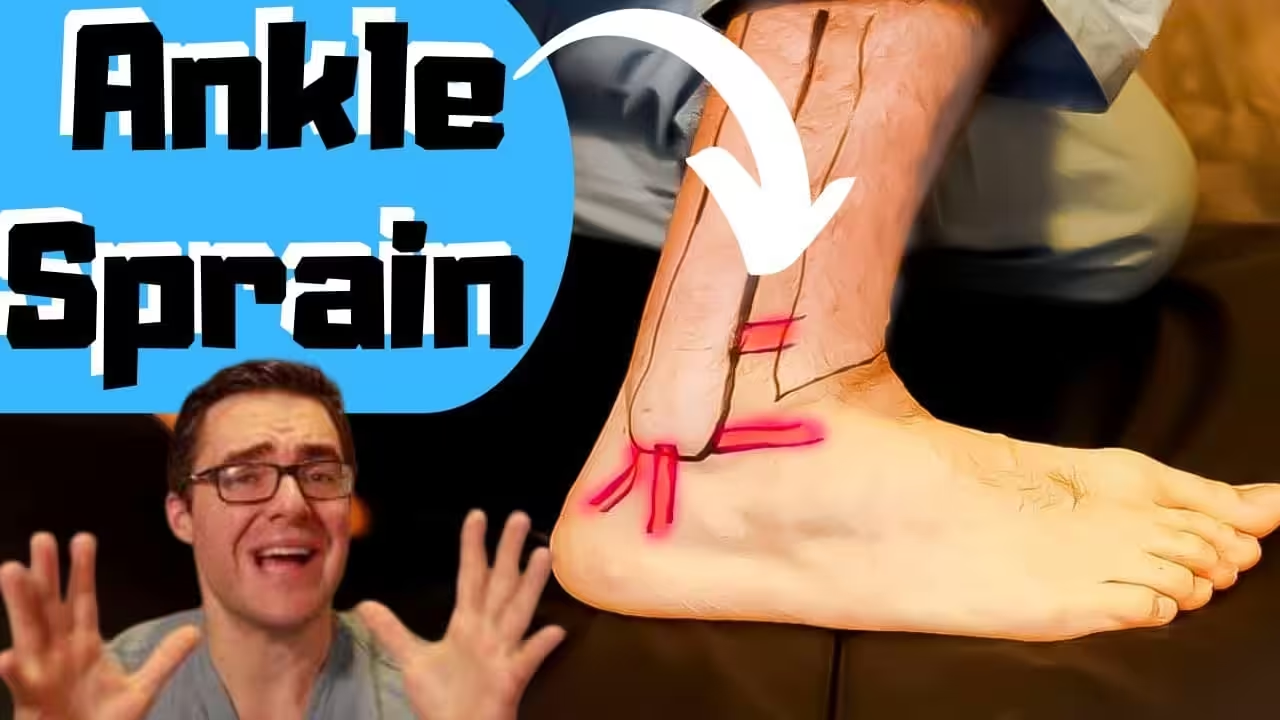
You are in the right place. Dr. Tom Biernacki, DPM, FACFAS — board-certified foot & ankle surgeon with 3,000+ surgeries — explains exactly what twisted ankle first aid means and what works. Call (810) 206-1402 for same-week appointment at Howell or Bloomfield Township.
Quick answer: Need a podiatrist’s opinion on this? Call Balance Foot & Ankle at (810) 206-1402 for same-week appointments in Howell or Bloomfield Township, Michigan. Most insurance accepted, including Medicare.

Medically Reviewed by Dr. Tom Biernacki, DPM, FACFAS — Board-certified podiatrist & foot surgeon | Balance Foot & Ankle | Last updated: May 2026
Quick Answer: Twisted Ankle First Aid
For a twisted ankle, apply RICE immediately: Rest (stop activity), Ice (15–20 min every 2 hours), Compression (elastic bandage), Elevation (above heart level). Get X-rays if you cannot bear weight or have bone tenderness — up to 15% of ankle sprains include a fracture. See a podiatrist within 24–48 hours for proper grading and a rehabilitation plan to prevent chronic instability.
A twisted ankle — also called a lateral ankle sprain — is the most common musculoskeletal injury in the United States, accounting for over 2 million emergency room visits annually. Despite being “common,” ankle sprains are frequently undertreated, leading to chronic instability, recurrent sprains, and cartilage damage in the ankle joint.
In our clinics at Howell and Bloomfield Township, we see twisted ankles every week. The most important thing we tell patients: how you treat the first 72 hours determines how well your ankle heals long-term.
Grades of Ankle Sprains
| Grade | Ligament Damage | Symptoms | Recovery |
|---|---|---|---|
| Grade 1 | Micro-tears only | Mild swelling, tender to touch | 1–2 weeks |
| Grade 2 | Partial ligament tear | Moderate swelling, bruising, some instability | 3–6 weeks |
| Grade 3 | Complete ligament rupture | Severe swelling, significant instability, unable to bear weight | 6–12+ weeks |
Step-by-Step First Aid for a Twisted Ankle
The RICE protocol remains the gold standard for the first 48–72 hours after an ankle sprain. Each component serves a distinct physiological purpose in controlling inflammation and protecting healing tissue.
Rest: Stop all weight-bearing activity immediately. Continuing to walk on a sprained ankle compresses inflamed tissue against bone and can convert a partial tear into a complete rupture. Use crutches if needed for the first 24–48 hours.
Ice: Apply a cold pack wrapped in a thin cloth to the lateral ankle for 15–20 minutes every 2 hours during waking hours. Ice reduces local blood flow, decreasing the release of inflammatory mediators that cause swelling. Do not apply ice directly to skin — frostbite is a real risk with prolonged direct contact.
Compression: Wrap the ankle with an elastic (ACE) bandage starting at the toes and working up the calf. Compression prevents edema from pooling in the joint space, which would extend pain and stiffness. The wrap should be snug but not so tight that it causes numbness or color change in the toes.
Elevation: Keep the ankle above the level of your heart whenever possible — ideally lying down with the foot propped on two pillows. Gravity-assisted venous and lymphatic drainage is one of the fastest ways to reduce acute ankle swelling.
Watch: Best Ways to Rehab Your Ankle Injury
Dr. Tom walks through the RICE protocol and early rehab exercises for twisted ankles:

Book a same-day ankle evaluation → | (810) 206-1402
When to Get X-Rays After a Twisted Ankle
The Ottawa Ankle Rules — a validated clinical decision tool used worldwide — specify that X-rays are needed if there is bone tenderness at the posterior tip of either malleolus OR at the base of the 5th metatarsal, OR if the patient cannot bear weight for 4 steps. These rules have a near-100% sensitivity for clinically significant fractures, meaning a negative Ottawa exam safely rules out most fractures.
| Ottawa Rule Criterion | X-Ray Needed? |
|---|---|
| Cannot take 4 steps immediately after injury | Yes |
| Bone tenderness over posterior fibula (lateral malleolus) | Yes |
| Bone tenderness over posterior tibia (medial malleolus) | Yes |
| Tenderness at base of 5th metatarsal (outside mid-foot) | Yes — foot X-ray too |
⚠️ When to see a podiatrist:
- Cannot bear weight at all after the injury
- Visible deformity or severe immediate bruising
- Numbness or tingling in the foot after the twist
- Swelling that rapidly worsens within 30 minutes
⭐ 4.6★ | 30K+ Sold
Essential support for twisted ankle recovery — stabilizes the joint and prevents re-injury while healing.
PowerStep Pinnacle Arch Support Insoles
⭐ 4.7★ | 50K+ Sold
Supports the entire kinetic chain during ankle recovery — reduces re-injury risk with every step.
Ready to Get Relief? Same-Week Appointments Available
Board-certified podiatric surgeon | Howell & Bloomfield Township, MI | Most Insurance Accepted
4.9★ | 1,123 Reviews | 3,000+ Surgeries
Or call: (810) 206-1402
Frequently Asked Questions
Should I wrap a twisted ankle immediately?
Yes — compression with an elastic bandage applied within the first 30–60 minutes after injury significantly reduces the degree of swelling that develops. Apply from the toes upward to prevent fluid pooling at the forefoot. Remove the wrap before sleeping to avoid restricting circulation overnight.
Can I walk on a twisted ankle?
For a Grade 1 sprain, walking is generally acceptable once the initial sharp pain subsides, as long as it is not significantly painful. For Grade 2–3 sprains, weight-bearing should be minimized for the first 24–48 hours. Walking through severe ankle pain delays healing and risks converting a partial tear to a complete one.
How long does a twisted ankle take to heal?
Grade 1 sprains: 1–2 weeks. Grade 2 sprains: 3–6 weeks. Grade 3 (complete ligament rupture): 8–12+ weeks, sometimes requiring bracing or surgical reconstruction. Without proper rehabilitation including proprioception training, up to 40% of ankle sprain patients develop chronic instability within 3 years.
What helps a twisted ankle heal faster?
Beyond RICE, the best evidence supports: early protected weight-bearing (once acute pain subsides), ankle proprioception exercises (balance board training), and avoiding NSAIDs after day 3 as they may impair ligament healing. A podiatrist can create a structured rehabilitation protocol tailored to your sprain grade and activity goals.
When should I see a doctor for a twisted ankle?
See a podiatrist if you meet any Ottawa Rule criteria, if swelling is severe and not improving after 48–72 hours of RICE, if you have had multiple ankle sprains (suggesting chronic ligament laxity), if you feel the ankle “giving way,” or if you are an athlete needing clearance to return to sport. Same-week appointments are available at Balance Foot & Ankle — (810) 206-1402.
Twisted Your Ankle? Get Properly Evaluated Today.
Dr. Tom Biernacki, DPM provides same-day ankle injury evaluations — including X-rays when needed.
Related: One Swollen Ankle — Causes | High Ankle Sprain Recovery | Signs of a Broken Ankle | Strained Ankle Ligaments
In-Office Treatment at Balance Foot & Ankle

If home treatment isn’t providing relief for your ankle condition, our podiatry team at Balance Foot & Ankle can help with same-week evaluations and advanced in-office care.
Doctor Hoy’s Natural Pain Relief Gel
Natural topical pain relief I use in our clinic. Arnica + camphor formula — apply directly to the area 3–4x daily. ($20–25)
Shop Doctor Hoy’s →
Dr. Tom Biernacki, DPM is a board-certified foot & ankle surgeon (ABFAS & ABPM) at Balance Foot & Ankle Specialists in Southeast Michigan. With over a decade of clinical experience, he specializes in heel pain, bunions, diabetic foot care, sports injuries, and minimally invasive surgery. Dr. Biernacki is a member of the APMA and ACFAS, and his patient education content on MichiganFootDoctors.com and YouTube has made him one of the most-followed foot & ankle educators on YouTube.
More questions patients ask
How long does an ankle sprain take to heal?
Grade 1: 1-3 weeks. Grade 2: 3-6 weeks. Grade 3: 6-12 weeks. Proper rehabilitation prevents chronic instability, which affects up to 40% of inadequately treated patients.
When should I see a doctor for a sprained ankle?
See a professional if you can't bear weight, notice significant swelling, heard a pop, have numbness, or pain hasn't improved after 5-7 days. Dr. Biernacki offers same-day urgent evaluations: 810-206-1402.
Can a sprained ankle heal without treatment?
Mild sprains may heal with rest, but undiagnosed tears frequently lead to chronic instability and early arthritis. Proper evaluation reduces long-term complication risk significantly.
Still have a question about coverage or cost? Book online and we will check your benefits before your visit: Book in Howell · Book in Bloomfield Township. Prefer to talk it through first? Call (810) 206-1402.