
Medically reviewed by Dr. Tom Biernacki, DPM, FACFAS
Board-certified foot and ankle surgeon | Balance Foot & Ankle, Howell and Bloomfield Township
Last reviewed: May 2026 · Updated: October 2026
Short answer: for most people with plantar fasciitis, the insole that works is a firm, ready-made arch support with a deep heel cup, worn from your first steps in the morning, inside a supportive shoe, together with daily calf and plantar fascia stretching. The over-the-counter insole we recommend most often in our offices is the PowerStep Pinnacle. Custom orthotics help some feet, but trials have not found them better than good off-the-shelf insoles for most people, so they are rarely the first step.
An insole is one part of the plan, not the whole plan. Below: what the research actually shows, what to look for, the insoles we recommend by foot type, how to wear them so they help, and when it is time to see a podiatrist instead.
![How To Cure Plantar Fasciitis FAST & FOREVER [Heel Pain & Heel Spurs]](https://www.michiganfootdoctors.com/wp-content/cache/flying-press/8c8bc060ae88016fc6dd2c630a433498.jpg)
Watch: Dr. Tom Biernacki on treating plantar fasciitis — MichiganFootDoctors YouTube
What insoles actually work for plantar fasciitis?
The plantar fascia is a thick band that runs from the heel to the base of the toes and works like a bowstring under the arch. Each time the arch flattens under load, and each time your toes bend as you push off, the band is pulled tight where it attaches to the heel. A good insole supports the arch and holds the heel’s fat pad in place, which takes some of that strain off while the tissue settles. That is the idea. Here is how it holds up in trials:
- Ready-made insoles did as well as custom ones. In the best-known randomized trial (Landorf and colleagues, 2006, 135 people), a firm prefabricated insole and a custom semi-rigid orthotic each gave a small improvement in function at 3 months compared with a soft, thin sham insole, and the two performed about the same. By 12 months the groups no longer differed.
- The benefit is real but modest. Two 2018 reviews of the trials reached the same conclusion: compared with sham insoles, orthoses give at most a small pain benefit, seen mainly at 7 to 12 weeks, and custom devices have not beaten prefabricated ones.
- Insoles work best as part of a plan. The 2023 physical therapy clinical practice guideline advises against using orthoses as the only treatment for short-term pain, and says they may be used alongside other care. Its strongest (grade A) recommendations include plantar fascia and calf stretching, taping, manual therapy, and night splints for people whose worst pain is the first steps in the morning.
- Most people get better. About 80% of people with plantar fasciitis improve within a year.
So the goal is not a miracle insert. It is a supportive, comfortable insole you will actually wear every day while stretching does its work, without spending custom-orthotic money before you know you need it.
What to look for in a plantar fasciitis insole
- Firm, contoured arch support. Press on the arch of the insole: it should hold its shape. A soft foam or gel insert feels good in the store but flattens under your weight and does little for the fascia.
- A deep heel cup. It cradles the heel and keeps the fat pad under the heel bone, where it cushions each step.
- Some cushioning on top. A firm shell with a softer top layer is easier to wear all day than a hard plastic plate.
- The right arch height for your foot. Flat or low arches usually do better with a more supportive shell; high arches need a higher-profile insole so the arch actually touches the foot.
- A fit that works in your shoes. Full-length insoles replace the factory insole in athletic, walking and work shoes. Slimmer 3/4-length styles fit dress shoes that have no removable insole.
The insoles we recommend most, by foot type
These are the insoles we already recommend on this site and in clinic. We do not rank them by a lab score; we match them to the foot in front of us. The names link to our detailed guides.
| Insole | Best for | Why we use it |
|---|---|---|
| PowerStep Pinnacle | First choice for most people with plantar fasciitis | Firm but flexible arch support, a deep heel cradle and dual-layer cushioning; fits most athletic, walking and work shoes |
| PowerStep Pinnacle Maxx | Flat feet and heavy overpronation | A firmer, more supportive Pinnacle with a built-in medial (varus) wedge for more control of the rolling-in motion |
| PowerStep Pinnacle High Arch | High arches and supination | A higher arch profile, so a high-arched foot is actually supported |
| CURREX RunPro | Runners | Made in three arch profiles (low, medium, high), so you can match your arch |
| Superfeet Green (now sold as All-Purpose Support High Arch) | People who want a very firm, high-profile shell and have roomy shoes | Firm, high-profile shell and a deep heel cup; can feel too hard during a painful flare |
Our first pick: PowerStep Pinnacle is the over-the-counter insole we recommend most often for plantar fasciitis, because it balances real arch support with enough cushioning to wear all day. Check the current price of PowerStep Pinnacle.
High arches: if your arch is high and the standard Pinnacle leaves a gap under it, the High Arch version is the one to try.

- High Arch Support: PowerStep supination insoles deliver firm, flexible high arch support plus a deep heel cradle for comfort, stability & motion control, helping align feet, reduce pain, and protect against ball & heel pressure.
- All Day Comfort & Support: PowerStep Pinnacle High shoe inserts for women and men use premium dual layer cushioning to deliver heel to toe comfort and responsive bounce back with every step, without going flat.
- Relieves & Helps Prevent Pain: PowerStep Pinnacle High insoles for supination can help alleviate common foot conditions often linked to supination, including plantar fasciitis, Achilles tendonitis, fat pad atrophy, and Morton’s neuroma.
- No Trimming: PowerStep insoles move easily from shoe to shoe. Inserts are sized by shoe size for footwear with removable factory insoles. Designed for walking, running, work & casual dress shoes; pairs well with best walking shoes for women and men.
- Made in the USA: We stand behind our PowerStep Insoles for women and men. Proudly made in the USA & backed by a 30-day money-back guarantee. HSA & FSA Eligible
Runners: CURREX RunPro comes in three arch heights, which makes it easier to get a good match. Check the current price of CURREX RunPro, or see our guide to insoles for running with plantar fasciitis.
Still deciding between brands? Our head-to-head reviews compare them directly: PowerStep vs Superfeet, CURREX RunPro vs PowerStep, Currex vs Superfeet and PowerStep Pinnacle vs Maxx vs Pulse.
Do heel cups and gel insoles help plantar fasciitis?
Heel cups and gel heel pads cushion the heel and are a reasonable add-on, especially if the pad under your heel feels thin. On their own, though, they do not support the arch, so they do little to reduce the pull on the plantar fascia. The most common mistake we see is a patient relying on a gel heel cup alone and wondering why the morning pain is still there. If you like the feel of gel, use it on top of real arch support rather than instead of it. More detail: gel vs foam insoles for plantar fasciitis.
How to wear insoles so they actually help
- Take out the factory insole. Never stack an arch support on top of the original insole; the shoe gets too tight and the arch sits in the wrong place.
- Break them in. Wear them a few hours a day for the first week and add time as they feel comfortable. Some arch pressure at first is normal. Sharp pain, new blisters or pain in a new spot is not.
- Start with your first steps. Plantar fasciitis usually hurts most on the first steps out of bed. Keep supportive shoes or slippers with real arch support next to the bed instead of walking barefoot.
- Wear them every day, not only on bad days. Insoles help by reducing strain over weeks, so wearing them now and then does little.
- Stretch every day. Pull the toes back to stretch the plantar fascia, and stretch the calf. Our plantar fasciitis stretches show how.
- Replace them when they wear out. When the arch shell starts to flatten or the top cover breaks down, the support is going. With daily wear, many people need a new pair within about a year. See how long orthotics last.
Store-bought insoles vs. custom orthotics
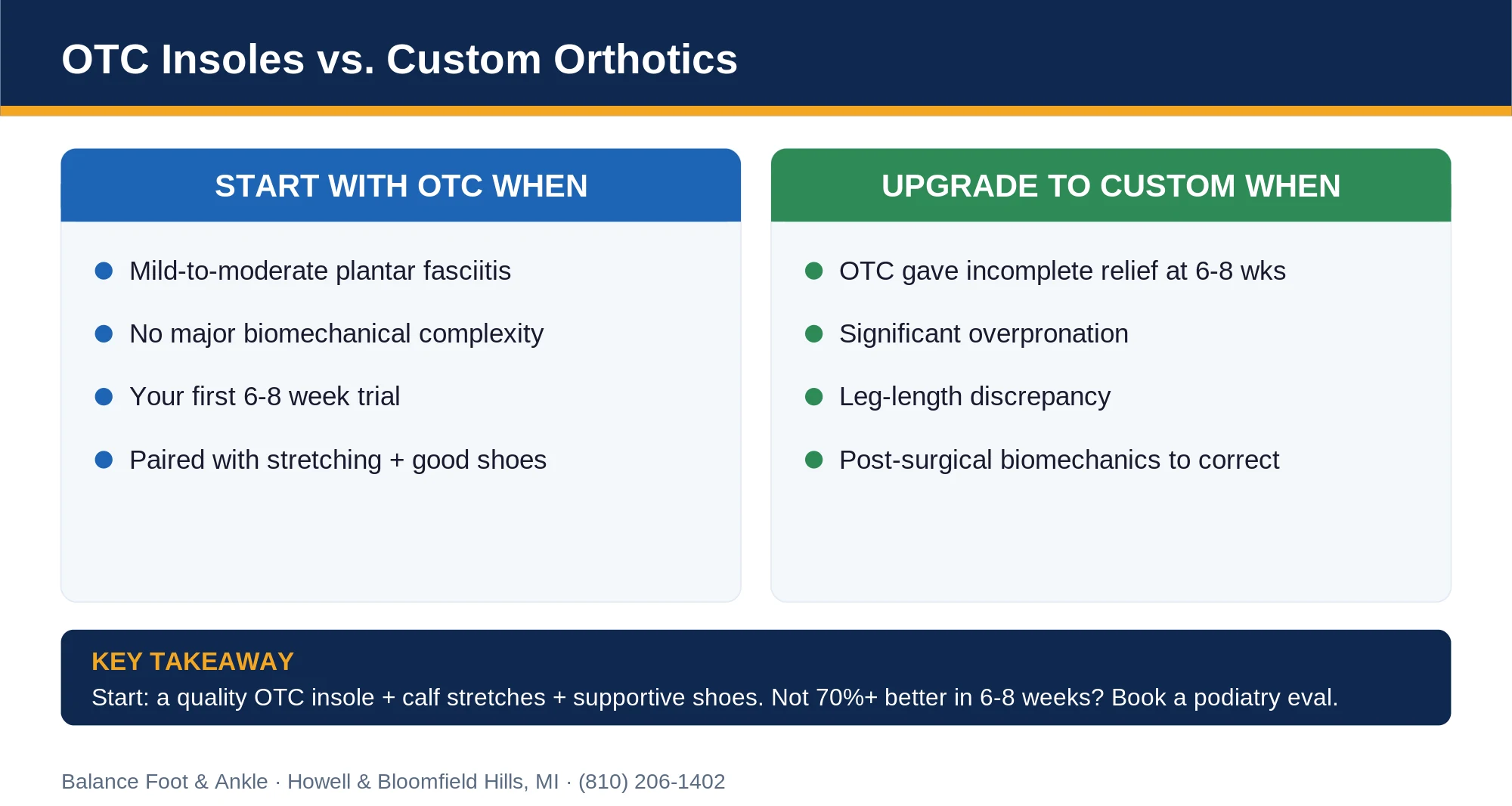
Because trials have found ready-made insoles to work about as well as custom orthotics for most people, we start with a good over-the-counter insole plus daily stretching for 6 to 8 weeks. Custom orthotics, made from a scan or mold of your feet after an exam, make more sense when:
- a good insole and stretching have not helped after 6 to 8 weeks of consistent use;
- your foot shape is far from average, such as a very flat foot, a rigid high arch or a leg length difference;
- you have more than one foot problem at once, such as plantar fasciitis with bunion or ball-of-foot pain;
- ready-made insoles do not fit your feet or the shoes you have to wear.
Custom orthotics cost more than store-bought insoles, and insurance coverage varies by plan, so ask our office or your insurer before you decide. Learn more about custom orthotics at Balance Foot & Ankle.
Insoles work best in the right shoes
An insole works with the shoe around it. Look for a firm heel counter, a sole that does not fold in half in the middle, a removable factory insole, and some heel-to-toe drop rather than a completely flat sole. Very soft, flexible or worn-out shoes undo much of what the insole does. Our best shoes for plantar fasciitis guide lists the models we recommend, and our brand guides cover the two we are asked about most: Brooks and Saucony.
Red flags: when insoles aren’t enough
- No real improvement after 6 to 8 weeks of consistent insole use and stretching: time for an exam and a treatment plan.
- Heel pain at rest or at night: can point to inflammatory arthritis, a stress fracture or, rarely, a bone tumor.
- Pain when the side of the heel bone is squeezed (not just at the bottom of the heel): a possible calcaneal stress fracture.
- Both heels at once, especially with back or joint stiffness: can be a sign of inflammatory arthritis.
- Numbness, tingling or burning into the arch or toes: possible nerve entrapment such as tarsal tunnel syndrome.
- A sudden pop followed by sharp pain and bruising: a possible plantar fascia tear.
- Pain that has lasted more than 3 months despite treatment: imaging such as ultrasound or MRI may be needed to look for other causes.
Frequently asked questions
What insoles do podiatrists recommend for plantar fasciitis?
Most podiatrists start with a firm, prefabricated arch support that has a deep heel cup, matched to your arch height, rather than a soft cushion insert. In our offices the one we recommend most is PowerStep Pinnacle, with the Maxx version for flat feet and the High Arch version for high arches. Custom orthotics are kept for feet that do not respond or do not fit a ready-made insole.
Should insoles for plantar fasciitis be hard or soft?
Firm underneath, softer on top. The arch shell should be firm enough to hold its shape under your weight, with a cushioned top layer for comfort. Very soft gel or foam feels good at first but gives the fascia little support; a completely rigid device can be hard to tolerate all day.
How long do insoles take to help plantar fasciitis?
Many people notice that walking is easier within a few weeks. In trials, the measurable benefit showed up within about 3 months, and full recovery often takes several months. About 80% of people improve within a year. If you are not clearly better after 6 to 8 weeks of insoles and daily stretching, have your foot examined.
Can insoles make plantar fasciitis worse?
They can if the arch is the wrong height or too rigid for your foot, or if you go straight to all-day wear. That can cause arch pain, blisters or pain in a new spot. Break new insoles in over a week or two; if pain gets sharper rather than easing, stop and have the fit checked.
Are custom orthotics better than store-bought insoles for plantar fasciitis?
For most people, no. Trials comparing them directly found similar results. Custom orthotics are worth considering when a good ready-made insole has not helped, when your foot shape is far from average, or when you have several foot problems at once.
Will I have to wear insoles forever?
Not necessarily. Many people wear them through recovery and then keep them for long days on their feet, exercise or work shoes. If your foot shape played a part in the plantar fasciitis, wearing supportive insoles longer can help keep it from coming back.
Do insoles help heel spurs?
Yes, because the pain usually comes from the plantar fascia, not the spur. A heel spur is a bony outgrowth that can form where the fascia pulls on the heel bone, and many people have one without any pain. Treating the plantar fasciitis with insoles and stretching relieves the pain in most cases; the spur itself rarely needs to be removed.
Can I move one pair of insoles between shoes?
Yes, as long as the shoes are the same size and have room for the insole. If you switch between work boots and sneakers every day, a second pair saves time and means you are never without support. For boots, see our insoles for work boots guide.
Still hurting after 6 to 8 weeks?
Our podiatrists can examine your foot, check whether your insole and shoes suit it, fit custom orthotics if you need them, and offer other plantar fasciitis treatment such as night splints, injections or shockwave therapy.
Book online: Howell or Bloomfield Township · or call (810) 206-1402
4330 E Grand River Ave, Howell MI 48843 · 43494 Woodward Ave #208, Bloomfield Township MI 48302
More insole guides
- Which PowerStep is best for plantar fasciitis
- Best insoles for flat feet and overpronation
- Best insoles for supination and high arches
- Best insoles for standing all day
- Best insoles for heavier bodies
- Best running insoles
- Arch support insoles
- Podiatrist-recommended orthotics
Sources
- Landorf KB, Keenan AM, Herbert RD. Effectiveness of foot orthoses to treat plantar fasciitis: a randomized trial. Arch Intern Med. 2006;166(12):1305-1310.
- Whittaker GA, Munteanu SE, Menz HB, Tan JM, Rabusin CL, Landorf KB. Foot orthoses for plantar heel pain: a systematic review and meta-analysis. Br J Sports Med. 2018;52(5):322-328.
- Rasenberg N, Riel H, Rathleff MS, Bierma-Zeinstra SMA, van Middelkoop M. Efficacy of foot orthoses for the treatment of plantar heel pain: a systematic review and meta-analysis. Br J Sports Med. 2018;52(16):1040-1046.
- Koc TA Jr, Bise CG, Neville C, Carreira D, Martin RL, McDonough CM. Heel pain – plantar fasciitis: revision 2023. J Orthop Sports Phys Ther. 2023;53(12):CPG1-CPG39.
- Trojian T, Tucker AK. Plantar fasciitis. Am Fam Physician. 2019;99(12):744-750.
- American Academy of Orthopaedic Surgeons. Plantar fasciitis and bone spurs. OrthoInfo.

Dr. Tom Biernacki, DPM is a board-certified foot & ankle surgeon (ABFAS & ABPM) at Balance Foot & Ankle Specialists in Southeast Michigan. With over a decade of clinical experience, he specializes in heel pain, bunions, diabetic foot care, sports injuries, and minimally invasive surgery. Dr. Biernacki is a member of the APMA and ACFAS, and his patient education content on MichiganFootDoctors.com and YouTube has made him one of the most-followed foot & ankle educators on YouTube.