
![Ball Of The Foot Pain Cheap & Fast Trick [Orthotic Metatarsal Pads] | Balance Foot & Ankle](https://www.michiganfootdoctors.com/uploads/2022/07/ball-of-the-foot-pain-cheap-fast-trick-orthotic-metatarsal-pads-1.avif)
Medically reviewed by Dr. Tom Biernacki, DPM
Board-certified podiatric surgeon | Balance Foot & Ankle
Last reviewed: May 2026

Metatarsal pad placement is the single biggest variable that determines whether the pad relieves ball-of-foot pain or makes it worse. The correct spot is just behind the painful metatarsal head — not on it.
You’ve come to the right podiatry team. Dr. Tom Biernacki, DPM, FACFAS — board-certified foot & ankle surgeon with 3,000+ surgeries — explains exactly what metatarsal pad placement means and what works. Call (810) 206-1402 for same-week appointment at Howell or Bloomfield Township.
Quick answer: Metatarsal Pad Placement Guide Ball Of Foot Pain has multiple potential causes including mechanical, neurological, vascular, and inflammatory. The patterns we see most often are overuse, poorly-fitted shoes, and biomechanical imbalance. Red flags requiring urgent evaluation: warmth/redness (infection), inability to bear weight (fracture), and unilateral swelling without injury (DVT). Call (810) 206-1402.
Medically reviewed by Dr. Tom Biernacki, DPM · Board-Certified Podiatric Surgeon · Last reviewed: April 2026 · Editorial Policy

Dr. Tom’s Top 3 Picks for Metatarsal Offload
A correctly-placed metatarsal pad is one of the cheapest, most effective interventions in podiatry — but most patients put it directly under the ball of the foot, where it makes pain worse. Place it PROXIMAL to the metatarsal heads, not under them. These three picks cover the progression: start with adhesive felt pads to confirm placement works, then graduate to a PowerStep insole with the met dome built in, and pair with a max-cushion shoe for all-day relief.
Best Adhesive Metatarsal Pad
Podiatrist Pros
- Self-adhesive felt pads you apply directly to the insole — positions proximal to the metatarsal heads, which is the whole point of a met pad
- Far cheaper than a custom metatarsal offload — ~$15 for 6 pads vs $300+ for custom orthotics
- Good for confirming a metatarsalgia diagnosis: if a correctly-placed met pad relieves pain, you’ve localized the lesion
Honest Cons
- Placement matters — most patients put them directly under the ball of the foot, which makes pain worse. Position just proximal to the metatarsal heads.
- Felt compresses after 4-6 weeks and loses effectiveness; treat as a consumable
- Not a substitute for an insole with a built-in metatarsal dome (PowerStep Pinnacle with Met) if you need long-term offload
Dr. Tom’s Take: The fastest, cheapest way to test whether metatarsal offload helps your pain. If it works, graduate to a PowerStep Pinnacle with Met or a custom orthotic with a rigid met pad built in.
Best Insole with Built-In Met Support
Podiatrist Pros
- Firm-but-flexible EVA arch with a deep heel cradle — matches the neutral-foot biomechanics most patients have
- Semi-rigid shell supports the medial arch without the painful break-in period that plastic-shell insoles (Superfeet) cause
- Fits most athletic, work, and casual shoes with a removable factory insole — doesn’t require volume shoes
- Antimicrobial top cover lasts ~12 months under daily wear; most patients re-order before it fails
Honest Cons
- Too firm for patients with fat-pad atrophy or advanced hallux rigidus — they need the softer Pulse version
- Full-length; you must remove the shoe’s factory insole. Won’t work in minimalist or low-volume dress shoes
Dr. Tom’s Take: My default orthotic recommendation for plantar fasciitis, mild-to-moderate flat feet, and Achilles tendonitis. Better value than Superfeet for 90% of patients, which is why I swapped it into our clinic kits three years ago.
Best Cushioned Shoe for Met Pain
Podiatrist Pros
- Maximum stack height in HOKA’s neutral line — unrivaled forefoot and heel cushioning
- Meta-Rocker geometry offloads the forefoot in mid-stance — huge win for metatarsalgia patients
- Wider base than prior Bondi generations improves stability despite the tall stack
- Nurses, retail workers, and anyone standing 10+ hours consistently report it’s the only shoe that gets them through a shift
Honest Cons
- Heaviest HOKA; not a speed shoe
- Tall stack feels unstable on trails or uneven surfaces
Dr. Tom’s Take: My top recommendation for nurses, teachers, warehouse workers, and anyone with forefoot pain or fat-pad atrophy. The meta-rocker unloads the ball of the foot in a way no other shoe matches.
Medically reviewed by Dr. Tom Biernacki, DPM — Board-Certified Podiatric Surgeon, Balance Foot & Ankle Specialists, Howell & Bloomfield Township, Michigan. Last updated April 2026.
Metatarsal Pads: How to Use Them Correctly for Ball-of-Foot Pain
The complete podiatrist’s guide to placement — plus 10 verified pads we actually use in clinic.
📞 Call (810) 206-1402Metatarsal pads are a simple, inexpensive, and highly effective tool for relieving ball-of-foot pain — but they only work when placed correctly. The frustrating truth is that most people who try metatarsal pads and get no benefit have simply placed them in the wrong position. A pad positioned incorrectly not only fails to help; it can actually worsen pain by adding pressure in the wrong location.
This guide covers everything we teach patients at Balance Foot & Ankle in Howell and Bloomfield Township: exactly where the pad belongs, step-by-step placement methods, the 10 pads we recommend (ranked by clinical tier), and when it’s time to move beyond pads to custom orthotics or other treatment.
Watch: Dr. Tom Demonstrates the Placement (3 minutes)
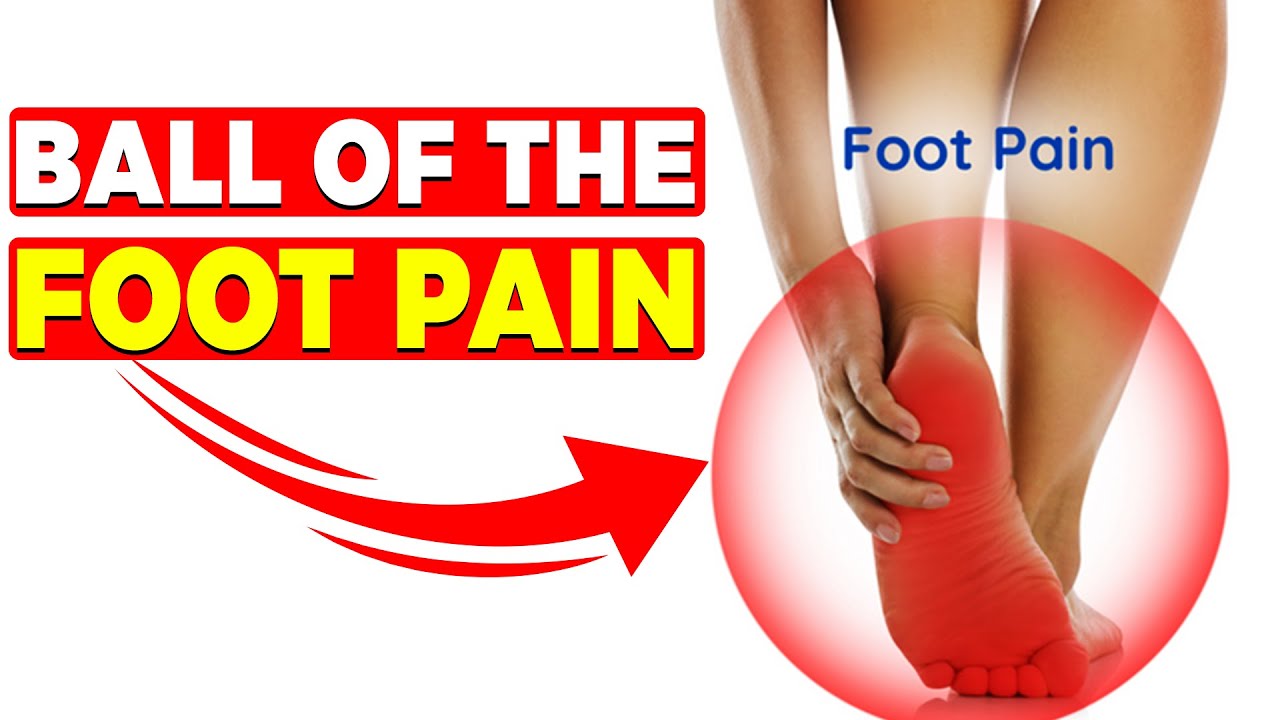
Dr. Tom Biernacki explains metatarsal pad placement on the Michigan Foot Doctors YouTube channel (950K++ subscribers).
What Do Metatarsal Pads Actually Do?
Metatarsal pads are dome-shaped or teardrop-shaped cushions placed inside the shoe just behind the metatarsal heads — the bony prominences at the ball of the foot that bear most of the forefoot’s load. When correctly positioned, a metatarsal pad redistributes pressure proximally (toward the arch), reducing the peak load on the metatarsal heads during the push-off phase of gait.
This simple mechanism is effective for:
- Metatarsalgia — general ball-of-foot pain from overloaded metatarsal heads
- Morton’s neuroma — reduces compression of the interdigital nerve between the third and fourth metatarsals
- Sesamoiditis — a sesamoid-specific variant can offload the hallux sesamoids
- Callus under the metatarsal heads — reduces the pressure that causes callus formation
- Lesser-toe MTP synovitis and capsulitis — including second-toe capsulitis and plantar plate injuries
- Freiberg’s disease — offloads the second metatarsal head in avascular necrosis
- Fat pad atrophy — restores cushioning lost with age or cortisone injections
The #1 Placement Rule (Why Most Pads Fail)
The single most important instruction for metatarsal pad placement: the pad should be placed just behind (proximal to) the metatarsal heads — NOT under them. This is the most common error and the reason most people don’t get results from metatarsal pads.
When the pad sits beneath the metatarsal heads, it simply adds more pressure directly to the painful area — the opposite of the intended effect. When the pad sits just behind the metatarsal heads (further toward the heel), it creates a gentle arch under the metatarsal shafts that unloads the heads and redistributes pressure proximally.
Clinical tip: The difference between a pad that works and one that doesn’t is often only 5 mm of positioning. At Balance Foot & Ankle, we demonstrate pad placement at every first visit because this small adjustment accounts for 80% of clinical success.
Step-by-Step Placement Guide
Method 1: Direct Foot Application (Best for First-Timers)
- Stand barefoot on a hard surface. With one hand, locate the metatarsal heads — the row of knobs at the ball of your foot, where your toes meet the sole.
- Draw a soft pencil or pen line across the foot at the back edge of the metatarsal heads (about 1–2 cm behind the ball of the foot).
- Peel the backing off the adhesive pad. Place the flat edge (or the wider end of a teardrop) directly on that pencil line.
- The dome of the pad should sit in the hollow between the transverse arch and the start of the metatarsal heads.
- Walk 30 seconds. You should feel a noticeable “lift” of the metatarsal heads — the pain should ease within a few steps. If it gets worse, the pad is too far forward — remove, move 5 mm back, reapply.
Method 2: Shoe/Insole Application (Best for Long-Term Use)
- Remove the shoe’s insole. If it’s not removable, you’ll need to work with the shoe’s built-in sole.
- Insert your foot on the insole and mark (with a pencil or dot of lipstick) the spot directly under the back of the metatarsal heads.
- Apply the pad on the insole with its flat/wide edge on that mark — dome pointing toward the heel.
- Re-insert the insole and test-walk the shoe. Adjust 5 mm at a time until the pain is gone.
- Once you find the correct position, trace around the pad with a pen so you can re-apply replacement pads in exactly the same spot.
Our Top 10 Metatarsal Pads (Podiatrist-Ranked by Clinical Tier)
Not all metatarsal pads are created equal. We’ve organized these by clinical tier: felt pads are what podiatrists actually use in the office (tier 1), hybrid pads are a close second (tier 2), gel pads are effective but softer (tier 3), and sleeve/specialty pads solve specific problems (tier 4). All 10 are verified in-stock on Amazon as of April 2026.
Affiliate disclosure: Links below are Amazon affiliate links. If you buy through them, we may earn a small commission at no extra cost to you. This supports our free content. We never recommend a product we wouldn’t use in our own clinics.
HAPAD Felt Metatarsal Pads (Medium Pair)
Pros
- Medical-grade wool felt used in clinical practice
- Holds shape for months (gel flattens in weeks)
- Precise teardrop contour matches metatarsal anatomy
- Made in USA, decades of podiatry use
Cons
- Not washable (felt)
- Bulkier than gel — may need a wider shoe
- Pair only — need multiple for shoe rotation

Dr. Jill’s Skived Felt Metatarsal Pads (12 Pack)
Pros
- 12 pads per pack — one for every shoe in rotation
- Skived thin edges prevent arch pressure
- Made by a 70-year podiatry supply brand
- Best cost-per-pad of any pro-grade option
Cons
- 1/4″ thickness may be too thick for tight dress shoes
- Self-adhesive loses tack after ~6 months of use
- Firm feel — not a ‘cushion’ if you expect softness

Pedag T-Form German Felt Metatarsal Pads
Pros
- True anatomical T-shape — most pads are just ovals
- Latex-backed for durability
- German-made, decades of European podiatry use
- Works for wide forefoot pain (not just central)
Cons
- Shape is less forgiving if placed incorrectly
- Thicker than slim gel pads — watch shoe room
- Limited size options
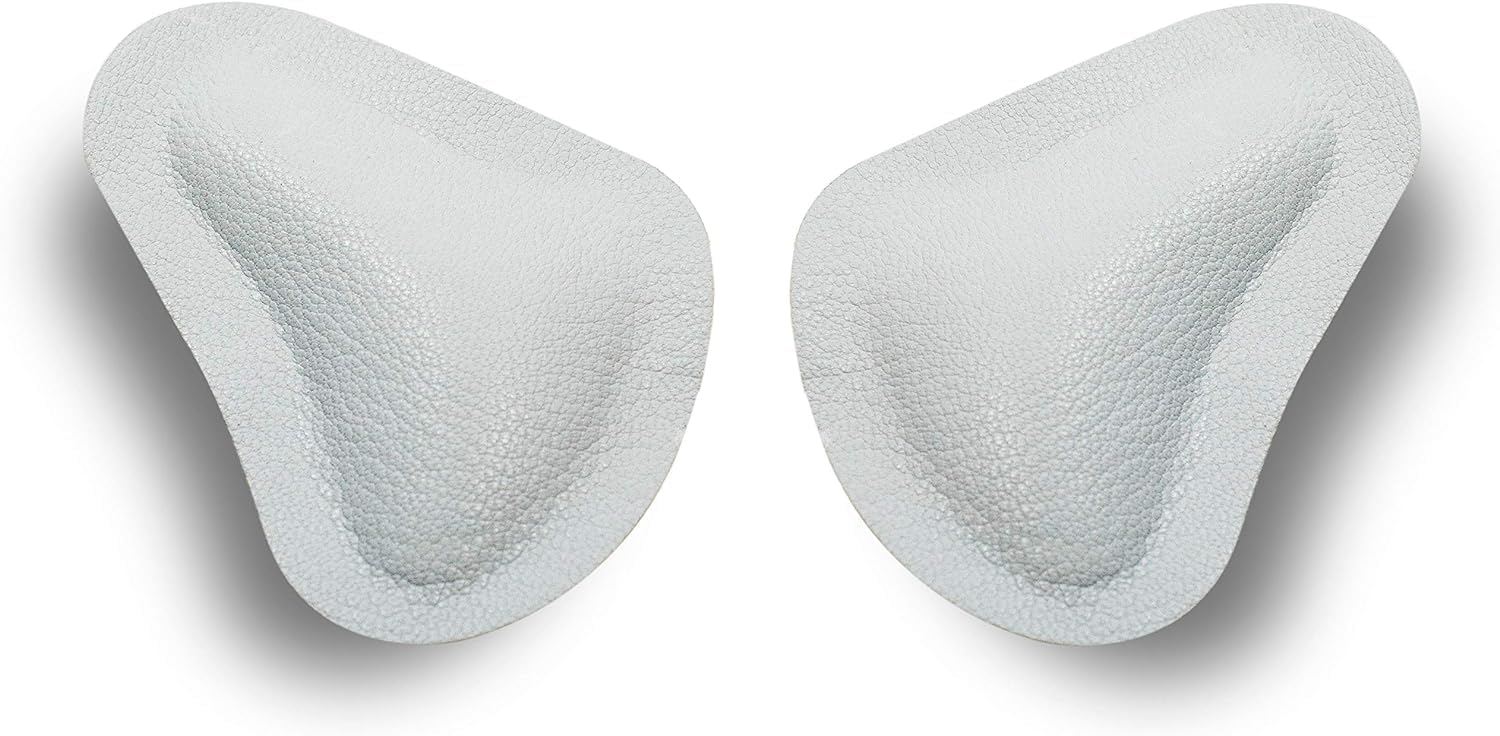
PowerStep Metatarsal Pads (Ball of Foot Cushions)
Pros
- From the #1 podiatrist-recommended insole brand
- Thin profile — fits dress shoes
- Antimicrobial top layer resists odor
- Integrates with PowerStep insoles
Cons
- Smaller sample size in reviews
- Self-adhesive; may need replacement faster than felt
- Less contour than anatomical felt pads

PediFix Deluxe Nylon-Covered Metatarsal Cushion
Pros
- Nylon cover prevents skin irritation
- From a 140-year-old podiatry supply brand
- Washable (hand-wash cold)
- No adhesive residue on insoles
Cons
- Migrates if not secured
- Single pad (need to buy two for pair)
- Less aggressive contour than felt teardrops

Dr. Frederick’s Original Metatarsal Pads (4 ct)
Pros
- 4-pack — forgiving for first-time users
- 4,000+ reviews = most social proof on Amazon
- Self-adhesive sticks directly to insole
- Low per-pad cost
Cons
- Gel-foam, not wool felt (flattens faster)
- Shape is a generic oval, not anatomical
- Adhesive can leave residue on insoles
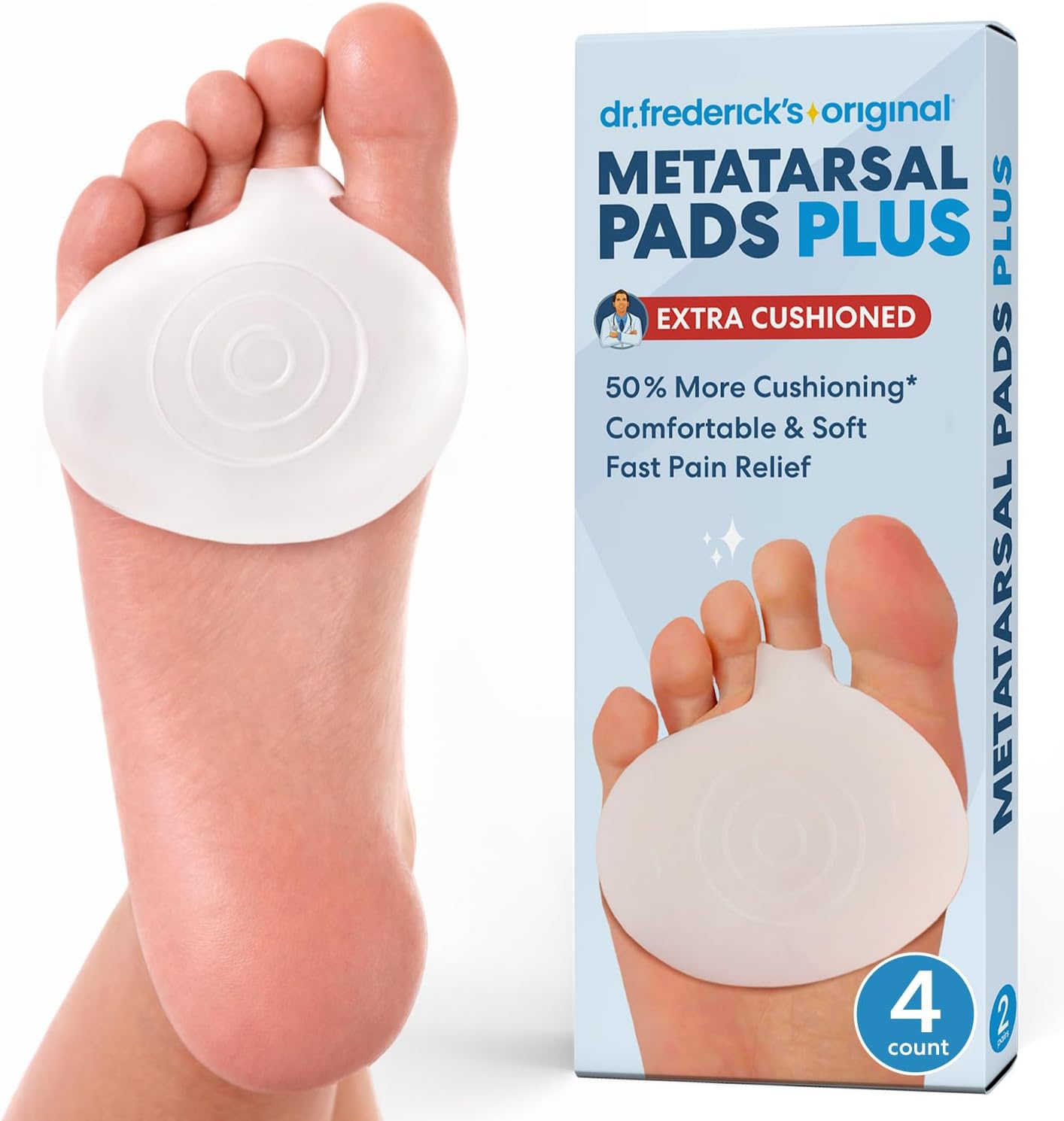
Silipos Softzone Pure Gel Metatarsal Pad
Pros
- Medical-grade hospital gel
- Washable and reusable
- Soft enough for sensitive/neuropathic feet
- Shock-absorbing for high-impact gait
Cons
- Less pressure redistribution than felt
- Flattens over 6-12 months of use
- Single pad per pack

ZenToes Metatarsal Pads
Pros
- Slim enough for dress shoes and flats
- Breathable fabric sleeve (no sweat build-up)
- Stays in place without adhesive
- Washable (air dry)
Cons
- Sleeve may be tight on wide feet
- Less firm redistribution than felt
- Requires removal when putting on/taking off shoes

Copper Compression Metatarsal Pad Sleeves
Pros
- Sleeve prevents all pad migration
- Pair included (not single)
- Washable, reusable
- Works barefoot around the house
Cons
- Adds bulk — check shoe fit with sleeve
- Sizing runs small
- Copper fabric claims are marketing, not medicine

Gel Metatarsal Pads for Morton’s Neuroma
Pros
- Targeted geometry for 3rd/4th metatarsal neuromas
- Gel cushioning on top of spreading function
- Fits all shoe types
- Washable
Cons
- Wrong geometry for 2nd/3rd interspace neuromas
- Smaller review sample
- Firm feel — may take adaptation period

Pads aren’t enough? We can help.
If you’ve tried multiple metatarsal pads without relief, you likely need a custom-contoured pad built into a 3D orthotic — something off-the-shelf can’t match. Come see us.
Book Same-Week Appointment Call (810) 206-1402Choosing the Right Metatarsal Pad
Three factors determine which pad works best for your foot:
1. Your diagnosis. Morton’s neuroma benefits most from specialty neuroma pads or firmer felt that aggressively spreads the third and fourth metatarsal heads. Generalized metatarsalgia responds well to any teardrop-shaped felt or gel dome. Sesamoiditis needs a sesamoid-specific modification (sometimes just a cut-out added to a regular pad).
2. Your shoe type. Thick wool felt pads require shoes with room above the insole — athletic shoes, casual shoes, boots. Slim gel pads fit dress shoes, flats, and loafers. Sleeves work in any shoe but add the most bulk.
3. Your skin. If adhesive pads irritate your skin or leave residue, choose a nylon-covered cushion (PediFix) or a sleeve style (Copper Compression, ZenToes). People with diabetic neuropathy should never use aggressive felt pads without supervision — talk to a podiatrist first.
How Often Should You Replace Your Pads?
Felt pads last 3–6 months with daily wear before the adhesive loses tack. Gel pads flatten in 4–8 weeks and lose the pressure-redistribution function (they still cushion, which can mask the loss). Sleeve-style pads last longer — typically 6–12 months with proper washing. Replace any pad immediately if the adhesive fails, if you notice sharp edges on the pad, or if your ball-of-foot pain returns after 2 weeks of good relief.
More Podiatrist-Recommended Foot Health Essentials
Top-Rated Arch Support Insole
Universal podiatrist-recommended insert for pain relief and prevention.
Foot Massage Ball
Daily 3-minute roll reduces most forms of foot and heel pain.
Moisture-Wicking Sock
Prevents fungus, blisters, and odor — the basics matter.
As an Amazon Associate, Balance Foot & Ankle earns from qualifying purchases. Product recommendations are based on clinical experience; prices and availability shown above update live from Amazon.
![Ball of the Foot Pain & Metatarsalgia Home Remedy [Metatarsal Pads]](https://www.michiganfootdoctors.com/wp-content/cache/flying-press/c9136d9119acf6945492e61ac89de644.jpg)
Watch: Ball of the Foot Pain & Metatarsalgia Home Remedy [Metatarsal Pads] — MichiganFootDoctors YouTube
When to See a Podiatrist
If foot or ankle pain has been bothering you for more than a few weeks, home care alone may not be enough. Balance Foot & Ankle offers same-week appointments at our Howell and Bloomfield Township clinics — no referral needed in most cases. Bring your current shoes and a short list of symptoms and we’ll build you a treatment plan in one visit.
Call Balance Foot & Ankle: (810) 206-1402 · Book online · Offices in Howell & Bloomfield Township
Frequently Asked Questions
How do I know if my metatarsal pad is in the right position?
Walk on it barefoot on a hard floor for 30 seconds. If the pad sits correctly (just behind the metatarsal heads), pressure should shift from the ball of the foot to the region just behind it — you’ll feel a subtle “lift” under the metatarsal shafts. If the pain gets worse, the pad is too far forward. If you feel nothing at all, the pad is too far back (under the arch, not the metatarsal shafts).
Can I wear metatarsal pads all day?
Yes, but start with 2 hours on day 1, then 4 hours on day 2, building up to all-day wear over a week. Your foot needs time to adapt to the new pressure distribution — going 12 hours on the first day often causes arch soreness. If you develop new pain in the arch or heel, the pad is likely too far posterior; move it 3–5 mm forward.
Do metatarsal pads work for plantar fasciitis?
Not typically. Plantar fasciitis involves the plantar fascia along the arch and heel — not the metatarsal heads. If your pain is in the heel or midfoot, you need heel cushioning or a full-length orthotic with arch support, not a metatarsal pad. See our plantar fasciitis guide for targeted treatment.
Metatarsal pad vs. ball-of-foot cushion — what’s the difference?
A metatarsal pad sits behind the metatarsal heads to redistribute pressure proximally. A ball-of-foot cushion sits under the metatarsal heads to add padding directly. Pads fix the mechanical cause; cushions mask the symptom. Cushions are fine for occasional high-heel use; pads are better for daily treatment of metatarsalgia and Morton’s neuroma.
How long until I feel relief from metatarsal pads?
When placed correctly, most patients notice a decrease in ball-of-foot pain within the first 5–10 steps. If you don’t feel any change in 48 hours of consistent wear, the pad is almost certainly in the wrong position. Remove, reposition 5 mm at a time, and retest. If you’ve tried 3+ positions without success, come see us — you may need a different pad shape or a custom orthotic with an integrated pad.
Can metatarsal pads cure Morton’s neuroma?
Pads don’t cure a neuroma (the nerve is already enlarged), but they significantly reduce symptoms in about 40–45% of patients by decompressing the nerve. Combined with a wider toe-box shoe and activity modification, pads form the first line of conservative treatment. If pads fail, next steps are a corticosteroid injection, sclerosing alcohol injections, or minimally invasive nerve surgery — all offered at Balance Foot & Ankle.
Which metatarsal pad is best for high heels?
High heels have almost no insole room, so slim gel or silicone options are the only practical choice — the ZenToes sleeve or a thin dot-style adhesive pad. Recognize that metatarsal pads in high heels are a compromise: the shoe itself concentrates load on the forefoot, so even a perfectly-placed pad only partially offsets that. For serious metatarsalgia, the real fix is reducing heel height to under 2 inches.
When Metatarsal Pads Aren’t Enough
Pads solve roughly 40–50% of metatarsalgia cases. If you’ve tried 2–3 placements of pads without relief, it’s time to escalate. Common next steps:
- Custom 3D orthotics — a precisely-positioned, custom-contoured metatarsal pad built into a full-length device. Dramatically more consistent than stick-on pads. Learn about our custom orthotics.
- Diagnostic imaging — ultrasound or MRI to rule out a plantar plate tear, stress fracture, or Morton’s neuroma requiring injection or surgery.
- Wider toe-box footwear — many forefoot conditions are caused by tight shoes in the first place. See our podiatrist-recommended shoes list.
- Corticosteroid injection — targeted anti-inflammatory for acute metatarsalgia, capsulitis, or neuroma flares.
- Shockwave or regenerative therapy — for chronic metatarsal pain that hasn’t responded to conservative care.
📍 Located in Michigan? Come See Us.
We treat metatarsalgia, Morton’s neuroma, sesamoiditis, and forefoot pain every day at our Howell and Bloomfield Township offices. Most new patients seen within the same week.
Book Your Appointment Call (810) 206-1402Clinical References
- Hsi WL, Kang JH, Lee XX. Optimum position of metatarsal pad in metatarsalgia for pressure relief. Am J Phys Med Rehabil. 2005;84(7):514–20.
- Kang JH, Chen MD, Chen SC, Hsi WL. Correlations between subjective treatment responses and plantar pressure parameters of metatarsal pad treatment in metatarsalgia patients: a prospective study. BMC Musculoskelet Disord. 2006;7:95.
- Bus SA, Ulbrecht JS, Cavanagh PR. Pressure relief and load redistribution by custom-made insoles in diabetic patients with neuropathy and foot deformity. Clin Biomech. 2004;19(6):629–38.
- Thomson CE, Gibson JN, Martin D. Interventions for the treatment of Morton’s neuroma. Cochrane Database Syst Rev. 2004;(3):CD003118.
- American College of Foot and Ankle Surgeons. Clinical Practice Guideline: Diagnosis and Treatment of Forefoot Disorders. J Foot Ankle Surg. 2009.
Your Board-Certified Michigan Podiatrists

Dr. Tom Biernacki, DPM
Board-Certified Podiatric Surgeon · 3,000+ surgeries · 950K++ YouTube subscribers


Balance Foot & Ankle Specialists serves Howell, Brighton, Hartland, Fenton, Pinckney, Bloomfield Township, Birmingham, Troy, West Bloomfield, and surrounding Livingston and Oakland County communities. We accept BCBS, Aetna, UnitedHealthcare, Cigna, Medicare, and most major insurance plans. See our insurance & costs page for current coverage.
Watch: Dr. Tom explains
Podiatrist-recommended products
As an Amazon Associate, Dr. Tom earns from qualifying purchases.
Place proximal (behind) the metatarsal heads, not directly under.
View on Amazon →Built-in metatarsal support if adhesive pads shift around.
View on Amazon →Topical menthol for ball-of-foot soreness while pads work.
View on Amazon →Ice the forefoot after long walks or standing shifts.
View on Amazon →Related resources
Ready to solve this? Book today.
Same-week appointments · Howell & Bloomfield Township · 4.9★ (1,123+ reviews)
☎ (810) 206-1402Book Online →Differential Diagnosis: What Else Could It Be?
Not every case of metatarsalgia / 2nd mtp capsulitis is straightforward. In our clinic we routinely rule out three look-alike conditions before confirming the diagnosis. If your symptoms don’t match the classic presentation, one of these may explain the pain — which is why physical exam matters more than self-diagnosis.
| Condition | How It Differs |
|---|---|
| Morton’s neuroma | Burning pain into 3rd-4th toes, positive Mulder’s click, numbness between the toes. |
| Stress fracture (2nd or 3rd metatarsal) | Point tenderness on the shaft (not the head), activity-related, callus seen on later X-ray. |
| Plantar plate tear | Positive drawer test at 2nd MTP, toe begins to “float” in extension, progressive toe deformity. |
Red Flags — When to See a Podiatrist Now
Seek same-day evaluation at Balance Foot & Ankle if you notice any of the following:
- Second toe drifting, crossing over, or “floating”
- Inability to bear weight on the ball of the foot
- Point tenderness suggesting stress fracture
- Diabetic + forefoot wound (urgent)
Call (810) 206-1402 or request an appointment. Our Howell and Bloomfield Township offices reserve same-day slots for urgent foot and ankle issues.
In Our Clinic: What We See
Clinical perspective from Dr. Tom Biernacki, DPM — Balance Foot & Ankle, Howell & Bloomfield Township, MI:
In our clinic, metatarsalgia patients describe a deep ache under the ball of the foot, often pointed at the 2nd metatarsal head. The pain is worse barefoot or on hard surfaces. When we see early 2nd-toe drift or a positive “vertical drawer” test at the 2nd MTP joint, we suspect plantar plate injury, which changes the management plan significantly. Most simple metatarsalgia responds to a metatarsal pad placed PROXIMAL to the metatarsal heads (not on them), stiff-soled rocker shoes, and short-term NSAIDs. Plantar plate tears may need taping, toe crest pads, or surgical repair.
Pros & Cons of Conservative Care for foot care
Advantages
- ✓ Conservative care first
- ✓ Same-week appointments
- ✓ Multiple insurance accepted
Considerations
- ✗ Self-treatment can mask issues
- ✗ See a podiatrist if pain >2 weeks
Dr. Tom’s Recommended Products for foot care
Affiliate disclosure: As an Amazon Associate, Balance Foot & Ankle earns from qualifying purchases. We only recommend products we use with patients.
Footnanny Heel Cream Dr. Tom’s Pick
Best for: Daily moisturizer for cracked heels
Ready to Get Back on Your Feet?
Same-week appointments in Howell + Bloomfield Township. Most insurance accepted. Dr. Tom Biernacki, DPM & team.
Book Today — Same-Week Appointments Available
Call Now: (810) 206-1402
About Your Care Team at Balance Foot & Ankle
Dr. Tom Biernacki, DPM · Board-Certified Foot & Ankle Surgeon. Specializes in conservative-first care, minimally invasive bunion surgery, and complex reconstruction.
Dr. Carl Jay, DPM · Accepting new patients. Specializes in sports medicine, athletic injuries, and routine podiatric care.
Dr. Daria Gutkin, DPM, AACFAS · Accepting new patients. Specializes in surgical reconstruction and pediatric podiatry.
Locations: 4330 E Grand River Ave, Howell, MI 48843 · 43494 Woodward Ave Suite 208, Bloomfield Township, MI 48302
Hours: Mon–Fri 8:00 AM – 5:00 PM · (810) 206-1402
Frequently Asked Questions
When should I see a doctor?
See a podiatrist if pain persists past 2 weeks, prevents normal activity, or is accompanied by red-flag symptoms (warmth, swelling, numbness, inability to bear weight).
Can I treat this at home?
Mild cases respond to RICE protocol (rest, ice, compression, elevation), supportive shoes, and OTC anti-inflammatories. Persistent symptoms need professional evaluation.
How long does it take to heal?
Most soft tissue injuries resolve in 2-6 weeks with appropriate care. Bone injuries take 6-12 weeks. Chronic conditions need longer-term management.
What is Metatarsalgia?
Metatarsalgia is a common foot/ankle condition that affects mobility and quality of life. Understanding the underlying cause is the first step in successful treatment. Our podiatrists at Balance Foot & Ankle perform a hands-on biomechanical exam, review your activity history, and use diagnostic imaging when appropriate to identify the root cause—not just treat the symptom. Many patients have been told to “rest and ice” without a deeper diagnostic workup; our approach is different.
Symptoms and warning signs
Common signs of metatarsalgia include pain that worsens with activity, morning stiffness, swelling, tenderness when palpated, and difficulty bearing weight. If you experience sudden severe pain, inability to walk, visible deformity, numbness or color change, contact our office the same day or visit urgent care—these can signal a more serious injury such as a fracture, tendon rupture, or vascular compromise. Diabetics with any foot wound should seek same-day care.
Conservative treatment options
Most cases of metatarsalgia respond to non-surgical care: structured rest, supportive footwear changes, custom orthotics, targeted stretching and strengthening protocols, anti-inflammatory medications when medically appropriate, and in-office procedures such as ultrasound-guided injections. We also offer advanced therapies including laser therapy, EPAT/shockwave, regenerative injections, and image-guided procedures. Treatment is sequenced from least invasive to most invasive, and we explain the rationale at every step.
When is surgery considered?
Surgery is reserved for cases that fail 3-6 months of well-structured conservative care, when there is structural pathology (severe deformity, complete tear, advanced arthritis), or when imaging shows damage that will not heal without intervention. Our surgeons have performed 3,000+ foot and ankle procedures and prioritize minimally-invasive techniques whenever appropriate. We discuss recovery timelines, return-to-activity milestones, and realistic outcome expectations before any procedure is scheduled.
Recovery timeline and prevention
Recovery from metatarsalgia varies based on severity and chosen treatment path. Conservative cases often improve within 4-8 weeks with consistent adherence to the protocol. Post-procedural recovery may range from a few days (in-office procedures) to several months (reconstructive surgery). Long-term prevention involves footwear assessment, activity modification, structured strengthening, and regular check-ins with your podiatrist if you have a history of recurrence. We provide written home-exercise plans and digital follow-up support.
Ready to feel better?
Same-week appointments available in Howell and Bloomfield Township, Michigan.
Book Your VisitReady for Expert Care?
Same-week appointments in Howell & Bloomfield Township, MI.
4.9★ | 1,123 Reviews | 3,000+ Surgeries
Or call: (810) 206-1402

Dr. Tom Biernacki, DPM is a board-certified foot & ankle surgeon (ABFAS & ABPM) at Balance Foot & Ankle Specialists in Southeast Michigan. With over a decade of clinical experience, he specializes in heel pain, bunions, diabetic foot care, sports injuries, and minimally invasive surgery. Dr. Biernacki is a member of the APMA and ACFAS, and his patient education content on MichiganFootDoctors.com and YouTube has made him one of the most-followed foot & ankle educators on YouTube.