

Medically reviewed by Dr. Tom Biernacki, DPM · Board-Certified Podiatric Surgeon · Last reviewed: April 2026 · Editorial Policy
Quick Answer
PRP Injections for Foot & Ankle: What to Expect — relates to foot pain — typically caused by overuse, footwear, or biomechanics. Most patients improve in 6-12 weeks with conservative care. Same-week appointments in Howell + Bloomfield Township: (810) 206-1402.
▶ Watch
Medically Reviewed by Dr. Tom Biernacki, DPM — Board-Certified Podiatrist, Balance Foot & Ankle Specialists, Michigan. Last updated April 2026.
Platelet-rich plasma (PRP) therapy has moved from experimental to mainstream in foot and ankle medicine over the past decade. It is now one of the most frequently requested treatments by patients who have done their own research — and one of the most discussed options at podiatry consultations. Understanding what PRP actually is, what conditions it evidence-supports, and what to realistically expect helps patients make informed decisions.
What Is PRP?
PRP is an autologous (from the patient’s own body) concentrated preparation of platelets and growth factors. The preparation process:
- A small volume of the patient’s blood (approximately 15–60 mL) is drawn from a peripheral vein
- The blood is centrifuged to separate plasma, platelets, and red blood cells
- The platelet-rich layer is extracted — typically concentrating platelets 3–5 times above baseline blood levels
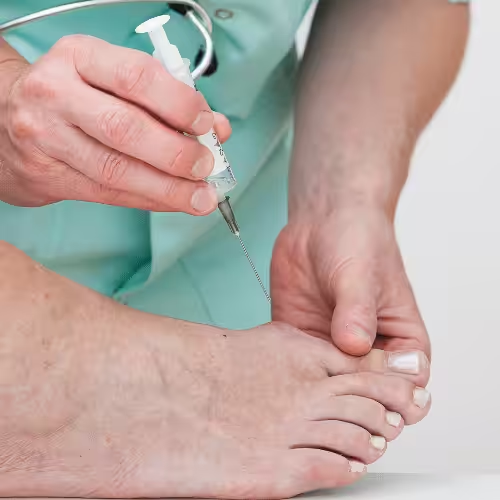
- The concentrated PRP is injected precisely into the target tissue
Platelets are the primary carriers of growth factors — bioactive proteins that initiate and regulate tissue repair. The growth factors concentrated in PRP include PDGF (platelet-derived growth factor), TGF-β (transforming growth factor), VEGF (vascular endothelial growth factor), IGF-1 (insulin-like growth factor), and EGF (epidermal growth factor). When injected into degenerative or injured tissue, these growth factors stimulate fibroblast proliferation, collagen synthesis, neovascularization, and cellular repair.
Conditions Treated with PRP in Foot and Ankle
Plantar Fasciitis
Multiple randomized controlled trials compare PRP to corticosteroid injection for plantar fasciitis. The consistent finding: PRP produces inferior short-term (4–8 week) pain relief compared to corticosteroid, but superior long-term (3–12 month) outcomes — with pain scores continuing to improve at 12 months in the PRP group as biological repair occurs, while corticosteroid benefit wanes. For patients with recurrent plantar fasciitis or those who have had prior corticosteroid injections without lasting relief, PRP is the preferred injectable option.
Achilles Tendinopathy
PRP for Achilles tendinopathy has a mixed evidence base — some RCTs show superiority to saline, others show equivalence. The current consensus is that PRP is appropriate for moderate-to-severe Achilles tendinopathy that has failed eccentric loading and other conservative measures, particularly insertional disease where corticosteroid is contraindicated.
Ankle Arthritis
Intra-articular PRP injection for ankle osteoarthritis targets inflammatory cytokines in the joint space and provides growth factors to remaining articular cartilage. Evidence shows significant pain reduction for 6–12 months in mild-to-moderate ankle arthritis. PRP is generally superior to hyaluronic acid injection and comparable to corticosteroid for ankle arthritis, with a better safety profile for repeated injections.
Peroneal and Posterior Tibial Tendinopathy
Ultrasound-guided PRP injection into the peroneal tendon sheath or along the posterior tibial tendon provides a targeted healing stimulus for tendinopathic tissue. Evidence is largely extrapolated from Achilles and patellar tendinopathy literature; clinical experience supports its use for chronic tendinopathy refractory to eccentric loading.
What to Expect at Your PRP Appointment
Before: Discontinue NSAIDs (ibuprofen, naproxen) for 1–2 weeks before injection — NSAIDs impair platelet function. Corticosteroids should be avoided for 3–4 weeks. Eat normally and stay hydrated. No specific preparation for the foot.
During: Blood draw takes 5–10 minutes. Centrifugation takes 10–15 minutes. Injection with ultrasound guidance takes approximately 5 minutes. Total visit: 30–45 minutes.
After: Soreness and swelling at the injection site for 2–7 days — this is expected and reflects the intended inflammatory response. Ice and elevation are helpful. Avoid NSAIDs for 2–4 weeks after injection. Reduced activity for 48–72 hours; normal walking is permitted.
Timeline: PRP works over weeks to months. Maximum benefit typically occurs at 3–6 months post-injection. Most protocols involve 1–3 injections spaced 4–6 weeks apart for tendinopathy; single injection protocols are more common for arthritis.
Insurance Coverage
Most commercial insurance plans and Medicare do not currently cover PRP injections for musculoskeletal conditions — it is typically an out-of-pocket expense. Dr. Biernacki discusses cost, likely response, and alternative options at your consultation to ensure you have complete information before proceeding.
Interested in PRP for Heel Pain, Achilles, or Ankle Arthritis?
Dr. Biernacki at Balance Foot & Ankle performs ultrasound-guided PRP injections for plantar fasciitis, Achilles tendinopathy, and ankle arthritis. Same-week consultations at Bloomfield Township and Howell.
📞 (810) 206-1402 | Request a Consultation →
📍 Located in Michigan?
Our board-certified podiatrists treat this condition at two convenient locations. Most new patients are seen the same week.
More Podiatrist-Recommended Cortisone Essentials
Hoka Clifton 10

- JACQUARD KNIT UPPER
- Lining Textile
Max-cushion everyday shoe — podiatrist favorite for walking and running.
PowerStep Pinnacle Insole

- The Pinnacle Full length insoles for men & women provide maximum cushioning, from high activity to moderate support. The PowerStep arch support shape provides stability to the foot and ankle, helping to relieve foot pain.
- When you spend all day on your feet, every step counts. PowerStep insoles are a podiatrist-recommended orthotic to help relieve & prevent foot pain related to athletes, runners, Plantar Fasciitis, heel spurs & other common foot, ankle & knee injuries
- The Pinnacle plantar fasciitis insoles offer superior heel cushioning and arch support. The dual-layer cushioning is designed to reduce stress and fatigue, while PowerStep premium arch support is designed for plantar fasciitis relief.
- The PowerStep Pinnacle arch support inserts for men & women can be worn in a variety of shoe types such as; athletic, walking, running, work & some casual shoes. Orthotic Inserts are ordered by shoe size, no trimming required.
- Made in the USA & backed by a 30-day money-back guarantee. PowerStep orthotic inserts for men & women are designed for shoes where the factory insole can be removed. HSA & FSA Eligible
The podiatrist-recommended over-the-counter orthotic.
OOFOS Recovery Slide

- The Original Recovery Footwear.
- Finding Your Size – For your perfect fit, consult the “size chart” link above. Wear a half size? In general, we recommend that women who wear a ½ size size UP, and men who wear a ½ size size DOWN
- OOahh – An evolution of the OOriginal, the OOahh slide features our proven foundation of OOfoam technology + patented footbed design with a slide-style strap that has become a best-seller in the OOFOS line
- OOfoam Technology – Our revolutionary OOfoam technology absorbs 37% more impact than traditional footwear foams to reduce the stress on your feet, joints & back. Plus, the closed-cell foam is machine washable and designed to minimize odor
- Patented Footbed – Our patented footbed cradles and supports arches to reduce energy exertion in the ankles by up to 47% compared to competitors’ footwear. So walking is easier. Recovery is faster. And yOO feel better
Impact-absorbing recovery sandal — wear after long days on your feet.
As an Amazon Associate, Balance Foot & Ankle earns from qualifying purchases. Product recommendations are based on clinical experience; prices and availability shown above update live from Amazon.

When to See a Podiatrist
Cortisone injections are most effective when paired with a root-cause fix — orthotic, shoe change, or physical therapy. At Balance Foot & Ankle, we use ultrasound guidance to place every injection exactly in the inflamed space, maximizing relief. And we always discuss the treatment plan that follows, so the pain stays gone.
Call Balance Foot & Ankle: (810) 206-1402 · Book online · Offices in Howell & Bloomfield Township
Pros & Cons of Conservative Care for foot care
Advantages
- ✓ Conservative care first
- ✓ Same-week appointments
- ✓ Multiple insurance accepted
Considerations
- ✗ Self-treatment can mask issues
- ✗ See a podiatrist if pain >2 weeks
Dr. Tom’s Recommended Products for foot care
Affiliate disclosure: As an Amazon Associate, Balance Foot & Ankle earns from qualifying purchases. We only recommend products we use with patients.
Footnanny Heel Cream Dr. Tom’s Pick
Best for: Daily moisturizer for cracked heels
Ready to Get Back on Your Feet?
Same-week appointments in Howell + Bloomfield Township. Most insurance accepted. Dr. Tom Biernacki, DPM & team.
Book Today — Same-Week Appointments Available
Call Now: (810) 206-1402
About Your Care Team at Balance Foot & Ankle
Dr. Tom Biernacki, DPM · Board-Certified Foot & Ankle Surgeon. Specializes in conservative-first care, minimally invasive bunion surgery, and complex reconstruction.
Dr. Carl Jay, DPM · Accepting new patients. Specializes in sports medicine, athletic injuries, and routine podiatric care.
Dr. Daria Gutkin, DPM, AACFAS · Accepting new patients. Specializes in surgical reconstruction and pediatric podiatry.
Locations: 4330 E Grand River Ave, Howell, MI 48843 · 43494 Woodward Ave Suite 208, Bloomfield Township, MI 48302
Hours: Mon–Fri 8:00 AM – 5:00 PM · (810) 206-1402
In-Office Treatment at Balance Foot & Ankle
If home treatment isn’t providing relief for your foot and ankle injuries, our podiatry team at Balance Foot & Ankle can help with same-week evaluations and advanced in-office care.
Same-week appointments available. (810) 206-1402
VitaMedica Arnica Gel
Arnica gel plus 15 plant compounds for sore feet, plantar fasciitis flares and post-activity soreness. Apply a thin layer to the sore area.
Shop VitaMedica Arnica Gel →Ready for Expert Care?
Same-week appointments in Howell & Bloomfield Township, MI.
4.9★ | 1,123 Reviews | 3,000+ Surgeries
Or call: (810) 206-1402

Dr. Tom Biernacki, DPM is a board-certified foot & ankle surgeon (ABFAS & ABPM) at Balance Foot & Ankle Specialists in Southeast Michigan. With over a decade of clinical experience, he specializes in heel pain, bunions, diabetic foot care, sports injuries, and minimally invasive surgery. Dr. Biernacki is a member of the APMA and ACFAS, and his patient education content on MichiganFootDoctors.com and YouTube has made him one of the most-followed foot & ankle educators on YouTube.