
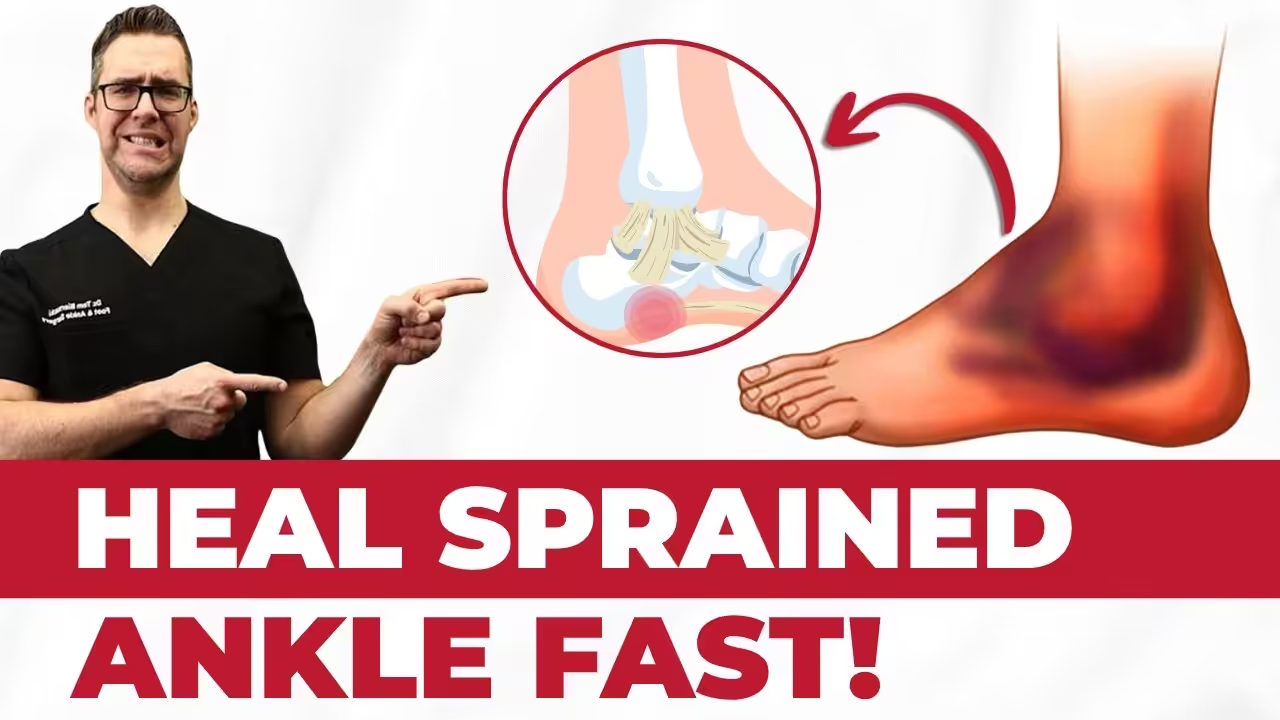

You are in the right place. Dr. Tom Biernacki, DPM, FACFAS — board-certified foot & ankle surgeon with 3,000+ surgeries — explains exactly what rolled ankle treatment means and what actually works. Call (810) 206-1402 for a same-week appointment at our Howell or Bloomfield Township office.
Quick answer: Treatment for rolled ankle treatment follows a stepwise approach: 1) conservative care first (rest, ice, supportive footwear, OTC anti-inflammatories), 2) physical therapy and targeted exercises, 3) in-office treatments (injections, custom orthotics) if conservative fails at 4-6 weeks, 4) surgery for refractory cases. Most patients resolve at step 1 or 2. Call (810) 206-1402.

Medically Reviewed by Dr. Tom Biernacki, DPM, FACFAS — Board-certified podiatrist & foot surgeon | Balance Foot & Ankle | Last updated: May 2026
Quick Answer: Rolled Ankle Treatment
A rolled ankle (lateral ankle sprain) is an inversion injury to the lateral ligaments — most commonly the anterior talofibular ligament (ATFL). Immediate treatment follows RICE protocol: Rest, Ice (20 min on/off), Compression with an elastic bandage, and Elevation above heart level. Most Grade 1 sprains resolve in 1-2 weeks; Grade 2 in 4-6 weeks; Grade 3 may require 3+ months and sometimes surgery. The critical step most people skip is proprioceptive rehabilitation — without it, re-sprain risk remains dramatically elevated.
What Just Happened to Your Ankle — The Anatomy of a Roll
When your ankle “rolls” inward, the foot inverts suddenly beyond its normal range, stressing the lateral ligament complex. The anterior talofibular ligament (ATFL) is the first to fail in 85% of ankle sprains — it resists anterior talar shift and is the weakest lateral ligament. With greater force, the calcaneofibular ligament (CFL) tears next. In severe events, the posterior talofibular ligament (PTFL) is also disrupted.
The immediate pain, swelling, and bruising are from ligament fiber tearing and hemorrhage into the surrounding soft tissue. The bone tenderness you may feel over the lateral malleolus (outer ankle bump) is usually from the ligament attachment, but it can also indicate an associated fracture — which is why the Ottawa Ankle Rules were developed: guidelines to determine when X-rays are needed after an ankle injury.
Grading Your Rolled Ankle — What Grade Is It?
| Grade | Ligament Damage | Signs | Recovery |
|---|---|---|---|
| Grade 1 | Microscopic tears; ligament intact | Mild pain, minimal swelling, can bear weight | 1-2 weeks |
| Grade 2 | Partial tear; some laxity | Moderate swelling/bruising; painful weight bearing | 4-6 weeks |
| Grade 3 | Complete rupture; instability | Significant swelling/bruising; can’t bear weight; feels unstable | 3-6 months |
RICE Protocol — The Right Way to Do It
Rest: Avoid activities that cause pain. Grade 1 sprains allow walking; Grade 2-3 sprains benefit from crutches to keep weight off the ankle for the first 24-48 hours. Complete non-weight bearing is rarely needed beyond 48-72 hours for most sprains — early protected movement actually accelerates healing compared to prolonged immobilization.
Ice: Apply ice or a frozen gel pack (wrapped in cloth to protect skin) for 15-20 minutes every 1-2 hours during the first 48-72 hours. Ice reduces pain and limits initial swelling. After 72 hours, the benefit of icing decreases — heat or contrast baths can then be introduced to promote circulation and healing.
Compression: An elastic bandage (ACE wrap) applied from the toes up to mid-calf reduces swelling accumulation. Apply firmly but not so tight that it causes numbness or color change in the toes. Stirrup ankle braces provide both compression and lateral support simultaneously.
Elevation: Keep the ankle above heart level whenever possible, particularly during the first 48 hours. Lying with the foot propped on pillows, not just sitting in a chair with the foot on a stool, achieves true elevation. This is the most underused component of RICE — most patients don’t elevate aggressively enough.
⚠ Most Common Mistake After Rolling Your Ankle
Returning to full activity as soon as pain resolves — without completing proprioceptive rehabilitation. This is by far the most common reason people re-sprain the same ankle repeatedly. Pain resolution does not equal ligament healing or proprioceptive recovery. The ankle’s position-sensing nerves (mechanoreceptors in the ligaments) are damaged in a sprain and need 4-6 weeks of specific balance training to recover. Patients who skip this step have a 40-70% re-sprain rate within the following year. A proper rehab program takes 15-20 minutes, 3x per week — entirely worth it to break the cycle.
Watch: Ankle Sprain Icing — What You Need to Know
Dr. Tom Biernacki covers how to ice a sprained ankle correctly, how long to use ice, and when to start bearing weight again:
Book a same-day ankle evaluation → · (810) 206-1402
Rehabilitation: The Phase That Prevents Re-Injury
Phase 1 (days 1-7): Pain and swelling control with RICE. Begin gentle ankle alphabet exercises (tracing letters with your toe) while seated to maintain motion without loading the ligaments.
Phase 2 (days 7-21): Range of motion restoration. Towel stretches, gentle calf stretches, ankle circles. Begin weight bearing as tolerated with a brace. Pool walking is excellent at this stage.
Phase 3 (weeks 3-6): Strengthening. Resistance band exercises in all four ankle directions. Single-leg balance (start with eyes open on flat surface, progress to eyes closed, then unstable surface). This is the proprioceptive recovery phase — it’s not optional.
Phase 4 (weeks 6+): Functional return. Jogging, lateral shuffles, sport-specific drills. Return to sport with a lace-up ankle brace for at least 6 months post-injury.
When should I see a doctor for a rolled ankle?
See a podiatrist if: you cannot bear weight at all; there is significant bruising that develops within minutes (indicates arterial damage); you feel or hear a pop followed by immediate instability; bony tenderness is over the posterior fibula (6cm up) or over the navicular; or pain and swelling are not improving after 5-7 days of RICE. These findings trigger the Ottawa Ankle Rules criteria for imaging to rule out fracture.
Can you walk on a rolled ankle?
Grade 1 sprains: yes, walking is generally okay and actually beneficial — early protected weight bearing promotes healing. Grade 2 sprains: painful weight bearing is possible but crutches for the first 24-48 hours reduce swelling and protect the healing ligament. Grade 3 sprains: weight bearing is typically not possible initially, and a boot or crutches are required. The ability to walk does not rule out a significant sprain or fracture.
How long does a rolled ankle take to heal completely?
Clinical healing (able to return to sport) occurs in 1-2 weeks for Grade 1, 4-6 weeks for Grade 2, and 3-6 months for Grade 3. However, full structural healing of the ligament takes 6-12 months regardless of grade. This is why proprioceptive training and bracing for sport should continue well past the point of pain resolution.
Should I use heat or ice for a rolled ankle?
Ice for the first 48-72 hours (acute phase). Heat introduces blood flow, which increases inflammation acutely — counterproductive when the goal is swelling limitation. After 72 hours, transitioning to heat or contrast (alternating hot and cold) promotes healing and reduces chronic stiffness. Many sports medicine teams use contrast baths (warm water 2 minutes, cold water 1 minute, repeat 4-5 cycles) starting on day 3-4 post-sprain.
Rolled Your Ankle? Get It Properly Evaluated
Dr. Tom Biernacki provides same-day ankle sprain evaluation with in-office X-ray at Howell and Bloomfield Township. Most insurance accepted.
Book an Appointment (810) 206-1402Related Resources
- Ankle Brace vs. Ankle Taping Guide
- High Ankle Sprain Recovery
- Broken Ankle Recovery Timeline
- Stress Fracture vs. Tendinitis
In-Office Treatment at Balance Foot & Ankle
If home treatment isn’t providing relief for your ankle condition, our podiatry team at Balance Foot & Ankle can help with same-week evaluations and advanced in-office care.
Doctor Hoy’s Natural Pain Relief Gel
Natural topical pain relief I use in our clinic. Arnica + camphor formula — apply directly to the area 3–4x daily. ($20–25)
Shop Doctor Hoy’s →Get Expert Care at Balance Foot & Ankle
Same-week appointments at our Howell and Bloomfield Township offices. Board-certified podiatric surgeons. Most insurance accepted.

Dr. Tom Biernacki, DPM is a board-certified foot & ankle surgeon (ABFAS & ABPM) at Balance Foot & Ankle Specialists in Southeast Michigan. With over a decade of clinical experience, he specializes in heel pain, bunions, diabetic foot care, sports injuries, and minimally invasive surgery. Dr. Biernacki is a member of the APMA and ACFAS, and his patient education content on MichiganFootDoctors.com and YouTube has made him one of the most-followed foot & ankle educators on YouTube.