

Medically reviewed by Dr. Tom Biernacki, DPM — Board-Certified Podiatric Surgeon — Balance Foot & Ankle, Howell & Bloomfield Hills, MI. Last updated April 2026.
▶ Watch
Medically Reviewed by Dr. Tom Biernacki, DPM — Board-Certified Podiatrist, Balance Foot & Ankle Specialists, Michigan. Last updated April 2026.
Not All Ankle Braces Are Created Equal
Walk into any sporting goods store and you’ll find a wall of ankle braces — sleeves, lace-up supports, rigid hinged braces, prophylactic braces, and everything in between. For patients recovering from ankle sprains, managing chronic instability, or trying to prevent initial injury in high-risk sports, knowing which type of brace is appropriate for which situation makes the difference between effective support and a product that looks helpful but doesn’t provide what’s actually needed.
This guide explains the major categories of ankle bracing, the clinical evidence for each, and how to choose appropriately for your situation.
Ankle Sleeve / Compression Sleeve
The simplest form of ankle “brace” is a knitted or neoprene sleeve that provides circumferential compression to the ankle without any structural support. Sleeves reduce swelling through compression, provide mild proprioceptive feedback (the pressure on the skin may enhance awareness of ankle position), and offer warmth that some athletes find subjectively comforting.
What they do NOT do: provide meaningful mechanical restriction of ankle inversion (the movement that causes most ankle sprains). A compression sleeve does not prevent ankle rolls and should not be worn as a “support” during high-risk activities.
Best for: mild ankle edema management, early post-sprain compression in conjunction with other treatments, sensory feedback for mild instability, and sports like swimming or yoga where full ankle mobility is needed but mild support is desired.
Lace-Up Ankle Braces
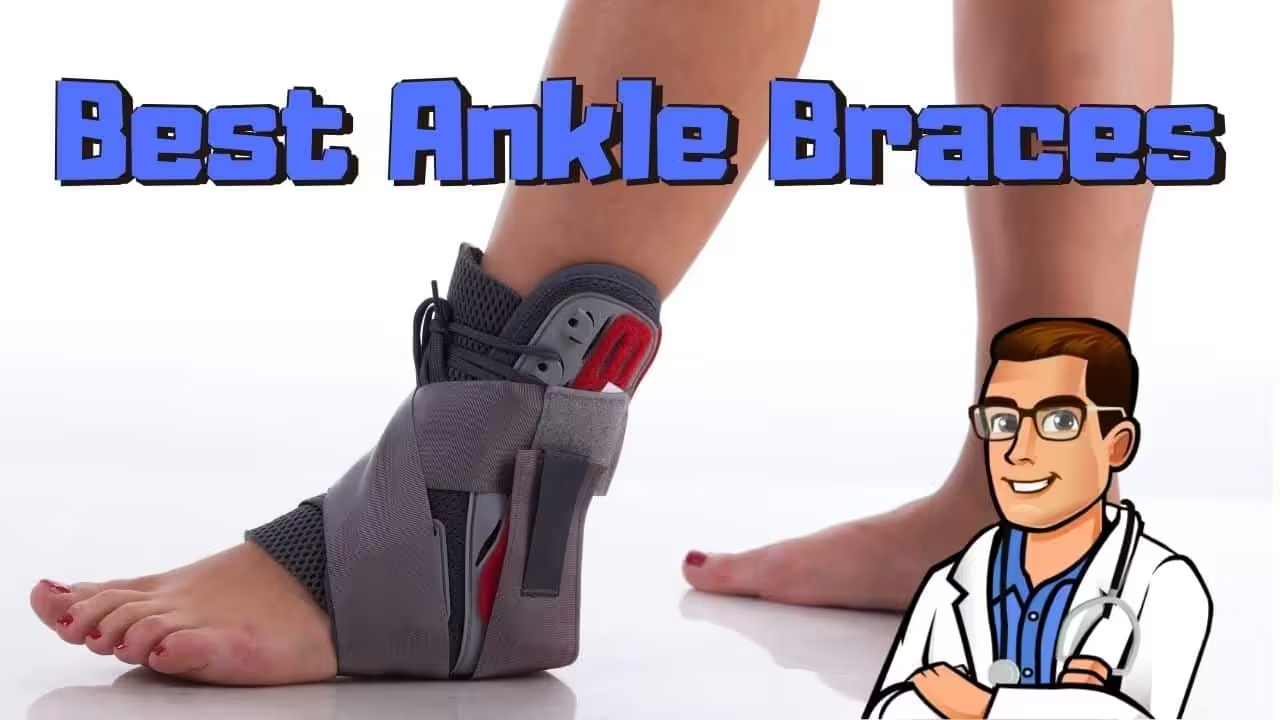
Lace-up braces — with a fabric or neoprene body and corded lacing system that cinches the brace snugly around the ankle — provide more substantial support than sleeves. They restrict inversion and some eversion movement while allowing a reasonable degree of plantarflexion and dorsiflexion. They are widely used in sports with significant ankle sprain risk.
Evidence for prophylactic lace-up ankle bracing in high-risk sports (basketball, volleyball, soccer) is actually quite strong: multiple studies demonstrate reduced ankle sprain incidence with consistent brace use during practice and competition, without the muscle weakness concerns historically associated with prolonged immobilization. Importantly, the benefit is greatest in athletes with a previous ankle sprain history — those who are already at elevated risk for recurrence.
Best for: athletes returning to sport after ankle sprain, athletes with a previous ankle sprain history in high-risk sports, post-sprain protection during the early phase of rehabilitation (when the ligaments are healing but the athlete is continuing activity).
Popular lace-up models include the ASO (Ankle Stabilizing Orthosis), McDavid Ankle Brace, and Swede-O Arch Lock — all of which have reasonable evidence bases.
Rigid/Semi-Rigid Hinged Ankle Braces
Hinged ankle braces have a more substantial shell (typically polypropylene or co-polymer plastic) with a hinge mechanism at the ankle axis that allows plantarflexion and dorsiflexion while blocking inversion and eversion. They provide greater restriction of lateral ankle movement than lace-up braces and are particularly useful for significant instability or early return to sport after more serious ligamentous injury.
Examples include the Aircast Air-Stirrup (a widely studied brace with the stirrup fitting beneath the malleoli) and the DJO Velocity (featuring a more lateral shell design). The Aircast Air-Stirrup has been evaluated in numerous clinical trials and is one of the most evidence-based options for acute ankle sprain management — used during the functional rehabilitation phase after sprains as an alternative to casting or complete immobilization.
Best for: grade 2–3 ankle sprains during the functional rehabilitation phase, athletes with moderate-to-severe lateral ankle instability, post-surgical protection of repaired ankle ligaments.
Ankle-Foot Orthoses (AFOs)
AFOs are prescription medical devices — typically custom-fabricated from polypropylene or carbon fiber — that extend from the foot up the back of the calf. They control ankle and foot motion more completely than commercially available braces. AFOs are used for neurological conditions causing foot drop, severe chronic ankle instability unresponsive to smaller braces, post-surgical recovery from ankle reconstruction or fracture fixation, and management of spastic equinovarus in cerebral palsy or stroke.
AFOs are not available over the counter — they require prescription and fitting by a podiatrist, orthotist, or physical therapist. Custom AFOs require a detailed prescription documenting the specific control needed, the patient’s weight and activity level, and the footwear the device must accommodate.
For athletes with significant neurological involvement (foot drop from L5 radiculopathy or peroneal nerve injury) or severe structural instability, carbon fiber AFOs offer a compromise between adequate support and the flexibility needed for athletic activity.
How Long Should You Wear an Ankle Brace?
A common question: will wearing an ankle brace weaken my muscles? The evidence does not support the concern that wearing ankle braces during sport causes meaningful calf or peroneal muscle weakness, as long as exercise and rehabilitation continue normally. The brace is a safeguard during high-risk activities — not a replacement for exercise.
For post-sprain recovery: lace-up or semi-rigid bracing during sport typically continues for 6–12 weeks after a significant sprain. After this period, athletes with good rehabilitation outcomes and restored proprioception may be able to discontinue bracing or reduce to a lace-up for high-risk activities only.
For chronic instability: many athletes choose to continue bracing during cutting sports indefinitely, particularly if they have had multiple sprains. The evidence supports this — there is no clinical harm from long-term prophylactic brace use during sport.
When Bracing Is Not Enough: Surgical Stabilization
Ankle bracing is a management strategy — not a cure — for chronic lateral ankle instability. When a patient cannot participate in their desired activities despite appropriate bracing and rehabilitation, surgical ankle stabilization (Brostrom-Gould procedure) is a highly effective and reliable intervention that restores normal ligamentous support. The procedure has excellent success rates and allows most athletes to return to sport without ongoing brace dependence.
If you find yourself bracing every single activity, avoiding sports you used to enjoy, or experiencing recurrent sprains despite bracing, discuss surgical evaluation with your podiatrist.
Foot or Ankle Pain? We Can Help.
Balance Foot & Ankle — Howell & Bloomfield Township, MI
📅 Book Online
📞 (810) 206-1402
When to See a Podiatrist About Ankle Braces
Choosing the right ankle brace depends on your specific condition, activity level, and injury history. A board-certified podiatrist can recommend the appropriate type of brace and determine if additional treatment is needed. At Balance Foot & Ankle, we provide ankle injury evaluation at our Howell and Bloomfield Hills offices.
Learn About Our Ankle Treatment Options | Book Your Appointment | Call (810) 206-1402
Clinical References
- Janssen KW, et al. “Effectiveness of ankle braces in reducing recurrence of ankle sprains.” Br J Sports Med. 2014;48(18):1321-1322.
- Dizon JM, Reyes JJ. “A systematic review on the effectiveness of external ankle supports in the prevention of inversion ankle sprains.” J Sci Med Sport. 2010;13(3):309-317.
- Kemler E, et al. “A systematic review of the treatment and prevention of acute ankle sprains.” Sports Med. 2011;41(3):185-197.
Insurance Accepted
BCBS · Medicare · Aetna · Cigna · United Healthcare · HAP · Priority Health · Humana · View All →
Howell Office
3980 E Grand River Ave, Suite 140
Howell, MI 48843
Get Directions →
Bloomfield Hills Office
43700 Woodward Ave, Suite 207
Bloomfield Hills, MI 48302
Get Directions →
Your Board-Certified Podiatrists



Ready to Get Back on Your Feet?
Same-week appointments available at both locations.
Book Your AppointmentWatch: Ankle Brace Guide
Dr. Tom reviews ankle brace types — lace-up vs stirrup vs sleeve, when to use, and when to wean.

Ankle Brace Selection
Different ankle braces serve different purposes. Dr. Tom’s recommended options by use case:
As an Amazon Associate, Balance Foot & Ankle earns from qualifying purchases. This supports our free patient education content.
Lace-up — best post-sprain and for chronic instability.
Rigid stirrup — Grade II-III sprains and immediate post-injury.
Mild swelling control + proprioception after recovery.
Functional taping for return-to-sport transition.
Related: Ankle Sprain Treatment · Chronic Ankle Instability · Book Same-Week Appointment
More Podiatrist-Recommended Foot Health Essentials
Hoka Clifton 10

Max-cushion everyday shoe — podiatrist favorite for walking and running.

OOFOS Recovery Slide

Impact-absorbing recovery sandal — wear after long days on your feet.
As an Amazon Associate, Balance Foot & Ankle earns from qualifying purchases. Product recommendations are based on clinical experience; prices and availability shown above update live from Amazon.
When to See a Podiatrist
If foot or ankle pain has been bothering you for more than a few weeks, home care alone may not be enough. Balance Foot & Ankle offers same-week appointments at our Howell and Bloomfield Hills clinics — no referral needed in most cases. Bring your current shoes and a short list of symptoms and we’ll build you a treatment plan in one visit.
Call Balance Foot & Ankle: (810) 206-1402 · Book online · Offices in Howell & Bloomfield Hills

Dr. Tom Biernacki, DPM is a double board-certified podiatrist and foot & ankle surgeon at Balance Foot & Ankle Specialists in Southeast Michigan. With over a decade of clinical experience, he specializes in heel pain, bunions, diabetic foot care, sports injuries, and minimally invasive surgery. Dr. Biernacki is a member of the APMA and ACFAS, and his patient education content on MichiganFootDoctors.com and YouTube has reached over one million views.
- Diagnosis and Treatment of Plantar Fasciitis (PubMed / AAFP)
- Heel Pain (APMA)
- Hallux Valgus (Bunions): Evaluation and Management (PubMed)
- Bunions (Mayo Clinic)