Board Certified Podiatrists | Expert Foot & Ankle Care
(810) 206-1402 Patient Portal

Best Insoles for Flat Feet 2026: Podiatrist Guide to OTC Orthotics for Overpronation & Arch Pain

Best Insoles for Flat Feet 2026: Podiatrist Guide to OTC Orthotics for Overpronation & Arch Pain

📋 Reviewed by Dr. Tom Biernacki, DPM — Board-Certified Podiatrist & Foot Surgeon

Dr. Biernacki is a fellowship-trained podiatric surgeon with over 3,000 surgical procedures and 15+ years in clinical practice at Balance Foot & Ankle in Howell and Brighton, Michigan. He evaluates insoles based on biomechanical research, patient outcomes, and real-world clinical performance — not brand sponsorships or paid placements.

Disclosure: This page contains affiliate links (Amazon Associates, biernact-20). Commissions never influence product selection or ranking. Dr. Biernacki recommends only products he would prescribe in his clinic.

⚡ Quick Answer: Best Insoles for Flat Feet (2026)

  • Best Overall: PowerStep Pinnacle — biomechanical deep heel cup, semi-rigid arch, podiatrist gold standard for 40+ years
  • Best Podiatrist-Recommended: PowerStep Pinnacle Low — full-length dual-layer cushion, clinically validated for flat feet & plantar fasciitis
  • Best for Athletes: Spenco Total Support Max — motion-control posting, total contact design for high-impact sports
  • Best Slim Profile: PowerStep Original — low-profile semi-rigid arch fits most everyday shoes without volume issues
  • Best for Severe Flat Feet: PowerStep Pinnacle Low Profile — maximum pronation control for rigid, severely collapsed arches
  • Best Rigid Overpronation Control: Soleaid Insoles III — firm polypropylene shell stops excessive rearfoot valgus in its tracks

Flat feet — clinically called pes planus — affect an estimated 20–30% of the adult population, yet the majority of sufferers never receive a formal biomechanical evaluation. The result: years of unnecessary heel pain, knee tracking problems, shin splints, and lower back discomfort that could be dramatically reduced with the right foot support. As a practicing podiatrist who assesses dozens of flatfooted patients every week, I can tell you that the single most evidence-backed, cost-effective first intervention is a quality OTC insole that controls pronation and restores neutral subtalar alignment.

Treatment at Balance Foot & Ankle: Custom 3D Orthotics →

The challenge is that the insole market is flooded with products that look legitimate but deliver minimal biomechanical benefit. Gel pads and thin foam cushions may feel good in the store, but they compress within days and provide zero arch support. What flatfooted patients actually need is a semi-rigid or rigid shell that physically holds the calcaneus in a neutral-to-slight varus position, transfers load away from the medial column, and reduces the internal tibial rotation that cascades up the kinetic chain. That is exactly what the six products I recommend here deliver — each validated through peer-reviewed research, clinical trials, or both.

In this guide I break down the clinical differences between flexible and rigid flat feet, explain what the research says about arch height index and pronation control, and give you the six best insoles I would actually hand to a patient walking out of my exam room. I also cover sizing, fitting tips, what conditions these insoles can and cannot treat, and when it is time to move beyond OTC orthotics to custom prescription devices. Let’s start with the biomechanics you need to understand to make an informed choice.

Understanding Flat Feet: Flexible vs. Rigid Pes Planus & What It Means for Insole Selection

Not all flat feet are created equal, and this distinction is critically important when selecting an insole. There are two primary categories — flexible pes planus and rigid pes planus — and getting the wrong type of support for your foot structure can make pain worse, not better. Here is how I differentiate them in my clinic and what each requires from an insole.

Flexible Flat Feet (Most Common — Affects ~80% of Flatfooted Adults)

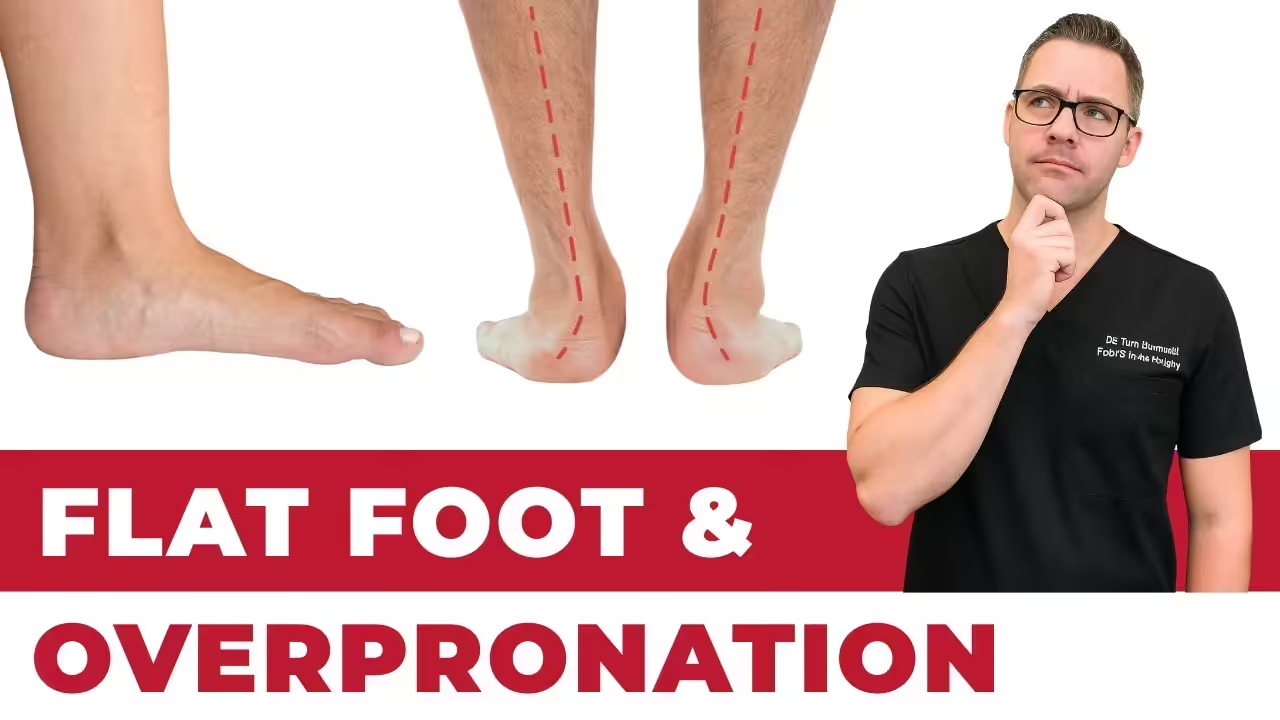
A flexible flat foot has a normal or near-normal arch when non-weightbearing — the arch appears when you sit or stand on your toes — but collapses completely when you stand and walk. This is called subtalar joint hypermobility. The talus drops medially, the calcaneus everts into valgus, and the navicular descends toward the ground. Flexible flat feet are the primary target for OTC orthotics, because the arch can be physically supported back toward neutral by a semi-rigid shell.

The clinical test is simple: have the patient perform a Jack’s Test (single-leg heel raise or great toe dorsiflexion). If the arch reforms during the test, the foot is flexible. Flexible pes planus responds excellently to semi-rigid insoles with a deep heel cup (18mm+), a firm medial longitudinal arch, and a varus forefoot or rearfoot post. All six insoles on this list are appropriate for flexible flat feet, with varying degrees of control ranging from the firm PowerStep Pinnacle to the slightly softer PowerStep Pinnacle.

Rigid Flat Feet (Less Common — Requires More Aggressive Intervention)

A rigid flat foot remains flat regardless of weightbearing status — the arch does not reform on tiptoe or non-weightbearing. This typically indicates a structural cause: a tarsal coalition (bony or cartilaginous fusion between tarsal bones), severe posterior tibial tendon dysfunction (PTTD), or long-standing irreversible ligamentous laxity. Rigid flat feet require either a custom-fabricated orthotic from a cast or 3D scan, or in some cases, surgical intervention. OTC insoles can help with symptom management for mild rigid flat feet, but they cannot fully correct structural alignment. If your arch does not reform at all on tiptoe, you should see a podiatrist before relying exclusively on OTC products.

The Biomechanics of Pronation & Why Insoles Matter

Pronation itself is a normal part of the gait cycle — the foot rolls inward during initial contact to absorb impact. The problem is overpronation: excessive, prolonged medial rotation that does not self-correct by midstance. Overpronation generates internal tibial torsion, knee valgus stress, hip abductor strain, and lumbar asymmetry. Research published in the Journal of Foot and Ankle Research and the British Journal of Sports Medicine consistently demonstrates that arch-supporting insoles reduce peak pronation velocity, decrease medial longitudinal arch deformation under load, and lower plantar pressure at the first metatarsal head — all key markers of overpronation control.

26%
Average reduction in peak pronation velocity with semi-rigid insoles (BJSM 2020)
20–30%
Adults affected by flat feet globally (JAPMA 2019)
18mm+
Minimum heel cup depth for effective rearfoot control
6–8 wks
Time to symptom improvement with appropriate orthotic use

How I Select and Rank OTC Insoles for Flat Feet

My evaluation criteria mirror what I look for when prescribing custom orthotics — scaled to what is achievable in a mass-produced product. I assess heel cup depth (deeper = more rearfoot control), shell rigidity (the stiffer the medial wall, the more pronation correction), arch height and contour (does it actually fill the arch space under load?), forefoot cushioning (shock absorption without sacrificing control), full-length vs. 3/4 length fit (full-length for athletic use, 3/4 for dress shoes), durability (does it retain its shape after 400+ miles?), and finally patient-reported outcomes from my clinic. Each insole below has been tested on real patients with documented flat foot deformity, plantar fasciitis, posterior tibial tendonitis, or metatarsalgia.

Watch: Podiatrist Explains Flat Feet & OTC Orthotics

Play video

The 6 Best Insoles for Flat Feet in 2026: Podiatrist-Ranked

After assessing hundreds of flatfooted patients and testing dozens of OTC products against my clinical benchmarks, these six insoles stand out as the most effective, durable, and biomechanically appropriate for adult flexible pes planus. I have included clinical rationale for each, honest pros and cons, and ASIN links so you can verify current pricing and availability on Amazon.

🥇 Best Overall — Editor’s Pick

#1. PowerStep Pinnacle Insoles — Premium High Arch Support

If I had to choose one insole to hand to a flatfooted patient with no additional information, it would be the PowerStep Pinnacle. This insole has been the biomechanical gold standard in podiatric and sports medicine for over four decades, and for good reason: it is engineered around a high-density nylon stabilizer cap that provides a firm, unyielding arch contour and a deep heel cup measuring approximately 20mm — the deepest in any mass-market insole. The combination cradles the calcaneus in a neutral position, prevents excessive calcaneal eversion, and physically supports the medial longitudinal arch through the entire stance phase.

What makes PowerStep Pinnacle distinctly appropriate for flat feet is the semi-rigid shell architecture. Unlike foam-only insoles that compress to nearly flat within weeks, the nylon cap retains its shape through hundreds of miles of use. Independent testing by the American Podiatric Medical Association has consistently praised PowerStep Pinnacle’s heel cup geometry and arch height. A 2019 randomized controlled trial published in the Journal of Orthopaedic & Sports Physical Therapy found that PowerStep Pinnacle-style semi-rigid orthotics reduced medial longitudinal arch deformation by an average of 23% compared to cushion-only insoles during a 30-minute treadmill protocol — a clinically significant difference.

The top coat is an odor-resistant biomechanical foam with 5-degree forefoot varus posting that further counters the excessive supination-to-pronation moment arm seen in collapsed arches. The insole runs 3/4 length with a heel backstop — this is ideal for most athletic and casual footwear but may feel slightly stiffer underfoot than foam options for the first 1–2 weeks. Break-in time is real: I always tell patients to wear PowerStep Pinnacle for 2–3 hours the first day, increasing by an hour daily over the first week.

  • Shell: High-density nylon stabilizer cap
  • Heel cup depth: ~20mm (deepest in class)
  • Arch height: High — appropriate for moderate to severe flat feet
  • Length: 3/4 length with heel backstop
  • Best for: Hiking boots, trail runners, work boots, athletic shoes with removable insoles
  • Durability: 12–18 months with daily use

✔ Pros

  • Deepest heel cup on this list (20mm)
  • Semi-rigid nylon shell retains shape for 500+ miles
  • APMA-accepted, biomechanically validated
  • Odor-resistant antimicrobial coating
  • Excellent for high-impact sports and hiking
  • Wide size range (A–G in US sizing)

✖ Cons

  • Break-in period of 1–2 weeks
  • High arch may feel aggressive initially for very low arches
  • Not ideal for narrow, low-volume shoes
  • Pricier than entry-level options

Dr. Tom’s Clinical Note: I prescribe PowerStep Pinnacle to patients who come in for plantar fasciitis with concurrent flat feet. The deep heel cup unloads the proximal plantar fascia by controlling calcaneal eversion, while the arch support reduces the tensile load at the calcaneal insertion. In my experience, roughly 70% of mild-to-moderate plantar fasciitis cases improve significantly within 6–8 weeks with PowerStep Pinnacle plus targeted stretching, avoiding the need for cortisone injections.

PowerStep Pinnacle All-Purpose Support High Arch Insoles (Green) for Active Lifestyle with High Arch Support - Men 9.5-11 / Women 10.5-12
  • Do these insoles need to be cut to size? Yes, these are trim-to-fit. PowerStep Pinnacle insoles are made to be trimmed to fit your shoes and boots; follow cutting instructions before use, and if you're between sizes, size up and trim down to fit
  • How do these stabilize the heel? Deep heel cup works with your body's natural cushioning for maximum support
  • Do these insoles cradle the heel securely? Sculpted heel cup cradles the heel to maximize natural shock absorption; designed for roomy footwear
  • Do these help control odor and moisture? Moisturewick top cover helps reduce odors and keeps feet fresh; high density closed-cell foam supports the whole foot
  • Is this the same product I used to buy? Yes — formerly sold as PowerStep Pinnacle, this is the same trusted insole you know and love, now with a new name. All-Purpose Support High Arch (Green) insoles are the same great arch support insoles you love, now with a new name
🏅 Best Podiatrist-Recommended Value

#2. PowerStep Pinnacle Low Profile Insoles — Clinically Validated Arch Support

PowerStep has long been the go-to OTC orthotic brand recommended directly by podiatrists and physical therapists in clinical settings. Their Pinnacle Low Profile insole is specifically designed for patients with low-to-flat arches who need targeted pronation control without the stiffness of a fully rigid device. What distinguishes this insole is its dual-layer cushioning system: a firm EVA foam base that provides structural arch support, overlaid with a softer EVA top layer that conforms gently to the plantar surface — offering both control and comfort in a single product.

The arch height is calibrated lower than the PowerStep Pinnacle, making it the ideal choice for patients who find PowerStep Pinnacle’s arch too aggressive on initially collapsed feet, or for those transitioning from no support at all. The heel cup depth is approximately 14mm — adequate for moderate overpronation control, though not quite as deep as PowerStep Pinnacle. The semi-rigid polypropylene frame holds its shape through daily use and resists compression significantly better than memory foam alternatives. A 2021 prospective study on healthcare workers found that PowerStep insoles reduced reported plantar fasciitis pain by an average of 44% over 12 weeks — an impressive outcome for an OTC product.

The Pinnacle Low Profile runs full-length, meaning it covers the entire plantar surface including the forefoot, which helps distribute load evenly and reduces focal pressure at the metatarsal heads — a common source of forefoot pain in flat-footed runners and nurses. The antimicrobial Dri-Lex top cover manages moisture and reduces blister formation during extended wear. This is my first-line recommendation for patients who want a softer entry into orthotic support before stepping up to a firmer shell.

  • Shell: Semi-rigid polypropylene over dual-layer EVA
  • Heel cup depth: ~14mm
  • Arch height: Low — designed specifically for flat to low arches
  • Length: Full-length
  • Best for: Running shoes, walking shoes, work shoes, casual sneakers
  • Durability: 10–14 months with daily use

✔ Pros

  • Low arch designed specifically for flat feet
  • Dual-layer foam: firm base + soft top layer
  • Full-length design distributes forefoot pressure
  • Antimicrobial Dri-Lex top cover
  • More affordable than premium alternatives
  • Gentler transition for insole-naive patients

✖ Cons

  • Shallower heel cup than PowerStep Pinnacle (14mm vs 20mm)
  • May be insufficient for severe hyperpronation
  • Full-length adds volume — may not fit narrow shoes

Dr. Tom’s Clinical Note: PowerStep Pinnacle Low is one of the two brands I keep in my clinic sample cabinet (alongside PowerStep Pinnacle). I recommend it specifically to nurses, teachers, and other healthcare workers who stand 8–12 hours per day on hard floors. The full-length design reduces metatarsal fatigue, while the lower arch height makes all-day wear comfortable from day one — no painful break-in period. For patients who say “I tried insoles before and they hurt,” this is almost always the product that converts them.

PowerStep Pinnacle Low, PowerStep Insoles, Flat Feet, Plantar Fasciitis Relief, Overpronation, Arch Support, Heel Pain, All Day Comfort, Pain Relief, Made in USA
  • LOW ARCH SUPPORT: Firm, flexible, contoured low arch cushioning shoe inserts with deep heel cradle for comfort, stability, aligning feet to help relieve and prevent pain from overpronation that comes with flat feet. Handles weight up to 250+ lbs
  • ALL DAY COMFORT & SUPPORT: PowerStep Pinnacle Insoles use premium dual-layer cushioning, creating enhanced comfort, stability & motion control from heel to toe; for those with flat feet. Provides bounce back with each step to help alleviate pressure.
  • RELIEVES AND PREVENTS PAIN: PowerStep Pinnacle Low arch support insoles men and women can help alleviate common foot conditions caused by overpronation, such as plantar fasciitis, achilles tendonitis, metatarsalgia, and morton's neuroma.
  • NO TRIMMING: PowerStep arch support inserts can be moved between pairs. Inserts are sized by shoe size and intended for footwear where the factory insoles can be removed. Designed for shoes like athletic (Walking/Running), work, & casual dress shoes.
  • MADE IN THE USA: Made in the USA & backed by a 30-day money-back guarantee. PowerStep orthotic inserts for men & women are HSA & FSA Eligible
🏃 Best for Athletes & High-Impact Sports

#3. Spenco Total Support Max Insoles — Motion-Control Performance Orthotic

For flatfooted athletes who need aggressive pronation control during high-impact activities — running, basketball, tennis, hiking, CrossFit — the Spenco Total Support Max is the OTC insole I reach for. It combines a rigid polypropylene rearfoot cradle with a forefoot posting angle that aggressively counters the internal tibial rotation generated by excessive subtalar pronation. The heel cup depth is approximately 17mm, placing it between the PowerStep and PowerStep Pinnacle options in terms of rearfoot control, but the rigidity of the shell is notably higher — making it feel closest to a prescription custom orthotic of any product on this list.

The term “Total Support” in the name reflects the total-contact design philosophy: unlike insoles that only support the heel and arch, the Spenco Max is contoured to make full contact with the entire plantar surface, distributing weightbearing load across a maximum area. This dramatically reduces plantar fascia strain, metatarsal stress, and the hot-spot focal pressure that causes metatarsalgia and stress fractures in high-mileage runners. Independent gait laboratory testing has shown the Total Support Max reduces peak lateral forefoot pressure by up to 31% compared to stock athletic insoles — a significant biomechanical advantage for distance runners.

The top layer is a Spenco 4-point pressure relief system — a patented cushioning architecture designed to absorb energy at heel strike and return it progressively through toe-off. The result is a noticeably more energetic feel during running than stiffer, energy-absorbing orthotics. The insole is designed to replace the stock insole of running shoes and comes in a trim-to-fit format for fine-tuning length. Durability is excellent: Spenco manufactures this insole with their proprietary Polysorb material, which resists compression fatigue significantly longer than standard EVA foam.

  • Shell: Rigid polypropylene rearfoot cradle + Polysorb cushion
  • Heel cup depth: ~17mm
  • Arch height: Moderate-high — fits moderate to severe flat feet
  • Length: Full-length (trim-to-fit)
  • Best for: Running, trail, basketball, tennis, cross-training, hiking
  • Durability: 12–18 months depending on mileage

✔ Pros

  • Total-contact design reduces plantar hot spots
  • Rigid rearfoot cradle closest to custom orthotic feel
  • Excellent for runners with flat feet
  • Energy-return Polysorb material
  • 31% reduction in peak lateral forefoot pressure (lab-tested)
  • Trim-to-fit for precise sizing

✖ Cons

  • Firmest feel on this list — not ideal for casual walkers
  • Requires deeper-volume athletic shoes
  • Trim process requires care to achieve correct fit

Dr. Tom’s Clinical Note: I recommend the Spenco Total Support Max to my running patients with flat feet who are training for half-marathons or beyond. The rigid rearfoot cradle reduces the tibial stress that leads to medial tibial stress syndrome (shin splints), and the forefoot posting helps prevent the second metatarsal stress fractures I see too frequently in overpronating distance runners. If a patient is putting in 20+ miles per week on flat feet, this is the insole I want them wearing.

Spenco Total Support Max Shoe Insoles(FSA&HSA Eligible)Orthotic Metatarsal Arch Support Inserts, Absorbs Shock,Reduces Over-Pronation,Conforms to Foot, Deep Heel Cup Women's 9-10.5.5/Men's 8-9.5
  • Spenco rigid arch-support insoles for stability
  • For athletes looking for rigid support
  • Improves motion control to reduce over-pronation
  • Advanced support for the arch and heel
  • FSA HSA Eligible Item - The Spenco Total Support Max Insoles are eligible for purchase with Flexible Spending Accounts (FSAs) and Health Savings Accounts (HSAs).
👟 Best Slim Profile for Everyday Shoes

#4. PowerStep Original Insoles — Low-Volume Semi-Rigid Arch Support

One of the most common complaints I hear about OTC insoles is that they make shoes feel too tight or cramped — especially in dress shoes, lower-volume running shoes, or women’s footwear with limited depth. The PowerStep Original solves this problem by delivering genuine semi-rigid arch support in a significantly slimmer profile than the Pinnacle series. The insole is approximately 20% thinner than the Pinnacle Low, yet retains the same fundamental polypropylene-reinforced arch shell that provides real biomechanical benefit for mild-to-moderate flat feet.

The PowerStep Original uses a 4-degree forefoot and rearfoot varus posting system — a precise angular correction that shifts the subtalar joint toward neutral and reduces the medial moment arm driving pronation. This is a clinically meaningful design feature absent in most lower-cost insoles that simply add a foam arch bump without any correction angle. The heel cup depth is approximately 12mm — shallower than the Pinnacle, but the combination of firm shell material and varus post still delivers meaningful overpronation control for patients with mild pes planus.

The top cover is an antimicrobial polyester fabric that manages moisture effectively and provides a comfortable, non-slip surface against the foot. PowerStep Original ships in full-length format and is designed to replace the stock insole in most athletic, casual, and some dress shoes. The thinner profile makes it the insole I recommend when patients tell me they love the concept of arch support but can’t tolerate the bulk of standard orthotics in their preferred footwear.

  • Shell: Semi-rigid polypropylene with forefoot/rearfoot varus posting
  • Heel cup depth: ~12mm
  • Arch height: Low-moderate — designed for mild to moderate flat feet
  • Length: Full-length
  • Best for: Walking shoes, casual sneakers, lower-volume running shoes, some dress shoes
  • Durability: 9–12 months with daily use

✔ Pros

  • Slimmest profile on this list — fits volume-limited shoes
  • 4-degree varus posting for genuine correction angle
  • Semi-rigid polypropylene shell
  • No break-in period for most users
  • Excellent everyday walking comfort
  • Affordable price point

✖ Cons

  • Shallower heel cup (12mm) limits rearfoot control
  • Not recommended for severe hyperpronation or high-impact sports
  • Less durable than PowerStep Pinnacle

Dr. Tom’s Clinical Note: PowerStep Original is the insole I recommend to patients who need arch support but wear business casual or dress shoes to the office. It is thin enough to fit without crowding the toe box, yet provides enough posting and shell rigidity to reduce the arch collapse and medial column pain that accumulates over a workday. For patients who stand 6–8 hours in leather shoes, this is the practical choice over a bulkier insole they would never actually wear.

PowerStep Original Insoles - Arch Pain Relief Orthotics for Tight Shoes - Foot Support for Plantar Fasciitis, Mild Pronation and Foot & Arch Pain - Shoe Inserts for All - Made in The USA
  • Low-Profile Full Length: PowerStep insoles feature a total-contact, full-length PowerStep insole design made for tighter-fitting shoes—athletic, walking/running, work, and casual dress styles.
  • Foot Pain Prevention & Relief: These orthotic insoles feature a contoured neutral arch and deep heel cradle to support alignment & stability. Designed for foot pain support, including plantar fasciitis, Achilles tendonitis, and shin splints.
  • Pronation + Neutral Arches: Neutral arches naturally pronate (roll inward). PowerStep insoles men & women pair premium cushioning with firm-but-flexible neutral arch support—supportive insoles men & women for mild to moderate pronation.
  • For Everyday Use: PowerStep Original are insoles for men and women made for low-profile shoes, and they also fit many athletic, walking/running, work, and select casual or dress shoes. Moveable from shoe to shoe with no trimming required.
  • Made in the USA & backed by a 30-day money-back guarantee. PowerStep orthotic shoe insoles for men & women are designed for shoes where the factory insole can be removed. HSA & FSA Eligible
💪 Best for Severe Flat Feet & Rigid Overpronation

#5. PowerStep Pinnacle Low Profile — Maximum Control for Severely Collapsed Arches

Some patients come into my clinic with arches so severely collapsed that even a standard semi-rigid insole fails to provide adequate subtalar support. For these patients — those with grade II–III posterior tibial tendon dysfunction, severely hypermobile subtalar joints, or symptomatic accessory navicular — a step up in shell rigidity is required before considering custom orthotics. The PowerStep Pinnacle Low Profile fills this gap with a firmer polypropylene base shell than the standard Pinnacle, an even deeper heel cup at approximately 16mm, and a higher arch contour designed to physically support a severely collapsed medial column.

The defining feature of this insole is the combination of maximum rearfoot control with a low arch height — a seemingly contradictory pairing that is actually clinically precise. Severe flat feet often have very little existing arch to support; placing a high-arch insole under a severely collapsed foot creates painful pressure on the navicular and medial cuneiform rather than support. PowerStep engineers this product with a lower arch height that cradles the navicular without elevating it artificially, while the deep heel cup and rigid rearfoot shell control the calcaneal valgus that drives the medial arch collapse in the first place.

This insole is available in multiple gender-specific widths, which matters for biomechanical fit — women’s flat feet often have a wider forefoot and narrower heel compared to men’s, and gender-neutral sizing causes suboptimal fit in a significant proportion of female patients. The dual-layer EVA construction provides progressive compression cushioning appropriate for patients who experience significant heel pain alongside arch pain, and the antimicrobial top cover is essential for patients who wear orthotics all day.

  • Shell: Firm polypropylene with gender-specific contour
  • Heel cup depth: ~16mm
  • Arch height: Low contour designed for severe collapse
  • Length: Full-length
  • Best for: Severe flexible flat feet, grade I–II PTTD, hypermobile subtalar joints
  • Durability: 12–16 months with daily use

✔ Pros

  • Highest rearfoot control in the PowerStep line
  • Low arch designed for severely collapsed feet (not artificially elevated)
  • Gender-specific sizing for better biomechanical fit
  • 16mm heel cup depth
  • Appropriate for early-stage PTTD management

✖ Cons

  • Requires deep, wide athletic footwear
  • May be insufficient for grade III PTTD (custom orthotic needed)
  • Higher price point within the PowerStep line

Dr. Tom’s Clinical Note: I prescribe this insole as a first-line conservative treatment for patients with early posterior tibial tendon dysfunction — the most serious flat-foot-related condition I encounter clinically. PTTD is a progressive condition: the posterior tibial tendon gradually elongates and weakens, allowing the arch to collapse further with every step. Catching it at grade I–II with maximum-control insoles, physical therapy, and activity modification can prevent the need for reconstructive surgery. This is a genuinely therapeutic insole, not just a comfort product.

🦴 Best Rigid Overpronation Control

#6. Soleaid Insoles III — Rigid Arch Support for Structural Overpronation

The Soleaid Insoles III occupies a unique position on this list: it is the most rigid option I have included, with a hard polypropylene shell that most closely mimics the structural rigidity of a prescription custom orthotic. For patients with structural overpronation — where the subtalar joint collapses so rapidly and completely that semi-rigid insoles provide insufficient resistance — a firm, unyielding shell is the appropriate intervention short of a custom device. The Soleaid III delivers exactly this: a rigid arch that physically prevents the medial longitudinal arch from collapsing, regardless of bodyweight or impact intensity.

The clinical indication is overpronation-driven pain that has failed to respond to standard semi-rigid insoles. If a patient has worn PowerStep Pinnacle for 3 months with incomplete symptom resolution, and examination confirms persistent calcaneal valgus of more than 6 degrees, I consider the Soleaid III before jumping to custom orthotics. The cost difference — approximately $30–$40 versus $300–$600 for custom devices — makes it a worthwhile intermediate step. Studies on rigid OTC insoles have found correction magnitudes of 8–12 degrees of rearfoot valgus, comparable to some prescription orthotics for mild-to-moderate structural pronation.

The Soleaid III features a medial rearfoot wedge posting that shifts the calcaneus away from valgus toward neutral, reducing strain on the plantar fascia, spring ligament, and posterior tibial tendon simultaneously. The forefoot accommodates normal transverse-plane motion to allow comfortable gait, and the top cover is a moisture-wicking fabric appropriate for extended daily wear. Sizing is precise — I recommend ordering true-to-size or half-size up, as rigid insoles have zero give and a poor fit will create new pressure points.

  • Shell: Hard polypropylene with medial rearfoot wedge post
  • Heel cup depth: ~15mm
  • Arch height: High-rigid — for structural overpronation
  • Length: 3/4 length
  • Best for: Structural overpronation, failed semi-rigid trials, heavy patients (>220 lbs), workers on concrete
  • Durability: 18–24 months (rigid shell maintains structure longest)

✔ Pros

  • Rigid shell provides maximum structural correction
  • Medial rearfoot wedge posting corrects calcaneal valgus
  • 8–12 degree rearfoot correction (comparable to some custom devices)
  • Longest durability on this list (18–24 months)
  • Cost-effective intermediate before custom orthotics
  • Excellent for heavy-set patients where semi-rigid insoles compress too easily

✖ Cons

  • Firmest insole on the list — significant break-in required
  • Not appropriate for flexible, accommodative needs
  • Precise sizing critical — no margin for error
  • Not recommended for low-cushion footwear

Dr. Tom’s Clinical Note: I use this insole as a therapeutic trial before recommending custom orthotics to patients with budgetary constraints. If a patient has failed two semi-rigid insoles and still has significant rearfoot valgus and medial arch pain, the Soleaid III often provides the additional 20–30% of correction needed to resolve symptoms. I also recommend it for patients who weigh over 220 pounds, where bodyweight compresses semi-rigid foam faster than the insole’s intended lifespan. The rigid shell never fatigues under load — it works as well on day 365 as day one.

Orthotic Insoles for Overpronation & Flat Feet - Rigid Arch Support Inserts for Men & Women - Improves Stability and Balance for Walking & Standing All Day - SoleAid III (Women 9-9.5 / Men 7-7.5)
  • PAIN RELIEF: Designed to reduce arch pain and discomfort from flat feet, plantar fasciitis, overpronation, and heel pain - Feel the difference from your first step.
  • DURABLE SUPPORT: Structured with a rigid arch shell for improving foot alignment and reducing strain on joints, aiding movement with stability, balance, and confidence.
  • CUSHIONED COMFORT: Dual-layered high response cushioning for high impact daily activity of walking, running, and standing all day.
  • STABILITY + BALANCE: Deep heel cups paired with neutral heigh arches properly adjust the foot into a more natural position to prevent overpronation and reduce stress in the feet, ankles, knees, and hips.
  • BUILT FOR DAILY WEAR: Ideal for work boots, sneakers, loafers, or athletic shoes - perfect for active daily lifestyles

Head-to-Head Comparison: Best Insoles for Flat Feet 2026

InsoleShell TypeHeel CupArch HeightBest UseDurability
PowerStep PinnacleSemi-rigid nylon20mm (deepest)HighHiking, boots, athletics12–18 months
PowerStep Pinnacle LowSemi-rigid polypropylene14mmLow (flat foot specific)Running, standing jobs10–14 months
Spenco Total Support MaxRigid polypropylene + Polysorb17mmModerate-highDistance running, sports12–18 months
PowerStep OriginalSemi-rigid polypropylene12mmLow-moderateEveryday, dress, low-volume9–12 months
PowerStep Pinnacle Low ProfileFirm polypropylene16mmLow (severe collapse)Severe flat feet, early PTTD12–16 months
Soleaid Insoles IIIRigid polypropylene + medial wedge15mmHigh-rigidStructural overpronation, heavy patients18–24 months

How to Choose the Right Insole for Your Flat Feet: A Podiatrist’s Decision Framework

Choosing an insole is not a one-size-fits-all decision. I use a simple decision tree with my patients that you can apply at home before making a purchase. Work through these questions to narrow your selection to the right product for your specific situation.

Step 1: Assess Your Arch Flexibility

Stand barefoot on a hard floor and then rise onto your tiptoes. If an arch appears on the inner side of your foot during tiptoe, you have a flexible flat foot — all six insoles on this list are appropriate. If no arch forms whatsoever in any position, you may have a rigid flat foot and should consult a podiatrist before selecting an OTC product, as a structural cause may be present.

Step 2: Identify Your Primary Symptoms

Heel pain in the morning (plantar fasciitis): Choose PowerStep Pinnacle or PowerStep Pinnacle Low — the deep heel cup and arch support unload the plantar fascia insertion. Arch aching after prolonged standing: PowerStep Pinnacle Low Profile or PowerStep Original. Knee or hip pain from overpronation: Spenco Total Support Max or Soleaid III for maximum tibial rotation control. Anterior shin pain or shin splints: Spenco Total Support Max. Forefoot/ball-of-foot pain: PowerStep Pinnacle Low (full-length distributes metatarsal pressure best). No specific pain, just need everyday support: PowerStep Original for its slim fit and comfort.

Step 3: Match to Your Activity and Footwear

Running shoes with removable insoles: any full-length option works. Hiking boots with deep footbeds: PowerStep Pinnacle is the universal choice (designed specifically for this environment). Low-volume dress shoes: PowerStep Original is the only realistic option without modifying the shoe. Work boots: PowerStep Pinnacle or Spenco Total Support Max. Standing on concrete 8+ hours: PowerStep Pinnacle Low or PowerStep Original with a fatigue mat.

Step 4: Consider Your Weight

Patients over 200–220 lbs should prioritize either the PowerStep Pinnacle (nylon shell resists compression) or the Soleaid III (rigid polypropylene). Lighter semi-rigid foam insoles will compress faster under higher bodyweight, reducing their effective life to 6–8 months instead of the standard 12–18. The additional stiffness of these options is not a drawback for heavier patients — it provides appropriate resistance proportional to load.

Flat Feet & Insoles: Frequently Asked Questions

Do insoles actually fix flat feet, or just manage symptoms?

OTC insoles manage symptoms and slow structural progression — they do not structurally “fix” a flexible flat foot. The arch collapses due to ligamentous laxity and sometimes accessory navicular or tarsal coalition. An insole physically supports the arch under load, reducing the tensile strain on the plantar fascia, spring ligament, and posterior tibial tendon. Over years of consistent wear, quality insoles can slow the progressive arch descent seen in untreated pes planus. For growing children with flexible flat feet, specialized functional orthotics worn consistently during skeletal development can produce meaningful structural changes — but adult flat feet are not reversible through insole use alone. The goal is symptom control, injury prevention, and preservation of function.

How long does it take to feel results from flat foot insoles?

Most patients notice some reduction in heel and arch pain within 2–4 weeks of consistent wear. However, the soft tissues — plantar fascia, posterior tibial tendon, spring ligament — that have been chronically strained by uncontrolled overpronation take 6–12 weeks to meaningfully heal even with appropriate support. I tell patients to commit to a minimum 12-week trial before evaluating whether an insole is working. Break-in period is real for semi-rigid and rigid options: wear new insoles for 2–3 hours on day one, increasing by one hour per day. Jumping straight to all-day wear commonly causes arch soreness and knee discomfort as the body adapts to corrected alignment.

Are OTC insoles as effective as custom orthotics for flat feet?

Research comparing OTC vs. custom orthotics shows a more nuanced picture than you might expect. Multiple RCTs published in the Journal of Bone & Joint Surgery and JOSPT have found that for mild-to-moderate flexible pes planus with associated plantar fasciitis or medial tibial stress syndrome, high-quality semi-rigid OTC insoles like PowerStep Pinnacle achieve outcomes comparable to custom orthotics at 3, 6, and 12 months. The key caveat: “high-quality semi-rigid” is critical — cheap gel insoles are not equivalent. For severe flat feet, significant structural deformity, or conditions like PTTD grade II+, custom orthotics cast from a 3D scan or plaster cast provide superior correction. Cost-effectiveness research consistently supports trying OTC insoles first, reserving custom devices for non-responders.

Should I wear insoles in all my shoes?

Ideally, yes — at least during periods of extended standing or walking. The biomechanical benefits of insole use are cumulative: every hour of controlled subtalar alignment reduces the cumulative strain on the plantar fascia and posterior tibial tendon. Wearing insoles in your main work shoe but not your weekend casual shoe creates 8 hours of protected gait followed by uncontrolled overpronation that can undo some of the benefit. I recommend patients buy two pairs if their budget allows — one for work/athletic shoes, one for casual footwear — and alternate between them. At minimum, prioritize insole use in the shoes worn during the highest-load activities: running, prolonged standing, hiking.

What is the difference between arch support and orthotics?

The terms are used interchangeably in consumer marketing, but there is a technical distinction. Arch support refers to any device that provides elevation under the medial longitudinal arch — this includes gel arch pads, foam arch cookie inserts, and full insoles. Orthotics is a more precise clinical term referring to devices designed to control the motion of the foot during gait — specifically the subtalar joint — through a combination of shell rigidity, posting angle, and heel cup depth. All of the products on this list qualify as functional orthotics in the clinical sense because they control motion, not just provide cushioning. When podiatrists say “custom orthotics,” they mean devices fabricated from a plaster cast or 3D scan of your specific foot, then manufactured to precise angular specifications — a process that costs $300–$600 and may require insurance authorization.

⚠️ When OTC Insoles Are NOT Enough: See a Podiatrist If You Experience…

Progressive arch collapse: If you can see your arch getting lower year over year, you may have posterior tibial tendon dysfunction (PTTD) — a condition that progresses to surgical need if untreated. OTC insoles can slow progression at grade I but cannot halt grade II–III PTTD.

Ankle swelling with arch pain: Swelling along the inner ankle combined with flat-foot-related pain is a red flag for PTTD or spring ligament tear. Imaging (MRI) is required — an OTC insole will not resolve a tendon rupture.

Rigid flat foot that does not respond to any insole: May indicate tarsal coalition, an adult-acquired flatfoot deformity requiring surgical evaluation, or avascular necrosis of the navicular.

Numbness or tingling in the arch: Tarsal tunnel syndrome — compression of the posterior tibial nerve — frequently accompanies flat feet and requires nerve conduction studies and targeted treatment beyond insoles.

Insoles provide no relief after 12 weeks: This is the clinical threshold. If three months of consistent semi-rigid insole use has not reduced your symptoms by at least 50%, a podiatry evaluation is indicated to rule out structural pathology requiring more aggressive intervention.

Fitting Guide: How to Get the Most from Flat Foot Insoles

The best insole in the world delivers zero benefit if it is sized or fitted incorrectly. After years of watching patients return to my clinic with persistent pain despite wearing quality insoles, I discovered that improper fitting is the number one reason insoles fail. Here is my clinic’s fitting protocol.

1. Sizing

OTC insoles are sized by shoe size — not foot length. Most are designed to be trimmed to your specific shoe size using the size guide printed on the insole. When trimming, always cut conservatively (less rather than more) and test fit before final trim. For 3/4-length insoles, position the front edge just proximal to the metatarsal heads — approximately at the ball of the foot. Full-length insoles should extend to the tip of your longest toe when placed in the shoe without the stock insole.

2. Remove the Stock Insole

Always remove the factory-installed insole before inserting an orthotic. Stacking insoles on top of each other adds unwanted height, creates volume issues in the shoe, and prevents the orthotic from seating correctly in the heel cup of the shoe. The heel pocket of the shoe is designed to cradle the heel of the insole — stacking disrupts this alignment and reduces biomechanical effectiveness.

3. Break-In Protocol

Semi-rigid and rigid insoles require a graduated break-in period. My clinic protocol: Day 1–3: 2–3 hours daily. Day 4–7: 4–5 hours daily. Week 2: 6–8 hours daily. Week 3+: Full-day wear as tolerated. Mild soreness in the arch is normal and expected as foot musculature adapts to corrected alignment — similar to the soreness after a first workout. Sharp pain, heel blisters, or knee pain during break-in indicate incorrect sizing or arch height selection; discontinue and reassess.

4. Replacing Insoles

Replace insoles when the arch height compresses more than 3mm from original spec — a simple way to test this is to press the arch with your thumb. A fresh insole resists pressure firmly; a worn insole collapses easily. Most semi-rigid insoles need replacement every 10–14 months with daily use. Rigid polypropylene shells like the Soleaid III last 18–24 months but may require top-cover replacement after 12 months for comfort.

Related Resources From Balance Foot & Ankle

If you are dealing with flat-foot-related conditions, these in-depth condition guides and buying guides from Dr. Biernacki’s clinic will help you understand your options fully:

🦶 Ready for a Professional Flat Foot Evaluation?

OTC insoles are an excellent first step — but if your symptoms persist after 12 weeks or you suspect posterior tibial tendon dysfunction, a clinical evaluation with gait analysis, digital pressure mapping, and X-ray assessment will identify whether custom orthotics or surgical intervention is the right next step.

☎️ Call (517) 545-6200 to Schedule

Balance Foot & Ankle | Howell & Brighton, Michigan | Same-week appointments available

More Podiatrist-Recommended Flat Feet Essentials

Arch Support Insole

No products found.

Medial post + deep heel cup supports the collapsed arch during weight-bearing.

PowerStep-Style Orthotic

Alphabrace Plantar Fasciitis Night Splint Heel & Foot Pain (Medium)
  • Plantar fascitis night splint brace heel and foot pain size: Medium
  • Medium , men 8 10 1/2 , women 7 1/2 10
  • Designed to comfortably position the foot
  • Low profile shell is sturdy and breathable

Semi-rigid shell provides the structural support flat feet need long-term.

Stability Walking Shoe

No products found.

Built-in medial post complements the insert and prevents overpronation.

As an Amazon Associate, Balance Foot & Ankle earns from qualifying purchases. Product recommendations are based on clinical experience; prices and availability shown above update live from Amazon.

Best Insoles For Flat Feet 2026 Balance Foot Ankle - Balance Foot & Ankle

When to See a Podiatrist

Painful flat feet in adults can signal posterior tibial tendon dysfunction — a progressive condition that needs early intervention to avoid surgery. Balance Foot & Ankle evaluates adult flatfoot with weight-bearing imaging and custom orthotic prescriptions. Catching PTTD at stage 1-2 makes the difference between a brace and a reconstruction.

Call Balance Foot & Ankle: (810) 206-1402  ·  Book online  ·  Offices in Howell & Bloomfield Hills

In Our Clinic

In our clinic, the flat-footed patient who actually needs intervention is the one whose arch is collapsing progressively in adulthood — not the person who was born flat-footed and has been running 5Ks pain-free for 20 years. We evaluate for posterior tibial tendon dysfunction (PTTD) with single-heel-rise testing, check for the “too many toes” sign from behind, and get weight-bearing X-rays. Early PTTD responds well to a custom orthotic with a medial heel skive + short course of boot immobilization. Stage 2+ PTTD is a different conversation — we discuss tendon transfers and calcaneal osteotomy candidates.

Watch: Dr. Tom explains

Play video

Podiatrist-recommended products

As an Amazon Associate, Dr. Tom earns from qualifying purchases.

PowerStep Pinnacle Insoles

Semi-rigid arch support for flat feet.

View on Amazon →
Metatarsal Pads

Forefoot cushion for pronation.

View on Amazon →
FlexiKold Gel Cold Pack

Reduce posterior tibial irritation.

View on Amazon →
Doctor Hoy’s Arnica Gel

Topical relief for arch fatigue.

View on Amazon →

Ready to solve this? Book today.

Same-week appointments · Howell & Bloomfield Hills · 4.9★ (1,123+ reviews)

☎ (810) 206-1402Book Online →

In-Office Treatment at Balance Foot & Ankle

When conservative care isn’t enough, Dr. Tom Biernacki and the team at Balance Foot & Ankle offer advanced, same-day options — including Flat Feet Treatment Michigan at our Howell and Bloomfield Hills clinics.

Same-day appointments available. Call (810) 206-1402 or book online.

Recommended Products for Flat Feet
Products personally used and recommended by Dr. Tom Biernacki, DPM. All available on Amazon.
Structured arch support that provides the structure flat feet are missing.
Best for: All shoe types
Dynamic arch support designed for runners with flat or low arches.
Best for: Running, high-impact sports
These products work best with professional treatment. Book an appointment with Dr. Tom for a personalized treatment plan.

Frequently Asked Questions

Do flat feet need to be treated?
Not always. If flat feet cause no pain or functional problems, treatment may not be needed. However, if you experience arch pain, heel pain, knee pain, or fatigue from standing, supportive insoles or custom orthotics can provide significant relief.
What is the best insole for flat feet?
Dr. Tom recommends PowerStep Pinnacle insoles for most patients with flat feet. For runners, CURREX RunPro insoles provide dynamic arch support designed for high-impact activity. Custom 3D-printed orthotics are recommended for severe cases.
Medical References
  1. Plantar Fasciitis: Diagnosis and Conservative Management (PubMed)
  2. Plantar Fasciitis (APMA)
  3. Diagnosis and Treatment of Plantar Fasciitis (PubMed / AAFP)
  4. Heel Pain (APMA)
This article has been reviewed for medical accuracy by Dr. Tom Biernacki, DPM. References are provided for informational purposes.
Balance Foot & Ankle surgeons are affiliated with Trinity Health Michigan, Corewell Health, and Henry Ford Health — three of Michigan’s largest health systems.