
Medically reviewed by Dr. Tom Biernacki, DPM — Board-Certified Podiatric Surgeon — Balance Foot & Ankle, Howell & Bloomfield Hills, MI. Last updated April 2026.
Medically Reviewed by Dr. Jeffery Agnoli, DPM — Board-Certified Podiatrist, Balance Foot & Ankle Specialists, Michigan. Last updated April 2026.
The global insole market generates billions of dollars annually — and with good reason. Insoles are one of the most effective, least invasive interventions for a wide range of foot conditions. But with hundreds of options available, choosing the right one is genuinely confusing. Here’s a podiatrist’s honest, evidence-based breakdown.
OTC Insoles vs. Custom Orthotics: What’s the Real Difference?
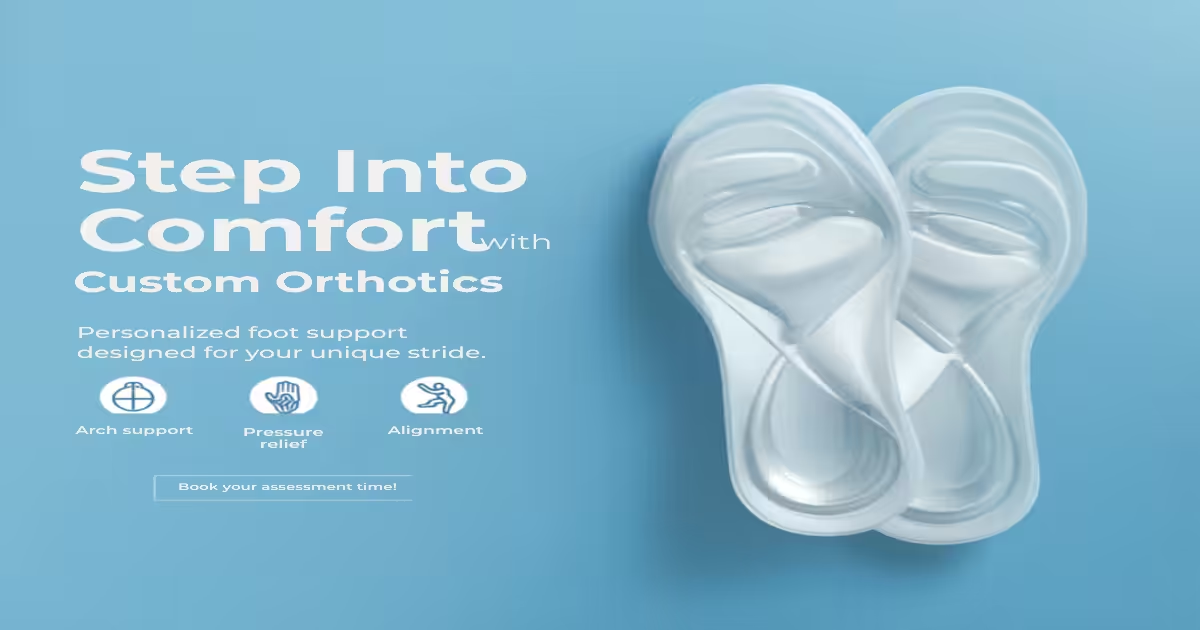
Over-the-counter insoles are mass-produced to accommodate general foot shapes. Custom orthotics are individually prescribed medical devices made from a 3D cast or scan of your specific foot, designed around your unique anatomy and biomechanical pattern. Both can be effective — but for different conditions and severity levels.
When OTC Insoles Work Well
- Mild plantar fasciitis (first 6–8 weeks of symptoms)
- General arch support and cushioning for healthy feet
- Temporary support while waiting for custom orthotic fabrication
- Budget constraints — OTC insoles cost $15–$75 vs. $300–$600+ for custom
When Custom Orthotics Are Necessary
- Moderate to severe plantar fasciitis that hasn’t resolved with OTC insoles
- Structural deformities (flat feet, high arches) causing pain or secondary problems
- Sports performance optimization (runner’s orthotics, cleated shoe orthotics)
- Diabetic foot protection — must be accommodative and precisely contoured
- Conditions requiring specific mechanical correction (overpronation, supination, leg length discrepancy)
Best OTC Insoles by Category
Best Overall: PowerStep Pinnacle
📍 Located in Michigan?
Our board-certified podiatrists treat this condition at two convenient locations. Same-day appointments often available.
Watch: Custom Orthotics vs OTC Insoles — Dr. Biernacki Explains

Dr. Tom Biernacki, DPM | Balance Foot & Ankle — Howell & Bloomfield Township, MI | (810) 206-1402
The gold standard OTC insole — widely recommended by podiatrists and physical therapists for 40+ years. Deep heel cup, high arch support, firm stabilizer cap. Best for moderate to high arches. Available in standard width and B/D widths. Shop PowerStep Pinnacle →
Best for Plantar Fasciitis: Powerstep Pinnacle
Excellent balance of arch support and cushioning. The dual-layer foam provides shock absorption that PowerStep Pinnacle’s firmer design lacks. The anti-microbial top cover addresses athlete’s foot risk. Best for moderate flat feet with plantar fasciitis. Shop Powerstep Pinnacle →
Best for High Arches: Total Support Max
High-arched feet need cushioning and a contoured arch that doesn’t over-correct. The Total Support Max fills the arch without posting, providing comfort without the rigid control that high arches don’t need. Shop Total Support →
Best for Heel Pain: Tuli’s Classic Heel Cups
For pure heel pain cushioning — Charcot’s rings or similar honeycomb designs provide shock absorption directly at the heel strike zone. Best used as an add-in to your existing shoe alongside arch support. Shop Tuli’s Heel Cups →
Best for Diabetics: RX Orthotic Arch Support
Diabetic patients need a softer, accommodative insole that redistributes pressure without creating new hot spots. The RX provides cushioning with a moderate arch fill and seamless design that minimizes blister risk. Shop RX →
One Key Rule for Insole Selection
You cannot effectively replace a custom orthotic with an OTC insole for structural or biomechanical conditions — but you can significantly help mild to moderate conditions. If you’ve tried 2–3 OTC insoles without improvement after 6–8 weeks, it’s time for a custom orthotic evaluation.
Ready for Custom Orthotics That Actually Work?
Dr. Biernacki at Balance Foot & Ankle designs custom orthotics using 3D digital scanning. Insurance and Medicare accepted.
or call (810) 206-1402
📧 Get Dr. Tom’s Free Lab Test Guide
Discover the 5 lab tests every person over 35 should ask their doctor about — explained in plain English by a board-certified physician.
Best Insoles for Foot Pain — Podiatrist Recommendations 2026
Looking for the best insoles to relieve foot pain? Our podiatrists compare over-the-counter options and explain when custom orthotics are the better choice.
Explore Our Custom 3D Orthotic Program → | Book Your Appointment | Call (810) 206-1402
Clinical References
- Banwell HA, et al. Efficacy of custom foot orthoses in improving pain and function. Journal of Foot and Ankle Research, 2014;7(1):1-11.
- Landorf KB, et al. Effectiveness of foot orthoses to treat plantar fasciitis: a randomized trial. Archives of Internal Medicine, 2006;166(12):1305-1310.
- Mills K, et al. A randomised control trial of short-term efficacy of in-shoe foot orthoses. BMC Musculoskeletal Disorders, 2012;13:111.

Dr. Tom Biernacki, DPM is a double board-certified podiatrist and foot & ankle surgeon at Balance Foot & Ankle Specialists in Southeast Michigan. With over a decade of clinical experience, he specializes in heel pain, bunions, diabetic foot care, sports injuries, and minimally invasive surgery. Dr. Biernacki is a member of the APMA and ACFAS, and his patient education content on MichiganFootDoctors.com and YouTube has reached over one million views.
- Plantar Fasciitis: Diagnosis and Conservative Management (PubMed)
- Plantar Fasciitis (APMA)
- Diagnosis and Treatment of Plantar Fasciitis (PubMed / AAFP)
- Heel Pain (APMA)
Recommended Products from Dr. Tom