
Medically reviewed by Dr. Tom Biernacki, DPM · Board-Certified Podiatric Surgeon · Last reviewed: April 2026 · Editorial Policy
Quick Answer
Calcaneal Stress Fracture: Diagnosis, Risk Factors, and Retu relates to foot/ankle injury — typically caused by trauma or twist. Most patients improve in 4-8 weeks with conservative care. Same-week appointments in Howell + Bloomfield Twp: (810) 206-1402.

Medically reviewed by Dr. Tom Biernacki, DPM — Board-certified foot & ankle surgeon, 3,000+ surgeries performed. Updated April 2026 with current clinical evidence. This article reflects real practice experience from Balance Foot & Ankle Specialists in Howell and Bloomfield Hills, Michigan.
Treatment at Balance Foot & Ankle: Foot Emergency Guide →
Quick Answer
Most foot and ankle problems respond to conservative care — proper footwear, supportive inserts, activity modification, and targeted stretching — within 4-8 weeks. Persistent pain beyond that window, or any symptom that prevents walking, warrants a podiatric evaluation to rule out fracture, tendon tear, or systemic cause.
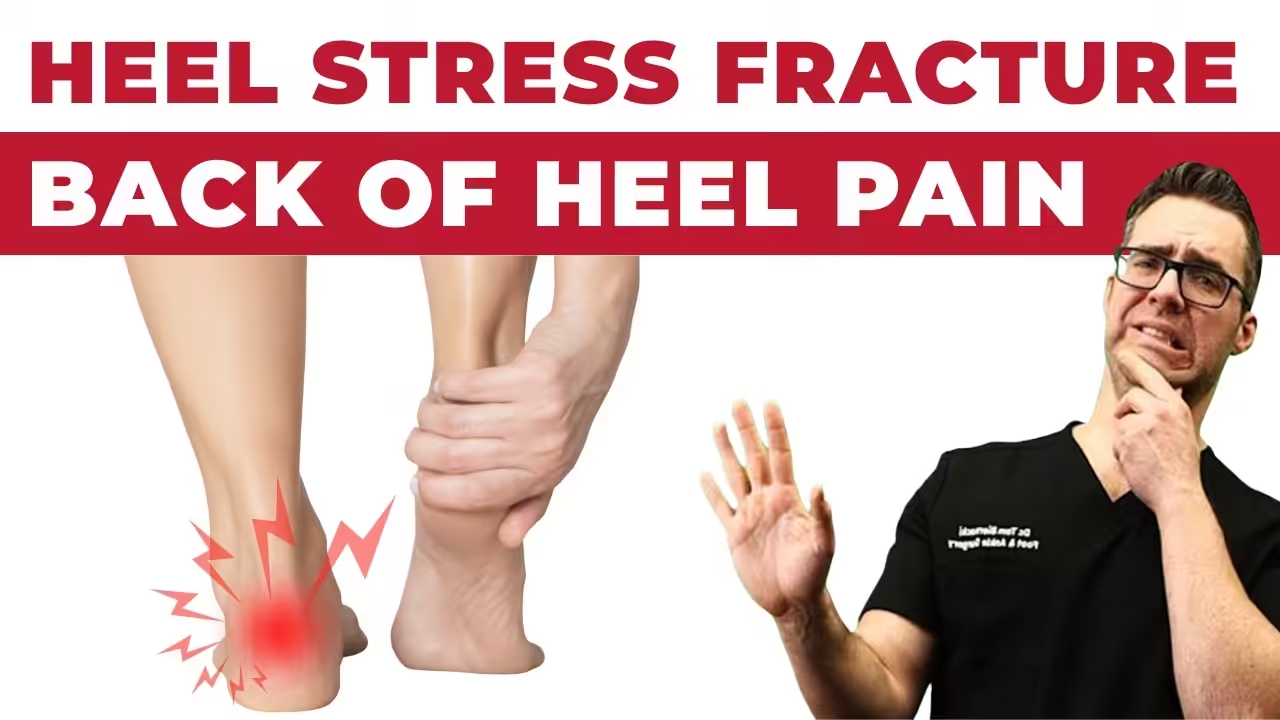
Watch: Dr. Tom Biernacki, DPM

Medically reviewed by Dr. Tom Biernacki, DPM — Board-Certified Podiatric Surgeon — Balance Foot & Ankle, Howell & Bloomfield Hills, MI. Last updated April 2026.
▶ Watch

Medically Reviewed by Dr. Tom Biernacki, DPM — Board-Certified Podiatrist, Balance Foot & Ankle Specialists, Michigan. Last updated April 2026.
Calcaneal stress fracture — a fatigue failure of the calcaneus (heel bone) from repetitive loading exceeding bone remodeling capacity — is an underdiagnosed cause of diffuse posterior heel pain in runners, military recruits, and active individuals. Unlike metatarsal stress fractures, calcaneal stress fractures produce a distinctive pain pattern and examination finding that allows clinical diagnosis before imaging confirmation.
Diagnosis
Clinical presentation: diffuse posterior heel pain that worsens progressively with weight-bearing activity over 2–4 weeks — unlike the first-step plantar fasciitis pain, calcaneal stress fracture pain worsens during activity and may persist into rest in advanced cases. The medial-lateral calcaneal squeeze test: direct lateral-to-medial and medial-to-lateral compression of the calcaneal body between the examiner’s hands — significant pain with this test has 80%+ sensitivity for calcaneal stress fracture. Imaging: plain X-rays are insensitive early (periosteal reaction visible at 2–3 weeks); MRI demonstrates bone marrow edema within 24–48 hours of injury and defines the fracture line; bone scan is highly sensitive but less specific. Ultrasound: periosteal elevation and hyperemia at the fracture site are visible on high-frequency ultrasound in experienced hands.
Risk Factors and Return to Activity
Risk factors: female sex (female athlete triad — low energy availability, menstrual dysfunction, low bone mineral density); military training (sudden mileage increase on hard surfaces); osteoporosis or vitamin D deficiency; previous stress fracture (indicates systemic bone metabolism risk); rapid mileage increase in runners (>10% weekly increase). Treatment: reduction in weight-bearing activity (not necessarily complete non-weight-bearing for calcaneal fractures — a boot or rigid shoe with heel cushioning allows protected walking in most cases); calcium and vitamin D optimization; bone density screening for recurrent or atypical presentations. Return to activity: gradual return beginning at 6–8 weeks based on resolution of squeeze test tenderness — full unrestricted running at 10–12 weeks. Dr. Biernacki at Balance Foot & Ankle evaluates suspected calcaneal stress fracture with the calcaneal squeeze test and diagnostic ultrasound or MRI referral for confirmation. Call (810) 206-1402 at our Bloomfield Hills or Howell office.
📧 Get Dr. Tom’s Free Lab Test Guide
Discover the 5 lab tests every person over 35 should ask their doctor about — explained in plain English by a board-certified physician.
📍 Located in Michigan?
Our board-certified podiatrists treat this condition at two convenient locations. Same-day appointments often available.
In-Office Treatment at Balance Foot & Ankle
If home care isn’t resolving your stress fracture, a visit with a board-certified podiatrist is the fastest path to accurate diagnosis and a personalized plan. At Balance Foot & Ankle Specialists, Dr. Tom Biernacki, Dr. Carl Jay, and Dr. Daria Gutkin offer same-day and next-day appointments at both our Howell and Bloomfield Hills offices. We perform on-site diagnostic ultrasound, digital X-ray, conservative care, advanced regenerative treatments, and minimally invasive surgery when indicated.
Call (810) 206-1402 or request an appointment online. Most insurance plans accepted, including Medicare, Blue Cross Blue Shield, Aetna, Cigna, and United Healthcare.
More Podiatrist-Recommended Stress Fracture Essentials
Max-Cushion Walking Shoe

Hoka Bondi 9 — maximum shock absorption during stress fracture recovery.
Foam Roller for Recovery

- Patented foam roller design offers a superior, multi-density exterior constructed over a rigid, hollow core
- Constructed from quality materials that won’t break down or lose shape from repeated use
- Includes access to free online instructional video library on foam rolling best practices from the experts at trigger point
- Trusted foam roller of physical and massage therapists, coaches, trainers and athletes
- Original Grid: Standard density, 13 x 5.5 inches, 500 pound weight limit; 1 year manufacturer's warranty

TriggerPoint foam roller — maintains lower-leg mobility during return to activity.
Supportive Insole

- The Pinnacle Full length insoles for men & women provide maximum cushioning, from high activity to moderate support. The PowerStep arch support shape provides stability to the foot and ankle, helping to relieve foot pain.
- When you spend all day on your feet, every step counts. PowerStep insoles are a podiatrist-recommended orthotic to help relieve & prevent foot pain related to athletes, runners, Plantar Fasciitis, heel spurs & other common foot, ankle & knee injuries
- The Pinnacle plantar fasciitis insoles offer superior heel cushioning and arch support. The dual-layer cushioning is designed to reduce stress and fatigue, while PowerStep premium arch support is designed for plantar fasciitis relief.
- The PowerStep Pinnacle arch support inserts for men & women can be worn in a variety of shoe types such as; athletic, walking, running, work & some casual shoes. Orthotic Inserts are ordered by shoe size, no trimming required.
- Made in the USA & backed by a 30-day money-back guarantee. PowerStep orthotic inserts for men & women are designed for shoes where the factory insole can be removed. HSA & FSA Eligible
PowerStep Pinnacle — distributes impact evenly across the foot.
As an Amazon Associate, Balance Foot & Ankle earns from qualifying purchases. Product recommendations are based on clinical experience; prices and availability shown above update live from Amazon.
When to See a Podiatrist
Most foot stress fractures heal in 6-8 weeks of protected weight-bearing — but rushing back to activity can turn a hairline fracture into a full break. Balance Foot & Ankle confirms stress fractures on X-ray or MRI and guides your return-to-running protocol. Don’t guess — we’ll tell you the exact week you can start jogging again.
Call Balance Foot & Ankle: (810) 206-1402 · Book online · Offices in Howell & Bloomfield Hills
Frequently Asked Questions
How long does a foot stress fracture take to heal?
Most foot stress fractures heal within 6–8 weeks with proper offloading. High-risk fractures (Jones fracture, navicular stress fracture) can take 3–6 months and sometimes require surgery. Premature return to activity is the most common cause of delayed healing.
How do I know if I have a stress fracture?
Stress fractures cause localized pain that worsens with activity and improves with rest, often with point tenderness over a specific bone. X-rays may be negative for 2–3 weeks after onset — MRI provides definitive diagnosis earlier.
Can you walk on a stress fracture?
This depends on the fracture location and severity. Many foot stress fractures allow limited walking in a protective boot. High-risk fractures (Jones, navicular) typically require non-weight-bearing. Walking on an unprotected stress fracture risks complete fracture.
Need Treatment at Balance Foot & Ankle?
Dr. Tom Biernacki, Dr. Carl Jay, and Dr. Daria Gutkin see patients at our Howell and Bloomfield Township offices.
Book Online or call (810) 206-1402
Calcaneal Stress Fracture Treatment in Michigan
Heel bone stress fractures cause deep, aching heel pain that worsens with activity. Our podiatrists use advanced imaging to differentiate calcaneal stress fractures from plantar fasciitis and provide evidence-based treatment protocols for safe return to activity.
Explore Heel Pain Treatment | Book Your Appointment | Call (810) 206-1402
Clinical References
- Sormaala MJ, Niva MH, Kiuru MJ, et al. Stress injuries of the calcaneus detected with magnetic resonance imaging in military recruits. J Bone Joint Surg Am. 2006;88(10):2237-2242.
- Matheson GO, Clement DB, McKenzie DC, et al. Stress fractures in athletes: a study of 320 cases. Am J Sports Med. 1987;15(1):46-58.
- Weinfeld SB, Haddad SL, Myerson MS. Metatarsal stress fractures. Clin Sports Med. 1997;16(2):319-338.

Insurance Accepted
BCBS · Medicare · Aetna · Cigna · United Healthcare · HAP · Priority Health · Humana · View All →
Howell Office
3980 E Grand River Ave, Suite 140
Howell, MI 48843
Get Directions →
Bloomfield Hills Office
43700 Woodward Ave, Suite 207
Bloomfield Hills, MI 48302
Get Directions →
Your Board-Certified Podiatrists



Ready to Get Back on Your Feet?
Same-week appointments available at both locations.
Book Your AppointmentMost Common Mistake We See
The most common mistake we see is: Waiting too long before seeking care. Fix: any foot pain lasting more than 4 weeks, or any sudden severe symptom, deserves a professional evaluation rather than more rest.
Warning Signs That Need Same-Day Care
Seek immediate evaluation at Balance Foot & Ankle if you experience any of the following:
- Unable to bear weight
- Severe swelling with skin colour change
- Fever with foot pain (possible infection)
- Diabetes plus any new foot symptom
Call (810) 206-1402 — same-day and next-day appointments at our Howell and Bloomfield Hills offices.
Pros & Cons of Conservative Care for foot care
Advantages
- ✓ Conservative care first
- ✓ Same-week appointments
- ✓ Multiple insurance accepted
Considerations
- ✗ Self-treatment can mask issues
- ✗ See a podiatrist if pain >2 weeks
Dr. Tom’s Recommended Products for foot care
Affiliate disclosure: As an Amazon Associate, Balance Foot & Ankle earns from qualifying purchases. We only recommend products we use with patients.


Footnanny Heel Cream Dr. Tom’s Pick
Best for: Daily moisturizer for cracked heels
Ready to Get Back on Your Feet?
Same-day appointments in Howell + Bloomfield Twp. Most insurance accepted. Dr. Tom Biernacki, DPM & team.
Book Today — Same-Day Appointments Available
Call Now: (810) 206-1402
About Your Care Team at Balance Foot & Ankle
Dr. Tom Biernacki, DPM · Board-Certified Foot & Ankle Surgeon. Specializes in conservative-first care, minimally invasive bunion surgery, and complex reconstruction.
Dr. Carl Jay, DPM · Accepting new patients. Specializes in sports medicine, athletic injuries, and routine podiatric care.
Dr. Daria Gutkin, DPM, AACFAS · Accepting new patients. Specializes in surgical reconstruction and pediatric podiatry.
Locations: 4330 E Grand River Ave, Howell, MI 48843 · 43494 Woodward Ave Suite 208, Bloomfield Twp, MI 48302
Hours: Mon–Fri 8:00 AM – 5:00 PM · (810) 206-1402

Dr. Tom Biernacki, DPM is a double board-certified podiatrist and foot & ankle surgeon at Balance Foot & Ankle Specialists in Southeast Michigan. With over a decade of clinical experience, he specializes in heel pain, bunions, diabetic foot care, sports injuries, and minimally invasive surgery. Dr. Biernacki is a member of the APMA and ACFAS, and his patient education content on MichiganFootDoctors.com and YouTube has reached over one million views.
- Plantar Fasciitis: Diagnosis and Conservative Management (PubMed)
- Plantar Fasciitis (APMA)
- Diagnosis and Treatment of Plantar Fasciitis (PubMed / AAFP)
- Heel Pain (APMA)
Related Treatments at Balance Foot & Ankle
Our board-certified podiatrists offer advanced treatments at our Bloomfield Hills and Howell locations.