
Quick answer: Corticosteroid Injections Podiatry Indications Technique is a common foot/ankle topic that affects many patients. Effective treatment starts with a targeted diagnosis, conservative-first treatment, and escalation only when needed. We treat this regularly at our Howell and Bloomfield Township practices. Book online, or call (810) 206-1402.
Medically reviewed by Dr. Tom Biernacki, DPM · Board-Certified Podiatric Surgeon · Last reviewed: April 2026 · Editorial Policy
The most important clinical decision with Corticosteroid Injections Podiatry Indications Technique isn’t which treatment to start with — it’s identifying the correct subtype. That changes everything. Call (810) 206-1402.
Quick Answer
Corticosteroid Injections in Podiatry: Indications, Techniqu relates to foot pain — typically caused by overuse, footwear, or biomechanics. Most patients improve in 6-12 weeks with conservative care. Same-week appointments in Howell + Bloomfield Township: (810) 206-1402.
Medically reviewed by Dr. Tom Biernacki, DPM — Board-Certified Podiatric Surgeon — Balance Foot & Ankle, Howell & Bloomfield Township, MI. Last updated April 2026.
▶ Watch
Medically Reviewed by Dr. Tom Biernacki, DPM — Board-Certified Podiatrist, Balance Foot & Ankle Specialists, Michigan. Last updated April 2026.
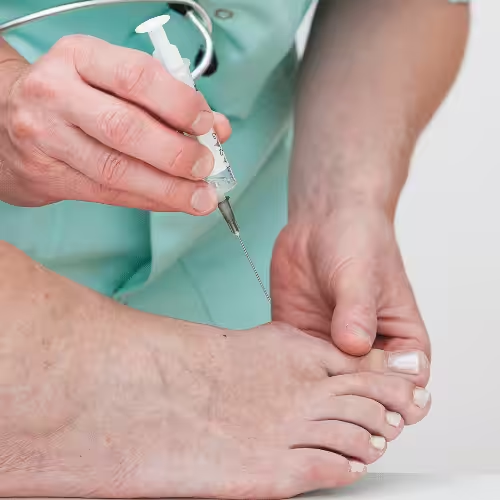
Corticosteroid injections are one of the most widely used interventional tools in podiatric medicine — providing targeted anti-inflammatory relief for a broad spectrum of foot and ankle conditions while avoiding the systemic effects of oral corticosteroids. When used appropriately — with precise diagnosis, correct anatomic targeting, and awareness of risks — they are safe and effective. When overused or imprecisely placed, they carry meaningful risks including soft-tissue atrophy, tendon rupture, skin depigmentation, and diabetic glucose dysregulation. Understanding the evidence base and technical requirements for each indication guides rational corticosteroid use.
Commonly Injected Conditions
Plantar fasciitis: the medial calcaneal tuberosity approach (placing the needle from the medial heel, directing it to the plantar fascia insertion under palpation or ultrasound guidance) provides reliable short-term pain relief in 60–80% of patients at 4–6 weeks. Long-term effect diminishes — corticosteroid injection for plantar fasciitis should be used as a bridge to orthotics and physical therapy, not as a stand-alone treatment. Risk of plantar fascia rupture (1–2%) limits injection frequency to maximum 1–2 per year per site. Morton’s neuroma: ultrasound-guided injection into the interdigital neuroma produces 70–80% short-term response; alcohol sclerosing series is preferred for sustained multi-treatment protocols. Retrocalcaneal bursitis: injection into the retrocalcaneal bursa (not the Achilles tendon) under ultrasound guidance rapidly reduces acute bursitis flares. First MTP joint (hallux rigidus and gout): intra-articular injection provides immediate gout flare relief and symptomatic improvement in hallux rigidus. MTP synovitis in RA: targeted periarticular or intra-articular injection under ultrasound guidance reduces synovial inflammation.
Ultrasound Guidance: When and Why
Real-time ultrasound guidance improves injection accuracy, particularly for small targets (interdigital neuromas, individual MTP joints, tendon sheaths), structures adjacent to tendons where blind injection risks intratendinous placement, and cystic structures requiring aspiration before injection. Ultrasound-guided plantar fascia injection reduces plantar fat pad injection rates (the primary cause of fat pad atrophy complications) by confirming needle placement at the fascia-bone interface rather than the plantar fat. Ultrasound-guided peroneal tendon sheath injection confirms peritendinous (not intratendinous) placement. For straightforward large joint or bursal injections (ankle, subtalar, retrocalcaneal bursa) with clear landmarks, ultrasound guidance adds incremental benefit but is not always required.
Corticosteroid Agents and Dosing
Common injectable corticosteroids in podiatry include: betamethasone (Celestone Soluspan) — long-acting crystalline suspension, 6 mg/mL, standard plantar fasciitis dose 1.5–3 mg; triamcinolone acetonide (Kenalog) — long-acting crystalline suspension, 10–40 mg/mL, most commonly used preparation in podiatry; and dexamethasone — soluble preparation appropriate for tendon sheath injection (less risk of crystalline deposit). Preparations are mixed with local anesthetic (1% lidocaine or 0.5% bupivacaine) to provide immediate post-injection comfort and confirm correct tissue placement by immediate pain relief.
Risks and Contraindications
Plantar fat pad atrophy — the most significant complication of plantar heel corticosteroid injection — results from corticosteroid-induced adipocyte lysis and fibroseptal disruption, reducing the mechanical cushioning of the plantar heel. Risk is dose-dependent and cumulative — limiting plantar heel injections to maximum 2–3 lifetime injections reduces risk. Skin depigmentation and subcutaneous atrophy occur when crystalline corticosteroid deposits near the skin surface — minimized by placing the injection at the intended deep target and not injecting during needle withdrawal. Achilles tendon rupture risk after intratendinous injection is significant — peritendinous injection under ultrasound guidance avoids this complication. Glucose dysregulation in diabetic patients can persist for 3–7 days after a corticosteroid injection — patients should monitor glucose and their prescribing physician should be aware.
Corticosteroid Injections at Balance Foot & Ankle
Dr. Biernacki at Balance Foot & Ankle performs ultrasound-guided corticosteroid injections for plantar fasciitis, Morton’s neuroma, retrocalcaneal bursitis, MTP synovitis, and other indicated foot and ankle conditions. Precise ultrasound guidance maximizes therapeutic effect while minimizing complications. Call (810) 206-1402 for a same-week evaluation and injection consultation.
Foot or Ankle Inflammation? Ask About Guided Injection Therapy.
Serving Southeast Michigan from Bloomfield Township and Howell.
📞 (810) 206-1402 |
📧 Get Dr. Tom’s Free Lab Test Guide
Discover the 5 lab tests every person over 35 should ask their doctor about — explained in plain English by a board-certified physician.
📍 Located in Michigan?
Our board-certified podiatrists treat this condition at two convenient locations. Same-day appointments often available.
Insurance Accepted
BCBS · Medicare · Aetna · Cigna · United Healthcare · HAP · Priority Health · Humana · View All →
Howell Office
4330 E Grand River Ave
Howell, MI 48843
Get Directions →
Bloomfield Township Office
43494 Woodward Ave, #208
Bloomfield Township, MI 48302
Get Directions →
Your Board-Certified Podiatrists



Ready to Get Back on Your Feet?
Same-week appointments available at both locations.
Book Your AppointmentMore Podiatrist-Recommended Cortisone Essentials
Hoka Clifton 10


Max-cushion everyday shoe — podiatrist favorite for walking and running.

OOFOS Recovery Slide

Impact-absorbing recovery sandal — wear after long days on your feet.
As an Amazon Associate, Balance Foot & Ankle earns from qualifying purchases. Product recommendations are based on clinical experience; prices and availability shown above update live from Amazon.

When to See a Podiatrist
Cortisone injections are most effective when paired with a root-cause fix — orthotic, shoe change, or physical therapy. At Balance Foot & Ankle, we use ultrasound guidance to place every injection exactly in the inflamed space, maximizing relief. And we always discuss the treatment plan that follows, so the pain stays gone.
Call Balance Foot & Ankle: (810) 206-1402 · Book online · Offices in Howell & Bloomfield Township
In-Office Treatment at Balance Foot & Ankle
When conservative care isn’t enough, Dr. Tom Biernacki and the team at Balance Foot & Ankle offer advanced, same-day options — including Cortisone Injections for Foot Pain Michigan at our Howell and Bloomfield Township clinics.
Same-day appointments available. Call (810) 206-1402 or book online.
Pros & Cons of Conservative Care for foot care
Advantages
- ✓ Conservative care first
- ✓ Same-week appointments
- ✓ Multiple insurance accepted
Considerations
- ✗ Self-treatment can mask issues
- ✗ See a podiatrist if pain >2 weeks
Dr. Tom’s Recommended Products for foot care
Affiliate disclosure: As an Amazon Associate, Balance Foot & Ankle earns from qualifying purchases. We only recommend products we use with patients.
Footnanny Heel Cream Dr. Tom’s Pick
Best for: Daily moisturizer for cracked heels
Ready to Get Back on Your Feet?
Same-day appointments in Howell + Bloomfield Township. Most insurance accepted. Dr. Tom Biernacki, DPM & team.
Book Today — Same-Day Appointments Available
Call Now: (810) 206-1402
About Your Care Team at Balance Foot & Ankle
Dr. Tom Biernacki, DPM · Board-Certified Foot & Ankle Surgeon. Specializes in conservative-first care, minimally invasive bunion surgery, and complex reconstruction.
Dr. Carl Jay, DPM · Accepting new patients. Specializes in sports medicine, athletic injuries, and routine podiatric care.
Dr. Daria Gutkin, DPM, AACFAS · Accepting new patients. Specializes in surgical reconstruction and pediatric podiatry.
Locations: 4330 E Grand River Ave, Howell, MI 48843 · 43494 Woodward Ave Suite 208, Bloomfield Township, MI 48302
Hours: Mon–Fri 8:00 AM – 5:00 PM · (810) 206-1402
In-Office Treatment at Balance Foot & Ankle
If home treatment isn’t providing relief for your foot and ankle conditions, our podiatry team at Balance Foot & Ankle can help with same-day evaluations and advanced in-office care.
Same-day appointments available. (810) 206-1402
Doctor Hoy’s Natural Pain Relief Gel
Natural topical pain relief I use in our clinic. Arnica + camphor formula — apply directly to the area 3–4x daily. ($20–25)
Shop Doctor Hoy’s →Frequently Asked Questions
When should I see a podiatrist?
If symptoms persist past 2 weeks, affect your normal activity, or are accompanied by red-flag symptoms (warmth, redness, swelling, inability to bear weight).
What does treatment cost?
Most diagnostic visits and conservative treatments are covered by Medicare and major insurers. Out-of-pocket costs vary by your specific plan.
How quickly can I get an appointment?
Most non-urgent cases see us within 5 business days. Urgent cases (sudden pain, possible fracture) typically same or next business day.
Ready for Expert Care?
Same-day appointments in Howell & Bloomfield Township, MI.
4.9★ | 1,123 Reviews | 3,000+ Surgeries
Or call: (810) 206-1402

Dr. Tom Biernacki, DPM is a board-certified foot & ankle surgeon (ABFAS & ABPM) at Balance Foot & Ankle Specialists in Southeast Michigan. With over a decade of clinical experience, he specializes in heel pain, bunions, diabetic foot care, sports injuries, and minimally invasive surgery. Dr. Biernacki is a member of the APMA and ACFAS, and his patient education content on MichiganFootDoctors.com and YouTube has made him one of the most-followed foot & ankle educators on YouTube.