

You are in the right place. Dr. Tom Biernacki, DPM, FACFAS — board-certified foot & ankle surgeon with 3,000+ surgeries — explains exactly what flexor hallucis longus tendinopathy posterior ankle pain guide means and what works. Call (810) 206-1402 for same-week appointment at Howell or Bloomfield Township.
Quick answer: Flexor Hallucis Longus Tendinopathy Posterior Ankle Pain Guide has multiple potential causes including mechanical, neurological, vascular, and inflammatory. The patterns we see most often are overuse, poorly-fitted shoes, and biomechanical imbalance. Red flags requiring urgent evaluation: warmth/redness (infection), inability to bear weight (fracture), and unilateral swelling without injury (DVT). Call (810) 206-1402.
Medically reviewed by Dr. Tom Biernacki, DPM · Board-Certified Podiatric Surgeon · Last reviewed: April 2026 · Editorial Policy
Quick Answer
Flexor Hallucis Longus Tendinopathy: Deep Posterior Ankle Pa relates to foot pain — typically caused by overuse, footwear, or biomechanics. Most patients improve in 6-12 weeks with conservative care. Same-week appointments in Howell + Bloomfield Township: (810) 206-1402.
Medically reviewed by Dr. Tom Biernacki, DPM — Board-Certified Podiatric Surgeon — Balance Foot & Ankle, Howell & Bloomfield Township, MI. Last updated April 2026.
▶ Watch
Medically Reviewed by Dr. Tom Biernacki, DPM — Board-Certified Podiatrist, Balance Foot & Ankle Specialists, Michigan. Last updated April 2026.
Flexor hallucis longus (FHL) tendinopathy is a condition that disproportionately affects ballet dancers, gymnasts, and runners — athletes who perform repetitive plantarflexion and toe-off loading. Often misdiagnosed as Achilles tendinopathy, ankle sprain, or posterior ankle impingement, FHL problems produce a characteristic deep posteromedial ankle and big toe pain that responds to specific treatments quite different from other ankle conditions.
Anatomy of the Flexor Hallucis Longus
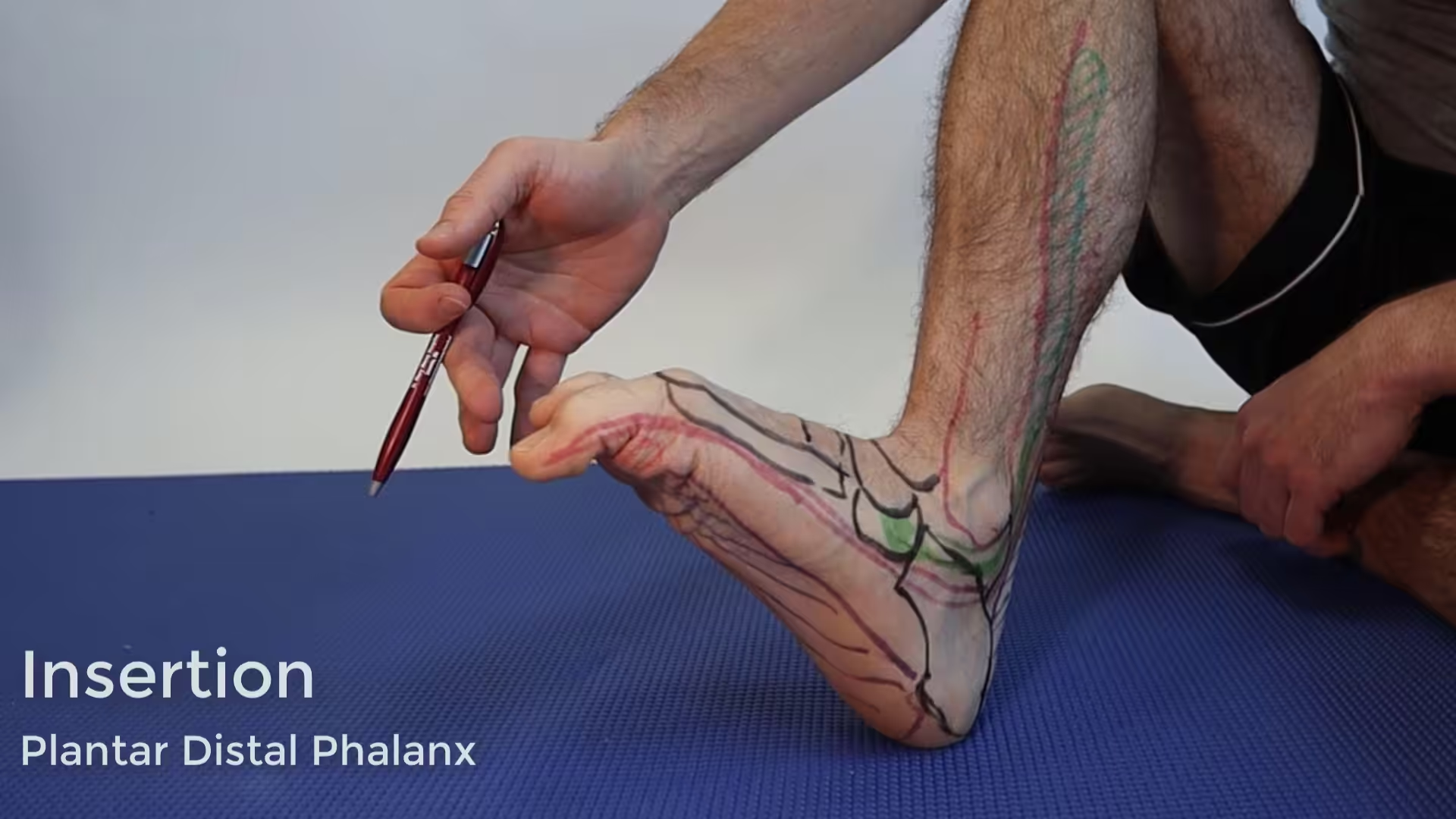
The FHL originates in the posterior compartment of the lower leg and runs through a fibro-osseous tunnel (the “master knot of Henry” distally, and a groove in the posterior talus proximally) behind the medial malleolus before inserting into the distal phalanx of the hallux. It is the primary plantarflexor of the big toe and an important contributor to propulsion and push-off strength.
The narrow posterior talar groove creates a mechanical compression point — particularly vulnerable to tenosynovitis (inflammation of the tendon sheath), triggering (triggering hallux — catching or locking of the hallux in flexion), and longitudinal tears when the tendon is repeatedly loaded against the tight fibro-osseous channel.
Causes and Mechanisms
FHL tendinopathy occurs in predictable athletic contexts:
- Ballet dancers: En pointe and demi-pointe work require extreme plantarflexion and push-off through the FHL — the highest incidence of FHL tendinopathy of any athletic group
- Runners: Repetitive push-off loading, particularly with flexible footwear, increases FHL demand
- Posterior ankle impingement: Os trigonum and Stieda process compress the FHL sheath during plantarflexion — FHL tenosynovitis is frequently part of the posterior impingement syndrome complex
- Hypertrophied FHL muscle belly: A low-lying accessory muscle belly within the narrow talar groove creates direct mechanical compression of the tendon
Symptoms
Classic presentation: deep posteromedial ankle pain reproduced with resisted big toe plantarflexion and passive big toe dorsiflexion. The “triggering hallux” — a palpable or audible snap/click of the FHL within its sheath, with intermittent locking of the hallux in flexion — is pathognomonic. Symptoms often localize to the posterior ankle (behind the medial malleolus) and may extend into the plantar surface of the hallux.
Distinguishing FHL from Achilles tendinopathy: FHL pain is posteromedial and reproduced by hallux motion; Achilles pain is posterior midline and reproduced by ankle plantarflexion without hallux movement.
Diagnosis
Clinical examination demonstrating posteromedial tenderness along the FHL course, triggering, and pain with resisted hallux plantarflexion is usually sufficient for diagnosis. Diagnostic ultrasound identifies tenosynovitis (fluid in the FHL sheath), hypoechoic areas within the tendon (tendinosis), and low-lying muscle belly impingement. MRI characterizes tenosynovitis extent, partial tears, and associated posterior ankle impingement.
Treatment
Conservative: Activity modification (reducing en pointe work or push-off loading), anti-inflammatory treatment (NSAIDs, ultrasound-guided FHL sheath injection), physical therapy focusing on eccentric FHL loading, and footwear modification to reduce FHL demand.
Surgical: When conservative management fails (typically after 3–6 months), FHL release — opening the fibro-osseous tunnel to decompress the tendon and resect any associated os trigonum or Stieda process — is highly effective. Dancers typically return to full performance within 3–4 months.
Posterior Ankle Pain in a Dancer or Athlete?
Dr. Biernacki at Balance Foot & Ankle evaluates FHL tendinopathy and posterior ankle impingement with on-site ultrasound and provides targeted injection therapy. Same-week appointments at Bloomfield Township and Howell.
📞 (810) 206-1402 | Request an Appointment →
📍 Located in Michigan?
Our board-certified podiatrists treat this condition at two convenient locations. Most new patients are seen the same week.
Insurance Accepted
BCBS · Medicare · Aetna · Cigna · United Healthcare · HAP · Priority Health · Humana · View All →
Howell Office
4330 E Grand River Ave
Howell, MI 48843
Get Directions →
Bloomfield Township Office
43494 Woodward Ave, #208
Bloomfield Township, MI 48302
Get Directions →
Your Board-Certified Podiatrists



Ready to Get Back on Your Feet?
Same-week appointments available at both locations.
Book Your AppointmentMore Podiatrist-Recommended Foot Health Essentials
Hoka Clifton 10


Watch: Achilles Tendonitis & Back of Heel Pain [BEST Home Treatments 2024!] — MichiganFootDoctors YouTube
Max-cushion everyday shoe — podiatrist favorite for walking and running.

OOFOS Recovery Slide

Impact-absorbing recovery sandal — wear after long days on your feet.
As an Amazon Associate, Balance Foot & Ankle earns from qualifying purchases. Product recommendations are based on clinical experience; prices and availability shown above update live from Amazon.
When to See a Podiatrist
If foot or ankle pain has been bothering you for more than a few weeks, home care alone may not be enough. Balance Foot & Ankle offers same-week appointments at our Howell and Bloomfield Township clinics — no referral needed in most cases. Bring your current shoes and a short list of symptoms and we’ll build you a treatment plan in one visit.
Call Balance Foot & Ankle: (810) 206-1402 · Book online · Offices in Howell & Bloomfield Township
Pros & Cons of Conservative Care for foot care
Advantages
- ✓ Conservative care first
- ✓ Same-week appointments
- ✓ Multiple insurance accepted
Considerations
- ✗ Self-treatment can mask issues
- ✗ See a podiatrist if pain >2 weeks
Dr. Tom’s Recommended Products for foot care
Affiliate disclosure: As an Amazon Associate, Balance Foot & Ankle earns from qualifying purchases. We only recommend products we use with patients.
Footnanny Heel Cream Dr. Tom’s Pick
Best for: Daily moisturizer for cracked heels
Ready to Get Back on Your Feet?
Same-week appointments in Howell + Bloomfield Township. Most insurance accepted. Dr. Tom Biernacki, DPM & team.
Book Today — Same-Week Appointments Available
Call Now: (810) 206-1402
About Your Care Team at Balance Foot & Ankle
Dr. Tom Biernacki, DPM · Board-Certified Foot & Ankle Surgeon. Specializes in conservative-first care, minimally invasive bunion surgery, and complex reconstruction.
Dr. Carl Jay, DPM · Accepting new patients. Specializes in sports medicine, athletic injuries, and routine podiatric care.
Dr. Daria Gutkin, DPM, AACFAS · Accepting new patients. Specializes in surgical reconstruction and pediatric podiatry.
Locations: 4330 E Grand River Ave, Howell, MI 48843 · 43494 Woodward Ave Suite 208, Bloomfield Township, MI 48302
Hours: Mon–Fri 8:00 AM – 5:00 PM · (810) 206-1402
In-Office Treatment at Balance Foot & Ankle
If home treatment isn’t providing relief for your Achilles tendon conditions, our podiatry team at Balance Foot & Ankle can help with same-week evaluations and advanced in-office care.
Same-week appointments available. (810) 206-1402
Learn about our Achilles tendonitis treatment → | Book online →
VitaMedica Arnica Gel
Arnica gel plus 15 plant compounds for sore feet, plantar fasciitis flares and post-activity soreness. Apply a thin layer to the sore area.
Shop VitaMedica Arnica Gel →Frequently Asked Questions
When should I see a doctor?
See a podiatrist if pain persists past 2 weeks, prevents normal activity, or is accompanied by red-flag symptoms (warmth, swelling, numbness, inability to bear weight).
Can I treat this at home?
Mild cases respond to RICE protocol (rest, ice, compression, elevation), supportive shoes, and OTC anti-inflammatories. Persistent symptoms need professional evaluation.
How long does it take to heal?
Most soft tissue injuries resolve in 2-6 weeks with appropriate care. Bone injuries take 6-12 weeks. Chronic conditions need longer-term management.

Dr. Tom Biernacki, DPM is a board-certified foot & ankle surgeon (ABFAS & ABPM) at Balance Foot & Ankle Specialists in Southeast Michigan. With over a decade of clinical experience, he specializes in heel pain, bunions, diabetic foot care, sports injuries, and minimally invasive surgery. Dr. Biernacki is a member of the APMA and ACFAS, and his patient education content on MichiganFootDoctors.com and YouTube has made him one of the most-followed foot & ankle educators on YouTube.