


Quick answer: Foot Ankle Changes After Knee Replacement is a common foot/ankle topic that affects many patients. Effective treatment starts with a targeted diagnosis, conservative-first treatment, and escalation only when needed. We treat this regularly at our Howell and Bloomfield Township practices. Call (810) 206-1402.

Medically Reviewed by Dr. Tom Biernacki, DPM, FACFAS — Board-certified podiatrist & foot surgeon | Balance Foot & Ankle | Last updated: May 2026
Quick Answer: Foot & Ankle Changes After Knee Replacement
Total knee replacement (TKR) corrects knee alignment and relieves pain, but frequently produces secondary foot and ankle adaptations — both beneficial and problematic. Patients who had varus (bow-legged) or valgus (knock-kneed) deformity before surgery often experience new foot mechanics after alignment correction. New-onset flat foot, ankle pain, and changes in shoe fit are common. Podiatric evaluation after TKR optimizes gait biomechanics, reduces fall risk, and prevents secondary foot injuries from compensatory mechanics.
Knee replacement is one of the most common major surgeries in the United States, with over 700,000 procedures performed annually. The focus of rehabilitation is understandably on the knee — but the foot and ankle exist in a kinetic chain with the knee, and correcting decades of knee deformity inevitably changes the mechanical environment for the structures below. As a podiatrist, I see a consistent pattern of foot and ankle presentations in patients 3–12 months post-TKR that are directly attributable to alignment changes from the procedure.
How Knee Deformity Creates Foot Compensation Patterns
When the knee has been chronically mal-aligned — either bowed outward (varus) or knock-kneed (valgus) — the foot develops compensatory mechanics to maintain balance and forward propulsion. A varus knee shifts load to the lateral compartment and foot; many patients with chronic varus knee OA develop supination (high arch loading) as compensation. A valgus knee shifts load medially, producing overpronation (flat foot) compensation. TKR corrects the knee alignment, but the compensatory foot mechanics — reinforced over years or decades — do not automatically normalize. The result is a mismatch between the new knee alignment and the habituated foot mechanics, which must be assessed and addressed post-operatively.
Common Foot Presentations After Total Knee Replacement
| Presentation | Prior Knee Deformity | Mechanism | Management |
|---|---|---|---|
| New medial ankle pain | Varus (bowleg) | Correction shifts load medially; posterior tibial tendon overloads | Medial arch orthotic, PT |
| Acquired flat foot progression | Valgus (knock-knee) | Increased medial load + posterior tibial tendon strain | UCBL orthotic, brace, PT |
| Plantar fasciitis (new onset) | Either | Gait normalization increases fascial loading after years of antalgic gait | Orthotics, stretching, supportive shoes |
| Lateral ankle instability | Varus | Supination compensation persists post-correction | Lateral wedge orthotic, ankle brace |
| Metatarsalgia / forefoot pain | Either | Improved gait velocity increases forefoot loading in previously antalgic gait | Metatarsal pad orthotic, wide shoe |
The “Post-TKR Gait Normalization” Foot Injury
One of the most satisfying outcomes of TKR is the return of normal gait — patients who shuffled slowly due to knee pain are able to walk more briskly and with greater step length after recovery. This is excellent for quality of life, but it also substantially increases loading on foot structures that have been relatively protected by an antalgic (pain-compensating) gait pattern for years. Plantar fasciitis, Achilles tendinopathy, and metatarsalgia commonly debut in the 3–6 months post-TKR window as normal gait mechanics resume at higher activity levels. These injuries are not complications of the TKR — they are secondary consequences of restored mobility in a foot that was not conditioned for normal loading.
Standard TKR rehabilitation programs focus on quadriceps strengthening, range of motion, and functional transfers — the foot and ankle are not typically assessed. This means that patients with pre-existing biomechanical issues (flat feet, high arches, previous ankle sprains, bunions) have those issues compounded by the new knee alignment without any proactive management. I recommend all TKR patients schedule a podiatric evaluation at 3 months post-surgery — before the high-activity walking programs that typically begin at this stage. Identifying and addressing foot mechanics before the loading increases prevents the secondary injuries that otherwise delay return to full function.
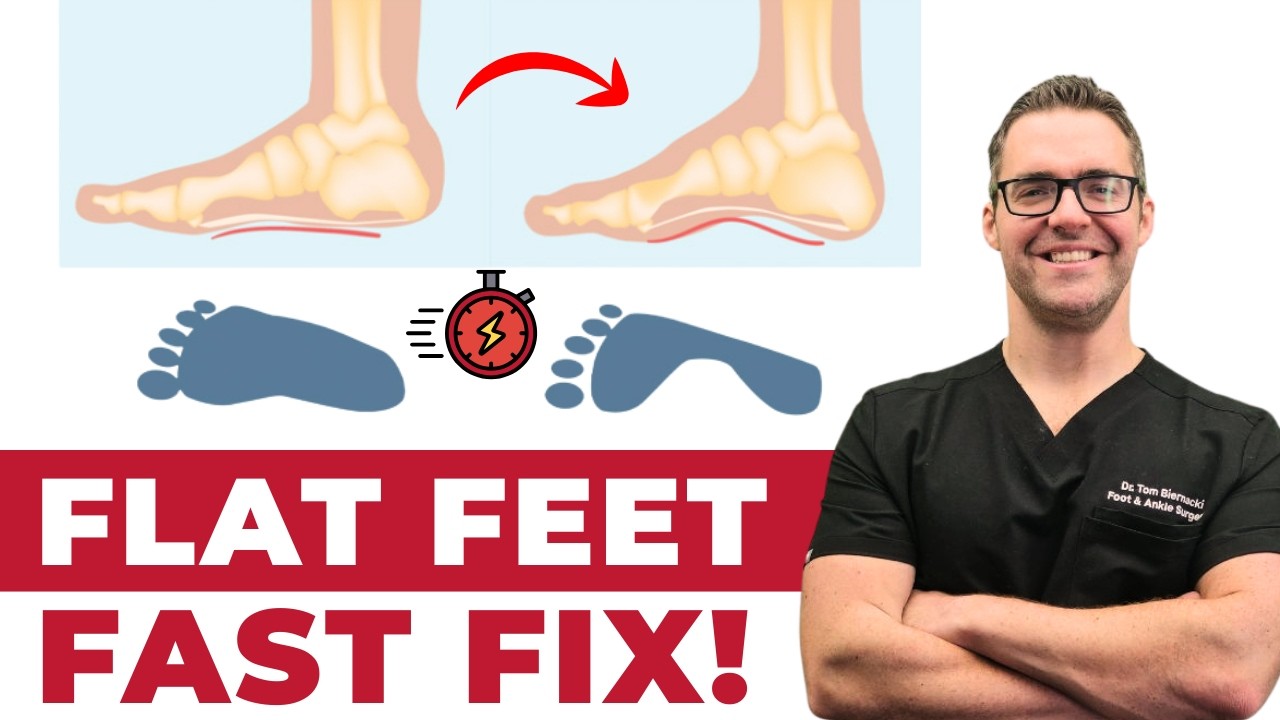
Watch: Foot & Knee Biomechanics — Dr. Tom Biernacki
Book a post-TKR foot assessment → | (810) 206-1402
Frequently Asked Questions
How soon after knee replacement should I see a podiatrist?
The optimal window is 10–14 weeks post-TKR — after the acute rehabilitation phase, once walking is normalized, and before high-activity programs that significantly increase loading. This timing allows assessment of actual gait mechanics under the new knee alignment and proactive orthotic fitting before new foot symptoms develop. Patients who present after foot symptoms have already developed still benefit from evaluation — the treatment is the same, but prevention is always preferable.
Can knee replacement cause flat feet?
TKR does not directly cause flat feet, but it can accelerate flat foot progression in patients with underlying posterior tibial tendon insufficiency that was compensated by their previous gait pattern. When valgus knee deformity is corrected, the new alignment changes medial compartment loading and can increase demand on the posterior tibial tendon. Combined with the increased walking that healthy post-TKR patients achieve, this can accelerate the progression of PTTD from stage I (tendinopathy) to stage II (flexible flat foot). Early recognition and orthotic management prevents structural deformity progression.
My foot pain started after knee surgery — is this normal?
New foot pain after TKR is common enough that it should be considered an expected possible consequence rather than a surprise complication. The biomechanical reasons are well-understood. It does not mean the surgery failed or was performed incorrectly — it means the kinetic chain below the corrected knee needs its own assessment and adjustment. Most post-TKR foot pain responds well to orthotics and targeted physical therapy. Call (810) 206-1402 for same-day evaluation at our Howell or Bloomfield Township offices.
Do I need different orthotics after knee replacement?
Possibly — if you had orthotics fitted before TKR, they were designed for your pre-surgical gait mechanics and alignment. After TKR corrects your knee alignment, the optimal orthotic prescription may change. I recommend bringing pre-existing orthotics to a post-TKR evaluation — I can assess whether they remain appropriate or need modification for your new gait pattern. This is particularly important if your knee had significant varus or valgus deformity before surgery.
Is ankle pain after knee replacement serious?
New ankle pain after TKR warrants evaluation but is rarely serious. Most cases represent posterior tibial tendinopathy or peroneal tendinopathy from changed mechanical loading — both respond well to orthotics and physical therapy. Ankle pain accompanied by significant swelling, redness, and warmth requires prompt evaluation to rule out infection (particularly relevant in the post-surgical period) or DVT. Gradual-onset ankle aching starting 6–12 weeks after TKR, without systemic symptoms, is typically a biomechanical issue.
Post-Knee Replacement Foot Assessment — Same-Day Available
Gait analysis, orthotics re-fitting, new foot pain evaluation — Howell & Bloomfield Township, MI
Book Appointment (810) 206-1402Related: Custom Orthotics Michigan | Plantar Fasciitis Treatment | Foot Arch Types
In-Office Treatment at Balance Foot & Ankle
If home treatment isn’t providing relief for your foot and ankle conditions, our podiatry team at Balance Foot & Ankle can help with same-day evaluations and advanced in-office care.
Same-day appointments available. (810) 206-1402
Doctor Hoy’s Natural Pain Relief Gel
Natural topical pain relief I use in our clinic. Arnica + camphor formula — apply directly to the area 3–4x daily. ($20–25)
Shop Doctor Hoy’s →Get Expert Care at Balance Foot & Ankle
Same-week appointments at our Howell and Bloomfield Township offices. Board-certified podiatric surgeons. Most insurance accepted.
Same-Week Appointments in Howell & Bloomfield Township
Three board-certified podiatric surgeons. 1,123+ five-star reviews. Most insurance accepted.

Dr. Tom Biernacki, DPM is a board-certified foot & ankle surgeon (ABFAS & ABPM) at Balance Foot & Ankle Specialists in Southeast Michigan. With over a decade of clinical experience, he specializes in heel pain, bunions, diabetic foot care, sports injuries, and minimally invasive surgery. Dr. Biernacki is a member of the APMA and ACFAS, and his patient education content on MichiganFootDoctors.com and YouTube has made him one of the most-followed foot & ankle educators on YouTube.