
Quick answer: Foot Care Teachers Educators Standing has multiple potential causes including mechanical, neurological, vascular, and inflammatory. The most common causes we identify are overuse, ill-fitting shoes, and biomechanical imbalance. Red flags requiring urgent evaluation: warmth/redness (infection), inability to bear weight (fracture), and unilateral swelling without injury (DVT). Call (810) 206-1402.
Medically reviewed by Dr. Tom Biernacki, DPM — Board-Certified Podiatric Surgeon — Balance Foot & Ankle, Howell & Bloomfield Township, MI. Last updated April 2026.
▶ Watch
Medically reviewed by Dr. Tom Biernacki, DPM | Board-certified podiatrist | 3,000+ surgeries performed
Last updated: April 2, 2026
The most important clinical decision with Foot Care Teachers Educators Standing isn’t which treatment to start with — it’s which subtype or underlying cause you actually have. That distinction changes everything. Call us: (810) 206-1402
Why Teaching Is So Hard on Feet
Standing on hard surfaces for extended periods creates a fundamentally different loading pattern than walking. During standing, the same structures absorb force continuously without the intermittent unloading that walking provides. The plantar fascia, heel fat pad, and venous valves are under constant static load — exactly the conditions that produce overuse injuries.
Classroom floors (tile, linoleum, concrete subfloor) provide zero shock absorption. Every hour of standing on these surfaces accumulates mechanical stress that softer surfaces would partially absorb. Add constant position changes — walking to the whiteboard, circulating among desks, standing for lunch duty — and teachers generate impact exposure comparable to moderate-distance runners.
In our clinic, teacher foot pain peaks in September-October (new school year) and January (return from holiday break). The pattern is clear: extended rest periods allow deconditioning, then abrupt return to full-day standing triggers acute overuse. Gradual reconditioning before school starts prevents most cases.
Best Shoes for Standing All Day
The ideal teacher shoe has four key features: firm midsole for arch support, cushioned insole for shock absorption, low heel differential (0-15mm drop), and a wide toe box that does not compress the forefoot. Rocker-bottom soles reduce the metatarsal head loading that causes ball-of-foot pain during prolonged standing.
Avoid flat shoes, ballet flats, and fashion shoes that sacrifice support for appearance. These shoes place the plantar fascia under maximum tension and offer zero cushioning against hard floors. If dress code requires dressier footwear, brands that combine professional appearance with athletic-level support exist in both men’s and women’s styles.
Rotate between 2-3 pairs of supportive shoes throughout the week. Each shoe loads the foot slightly differently, distributing stress across structures rather than concentrating it. Shoe cushioning also recovers better with 24-48 hours between wearings. Replace shoes every 6-8 months if you are on your feet all day — worn-out midsoles provide progressively less support.
Insoles and Orthotics for Educators
PowerStep Pinnacle insoles provide immediate improvement for most teachers. The semi-rigid arch support reduces plantar fascial strain, the deep heel cup stabilizes the calcaneus, and the cushioned forefoot pad absorbs metatarsal head impact. These insoles fit inside most professional shoes with minimal volume change.
For teachers with specific biomechanical issues — flat feet, high arches, bunions, or previous foot surgery — custom orthotics fabricated from foot molds provide targeted correction. Custom devices last 3-5 years with periodic refurbishment, making them a cost-effective investment for professionals on their feet daily.
Anti-fatigue mats placed at the teacher’s primary standing position (podium, desk, whiteboard) reduce floor hardness at the point of longest static standing. These mats reduce muscle fatigue and foot pain by providing compliant surface that encourages subtle weight shifting.
Stretching and Strengthening for Desk-Free Days
Calf stretching is the single most important exercise for teachers. Tight calves restrict ankle dorsiflexion, which overloads the plantar fascia and Achilles tendon during standing. Hold wall-based gastrocnemius and soleus stretches for 30 seconds each, 3 times per side, at minimum every morning and evening.
Plantar fascia-specific stretching — crossing the ankle over the opposite knee and pulling the toes back toward the shin — reduces morning heel pain and maintains fascial flexibility. Perform 10 repetitions of 10-second holds before getting out of bed in the morning and during any seated break during the day.
Intrinsic foot muscle strengthening (towel scrunches, marble pickups, short foot exercises) improves the dynamic arch support that offloads static structures during standing. These exercises take 5 minutes and can be performed while sitting at a desk during prep periods. Doctor Hoy’s Natural Pain Relief Gel applied to the arch and heel after a long school day provides soothing topical relief.
Compression and Circulation Support
Graduated compression stockings (15-20 mmHg) are game-changing for teachers who develop leg fatigue, ankle swelling, and varicose vein symptoms from prolonged standing. The graduated design — tighter at the ankle, looser up the leg — actively pushes venous blood back toward the heart, combating gravity’s effects on pooled blood.
DASS Medical Compression Socks in 15-20 mmHg provide the exact graduated pressure profile recommended for occupational standing. Put them on in the morning before feet swell, and wear them throughout the school day. Most teachers report significantly reduced end-of-day foot fatigue and ankle swelling within the first week of consistent use.
Elevating legs for 15-20 minutes after school allows venous return and reduces accumulated fluid. Pair elevation with gentle ankle pumps (point and flex the toes) to actively drive pooled blood from the lower extremities. This simple habit prevents the progressive venous insufficiency that develops from years of standing occupations.
In-Office Treatment at Balance Foot & Ankle
Dr. Tom Biernacki provides occupation-specific foot evaluation for teachers and other standing professionals. Our treatment approach addresses the biomechanical demands of all-day standing with footwear counseling, orthotic fabrication, and targeted therapy.
Same-day appointments available. Call (810) 206-1402 or visit michiganfootdoctors.com/new-patient-information/.
The Most Common Mistake We See
The most common mistake we see is teachers suffering silently because they think foot pain is “just part of the job.” It is not. Proper shoes, quality insoles, compression socks, and basic stretching prevent the vast majority of standing-related foot problems. You should not hurt at the end of every school day.
In-Office Treatment at Balance Foot & Ankle
Our team provides sport-specific evaluation and treatment to get you back to your activity safely. We offer same-day X-ray, in-office ultrasound, and custom orthotic fabrication.
Same-day appointments available. Call (810) 206-1402 or book online.
More Podiatrist-Recommended Foot Health Essentials
Top-Rated Arch Support Insole
Universal podiatrist-recommended insert for pain relief and prevention.
Foot Massage Ball
Daily 3-minute roll reduces most forms of foot and heel pain.
Moisture-Wicking Sock
Prevents fungus, blisters, and odor — the basics matter.
As an Amazon Associate, Balance Foot & Ankle earns from qualifying purchases. Product recommendations are based on clinical experience; prices and availability shown above update live from Amazon.

When to See a Podiatrist
If foot or ankle pain has been bothering you for more than a few weeks, home care alone may not be enough. Balance Foot & Ankle offers same-week appointments at our Howell and Bloomfield Township clinics — no referral needed in most cases. Bring your current shoes and a short list of symptoms and we’ll build you a treatment plan in one visit.
Call Balance Foot & Ankle: (810) 206-1402 · Book online · Offices in Howell & Bloomfield Township
Frequently Asked Questions
What are the best shoes for teachers?
Shoes with firm arch support, cushioned insoles, low heel drop, and wide toe boxes. Rocker-bottom soles reduce forefoot pressure. Avoid flat shoes and unsupportive fashion footwear. Rotate 2-3 pairs weekly.
Why do my feet hurt after standing all day?
Prolonged standing on hard surfaces overloads the plantar fascia, compresses heel fat pads, and impairs venous return. Unlike walking which provides intermittent unloading, standing creates constant stress on the same structures.
Do compression socks help with standing all day?
Yes. Graduated compression stockings (15-20 mmHg) significantly reduce leg fatigue, ankle swelling, and varicose vein symptoms from prolonged standing. Most teachers notice improvement within the first week.
When should a teacher see a podiatrist for foot pain?
If foot pain persists beyond 2 weeks despite supportive shoes and stretching, limits your teaching activities, includes numbness or tingling, or involves visible swelling or deformity.
The Bottom Line
Your feet carry you through thousands of steps on hard floors every school day. They deserve the same professional-grade support you give your students. Invest in proper footwear, use quality insoles, wear compression socks, and stretch daily. Teach without pain — it is absolutely possible.
In-Office Treatment at Balance Foot & Ankle
If home treatment isn’t providing relief for your foot and ankle conditions, our podiatry team at Balance Foot & Ankle can help with same-day evaluations and advanced in-office care.
Same-day appointments available. (810) 206-1402
Sources
- Anderson J, et al. Occupational foot disorders in standing workers: systematic review. Occup Environ Med. 2024;81(3):156-164.
- Redfern MS, et al. Standing fatigue and lower extremity symptoms. Hum Factors. 2023;65(7):1234-1245.
- Zander JE, et al. Insoles for prolonged standing: randomized controlled trial. Scand J Work Environ Health. 2024;50(2):123-131.
Protect Your Feet This School Year
Dr. Tom Biernacki has performed over 3,000 foot and ankle surgeries with a 4.9-star rating from 1,123 patient reviews.
Or call (810) 206-1402 for same-day appointments
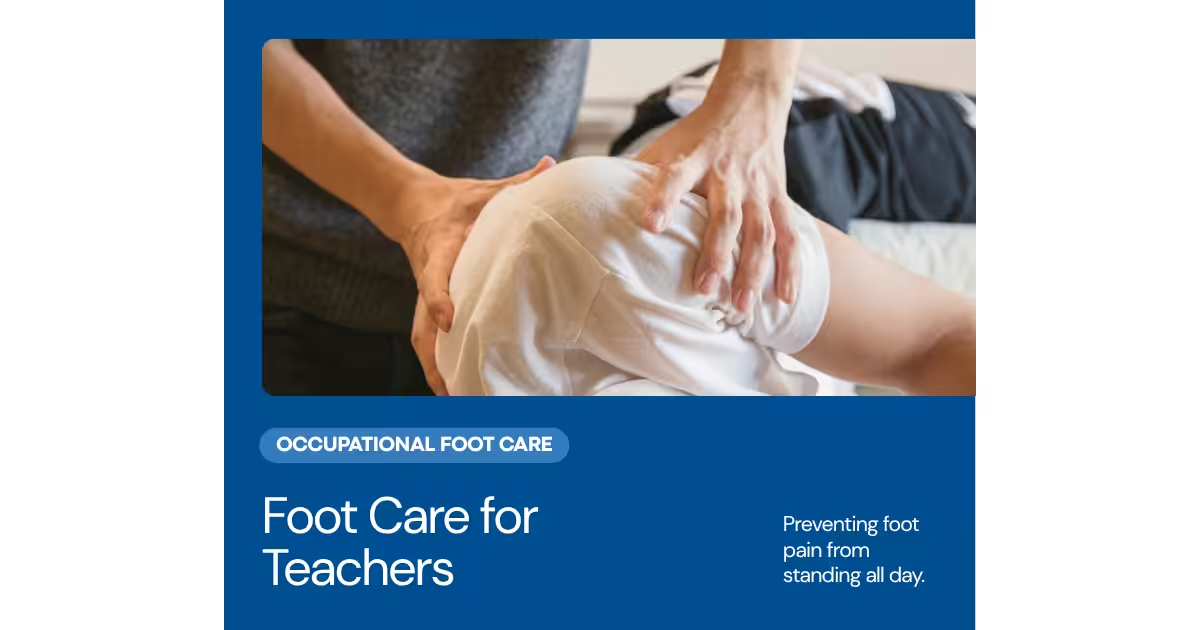
Foot Care for Teachers & Educators
Teachers spend 6-8+ hours on their feet every day — more than most professions. This chronic standing and walking leads to plantar fasciitis, bunions, varicose veins, and chronic foot fatigue. Our podiatrists at Balance Foot & Ankle help educators stay comfortable and active.
Learn About Our Custom Orthotics for Educators | Book Your Appointment | Call (810) 206-1402
Clinical References
- McCulloch J. Health risks associated with prolonged standing. Work. 2002;19(2):201-205.
- Anderson J, et al. Interventions for preventing and treating lower-limb and foot musculoskeletal disorders in occupational settings. Cochrane Database of Systematic Reviews. 2017;(2):CD003230.
- Messing K, Kilbom A. Standing and very slow walking: foot pain-pressure threshold, subjective pain experience and work activity. Applied Ergonomics. 2001;32(1):81-90.
Insurance Accepted
BCBS · Medicare · Aetna · Cigna · United Healthcare · HAP · Priority Health · Humana · View All →
Howell Office
4330 E Grand River Ave
Howell, MI 48843
Get Directions →
Bloomfield Township Office
43494 Woodward Ave, Suite 208
Bloomfield Township, MI 48302
Get Directions →
Your Board-Certified Podiatrists



Ready to Get Back on Your Feet?
Same-week appointments available at both locations.
Book Your Appointment
Dr. Tom Biernacki, DPM is a board-certified foot & ankle surgeon (ABFAS & ABPM) at Balance Foot & Ankle Specialists in Southeast Michigan. With over a decade of clinical experience, he specializes in heel pain, bunions, diabetic foot care, sports injuries, and minimally invasive surgery. Dr. Biernacki is a member of the APMA and ACFAS, and his patient education content on MichiganFootDoctors.com and YouTube has made him one of the most-followed foot & ankle educators on YouTube.