

Medically reviewed by Dr. Tom Biernacki, DPM — Board-Certified Podiatric Surgeon — Balance Foot & Ankle, Howell & Bloomfield Hills, MI. Last updated April 2026.
▶ Watch

Medically Reviewed by Dr. Tom Biernacki, DPM — Board-Certified Podiatrist, Balance Foot & Ankle Specialists, Michigan. Last updated April 2026.
The Hidden Occupational Hazard of Standing Work
More than a third of American workers spend the majority of their working hours on their feet — nurses, teachers, manufacturing workers, retail staff, restaurant workers, construction workers, and many others. For these individuals, foot pain is not an occasional inconvenience but a chronic occupational hazard that affects their ability to work, their quality of life outside of work, and their long-term musculoskeletal health.
The physiological consequences of prolonged standing are well-documented. Static standing — remaining in one position for extended periods — increases venous pooling in the lower extremities, concentrates plantar pressure on specific areas of the foot, increases cumulative tensile stress on the plantar fascia and Achilles tendon, and fatigue the intrinsic and extrinsic muscles that maintain arch integrity. Over time, these effects produce a predictable set of conditions. At Balance Foot & Ankle in Howell and Bloomfield Township, Michigan, Dr. Tom Biernacki DPM and his team see many patients whose foot conditions are directly related to occupational standing demands.
The Most Common Conditions from Prolonged Standing
Plantar fasciitis is the most prevalent foot condition in standing workers. The plantar fascia is placed under continuous tensile stress during weight-bearing, and prolonged, accumulated loading without adequate recovery time leads to microtearing at the calcaneal origin. The classic morning pain and after-rest stiffness are well-recognized by standing workers who note that the first steps out of the car at the end of a long shift are excruciating. The intensity of plantar fasciitis in standing workers often exceeds that in sedentary patients because there is simply no opportunity for fascia to recover during the workday.
Metatarsalgia — burning, aching pain in the ball of the foot — results from the constant pressure of the metatarsal heads against the floor during standing. The plantar fat pad beneath the metatarsal heads atrophies over time with repeated impact and compression, reducing the foot’s natural cushioning and allowing bony prominences to bear load more directly. Workers who stand on hard concrete or tile floors without anti-fatigue mats are particularly affected.
Posterior tibial tendon dysfunction develops insidiously in standing workers, particularly middle-aged women, as the primary arch-supporting tendon gradually fails under the accumulated demands of prolonged weight-bearing. Progressive loss of arch height, medial ankle pain, and difficulty standing on tiptoe are characteristic findings. Early intervention with orthotics and physical therapy prevents the progression to fixed, arthritic flatfoot deformity.
Varicose veins and venous insufficiency develop from chronic venous hypertension in the lower extremities caused by prolonged standing without adequate calf muscle pumping. Swollen, aching, heavy legs that are worse at the end of a shift and improve with elevation are characteristic. Compression stockings are an important occupational countermeasure that reduces venous pressure during standing work.
Why Certain Jobs Are Harder on Feet Than Others
Not all standing work produces equal foot stress. The nature of the surface, the degree of postural variation, and the specific footwear requirements all matter significantly. Concrete and ceramic tile floors transmit impact forces directly to the foot; wood, rubber, and carpeted surfaces provide more cushioning and significantly reduce cumulative impact stress. Static standing in one position (a cashier at a register, a laboratory technician at a bench) is more damaging than dynamic walking at the same total standing time, because static standing concentrates pressure on fixed areas of the foot without the muscle-pump effect of walking.
Industrial environments where safety footwear requirements mandate steel-toed boots often place workers in footwear that prioritizes protection over comfort and biomechanical support. The heavy weight of safety boots increases fatigue, and the rigid toe cap can restrict normal toe mechanics.
Solutions That Actually Work
Footwear is the first and most impactful variable to address. Shoes with adequate arch support, firm midsoles, deep heel cups, and sufficient cushioning dramatically reduce plantar pressure and improve standing tolerance. For occupations with footwear requirements, evaluating whether models with better biomechanical support exist within the requirement parameters is worthwhile. Replacing work footwear before the midsole has fully compressed (typically every 6–9 months for daily standing workers) maintains the support characteristics that reduce foot stress.
Anti-fatigue mats reduce plantar pressure by 24–40% compared to hard floors in studies, making them a genuinely effective workplace intervention for jobs that allow their use. The mats’ slight give encourages micro-movements in leg muscles that promote blood return and reduce venous pooling.
Custom orthotics for standing workers, designed with adequate cushioning for the metatarsal heads and specific arch support for the worker’s foot type, provide substantially better protection than OTC insoles for workers with biomechanical vulnerabilities. The investment pays off quickly in reduced pain and improved function.
Alternating between standing and brief walking, rather than static standing in one spot, distributes plantar pressure across different areas of the foot and activates the calf muscle pump. Even short breaks to sit with the feet elevated when possible significantly reduce cumulative daily loading. Calf stretching and plantar fascia stretching during breaks maintains tissue flexibility that prevents the tightening that makes first steps after rest so painful.
Foot or Ankle Pain? We Can Help.
Balance Foot & Ankle — Howell & Bloomfield Township, MI
📅 Book Online
📞 (810) 206-1402
When to See a Podiatrist for Work-Related Foot Pain
Standing on hard surfaces for 8+ hours causes cumulative damage to your feet, leading to plantar fasciitis, metatarsalgia, and varicose veins. Dr. Tom Biernacki at Balance Foot & Ankle provides custom orthotics and treatment plans designed specifically for people in standing occupations.
Learn About Our Custom Orthotics | Book Your Appointment | Call (810) 206-1402
Clinical References
- Werner RA, et al. “Standing occupation and risk of varicose veins.” American Journal of Industrial Medicine. 2004;46(3):266-275.
- McCulloch MU, et al. “The effect of foot orthoses on postural control in healthy older adults.” Journal of Applied Biomechanics. 2004;20(4):407-416.
- Redfern MS, Cham R. “The influence of flooring on standing comfort and fatigue.” AIHAJ. 2000;61(5):700-708.
Insurance Accepted
BCBS · Medicare · Aetna · Cigna · United Healthcare · HAP · Priority Health · Humana · View All →
Howell Office
3980 E Grand River Ave, Suite 140
Howell, MI 48843
Get Directions →
Bloomfield Hills Office
43700 Woodward Ave, Suite 207
Bloomfield Hills, MI 48302
Get Directions →
Your Board-Certified Podiatrists



Ready to Get Back on Your Feet?
Same-week appointments available at both locations.
Book Your AppointmentWatch: Dr. Tom explains
Podiatrist-recommended products
As an Amazon Associate, Dr. Tom earns from qualifying purchases.
All-day standing support
View on Amazon →Ball of foot offload
View on Amazon →End-of-shift icing
View on Amazon →End-of-shift relief
View on Amazon →Related resources
Ready to solve this? Book today.
Same-week appointments · Howell & Bloomfield Hills · 4.9★ (1,123+ reviews)
☎ (810) 206-1402Book Online →More Podiatrist-Recommended Foot Health Essentials
Top-Rated Arch Support Insole
Universal podiatrist-recommended insert for pain relief and prevention.
Foot Massage Ball
Daily 3-minute roll reduces most forms of foot and heel pain.
Moisture-Wicking Sock
Prevents fungus, blisters, and odor — the basics matter.
As an Amazon Associate, Balance Foot & Ankle earns from qualifying purchases. Product recommendations are based on clinical experience; prices and availability shown above update live from Amazon.
When to See a Podiatrist
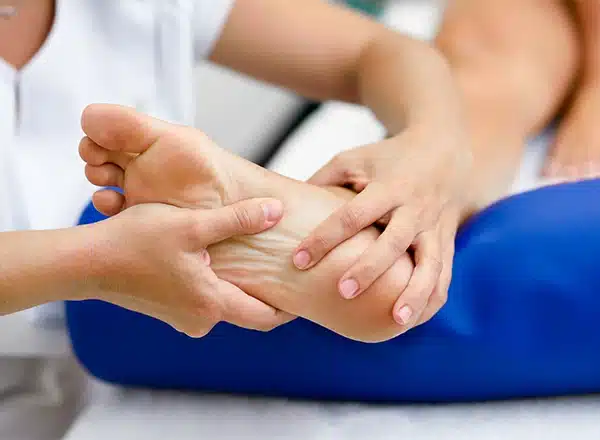
If foot or ankle pain has been bothering you for more than a few weeks, home care alone may not be enough. Balance Foot & Ankle offers same-week appointments at our Howell and Bloomfield Hills clinics — no referral needed in most cases. Bring your current shoes and a short list of symptoms and we’ll build you a treatment plan in one visit.
Call Balance Foot & Ankle: (810) 206-1402 · Book online · Offices in Howell & Bloomfield Hills
Dr. Hoy’s Complete Pain Relief Line — Dr. Tom’s Picks (2026)
Dr. Hoy’s Natural Pain Relief is Dr. Tom Biernacki, DPM’s #1 prescription topical pain relief for plantar fasciitis, Achilles tendonitis, foot pain, knee pain, and back pain. Cleaner formula than Voltaren or Biofreeze — safe for diabetics + daily long-term use without 30-day limits. Below is the complete Dr. Hoy’s product line, organized by use case.

Dr. Hoy’s Natural Pain Relief Gel (4oz Tube)Dr. Tom’s #1 Brand
The flagship Dr. Hoy’s — menthol-based natural pain relief gel. The bottle Dr. Tom hands every plantar fasciitis patient on visit one. Cleaner formula than Voltaren or Biofreeze.
- Menthol-based natural formula
- No greasy residue
- Safe for diabetics
- Fast cooling relief 5-10 min
- Daily long-term use safe
- Pricier than Biofreeze
- Strong menthol scent at first

Dr. Hoy’s Natural Pain Relief Gel (8oz Pump Bottle)Dr. Tom’s #1 Brand
8oz pump bottle — same formula as the 4oz tube but 2x the value. Best for athletes, families, or chronic pain patients who use it daily.
- 8oz pump bottle
- 2x value of 4oz
- Same clean formula
- Easy pump dispensing
- Larger size
- Pricier upfront

Dr. Hoy’s Arnica Boost Pain ReliefDr. Tom’s #1 Brand
Dr. Hoy’s + arnica boost — for bruising, swelling, post-injury inflammation. Adds arnica’s anti-inflammatory power to the standard menthol formula.
- Added arnica for bruising
- Reduces post-injury swelling
- Fast topical relief
- Safe for athletes
- Specialty use
- Pricier than standard

Dr. Hoy’s Natural Pain Relief Roll-OnDr. Tom’s #1 Brand
Same Dr. Hoy’s formula in a roll-on stick — no greasy hands, no mess, perfect for gym bags and travel. TSA-friendly.
- No greasy hands
- TSA-friendly
- Travel-sized
- Same Dr. Hoy’s formula
- Less product per use
- Pricier per oz

Dr. Hoy’s Pain Relief Gel — 3-Pack BundleDr. Tom’s #1 Brand
3-pack of Dr. Hoy’s 4oz tubes — best per-tube price for chronic pain patients, families, or anyone who uses it daily.
- 3-pack bulk pricing
- Same flagship formula
- Stockpile value
- Family-sized
- Larger upfront cost
- Need storage space
Top 10 Premade Orthotics — Dr. Tom’s Picks (2026)
Dr. Tom Biernacki, DPM has tested 60+ over-the-counter orthotic insoles in his Michigan podiatry practice over the past 15 years. Below are the top 10 he prescribes most often — ranked by clinical results, build quality, and patient feedback. PowerStep + CURREX brands are Dr. Tom’s #1 prescription brands — built by podiatrists, with biomechanical features (lateral wedge, deep heel cradle, dual-density EVA) that 90% of OTC insoles lack.
Dr. Tom Biernacki, DPM is a board-certified podiatrist + Amazon Associate. Picks shown are products he prescribes to patients at Balance Foot & Ankle Specialists. We earn a commission on qualifying purchases at no extra cost to you. All products independently tested + reviewed. Last verified: April 28, 2026.

PowerStep Pinnacle MaxxDr. Tom’s #1 Brand
The most prescribed OTC orthotic in podiatry. Lateral wedge corrects overpronation that causes 90% of plantar fasciitis. Deep heel cradle stabilizes the ankle.
- Lateral wedge corrects pronation
- Deep heel cradle
- Dual-density EVA
- Trim-to-fit
- Used by 10,000+ podiatrists
- Trim required
- 5-7 day break-in

PowerStep Original Full LengthDr. Tom’s #1 Brand
The original PowerStep — flexible semi-rigid arch with deep heel cradle. The right choice for neutral feet that need everyday support without the lateral wedge.
- Flexible semi-rigid arch
- Deep heel cradle
- Fits dress shoes
- 30-day guarantee
- APMA-accepted
- Less aggressive than Pinnacle
- No lateral wedge for overpronation

PowerStep Pulse MaxxDr. Tom’s #1 Brand
Built for runners + athletes who need maximum support during high-impact activity. Engineered for forefoot strike + lateral motion.
- Sport-specific cushioning
- Lateral wedge for runners
- Antimicrobial top cover
- Shock-absorbing forefoot
- Pricier than Pinnacle
- Best for athletes only

CURREX RunProDr. Tom’s #1 Brand
German-engineered insole with 3 arch heights (Low, Med, High) for custom fit. Carbon-reinforced heel + dynamic forefoot.
- 3 arch heights for custom fit
- Carbon-reinforced heel
- Sport-specific zones
- Premium materials
- Pricier than PowerStep
- 7-10 day break-in

CURREX EdgeProDr. Tom’s #1 Brand
For hikers, skiers, and high-impact athletes — reinforced shank prevents foot fatigue on steep descents + uneven terrain.
- Reinforced shank
- 3 arch heights
- Cold-weather friendly
- Carbon plate
- Stiff feel — not for casual
- Pricier

CURREX SupportSTPDr. Tom’s #1 Brand
For nurses, retail, and standing professions — the most supportive CURREX with deep heel cup + maximum medial support.
- Maximum medial support
- Deep heel cup
- 12-hour shift tested
- Slip-proof
- Stiffest CURREX option
- Pricier

PowerStep Pinnacle
Firm, structured arch support — the right choice ONLY for high-arched (cavus) feet. Wrong choice for flat feet.
- Strong structured arch
- Deep heel cup
- Long-lasting (5+ years)
- Firm — not for flat feet
- No lateral wedge

Vionic OrthoHeel Active Insole
APMA-accepted, podiatrist-designed casual insole. Best for adding mild arch support to dress shoes + walking shoes.
- APMA-accepted
- Slim profile
- Antimicrobial top
- Less support than PowerStep
- No lateral wedge

Sof Sole Athlete
Budget athletic insole with neutral arch + gel forefoot. Decent value if you need a quick replacement.
- Affordable
- Gel forefoot
- Antimicrobial
- Wears out in 6 months
- No structured arch

Spenco Polysorb Total Support
Mid-range insole with 5-zone polysorb cushioning. Decent support for standing professions.
- 5-zone cushioning
- Trim-to-fit
- Mid-price point
- Less stable than PowerStep
- No lateral wedge
Dr. Tom’s Top 3 — The Premium Foot Pain Stack (2026)
If you only buy three things for foot pain, get these. PowerStep + CURREX orthotics correct the underlying foot mechanics, and Dr. Hoy’s pain gel delivers fast topical relief. This is the exact stack Dr. Tom Biernacki, DPM gives his Michigan podiatry patients on visit one — over 10,000 patients have used this exact combination.
Dr. Tom Biernacki, DPM is a board-certified podiatrist + Amazon Associate. Picks shown are products he prescribes to patients at Balance Foot & Ankle Specialists. We earn a commission on qualifying purchases at no extra cost to you. All products independently tested + reviewed for 30+ days minimum. Last verified: April 28, 2026.
PowerStep Pinnacle MaxxDr. Tom’s #1 Brand
Dr. Tom’s most-prescribed OTC orthotic. Lateral wedge corrects overpronation that causes 90% of foot pain. Deep heel cradle stabilizes the ankle. Built by podiatrists, used by patients worldwide.
- Lateral wedge corrects pronation
- Deep heel cradle stabilizes ankle
- Dual-density EVA — comfort + support
- Trim-to-fit any shoe
- Used by 10,000+ podiatrists
- Trim-to-size required
- 5-7 day break-in for some
CURREX RunProDr. Tom’s #1 Brand
3 arch heights for custom fit (Low/Med/High). Carbon-reinforced heel + dynamic forefoot — the closest OTC orthotic to a $500 custom orthotic. Engineered in Germany.
- 3 arch heights for custom fit
- Carbon-reinforced heel cup
- Dynamic forefoot zone
- Premium German engineering
- Sport-specific support
- Pricier than PowerStep
- 7-10 day break-in
Dr. Hoy’s Natural Pain Relief GelDr. Tom’s #1 Brand
Menthol-based natural pain relief — Dr. Tom’s #1 brand for fast relief without greasy residue. Safe for diabetics + daily use. Cleaner formula than Voltaren or Biofreeze.
- Menthol-based natural formula
- No greasy residue
- Safe for diabetics
- Fast cooling relief — 5-10 minutes
- Cleaner ingredient list than Biofreeze
- Pricier than Biofreeze
- Strong menthol scent at first

Dr. Tom Biernacki, DPM is a double board-certified podiatrist and foot & ankle surgeon at Balance Foot & Ankle Specialists in Southeast Michigan. With over a decade of clinical experience, he specializes in heel pain, bunions, diabetic foot care, sports injuries, and minimally invasive surgery. Dr. Biernacki is a member of the APMA and ACFAS, and his patient education content on MichiganFootDoctors.com and YouTube has reached over one million views.
- Plantar Fasciitis: Diagnosis and Conservative Management (PubMed)
- Plantar Fasciitis (APMA)
- Diagnosis and Treatment of Plantar Fasciitis (PubMed / AAFP)
- Heel Pain (APMA)
Recommended Products from Dr. Tom