
Quick answer: Foot Skin Conditions Psoriasis Lichen Planus Tinea Pedis Differential is a clinical condition that responds to evidence-based treatment when caught early. Symptoms include pain, swelling, and altered function. Diagnosis requires clinical exam, often imaging. Treatment ladder: conservative care first (4-6 weeks), then targeted interventions if needed. Call (810) 206-1402.
Medically reviewed by Dr. Tom Biernacki, DPM · Board-Certified Podiatric Surgeon · Last reviewed: April 2026 · Editorial Policy
The most important clinical decision with Foot Skin Conditions Psoriasis Lichen Planus Tinea Pedis Differential isn’t which treatment to start with — it’s identifying the correct subtype. That changes everything. Call (810) 206-1402.
Quick Answer
Foot Skin Conditions 2026: Psoriasis, Tinea & More DPM relates to foot pain — typically caused by overuse, footwear, or biomechanics. Most patients improve in 6-12 weeks with conservative care. Same-week appointments in Howell + Bloomfield Hills: (810) 206-1402.
Medically reviewed by Dr. Tom Biernacki, DPM — Board-Certified Podiatric Surgeon — Balance Foot & Ankle, Howell & Bloomfield Hills, MI. Last updated April 2026.
▶ Watch

Medically Reviewed by Dr. Tom Biernacki, DPM — Board-Certified Podiatrist, Balance Foot & Ankle Specialists, Michigan. Last updated April 2026.
The skin of the foot presents unique diagnostic challenges — multiple dermatological conditions produce overlapping presentations of scaling, erythema, vesiculation, and nail changes that require systematic clinical differentiation. Psoriasis, lichen planus, and tinea pedis (athlete’s foot) are three common conditions that can be clinically similar yet require completely different treatments; misdiagnosis leads to ineffective or harmful therapy. Podiatric physicians encounter these conditions regularly and must be able to recognize their distinguishing features.
Tinea Pedis: The Common Mimicker
Tinea pedis (dermatophyte fungal infection of the foot) presents in several clinical patterns: interdigital (most common — maceration, scaling, and fissuring between the toes, particularly the 4th–5th web space), moccasin (diffuse hyperkeratotic scaling of the entire plantar surface and lateral sides in a “moccasin distribution” — easily confused with psoriasis or eczema), and vesicular (vesicles and bullae on the arch and instep). KOH preparation — microscopic examination of skin scrapings treated with potassium hydroxide revealing fungal hyphae — is the definitive rapid in-office test and should be performed before prescribing antifungals when the diagnosis is uncertain. Tinea pedis responds to topical azoles (clotrimazole, miconazole) or terbinafine; moccasin-type often requires 2–4 weeks of oral terbinafine for adequate penetration of the hyperkeratotic scale.
Palmoplantar Psoriasis: Plaques Without Classic Distribution
Psoriasis of the foot (palmoplantar psoriasis) presents as well-demarcated, erythematous, silvery-scaled plaques on the plantar surface and heels — often sharply delineated at weight-bearing skin lines. Nail psoriasis (onychopathy) — pitting, oil-drop discoloration, subungual hyperkeratosis, nail dystrophy — accompanies plantar psoriasis in many patients and is a key diagnostic clue distinguishing psoriasis from tinea pedis (fungal toenail can look similar, but onychomycosis lacks the oil-drop sign and typically produces more irregular thickening). Psoriasis does not fluoresce under Wood’s lamp and KOH is negative. Pustular psoriasis of the foot (palmoplantar pustulosis) produces sterile yellow-white pustules within erythematous plaques — completely unlike tinea pedis vesicles, which contain fluid and rupture leaving macerated skin. Psoriatic plaques respond to topical corticosteroids (class I or II for foot skin), vitamin D analogues (calcipotriene), and systemic therapy when plantar involvement is functionally disabling.
Lichen Planus: Violaceous Papules and Koebner Phenomenon
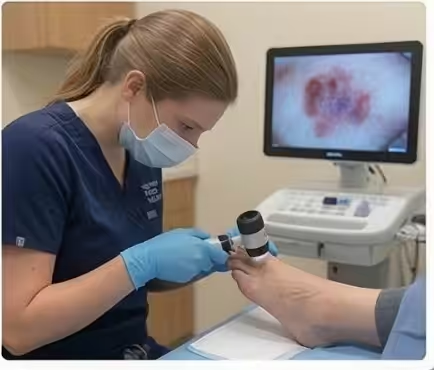
Lichen planus of the foot presents as violaceous (purple), flat-topped polygonal papules, often with a fine white overlying network (Wickham’s striae) visible on dermoscopy. The plantar surface may have hypertrophic lichen planus — thick, verrucous, highly pruritic plaques that are detailedly difficult to treat. Nail lichen planus produces longitudinal ridging and furrowing, pterygium (scar formation across the nail fold onto the nail surface), and ultimately complete nail loss in severe cases — a feature not seen with psoriasis or onychomycosis. Koebner phenomenon (new lesions developing at sites of skin trauma, including pressure points on the foot) is characteristic. Diagnosis is confirmed by punch biopsy when clinical features are ambiguous. Treatment: potent topical corticosteroids (clobetasol propionate) under occlusion for plantar hypertrophic lichen planus, intralesional triamcinolone for resistant plaques, and systemic therapy (cyclosporine, retinoids) for extensive disease. Dr. Biernacki at Balance Foot & Ankle evaluates complex foot skin conditions, performs KOH preparation and nail cultures in-office, and coordinates dermatology referral for biopsy when indicated. Call (810) 206-1402.
📧 Get Dr. Tom’s Free Lab Test Guide
Discover the 5 lab tests every person over 35 should ask their doctor about — explained in plain English by a board-certified physician.
📍 Located in Michigan?
Our board-certified podiatrists treat this condition at two convenient locations. Same-day appointments often available.

Insurance Accepted
BCBS · Medicare · Aetna · Cigna · United Healthcare · HAP · Priority Health · Humana · View All →
Howell Office
4330 E Grand River Ave
Howell, MI 48843
Get Directions →
Bloomfield Hills Office
43494 Woodward Ave, #208
Bloomfield Hills, MI 48302
Get Directions →
Your Board-Certified Podiatrists



Ready to Get Back on Your Feet?
Same-week appointments available at both locations.
Book Your AppointmentMore Podiatrist-Recommended Athletes Foot Essentials
Breathable Diabetic-Style Shoe
Orthofeet Sprint — reduces moisture buildup that feeds athlete’s foot.
Moisture-Wicking Sock


OS1st FS4 — eliminates the warm-wet environment tinea needs to grow.
Breathable Recovery Slide
HOKA Ora 3 — lets feet air out to prevent recurrence.
As an Amazon Associate, Balance Foot & Ankle earns from qualifying purchases. Product recommendations are based on clinical experience; prices and availability shown above update live from Amazon.

When to See a Podiatrist
If athlete’s foot keeps returning after topical treatment, the reservoir is usually inside the shoes or toenails. Balance Foot & Ankle checks for concurrent toenail fungus (which re-infects the skin) and prescribes combination therapy that breaks the cycle. Persistent itching, cracking, or odor is treatable — don’t tolerate it.
Call Balance Foot & Ankle: (810) 206-1402 · Book online · Offices in Howell & Bloomfield Hills
Pros & Cons of Conservative Care for foot care
Advantages
- ✓ Conservative care first
- ✓ Same-week appointments
- ✓ Multiple insurance accepted
Considerations
- ✗ Self-treatment can mask issues
- ✗ See a podiatrist if pain >2 weeks
Dr. Tom’s Recommended Products for foot care
Affiliate disclosure: As an Amazon Associate, Balance Foot & Ankle earns from qualifying purchases. We only recommend products we use with patients.
Footnanny Heel Cream Dr. Tom’s Pick
Best for: Daily moisturizer for cracked heels
Ready to Get Back on Your Feet?
Same-day appointments in Howell + Bloomfield Hills. Most insurance accepted. Dr. Tom Biernacki, DPM & team.
Book Today — Same-Day Appointments Available
Call Now: (810) 206-1402
About Your Care Team at Balance Foot & Ankle
Dr. Tom Biernacki, DPM · Board-Certified Foot & Ankle Surgeon. Specializes in conservative-first care, minimally invasive bunion surgery, and complex reconstruction.
Dr. Carl Jay, DPM · Accepting new patients. Specializes in sports medicine, athletic injuries, and routine podiatric care.
Dr. Daria Gutkin, DPM, AACFAS · Accepting new patients. Specializes in surgical reconstruction and pediatric podiatry.
Locations: 4330 E Grand River Ave, Howell, MI 48843 · 43494 Woodward Ave Suite 208, Bloomfield Hills, MI 48302
Hours: Mon–Fri 8:00 AM – 5:00 PM · (810) 206-1402
In-Office Treatment at Balance Foot & Ankle
If home treatment isn’t providing relief for your sports-related foot injuries, our podiatry team at Balance Foot & Ankle can help with same-day evaluations and advanced in-office care.
Same-day appointments available. (810) 206-1402
Doctor Hoy’s Natural Pain Relief Gel
Natural topical pain relief I use in our clinic. Arnica + camphor formula — apply directly to the area 3–4x daily. ($20–25)
Shop Doctor Hoy’s →Frequently Asked Questions
What causes this condition?
Causes include mechanical stress, biomechanical imbalance, age-related changes, and sometimes systemic disease. Our clinical exam plus imaging identifies the specific driver.
Can it go away on its own?
Mild cases sometimes resolve with rest and supportive footwear. Persistent symptoms past 4-6 weeks rarely resolve without active treatment.
Is surgery required?
Most patients resolve with non-surgical care. Surgery is reserved for refractory cases or structural deformity.
Ready for Expert Care?
Same-day appointments in Howell & Bloomfield Hills, MI.
4.9★ | 1,123 Reviews | 3,000+ Surgeries
Or call: (810) 206-1402

Dr. Tom Biernacki, DPM is a board-certified foot & ankle surgeon (ABFAS & ABPM) at Balance Foot & Ankle Specialists in Southeast Michigan. With over a decade of clinical experience, he specializes in heel pain, bunions, diabetic foot care, sports injuries, and minimally invasive surgery. Dr. Biernacki is a member of the APMA and ACFAS, and his patient education content on MichiganFootDoctors.com and YouTube has made him one of the most-followed foot & ankle educators on YouTube.