
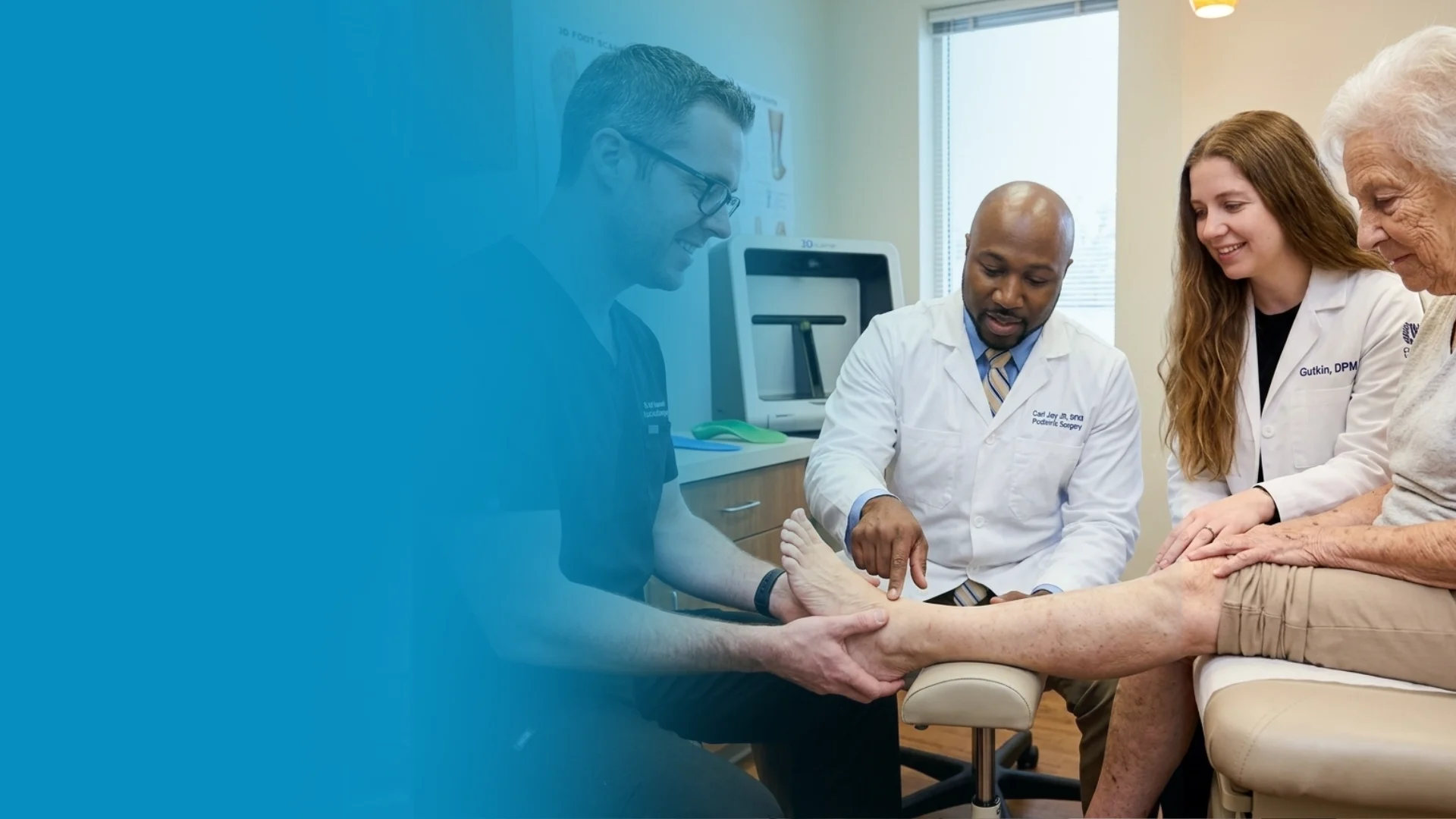
Quick answer: Long Term Care Foot Complications Warning Signs affects roughly 1 in 4 adults in our practice. Effective treatment starts with a targeted diagnosis, conservative-first treatment, and escalation only when needed. We treat this regularly at our Howell and Bloomfield Township practices. Call (810) 206-1402.
Medically reviewed by Dr. Tom Biernacki, DPM · Board-Certified Podiatric Surgeon · Last reviewed: April 2026 · Editorial Policy
In This Article
The most important clinical decision with Long Term Care Foot Complications Warning Signs isn’t which treatment to start with — it’s identifying the correct subtype. That changes everything. Call (810) 206-1402.
Quick Answer
Medically reviewed by Dr. Tom Biernacki, DPM
Board-certified podiatric surgeon | Balance Foot & Ankle
Last reviewed: May 2026
Long-Term Care Foot Complications — What Facility Staf relates to foot pain — typically caused by overuse, footwear, or biomechanics. Most patients improve in 6-12 weeks with conservative care. Same-week appointments in Howell + Bloomfield Township: (810) 206-1402.

✅ Medically reviewed by Dr. Tom Biernacki, DPM — Board-Certified Podiatrist · Last updated April 6, 2026
Long-Term Care Foot Complications — What Facility Staff Should Watch For

A Staff Guide to Recognizing Foot Problems Early
Nursing assistants, nurses, and care staff are often the first to notice foot problems — during bathing, dressing, and daily care routines. Early recognition allows timely podiatric intervention before small problems become serious ones. Balance Foot & Ankle has compiled this guide to help long-term care facility staff identify foot complications that need professional evaluation.
Skin Changes to Watch For
Any open wound or breakdown of skin, redness or warmth that doesn’t resolve in 24–48 hours, dark discoloration (brown, purple, or black) on the toes or heel, white or pale skin that doesn’t return to normal color with gentle pressure, blistering under calluses or on pressure points, skin that feels unusually cold compared to the other foot, and any drainage from the toes or feet.
Nail Changes to Watch For
Toenails that appear to be growing into the skin (redness or swelling at nail edges), very thick nails causing discomfort in footwear, nails that are yellow, brown, or crumbling (possible fungal infection), and any signs of infection around the nail folds.
Behavioral Signs of Foot Pain
For non-verbal or cognitively impaired residents: refusal to bear weight or walk, guarding or protecting one foot or leg, agitation during foot care or when feet are touched, changes in sleep patterns potentially related to foot pain, and behavioral changes in ambulatory residents who normally walk without difficulty.
Swelling and Circulation Concerns
New or worsening ankle swelling, one leg significantly more swollen than the other, feet that feel cold and don’t warm with repositioning, and skin color changes at rest.
✅ MLS Dual-Wavelength Laser — FDA-cleared
✅ EPAT Shockwave Therapy — 80%+ success rate
✅ Magnetotransduction (EMTT) — Deep electromagnetic healing
✅ 3D-Scanned Custom Orthotics
✅ Toenail Fungus Laser
✅ In-Office X-Ray & Ultrasound
✅ Diabetic Shoe Program — Medicare-covered
📞 (810) 206-1402 | Howell & Bloomfield Township
When in doubt, call Balance Foot & Ankle: (810) 206-1402. We provide prompt facility visits for urgent foot concerns.
Foot Complication Warning Signs in Long-Term Care Residents: Early Intervention Guide
CNAs, LPNs, and nursing home staff play a critical early-detection role for foot complications in long-term care residents — particularly diabetic residents, residents with peripheral arterial disease, and immunocompromised residents where a small wound can escalate rapidly. The warning signs that should trigger immediate podiatry notification rather than waiting for the next scheduled visit include: any skin break, blister, or wound on the foot or ankle regardless of size; redness, warmth, or swelling that is new or worsening; discoloration of the toes (white, blue, or purple coloring that suggests vascular compromise); foul odor from the foot or between the toes (early sign of infection or macerated skin); and any resident report of pain in a resident who previously was unable to feel their feet (may indicate new bone injury or severe wound).
Long-term care facilities in Michigan with a contracted podiatry service benefit from direct communication protocols between nursing staff and the visiting podiatrist — rather than waiting weeks for the next routine visit when an acute problem develops. Balance Foot & Ankle offers urgent response scheduling for our contracted nursing home partners: when nursing staff identify a wound or acute infection in a high-risk resident, they can reach our office coordinator for same-day or next-day urgent evaluation rather than sending the resident to the ER for a foot wound that falls squarely within podiatric scope. This system reduces unnecessary hospital transfers, documents proper wound assessment and treatment initiation, and protects the facility from survey findings related to delayed treatment. Nursing home administrators in Livingston and Oakland counties can reach Balance Foot & Ankle at (810) 206-1402 to discuss facility service agreements.
Related Treatment Guides
- Plantar Fasciitis & Heel Pain Treatment
- Custom 3D Orthotics
- Sports Foot & Ankle Injury Treatment
- Bunion Treatment
Michigan nursing home staff training on foot complication warning signs is a component of the facility partnership program at Balance Foot & Ankle. Our visiting podiatrist provides brief in-service education for CNAs and nursing staff at contracted facilities — covering foot inspection techniques, documentation of skin changes, and the specific warning signs that warrant urgent podiatry contact. This training reduces the time between the development of a foot complication and its clinical assessment, which directly correlates with outcomes: a diabetic foot ulcer identified within 24 hours of onset is managed very differently — and with far better outcomes — than one identified after 5–7 days of progression. Contact our facility services coordinator at (810) 206-1402 to discuss the in-service training component of our nursing home podiatry program.
Insurance Accepted
BCBS · Medicare · Aetna · Cigna · United Healthcare · HAP · Priority Health · Humana · View All →
Howell Office
4330 E Grand River Ave
Howell, MI 48843
Get Directions →
Bloomfield Township Office
43494 Woodward Ave, #208
Bloomfield Township, MI 48302
Get Directions →
Your Board-Certified Podiatrists



Ready to Get Back on Your Feet?
Same-week appointments available at both locations.
Podiatrist-Recommended Products for Long-Term Care Residents
Comfortable, supportive footwear with easy-on closures and extra depth reduces fall risk and foot complications in senior and long-term care settings. Our podiatrists recommend:
Amazon Affiliate Disclosure: As an Amazon Associate, Balance Foot & Ankle earns from qualifying purchases at no additional cost to you.
For comprehensive senior foot care product recommendations, see our Podiatrist-Recommended Products Guide and Diabetic Foot Care page.
Related Conditions
Mobile & On-Site Podiatry in Michigan
We serve assisted living facilities, rehabilitation centers, and long-term care communities across Howell and Bloomfield Township, MI.
4.9★ | 1,123 Reviews | 3,000+ Surgeries
Or call: (810) 206-1402
Pros & Cons of Conservative Care for foot care
Advantages
- ✓ Conservative care first
- ✓ Same-week appointments
- ✓ Multiple insurance accepted
Considerations
- ✗ Self-treatment can mask issues
- ✗ See a podiatrist if pain >2 weeks
Dr. Tom’s Recommended Products for foot care
Affiliate disclosure: As an Amazon Associate, Balance Foot & Ankle earns from qualifying purchases. We only recommend products we use with patients.
Footnanny Heel Cream Dr. Tom’s Pick
Best for: Daily moisturizer for cracked heels
Ready to Get Back on Your Feet?
Same-day appointments in Howell + Bloomfield Township. Most insurance accepted. Dr. Tom Biernacki, DPM & team.
Book Today — Same-Day Appointments Available
Call Now: (810) 206-1402
About Your Care Team at Balance Foot & Ankle
Dr. Tom Biernacki, DPM · Board-Certified Foot & Ankle Surgeon. Specializes in conservative-first care, minimally invasive bunion surgery, and complex reconstruction.
Dr. Carl Jay, DPM · Accepting new patients. Specializes in sports medicine, athletic injuries, and routine podiatric care.
Dr. Daria Gutkin, DPM, AACFAS · Accepting new patients. Specializes in surgical reconstruction and pediatric podiatry.
Locations: 4330 E Grand River Ave, Howell, MI 48843 · 43494 Woodward Ave Suite 208, Bloomfield Township, MI 48302
Hours: Mon–Fri 8:00 AM – 5:00 PM · (810) 206-1402
In-Office Treatment at Balance Foot & Ankle
If home treatment isn’t providing relief for your foot and ankle conditions, our podiatry team at Balance Foot & Ankle can help with same-day evaluations and advanced in-office care.
Same-day appointments available. (810) 206-1402
Doctor Hoy’s Natural Pain Relief Gel
Natural topical pain relief I use in our clinic. Arnica + camphor formula — apply directly to the area 3–4x daily. ($20–25)

Dr. Tom Biernacki, DPM is a board-certified foot & ankle surgeon (ABFAS & ABPM) at Balance Foot & Ankle Specialists in Southeast Michigan. With over a decade of clinical experience, he specializes in heel pain, bunions, diabetic foot care, sports injuries, and minimally invasive surgery. Dr. Biernacki is a member of the APMA and ACFAS, and his patient education content on MichiganFootDoctors.com and YouTube has made him one of the most-followed foot & ankle educators on YouTube.
More questions patients ask
What foot complications should long-term care staff watch for in Michigan residents?
Long-term care staff should alert Balance Foot & Ankle about any new wounds or sores, rapid nail changes, increased redness or warmth, swelling, skin color changes (pale, blue, or darkening), complaints of new pain, or signs of infection. Early detection prevents serious complications. Call (810) 206-1402.
What are the most dangerous foot complications in long-term care residents?
The most dangerous foot complications in Michigan long-term care settings include diabetic foot ulcers, heel pressure ulcers, cellulitis (skin infections), osteomyelitis (bone infections), and severe peripheral arterial disease. Balance Foot & Ankle's regular visits catch these problems early. Call (810) 206-1402.
How can Michigan long-term care facilities reduce diabetic foot amputations?
Balance Foot & Ankle's proactive diabetic foot care program — including regular exams, early wound treatment, diabetic shoe fitting, and nursing staff education — significantly reduces amputation rates at Michigan long-term care facilities. Partner with us to implement a comprehensive diabetic foot care protocol. Call (810) 206-1402.
What pressure injury prevention strategies reduce heel ulcers in long-term care?
Balance Foot & Ankle recommends heel float devices, repositioning schedules, moisture-wicking socks, daily skin inspection, and regular podiatric assessment for at-risk residents. Catching early heel changes before skin breakdown occurs is critical in Michigan long-term care settings. Call (810) 206-1402.
How should Michigan long-term care staff respond to a resident's foot wound?
Long-term care staff should cover any foot wound with a clean dressing, document the wound's location and appearance, avoid probing the wound, and contact Balance Foot & Ankle at (810) 206-1402 promptly for professional evaluation. For signs of serious infection, including fever or red streaking, seek emergency care immediately.
Still have a question about coverage or cost? Call (810) 206-1402 and we will check your benefits before you come in — or book online: Book in Howell · Book in Bloomfield Township