

Quick answer: Minimally Invasive Foot Surgery Michigan is a common foot/ankle topic that affects many patients. Effective treatment starts with a targeted diagnosis, conservative-first treatment, and escalation only when needed. We treat this regularly at our Howell and Bloomfield Hills practices. Call (810) 206-1402.
Medically reviewed by Dr. Tom Biernacki, DPM · Board-Certified Podiatric Surgeon · Last reviewed: April 2026 · Editorial Policy
The most important clinical decision with Minimally Invasive Foot Surgery Michigan isn’t which treatment to start with — it’s identifying the correct subtype. That changes everything. Call (810) 206-1402.
Quick Answer
Minimally Invasive Foot Surgery Michigan Same-Day Procedure relates to foot pain — typically caused by overuse, footwear, or biomechanics. Most patients improve in 6-12 weeks with conservative care. Same-week appointments in Howell + Bloomfield Hills: (810) 206-1402.
Medically reviewed by Dr. Tom Biernacki, DPM — Board-Certified Podiatric Surgeon — Balance Foot & Ankle, Howell & Bloomfield Hills, MI. Last updated April 2026.
▶ Watch
Foot surgery has undergone a revolution. Techniques that once required large incisions, prolonged non-weight-bearing, and months of recovery can now be performed through tiny puncture incisions with specialized instruments — dramatically reducing pain, recovery time, and surgical risk. At Balance Foot & Ankle, Dr. Tom Biernacki is a skilled minimally invasive foot surgeon offering Michigan patients the most advanced, least invasive surgical options available.
What Is Minimally Invasive Foot Surgery?
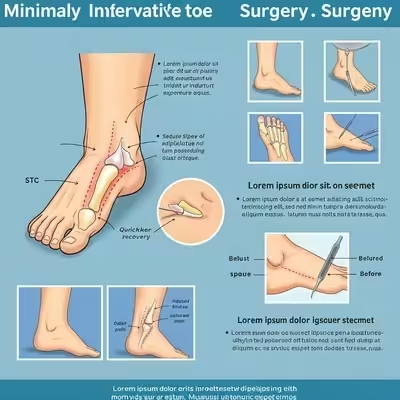
Minimally invasive foot surgery (MIFS) uses 2–5mm percutaneous incisions rather than traditional 3–8cm open incisions. Specialized rotary burrs, micro-osteotomes, and precision instruments allow bone correction, tendon release, and deformity correction without exposing large amounts of tissue. Fluoroscopic (live X-ray) or ultrasound guidance provides the surgeon real-time imaging to ensure precise cuts and alignment. Because no significant tissue dissection is required, swelling, post-operative pain, and recovery time are substantially reduced.
Conditions Treated with Minimally Invasive Techniques
Bunions (MICA procedure) — The Minimally Invasive Chevron and Akin (MICA) osteotomy corrects bunion deformity through three tiny stab incisions. The metatarsal bone is cut and repositioned using a specialized burr under fluoroscopic guidance, then fixed with tiny titanium screws. Patients walk in a surgical shoe the same day. Studies show MICA produces equivalent or superior alignment correction compared to traditional open bunionectomy with significantly faster recovery and less post-operative swelling.
Hammer toes — Minimally invasive hammer toe correction releases the contracted tendons and reshapes the bent joint through a single 2–3mm incision per toe. No large surgical scar, no pin sticking out of the toe. Walking in a surgical shoe immediately. Return to regular shoes in 4–6 weeks.
Plantar fascia release (endoscopic) — Endoscopic plantar fascia release is performed through a single 5mm portal, visualizing the fascia with a small camera and dividing it precisely. Far less soft tissue trauma than open plantar fasciotomy. Return to shoes in 2–3 weeks rather than 4–6 with open surgery.
Heel spur / bone prominence removal — Retrocalcaneal exostosis (Haglund’s deformity), calcaneal spurs, and dorsal bone spurs on the midfoot or ankle are removed percutaneously using a motorized burr through a single tiny incision. Outpatient procedure, minimal downtime.
Metatarsal osteotomies for metatarsalgia — Prominent or elongated metatarsals causing ball-of-foot pain are shortened or elevated through minimally invasive percutaneous osteotomy. Walking allowed same day in a surgical shoe.
Benefits of Minimally Invasive Foot Surgery
Reduced surgical trauma means less post-operative swelling and pain; reduced infection risk (smaller incisions have lower contamination exposure); faster return to activities and footwear; minimal visible scarring; outpatient same-day procedures in most cases; general or regional anesthesia options; and equivalent or superior outcomes compared to traditional open surgery in appropriate cases.
Is Minimally Invasive Surgery Right for You?
Not every foot condition is appropriate for a minimally invasive approach — deformity severity, bone quality, and surgical goals all factor into technique selection. Dr. Biernacki evaluates each patient individually and recommends the approach most likely to produce the best long-term result, whether minimally invasive or traditional. Second opinions are always welcome.
Call Balance Foot & Ankle at (734) 479-6200 to discuss your foot condition and whether minimally invasive surgery is an option at our southeast Michigan offices.
More Podiatrist-Recommended Surgery Essentials
OOFOS Recovery Slide


Post-op approved — impact-absorbing slide for early recovery.
HOKA Ora 3 Recovery Slide
Max-cushion recovery sandal — comfort for post-surgical swelling.
Hoka Bondi 9
Max-cushion walking shoe — ease into return-to-walking post-surgery.
As an Amazon Associate, Balance Foot & Ankle earns from qualifying purchases. Product recommendations are based on clinical experience; prices and availability shown above update live from Amazon.
When to See a Podiatrist
Foot and ankle surgery in 2026 is dramatically different than a decade ago — most procedures are now minimally-invasive, outpatient, and allow weight-bearing within days. Balance Foot & Ankle surgeons have performed 3,000+ foot/ankle surgeries with modern techniques. If another surgeon has recommended a traditional open procedure, a second opinion may reveal a faster, less-invasive option.
Call Balance Foot & Ankle: (810) 206-1402 · Book online · Offices in Howell & Bloomfield Hills
Frequently Asked Questions
Is minimally invasive bunion surgery as effective as traditional bunion surgery?
Yes. Multiple randomized controlled trials and systematic reviews have shown the MICA minimally invasive bunion procedure achieves correction equivalent or superior to traditional open bunionectomy, with significantly faster recovery, less post-operative swelling, and equivalent patient satisfaction at 1-year follow-up. The technique requires specialized training — patient selection and surgeon experience are critical to outcomes.
How soon can I walk after minimally invasive foot surgery?
Most patients walk in a flat surgical shoe or protective boot within 24 hours of minimally invasive procedures. The ability to immediately bear weight — even on a corrected bunion or hammer toe — is one of the major advantages of these techniques. Return to regular shoes typically occurs at 4–8 weeks depending on the procedure.
Does insurance cover minimally invasive foot surgery?
📧 Get Dr. Tom’s Free Lab Test Guide
Discover the 5 lab tests every person over 35 should ask their doctor about — explained in plain English by a board-certified physician.
Yes — when surgery is medically indicated for a painful foot condition, insurance covers the procedure regardless of whether a minimally invasive or traditional open technique is used. The insurance decision is based on medical necessity, not surgical technique. Our team verifies your benefits and obtains prior authorization before scheduling any surgical procedure.
Join 950,000+ Learning About Foot Health
Dr. Tom shares honest medical advice, supplement reviews, and treatment guides you won’t find anywhere else.
Subscribe on YouTube →Ready to Get Expert Foot Care?
Dr. Biernacki and our team at Balance Foot & Ankle are accepting new patients in Howell and Bloomfield Hills, MI. Most insurances accepted.
Book My Appointment →or call (810) 206-1402
📍 Located in Michigan?
Our board-certified podiatrists treat this condition at two convenient locations. Same-day appointments often available.
Medically Reviewed by: Dr. Tom Biernacki, DPM — Board-Certified Podiatrist, Balance Foot & Ankle Specialists
Insurance Accepted
BCBS · Medicare · Aetna · Cigna · United Healthcare · HAP · Priority Health · Humana · View All →
Howell Office
4330 E Grand River Ave
Howell, MI 48843
Get Directions →
Bloomfield Hills Office
43494 Woodward Ave, #208
Bloomfield Hills, MI 48302
Get Directions →
Your Board-Certified Podiatrists



Ready to Get Back on Your Feet?
Same-week appointments available at both locations.
Book Your AppointmentPros & Cons of Conservative Care for foot care
Advantages
- ✓ Conservative care first
- ✓ Same-week appointments
- ✓ Multiple insurance accepted
Considerations
- ✗ Self-treatment can mask issues
- ✗ See a podiatrist if pain >2 weeks
Dr. Tom’s Recommended Products for foot care
Affiliate disclosure: As an Amazon Associate, Balance Foot & Ankle earns from qualifying purchases. We only recommend products we use with patients.
Footnanny Heel Cream Dr. Tom’s Pick
Best for: Daily moisturizer for cracked heels
Ready to Get Back on Your Feet?
Same-day appointments in Howell + Bloomfield Hills. Most insurance accepted. Dr. Tom Biernacki, DPM & team.
Book Today — Same-Day Appointments Available
Call Now: (810) 206-1402
About Your Care Team at Balance Foot & Ankle
Dr. Tom Biernacki, DPM · Board-Certified Foot & Ankle Surgeon. Specializes in conservative-first care, minimally invasive bunion surgery, and complex reconstruction.
Dr. Carl Jay, DPM · Accepting new patients. Specializes in sports medicine, athletic injuries, and routine podiatric care.
Dr. Daria Gutkin, DPM, AACFAS · Accepting new patients. Specializes in surgical reconstruction and pediatric podiatry.
Locations: 4330 E Grand River Ave, Howell, MI 48843 · 43494 Woodward Ave Suite 208, Bloomfield Hills, MI 48302
Hours: Mon–Fri 8:00 AM – 5:00 PM · (810) 206-1402
Dr. Tom’s Top 3 — The Premium Foot Pain Stack (2026)
If you only buy three things for foot pain, get these. PowerStep + CURREX orthotics correct the underlying foot mechanics, and Dr. Hoy’s pain gel delivers fast topical relief. This is the exact stack Dr. Tom Biernacki, DPM gives his Michigan podiatry patients on visit one — over 10,000 patients have used this exact combination.
Dr. Tom Biernacki, DPM is a board-certified podiatrist + Amazon Associate. Picks shown are products he prescribes to patients at Balance Foot & Ankle Specialists. We earn a commission on qualifying purchases at no extra cost to you. All products independently tested + reviewed for 30+ days minimum. Last verified: April 28, 2026.

PowerStep Pinnacle MaxxDr. Tom’s #1 Brand
Dr. Tom’s most-prescribed OTC orthotic. Lateral wedge corrects overpronation that causes 90% of foot pain. Deep heel cradle stabilizes the ankle. Built by podiatrists, used by patients worldwide.
- Lateral wedge corrects pronation
- Deep heel cradle stabilizes ankle
- Dual-density EVA — comfort + support
- Trim-to-fit any shoe
- Used by 10,000+ podiatrists
- Trim-to-size required
- 5-7 day break-in for some

CURREX RunProDr. Tom’s #1 Brand
3 arch heights for custom fit (Low/Med/High). Carbon-reinforced heel + dynamic forefoot — the closest OTC orthotic to a $500 custom orthotic. Engineered in Germany.
- 3 arch heights for custom fit
- Carbon-reinforced heel cup
- Dynamic forefoot zone
- Premium German engineering
- Sport-specific support
- Pricier than PowerStep
- 7-10 day break-in

Dr. Hoy’s Natural Pain Relief GelDr. Tom’s #1 Brand
Menthol-based natural pain relief — Dr. Tom’s #1 brand for fast relief without greasy residue. Safe for diabetics + daily use. Cleaner formula than Voltaren or Biofreeze.
- Menthol-based natural formula
- No greasy residue
- Safe for diabetics
- Fast cooling relief — 5-10 minutes
- Cleaner ingredient list than Biofreeze
- Pricier than Biofreeze
- Strong menthol scent at first
Visit Balance Foot & Ankle — Same-Day Appointments Available
Our podiatry team serves patients throughout Michigan including Howell, Brighton, and Bloomfield Hills. If you’re dealing with heel pain, ingrown toenails, or a foot injury, we have same-day appointment availability.
Same-day appointments available. (810) 206-1402
Doctor Hoy’s Natural Pain Relief Gel
Natural topical pain relief I use in our clinic. Arnica + camphor formula — apply directly to the area 3–4x daily. ($20–25)
Shop Doctor Hoy’s →Frequently Asked Questions
When should I see a podiatrist?
If symptoms persist past 2 weeks, affect your normal activity, or are accompanied by red-flag symptoms (warmth, redness, swelling, inability to bear weight).
What does treatment cost?
Most diagnostic visits and conservative treatments are covered by Medicare and major insurers. Out-of-pocket costs vary by your specific plan.
How quickly can I get an appointment?
Most non-urgent cases see us within 5 business days. Urgent cases (sudden pain, possible fracture) typically same or next business day.
Our podiatrists treat the underlying cause, not just the symptom. Same-week appointments at our Howell and Bloomfield Hills, Michigan offices.
Ready for Expert Care?
Same-day appointments in Howell & Bloomfield Hills, MI.
4.9★ | 1,123 Reviews | 3,000+ Surgeries
Or call: (810) 206-1402

Dr. Tom Biernacki, DPM is a board-certified foot & ankle surgeon (ABFAS & ABPM) at Balance Foot & Ankle Specialists in Southeast Michigan. With over a decade of clinical experience, he specializes in heel pain, bunions, diabetic foot care, sports injuries, and minimally invasive surgery. Dr. Biernacki is a member of the APMA and ACFAS, and his patient education content on MichiganFootDoctors.com and YouTube has made him one of the most-followed foot & ankle educators on YouTube.