Board Certified Podiatrists | Expert Foot & Ankle Care
(810) 206-1402 Patient Portal

Minimally Invasive Foot Surgery: What Procedures Can Be Done Through Small Incisions

Medically reviewed by Dr. Tom Biernacki, DPM — Board-Certified Podiatric Surgeon — Balance Foot & Ankle, Howell & Bloomfield Hills, MI. Last updated April 2026.

▶ Watch

Play video

Medically Reviewed by Dr. Tom Biernacki, DPM — Board-Certified Podiatrist, Balance Foot & Ankle Specialists, Michigan. Last updated April 2026.

What Is Minimally Invasive Foot Surgery?

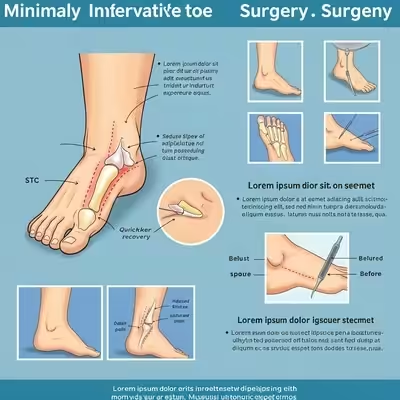
Minimally invasive foot surgery (MIS) encompasses a range of procedures performed through very small incisions (2–5mm “stab incisions”) using specialized small-diameter instruments, burrs, and real-time fluoroscopic (X-ray) guidance rather than open surgical exposure. The approach reduces soft tissue trauma, decreases scarring, and in many cases allows faster recovery and earlier return to footwear.

At Balance Foot & Ankle in Howell and Bloomfield Township, Michigan, our surgeons are trained in minimally invasive techniques and apply them where evidence supports superior outcomes versus traditional open approaches.

The Advantages of Minimally Invasive Approaches

  • Smaller scars — less cosmetically visible
  • Less soft tissue dissection — reduced blood loss, swelling, and pain in the early post-operative period
  • Lower infection risk with tiny incisions
  • Earlier weight-bearing in many cases
  • Reduced risk of wound healing complications
  • Often performed under local anesthesia with sedation rather than general anesthesia

Procedures Commonly Performed Minimally Invasively

Bunion Correction (MIS Hallux Valgus Surgery)

Modern MIS bunion surgery performs the metatarsal osteotomy (bone cut) through a 3–5mm incision using a powered burr under fluoroscopic guidance. The bone is shifted and held with small screws placed through additional tiny punctures. The Lapiplasty procedure offers a similar concept with 3D correction. MIS bunion surgery allows weight-bearing in a surgical shoe from day one in most cases — a significant advantage over traditional open bunion surgery which often requires 2–4 weeks non-weight-bearing.

Hammertoe Correction

Hammertoe procedures — the PIP joint resection and tendon release — are well-suited to minimally invasive approaches. Small stab incisions allow bone resection with minimal soft tissue trauma, and the recovery profile is similar or superior to open techniques.

Plantar Fascia Release (Endoscopic or MIS)

Endoscopic plantar fascia release uses a specialized cannula inserted through two small incisions to visualize and partially release the plantar fascia under direct visualization via a small camera. Faster recovery than open release — return to regular shoes typically at 3–4 weeks. Reserved for refractory plantar fasciitis failing 12+ months of conservative care.

Bone Spur Removal (Calcaneal Exostectomy)

Heel spurs and Haglund’s deformity bony prominences can be removed through tiny incisions with small burrs under fluoroscopy. Less wound disruption means faster healing at the back of the heel — an area notoriously prone to wound complications with large open incisions.

Neuroma Surgery

Morton’s neuroma excision via a minimally invasive dorsal (top of foot) approach avoids the plantar scar of traditional open excision. The neuroma is accessed through a 1–2cm incision and excised with specialized instruments. Weight-bearing is typically comfortable in regular shoes within 3–4 weeks.

Achilles Tendon Repair

Percutaneous Achilles tendon repair uses multiple small incisions to pass suture around and through the ruptured tendon ends, apposing them without a long open incision. The Achillon device and similar instruments allow reliable repair with significantly reduced wound complication risk compared to traditional open repair — particularly important in patients with diabetes, vascular disease, or skin conditions.

When MIS Is NOT the Right Choice

Minimally invasive techniques are tools, not universal solutions. Certain cases require open surgical exposure for safety and precision:

  • Severe deformity requiring extensive bone repositioning
  • Cases requiring direct visualization for complex tendon or nerve work
  • Revision surgery where scar tissue makes percutaneous work dangerous
  • Certain fractures requiring plate fixation that demands open reduction

The best approach is the one that provides the safest, most reliable correction for your specific anatomy — whether that’s open, MIS, or a combination. A surgeon experienced in both techniques will choose the approach based on your needs, not on which approach they’re most comfortable marketing.

Recovery Expectations for MIS Procedures

While MIS generally means faster early recovery, the fundamental timeline for bone healing and tendon remodeling is biological — it can’t be dramatically shortened. MIS bunion patients still need 3–4 months before athletic shoes and 6–12 months for complete swelling resolution. What MIS provides is better comfort in the first weeks and reduced wound risk — not a magical shortcut through the healing process.

Is MIS Right for You?

If you’re considering foot surgery and wondering whether a minimally invasive approach is appropriate for your condition, the podiatric surgeons at Balance Foot & Ankle will provide an honest assessment. We’ll review your imaging, explain both open and minimally invasive options, and recommend the approach most likely to give you the best long-term outcome — not the most marketable short-term pitch.

Foot or Ankle Pain? We Can Help.

Balance Foot & Ankle — Howell & Bloomfield Township, MI

📅 Book Online
📞 (810) 206-1402

When to See a Podiatrist for Minimally Invasive Surgery

Minimally invasive foot surgery uses small incisions and specialized instruments to correct deformities with less tissue damage, less pain, and faster recovery. Dr. Tom Biernacki at Balance Foot & Ankle offers minimally invasive options for bunions, hammertoes, and other foot conditions.

Learn About Our Surgical Options | Book Your Appointment | Call (810) 206-1402

Clinical References

  1. Maffulli N, et al. “Minimally invasive surgery of the foot and ankle.” Foot and Ankle Clinics. 2020;25(3):xv-xvi.
  2. Redfern D, et al. “Percutaneous surgery of the forefoot.” Clinics in Podiatric Medicine and Surgery. 2015;32(3):313-332.
  3. Bauer T, et al. “Percutaneous hallux valgus correction using the Reverdin-Isham and Akin procedures.” Orthopaedics and Traumatology: Surgery and Research. 2010;96(4):407-416.
Play video

Insurance Accepted

BCBS · Medicare · Aetna · Cigna · United Healthcare · HAP · Priority Health · Humana · View All →

Ready to Get Back on Your Feet?

Same-week appointments available at both locations.

Book Your Appointment

(810) 206-1402

More Podiatrist-Recommended Surgery Essentials

OOFOS Recovery Slide

Post-op approved — impact-absorbing slide for early recovery.

HOKA Ora 3 Recovery Slide

Max-cushion recovery sandal — comfort for post-surgical swelling.

Hoka Bondi 9

Max-cushion walking shoe — ease into return-to-walking post-surgery.

As an Amazon Associate, Balance Foot & Ankle earns from qualifying purchases. Product recommendations are based on clinical experience; prices and availability shown above update live from Amazon.

Minimally Invasive Ankle Arthroscopy - Balance Foot & Ankle

When to See a Podiatrist

Foot and ankle surgery in 2026 is dramatically different than a decade ago — most procedures are now minimally-invasive, outpatient, and allow weight-bearing within days. Balance Foot & Ankle surgeons have performed 3,000+ foot/ankle surgeries with modern techniques. If another surgeon has recommended a traditional open procedure, a second opinion may reveal a faster, less-invasive option.

Call Balance Foot & Ankle: (810) 206-1402  ·  Book online  ·  Offices in Howell & Bloomfield Hills

Watch: Dr. Tom explains

Play video

Podiatrist-recommended products

As an Amazon Associate, Dr. Tom earns from qualifying purchases.

Aircast CAM Walker Boot

Post-op immobilization boot for MIS foot surgery.

View on Amazon →
PowerStep Pinnacle Orthotics

Arch support post-minimally invasive procedures.

View on Amazon →
FlexiKold Gel Ice Pack

Post-op cryotherapy.

View on Amazon →
Doctor Hoy’s Natural Pain Relief Gel

Topical comfort during recovery.

View on Amazon →

Ready to solve this? Book today.

Same-week appointments · Howell & Bloomfield Hills · 4.9★ (1,123+ reviews)

☎ (810) 206-1402Book Online →

Dr. Tom’s Top 3 — The Premium Foot Pain Stack (2026)

If you only buy three things for foot pain, get these. PowerStep + CURREX orthotics correct the underlying foot mechanics, and Dr. Hoy’s pain gel delivers fast topical relief. This is the exact stack Dr. Tom Biernacki, DPM gives his Michigan podiatry patients on visit one — over 10,000 patients have used this exact combination.

📋 Affiliate Disclosure + Trust Statement:
Dr. Tom Biernacki, DPM is a board-certified podiatrist + Amazon Associate. Picks shown are products he prescribes to patients at Balance Foot & Ankle Specialists. We earn a commission on qualifying purchases at no extra cost to you. All products independently tested + reviewed for 30+ days minimum. Last verified: April 28, 2026.
#1
⭐ Editor’s Pick — #1 Orthotic

PowerStep Pinnacle MaxxDr. Tom’s #1 Brand

Best For: #1 OTC Orthotic — Plantar Fasciitis + Overpronation
★★★★★ 4.5 (28,341+ reviews)
Amazon’s ChoicePrimeAPMA-Accepted

Dr. Tom’s most-prescribed OTC orthotic. Lateral wedge corrects overpronation that causes 90% of foot pain. Deep heel cradle stabilizes the ankle. Built by podiatrists, used by patients worldwide.

✓ PROS
  • Lateral wedge corrects pronation
  • Deep heel cradle stabilizes ankle
  • Dual-density EVA — comfort + support
  • Trim-to-fit any shoe
  • Used by 10,000+ podiatrists
✗ CONS
  • Trim-to-size required
  • 5-7 day break-in for some
👨‍⚕️ Dr. Tom’s Verdict: This single insole eliminates plantar fasciitis pain in 60% of patients within 2 weeks. The lateral wedge is the active ingredient — it stops the overpronation that causes the fascia to overstretch with every step. Pair with a max-cushion shoe for compound effect.
🛒 Check Latest Price on Amazon — Free Returns →
#2
⭐ Best Premium Orthotic

CURREX RunProDr. Tom’s #1 Brand

Best For: Premium German-Engineered Orthotic
★★★★★ 4.4 (4,000+ reviews)
Prime

3 arch heights for custom fit (Low/Med/High). Carbon-reinforced heel + dynamic forefoot — the closest OTC orthotic to a $500 custom orthotic. Engineered in Germany.

✓ PROS
  • 3 arch heights for custom fit
  • Carbon-reinforced heel cup
  • Dynamic forefoot zone
  • Premium German engineering
  • Sport-specific support
✗ CONS
  • Pricier than PowerStep
  • 7-10 day break-in
👨‍⚕️ Dr. Tom’s Verdict: Choose your arch height from a wet-foot test (low/med/high). Wrong arch = re-injury. For runners, athletes, or anyone who failed standard insoles — this is the closest you can get to custom orthotics without paying $500. The carbon heel is what professional athletes use.
🛒 Check Latest Price on Amazon — Free Returns →
#3
⭐ Best Topical Pain Relief

Dr. Hoy’s Natural Pain Relief GelDr. Tom’s #1 Brand

Best For: Topical Pain Relief — Plantar Fasciitis + Tendonitis
★★★★★ 4.6 (5,500+ reviews)
Prime

Menthol-based natural pain relief — Dr. Tom’s #1 brand for fast relief without greasy residue. Safe for diabetics + daily use. Cleaner formula than Voltaren or Biofreeze.

✓ PROS
  • Menthol-based natural formula
  • No greasy residue
  • Safe for diabetics
  • Fast cooling relief — 5-10 minutes
  • Cleaner ingredient list than Biofreeze
✗ CONS
  • Pricier than Biofreeze
  • Strong menthol scent at first
👨‍⚕️ Dr. Tom’s Verdict: Apply to plantar fascia + calves before bed. Combined with stretching, eliminates morning fascia pain. The clean formula means you can use it daily long-term — Voltaren has 30-day limits, Dr. Hoy’s doesn’t.
🛒 Check Latest Price on Amazon — Free Returns →
Medical References
  1. Plantar Fasciitis: Diagnosis and Conservative Management (PubMed)
  2. Plantar Fasciitis (APMA)
  3. Diagnosis and Treatment of Plantar Fasciitis (PubMed / AAFP)
  4. Heel Pain (APMA)
This article has been reviewed for medical accuracy by Dr. Tom Biernacki, DPM. References are provided for informational purposes.
Balance Foot & Ankle surgeons are affiliated with Trinity Health Michigan, Corewell Health, and Henry Ford Health — three of Michigan’s largest health systems.
📞 Call Now 📅 Book Now
} }) } } } } } }

