
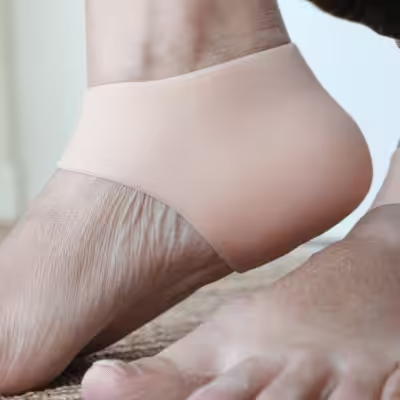

Postoperative swelling after foot surgery follows a predictable timeline — peak at days 2-5, gradual reduction through weeks 6-12, residual swelling for months. Compression and elevation accelerate resolution.
You’re in the right place. Dr. Tom Biernacki, DPM, FACFAS — board-certified foot & ankle surgeon with 3,000+ surgeries — explains exactly what postoperative foot surgery swelling means and what works. Call (810) 206-1402 for same-day appointment at Howell or Bloomfield Township.
Medically reviewed by Dr. Tom Biernacki, DPM · Board-Certified Podiatric Surgeon · Last reviewed: April 2026 · Editorial Policy
Medically reviewed by Dr. Tom Biernacki, DPM — Board-certified foot & ankle surgeon, 3,000+ surgeries performed. Updated April 2026 with current clinical evidence. This article reflects real practice experience from Balance Foot & Ankle Specialists in Howell and Bloomfield Township, Michigan.
The most important clinical decision with Postoperative Swelling Foot Surgery Timeline Management isn’t which treatment to start with — it’s identifying the correct subtype. That changes everything. Call (810) 206-1402.
Quick Answer
Most foot and ankle problems respond to conservative care — proper footwear, supportive inserts, activity modification, and targeted stretching — within 4-8 weeks. Persistent pain beyond that window, or any symptom that prevents walking, warrants a podiatric evaluation to rule out fracture, tendon tear, or systemic cause.
Watch: Dr. Tom Biernacki, DPM

Medically reviewed by Dr. Tom Biernacki, DPM — Board-Certified Podiatric Surgeon — Balance Foot & Ankle, Howell & Bloomfield Township, MI. Last updated April 2026.
▶ Watch
Medically Reviewed by Dr. Tom Biernacki, DPM — Board-Certified Podiatrist, Balance Foot & Ankle Specialists, Michigan. Last updated April 2026.
Postoperative swelling after foot and ankle surgery is one of the most common patient concerns during recovery — and one of the most misunderstood. Foot and ankle swelling after surgery is not only expected, it is normal and appropriate as a component of tissue healing. However, the specific character, timeline, and response of swelling to elevation and compression helps distinguish normal post-surgical edema from concerning findings that require evaluation.
Normal Swelling Timeline
Immediate post-operative (days 1–14): significant swelling is normal and expected — the surgical trauma and inflammatory response produce tissue edema that peaks at 3–5 days. Pain from swelling is normal in this phase; the foot should be kept elevated above heart level as much as possible. Weeks 2–6: swelling begins to gradually decrease; pitting edema (pressing on the foot leaves an indentation) is normal. The rate of improvement depends heavily on compliance with elevation — each hour of non-elevation adds to the cumulative edema burden. Months 2–6: residual swelling is common and normal, particularly in the morning or after prolonged standing. Full resolution of foot and ankle post-surgical swelling typically requires 3–12 months depending on the procedure — ankle reconstructions and calcaneal osteotomies have the longest swelling resolution timelines. Warning signs requiring urgent evaluation: rapid increase in swelling with warmth and erythema (wound infection or DVT); calf swelling out of proportion to foot swelling (DVT); fever >101°F; increasing rather than decreasing pain beyond day 7; skin breakdown under compression dressings.
Swelling Management Strategies
Elevation: the single most effective intervention — foot must be above heart level, not just propped on a pillow on the couch; lying with legs up a wall or on elevated pillows in bed. Compression: post-operative stockings at the appropriate compression level (20–30mmHg) beginning when allowed by the surgical dressing. Foot pump exercises: gentle ankle pump exercises (active dorsiflexion-plantarflexion) promote venous return and reduce dependent edema — begin as soon as cleared by the surgeon. Cold therapy: elevation + ice for the first 72 hours reduces post-operative pain and swelling — a specialized post-op cryotherapy device provides more consistent cooling than ice bags. Dr. Biernacki at Balance Foot & Ankle provides detailed post-operative swelling management instructions and close follow-up after all foot and ankle procedures. Call (810) 206-1402 at our Bloomfield Township or Howell office with any post-operative concerns.
📧 Get Dr. Tom’s Free Lab Test Guide
Discover the 5 lab tests every person over 35 should ask their doctor about — explained in plain English by a board-certified physician.
📍 Located in Michigan?
Our board-certified podiatrists treat this condition at two convenient locations. Same-day appointments often available.
When to See a Podiatrist
Many foot conditions can be managed conservatively at home, but some require professional evaluation. See a podiatrist promptly if you experience:
- Pain that persists for more than 2 weeks despite rest
- Swelling, redness, or warmth that isn’t improving
- Numbness, tingling, or burning in the feet
- A wound or sore that is not healing within 2 weeks
- Any foot concern if you have diabetes or poor circulation
- Nail changes that suggest fungal infection or other problems
At Balance Foot & Ankle, our three board-certified podiatrists — Dr. Tom Biernacki, Dr. Carl Jay, and Dr. Daria Gutkin — provide comprehensive foot and ankle care at our Howell and Bloomfield Township offices. Most insurance plans are accepted.
Related Conditions & Resources
Ready to Get Relief? We’re Here to Help.
Board-certified podiatrists Dr. Tom Biernacki, Dr. Carl Jay, and Dr. Daria Gutkin see patients daily at our Howell and Bloomfield Township, MI offices.
📅 Book Online
📞 (810) 206-1402
Insurance Accepted
BCBS · Medicare · Aetna · Cigna · United Healthcare · HAP · Priority Health · Humana · View All →
Howell Office
4330 E Grand River Ave
Howell, MI 48843
Get Directions →
Bloomfield Township Office
43494 Woodward Ave, #208
Bloomfield Township, MI 48302
Get Directions →
Your Board-Certified Podiatrists



Ready to Get Back on Your Feet?
Same-week appointments available at both locations.
Book Your AppointmentIn-Office Treatment at Balance Foot & Ankle
If home care isn’t resolving your your foot or ankle concern, a visit with a board-certified podiatrist is the fastest path to accurate diagnosis and a personalized plan. At Balance Foot & Ankle Specialists, Dr. Tom Biernacki, Dr. Carl Jay, and Dr. Daria Gutkin offer same-day and next-day appointments at both our Howell and Bloomfield Township offices. We perform on-site diagnostic ultrasound, digital X-ray, conservative care, advanced regenerative treatments, and minimally invasive surgery when indicated.
Call (810) 206-1402 or request an appointment online. Most insurance plans accepted, including Medicare, Blue Cross Blue Shield, Aetna, Cigna, and United Healthcare.
Most Common Mistake We See
The most common mistake we see is: Waiting too long before seeking care. Fix: any foot pain lasting more than 4 weeks, or any sudden severe symptom, deserves a professional evaluation rather than more rest.
Warning Signs That Need Same-Day Care
Seek immediate evaluation at Balance Foot & Ankle if you experience any of the following:
- Unable to bear weight
- Severe swelling with skin colour change
- Fever with foot pain (possible infection)
- Diabetes plus any new foot symptom
Call (810) 206-1402 — same-day and next-day appointments at our Howell and Bloomfield Township offices.
Watch: Dr. Tom explains
Podiatrist-recommended products
As an Amazon Associate, Dr. Tom earns from qualifying purchases.
Post-op edema first-line.
View on Amazon →Graduated compression for lymphatic drainage.
View on Amazon →Topical relief around swollen tissues.
View on Amazon →Rehab-phase arch support.
View on Amazon →Related resources
Ready to solve this? Book today.
Same-week appointments · Howell & Bloomfield Township · 4.9★ (1,123+ reviews)
☎ (810) 206-1402Book Online →Watch: Dr. Tom explains
Podiatrist-recommended products
As an Amazon Associate, Dr. Tom earns from qualifying purchases.
Protocol icing
View on Amazon →Offloading
View on Amazon →Peri-incision comfort
View on Amazon →Return-to-shoe support
View on Amazon →Related resources
Ready to solve this? Book today.
Same-week appointments · Howell & Bloomfield Township · 4.9★ (1,123+ reviews)
☎ (810) 206-1402Book Online →More Podiatrist-Recommended Surgery Essentials
OOFOS Recovery Slide

![Stop These Mistakes Making Edema Swelling Worse! [Swollen Feet Ankles And Legs Fast Fix]](https://www.michiganfootdoctors.com/wp-content/cache/flying-press/4a7b775817c9c770ed7a9357a1ced610.jpg)
Watch: Stop These Mistakes Making Edema Swelling Worse! [Swollen Feet Ankles And Legs Fast Fix] — MichiganFootDoctors YouTube
Post-op approved — impact-absorbing slide for early recovery.
HOKA Ora 3 Recovery Slide
Max-cushion recovery sandal — comfort for post-surgical swelling.
Hoka Bondi 9
Max-cushion walking shoe — ease into return-to-walking post-surgery.
As an Amazon Associate, Balance Foot & Ankle earns from qualifying purchases. Product recommendations are based on clinical experience; prices and availability shown above update live from Amazon.
When to See a Podiatrist
Foot and ankle surgery in 2026 is dramatically different than a decade ago — most procedures are now minimally-invasive, outpatient, and allow weight-bearing within days. Balance Foot & Ankle surgeons have performed 3,000+ foot/ankle surgeries with modern techniques. If another surgeon has recommended a traditional open procedure, a second opinion may reveal a faster, less-invasive option.
Call Balance Foot & Ankle: (810) 206-1402 · Book online · Offices in Howell & Bloomfield Township
Pros & Cons of Conservative Care for foot care
Advantages
- ✓ Conservative care first
- ✓ Same-week appointments
- ✓ Multiple insurance accepted
Considerations
- ✗ Self-treatment can mask issues
- ✗ See a podiatrist if pain >2 weeks
Dr. Tom’s Recommended Products for foot care
Affiliate disclosure: As an Amazon Associate, Balance Foot & Ankle earns from qualifying purchases. We only recommend products we use with patients.
Footnanny Heel Cream Dr. Tom’s Pick
Best for: Daily moisturizer for cracked heels
Ready to Get Back on Your Feet?
Same-day appointments in Howell + Bloomfield Township. Most insurance accepted. Dr. Tom Biernacki, DPM & team.
Book Today — Same-Day Appointments Available
Call Now: (810) 206-1402
About Your Care Team at Balance Foot & Ankle
Dr. Tom Biernacki, DPM · Board-Certified Foot & Ankle Surgeon. Specializes in conservative-first care, minimally invasive bunion surgery, and complex reconstruction.
Dr. Carl Jay, DPM · Accepting new patients. Specializes in sports medicine, athletic injuries, and routine podiatric care.
Dr. Daria Gutkin, DPM, AACFAS · Accepting new patients. Specializes in surgical reconstruction and pediatric podiatry.
Locations: 4330 E Grand River Ave, Howell, MI 48843 · 43494 Woodward Ave Suite 208, Bloomfield Township, MI 48302
Hours: Mon–Fri 8:00 AM – 5:00 PM · (810) 206-1402
Frequently Asked Questions
When should I see a podiatrist?
If symptoms persist past 2 weeks, affect your normal activity, or are accompanied by red-flag symptoms (warmth, redness, swelling, inability to bear weight).
What does treatment cost?
Most diagnostic visits and conservative treatments are covered by Medicare and major insurers. Out-of-pocket costs vary by your specific plan.
How quickly can I get an appointment?
Most non-urgent cases see us within 5 business days. Urgent cases (sudden pain, possible fracture) typically same or next business day.

Dr. Tom Biernacki, DPM is a board-certified foot & ankle surgeon (ABFAS & ABPM) at Balance Foot & Ankle Specialists in Southeast Michigan. With over a decade of clinical experience, he specializes in heel pain, bunions, diabetic foot care, sports injuries, and minimally invasive surgery. Dr. Biernacki is a member of the APMA and ACFAS, and his patient education content on MichiganFootDoctors.com and YouTube has made him one of the most-followed foot & ankle educators on YouTube.