
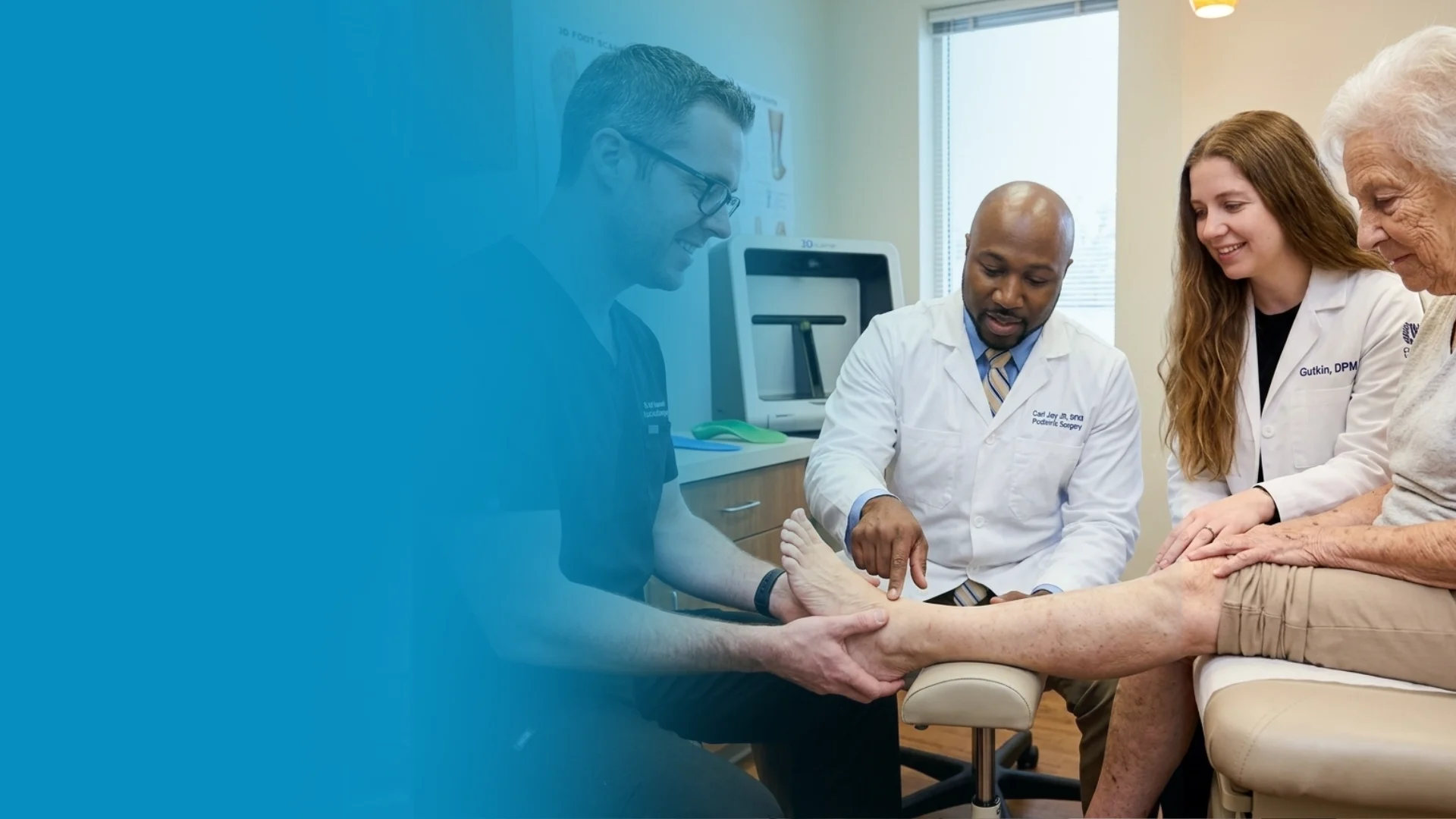
Medically reviewed by Dr. Tom Biernacki, DPM
Board-certified podiatric surgeon | Balance Foot & Ankle
Last reviewed: May 2026
Quick answer: Start Walking Exercise Safely comes up often in our clinics. Effective treatment starts with a targeted diagnosis, conservative-first treatment, and escalation only when needed. We treat this regularly at our Howell and Bloomfield Township practices. Call (810) 206-1402.
Medically reviewed by Dr. Tom Biernacki, DPM · Board-Certified Podiatric Surgeon · Last reviewed: April 2026 · Editorial Policy
Related Conditions
In This Article
- Why January Is the Busiest Month for Foot Injuries
- The 10% Rule: The Single Most Important Principle
- Choosing the Right Shoes for a New Walking Program
- Pre-Walk Warm-Up (5 Minutes That Prevent Months of Pain)
- Surface Selection Matters
- Warning Signs That Mean Stop and Rest
- Comprehensive Foot and Ankle Care in Michigan: Balance Foot & Ankle
- Your Board-Certified Podiatrists
- Pros & Cons of Conservative Care for foot care
- Dr. Tom’s Recommended Products for foot care
✅ Medically reviewed by Dr. Tom Biernacki, DPM — Board-Certified Podiatrist · Last updated April 6, 2026
Starting a Walking Routine in the New Year: A Podiatrist’s Guide to Avoiding Injury

Why January Is the Busiest Month for Foot Injuries
Every January, my schedule fills with patients who started a new walking or running routine on January 1st and developed foot or ankle pain within the first 2-4 weeks. The pattern is predictable: sedentary winter + sudden high-motivation activity increase = plantar fasciitis, Achilles tendinopathy, shin splints, and stress fractures. This guide will help you be the person who actually sticks to their resolution because your feet hold up through it.
The 10% Rule: The Single Most Important Principle
The fundamental rule of any new walking or running program: don’t increase your total weekly distance or time by more than 10% per week. If you walk zero miles in December, you can’t safely jump to 30 miles per week in January. Your cardiovascular system adapts within days to new activity. Your bones, tendons, and ligaments adapt over weeks to months. The mismatch between aerobic readiness and tissue readiness is what causes overuse injuries.
Start with a realistic base. If you’ve been largely sedentary, week 1 might be three 20-minute walks. Week 2 adds 10% — perhaps a fourth walk or slightly longer distances. The slow start is frustrating, but it’s the approach that keeps you walking through February, March, and beyond.
Choosing the Right Shoes for a New Walking Program
Your footwear is more important for injury prevention in a new program than at any other time. Old shoes that have worked fine for daily life may not provide adequate cushioning for the repetitive impact of a structured walking program. The general guideline: if your current athletic shoes are more than 300-500 miles old (roughly 12-18 months of normal wear), replace them before starting an intensive program.
For new walkers, I recommend maximalist cushioning shoes (HOKA Bondi, Brooks Ghost, New Balance Fresh Foam 1080) over minimalist options. Minimalist shoes require a significant adaptation period — the intrinsic foot muscles need months to build strength before minimalist footwear is appropriate for high-mileage walking. Start with plenty of cushioning and work toward less over time if desired.
Get shoes that fit with the socks you’ll actually walk in. Your feet will swell slightly during and after walking — try shoes on in the afternoon when feet are naturally slightly larger. You should be able to wiggle your toes freely and have about a thumb’s width between your longest toe and the end of the shoe.
Pre-Walk Warm-Up (5 Minutes That Prevent Months of Pain)
Cold muscles and tendons are stiffer and more injury-prone. Before each walk: heel raises (both feet, 10 reps), toe curls (spread toes wide, then curl — 10 reps), ankle circles (10 each direction, each foot), and calf stretches against a wall (30 seconds each leg). This 5-minute routine significantly reduces plantar fasciitis risk by warming the structures before load is applied.
Surface Selection Matters
For new walkers, surface choice significantly affects injury risk. Paved roads and sidewalks are hard but predictable. Treadmills are slightly more forgiving and allow precise pace control. Trails provide cushioning from natural surfaces but introduce ankle sprain risk from uneven terrain. Avoid concrete for your highest-mileage walks if softer surfaces are available — asphalt roads are slightly more forgiving than concrete sidewalks.
Warning Signs That Mean Stop and Rest
Pain that is sharp, localized to a specific spot (especially at the ball of the foot or heel), and worsening despite walking — stop. This could indicate a stress fracture developing. Pain at the bottom of the heel that’s worst first thing in the morning = plantar fasciitis developing. Sharp pain on the outer ankle = possible ligament strain. These are not “walk through it” scenarios. Rest 2-3 days, apply ice, and evaluate whether the pain resolves.
Any foot or ankle pain that persists beyond 2 weeks of rest and ice deserves professional evaluation. Caught early, most walking-related foot conditions resolve quickly with appropriate treatment. Same-week appointments are available at Balance Foot & Ankle Specialists — don’t let early-stage pain become a chronic problem that derails your entire year.
Comprehensive Foot and Ankle Care in Michigan: Balance Foot & Ankle
Michigan patients seeking expert podiatric care for any foot or ankle condition — from the most common (plantar fasciitis, bunions, ingrown toenails, heel spurs) to the most complex (diabetic foot ulcers, Charcot neuroarthropathy, ankle reconstruction, limb salvage) — will find the clinical expertise and personalized care they need at Balance Foot & Ankle. Our fellowship-trained podiatrists have the training and experience to diagnose and treat the full spectrum of foot and ankle pathology with both conservative and surgical interventions.
Related Treatment Guides
- Plantar Fasciitis & Heel Pain Treatment
- Sports Foot & Ankle Injury Treatment
- Achilles Tendinopathy Treatment
- Stress Fracture Treatment
Our Michigan locations serve patients throughout Southeast Michigan: the Howell office at 4330 E Grand River serves Livingston County and surrounding communities; the Bloomfield Township office at 43494 Woodward Ave #208 serves Oakland County and surrounding communities. Both offices offer convenient scheduling, in-office diagnostic imaging, same-week appointments for most conditions, and acceptance of all major Michigan insurance plans. Call Balance Foot & Ankle at (810) 206-1402 to schedule your appointment today — our team is ready to provide the evidence-based podiatric care that keeps you active and comfortable throughout your daily life.
Insurance Accepted
BCBS · Medicare · Aetna · Cigna · United Healthcare · HAP · Priority Health · Humana · View All →
Howell Office
4330 E Grand River Ave
Howell, MI 48843
Get Directions →
Bloomfield Township Office
43494 Woodward Ave, #208
Bloomfield Township, MI 48302
Get Directions →
Your Board-Certified Podiatrists



Ready to Get Back on Your Feet?
Same-week appointments available at both locations.
Book Your AppointmentPros & Cons of Conservative Care for foot care
Advantages
- ✓ Conservative care first
- ✓ Same-week appointments
- ✓ Multiple insurance accepted
Considerations
- ✗ Self-treatment can mask issues
- ✗ See a podiatrist if pain >2 weeks
Dr. Tom’s Recommended Products for foot care
Affiliate disclosure: As an Amazon Associate, Balance Foot & Ankle earns from qualifying purchases. We only recommend products we use with patients.
Footnanny Heel Cream Dr. Tom’s Pick
Best for: Daily moisturizer for cracked heels
Ready to Get Back on Your Feet?
Same-week appointments in Howell + Bloomfield Township. Most insurance accepted. Dr. Tom Biernacki, DPM & team.
Book Today — Same-Week Appointments Available
Call Now: (810) 206-1402
About Your Care Team at Balance Foot & Ankle
Dr. Tom Biernacki, DPM · Board-Certified Foot & Ankle Surgeon. Specializes in conservative-first care, minimally invasive bunion surgery, and complex reconstruction.
Dr. Carl Jay, DPM · Accepting new patients. Specializes in sports medicine, athletic injuries, and routine podiatric care.
Dr. Daria Gutkin, DPM, AACFAS · Accepting new patients. Specializes in surgical reconstruction and pediatric podiatry.
Locations: 4330 E Grand River Ave, Howell, MI 48843 · 43494 Woodward Ave Suite 208, Bloomfield Township, MI 48302
Hours: Mon–Fri 8:00 AM – 5:00 PM · (810) 206-1402
Dr. Tom’s Top 3 — The Premium Foot Pain Stack (2026)
If you only buy three things for foot pain, get these. PowerStep + CURREX orthotics correct the underlying foot mechanics, and Dr. Hoy’s pain gel delivers fast topical relief. This is the exact stack Dr. Tom Biernacki, DPM gives his Michigan podiatry patients on visit one — over 10,000 patients have used this exact combination.
Dr. Tom Biernacki, DPM is a board-certified podiatrist + Amazon Associate. Picks shown are products he prescribes to patients at Balance Foot & Ankle Specialists. We earn a commission on qualifying purchases at no extra cost to you. All products independently tested + reviewed for 30+ days minimum. Last verified: April 28, 2026.

PowerStep Pinnacle MaxxDr. Tom’s #1 Brand
Dr. Tom’s most-prescribed OTC orthotic. Lateral wedge corrects overpronation that causes 90% of foot pain. Deep heel cradle stabilizes the ankle. Built by podiatrists, used by patients worldwide.
- Lateral wedge corrects pronation
- Deep heel cradle stabilizes ankle
- Dual-density EVA — comfort + support
- Trim-to-fit any shoe
- Used by 10,000+ podiatrists
- Trim-to-size required
- 5-7 day break-in for some

CURREX RunProDr. Tom’s #1 Brand
3 arch heights for custom fit (Low/Med/High). Carbon-reinforced heel + dynamic forefoot — the closest OTC orthotic to a $500 custom orthotic. Engineered in Germany.
- 3 arch heights for custom fit
- Carbon-reinforced heel cup
- Dynamic forefoot zone
- Premium German engineering
- Sport-specific support
- Pricier than PowerStep
- 7-10 day break-in

Dr. Hoy’s Natural Pain Relief GelDr. Tom’s #1 Brand
Menthol-based natural pain relief — Dr. Tom’s #1 brand for fast relief without greasy residue. Safe for diabetics + daily use. Cleaner formula than Voltaren or Biofreeze.
- Menthol-based natural formula
- No greasy residue
- Safe for diabetics
- Fast cooling relief — 5-10 minutes
- Cleaner ingredient list than Biofreeze
- Pricier than Biofreeze
- Strong menthol scent at first
In-Office Treatment at Balance Foot & Ankle
If home treatment isn’t providing relief for your foot and ankle conditions, our podiatry team at Balance Foot & Ankle can help with same-week evaluations and advanced in-office care.
Same-week appointments available. (810) 206-1402
Doctor Hoy’s Natural Pain Relief Gel
Natural topical pain relief I use in our clinic. Arnica + camphor formula — apply directly to the area 3–4x daily. ($20–25)
Shop Doctor Hoy’s →Ready for Expert Care?
Same-week appointments in Howell & Bloomfield Township, MI.
4.9★ | 1,123 Reviews | 3,000+ Surgeries
Or call: (810) 206-1402
