
Medically reviewed by Dr. Tom Biernacki, DPM
Board-certified podiatric surgeon | Balance Foot & Ankle, Howell & Bloomfield Township, MI
Last reviewed: May 2026

| Type | Cause | Joint Pattern | X-ray Finding | Age of Onset |
|---|---|---|---|---|
| Post-traumatic Osteoarthritis | Prior ankle fracture; chronic instability; OCD | Ankle only (tibiotalar); asymmetric | Joint space narrowing; osteophytes; subchondral sclerosis at injury site | Any age — 10–20 years after trauma |
| Primary Osteoarthritis | Idiopathic cartilage wear; aging | Ankle ± subtalar; diffuse | Global joint space narrowing; circumferential osteophytes | Usually >55 years |
| Rheumatoid Arthritis | Autoimmune synovitis; cartilage destruction | Often bilateral; multiple joints (ankle + subtalar + midfoot) | Periarticular erosions; uniform joint space loss; osteopenia | 35–55 years most common |
| Gout (Chronic Tophaceous) | Uric acid crystal deposition | 1st MTP most common; ankle in chronic gout | Punched-out erosions; tophaceous deposits | 40–60 years; male predominant |
| Hemophilic Arthropathy | Recurrent hemarthrosis; iron deposition | Ankle; knee; elbow | Epiphyseal enlargement; joint destruction; hemosiderin on MRI | Childhood through adult |
| Treatment | Stage / Indication | Evidence Level | Pain Reduction | Duration of Effect |
|---|---|---|---|---|
| NSAIDs + Activity Modification | All mild–moderate arthritis; first-line | Level I | 30–50% pain reduction | Symptom management only |
| Custom AFO or Ankle Brace | Moderate arthritis; instability component; unable to tolerate surgery | Level III | 50–60% functional improvement | Ongoing — accommodative |
| Intra-articular Corticosteroid Injection | Acute flare; moderate arthritis | Level II | 60–80% at 4 weeks | 3–6 months average |
| PRP Injection (Intra-articular) | Moderate arthritis; failed corticosteroid at 12 months | Level II | 50–60% at 6 months | 6–12 months; superior to HA at 6 months |
| Ankle Arthroscopy (Debridement / Osteophyte Removal) | Anterior impingement; loose bodies; early arthritis | Level III | 70–80% improvement in anterior impingement | 2–5 years before progression |
| Total Ankle Replacement (TAR) | Severe arthritis; age >50; low-to-moderate activity | Level II | 85–90% pain relief; preserves motion | 85–90% implant survival at 10 years |
| Ankle Arthrodesis (Fusion) | Severe arthritis; any age; high-demand; poor bone stock | Level II | 85–90% pain relief | Permanent if fusion achieved |
Quick answer: Treatment for ankle arthritis treatment options pain relief follows a stepwise approach: 1) conservative care first (rest, ice, supportive footwear, OTC anti-inflammatories), 2) physical therapy and targeted exercises, 3) in-office treatments (injections, custom orthotics) if conservative fails at 4-6 weeks, 4) surgery for refractory cases. Most patients resolve at step 1 or 2. Call (810) 206-1402.
Medically Reviewed | Dr. Tom Biernacki, DPM | Board-Certified Podiatric Surgeon | Balance Foot & Ankle, Michigan

![How to Regrow Cartilage & Reverse OsteoArthritis? [Can We Do It?]](https://www.michiganfootdoctors.com/wp-content/cache/flying-press/6f8bfd0a4becc695adbde1cd9df37f15.jpg)
Watch: How to Regrow Cartilage & Reverse OsteoArthritis? [Can We Do It?] — MichiganFootDoctors YouTube
The most important clinical decision with Ankle Arthritis Treatment Options Pain Relief isn’t which treatment to start with — it’s identifying the correct subtype. That changes everything. Call (810) 206-1402.
The most important clinical decision with Ankle Arthritis Treatment Options Pain Relief isn’t which treatment to start with — it’s identifying the correct subtype. That changes everything. Call (810) 206-1402.
Understanding Ankle Arthritis
Ankle arthritis (tibiotalar arthritis) is degeneration of the cartilage lining the ankle joint — the articulation between the tibia and the talus bone. Unlike hip and knee arthritis, which commonly develop from primary osteoarthritis, ankle arthritis is most often post-traumatic, occurring as a late consequence of ankle fractures, severe ankle sprains, or osteochondral lesions that damaged the cartilage. Primary osteoarthritis of the ankle is less common but does occur. Inflammatory arthritis — rheumatoid, psoriatic, and ankylosing spondylitis — can also cause destructive ankle arthritis.
Symptoms and Diagnosis
Ankle arthritis presents with deep, aching pain localized to the front of the ankle joint that worsens with weight-bearing activity and improves with rest. Morning stiffness lasting 15–30 minutes is characteristic. As the disease progresses, range of motion decreases — particularly dorsiflexion — and pain may occur with simple walking on uneven ground. Swelling around the ankle joint, a grinding sensation (crepitus), and visible deformity in advanced cases complete the clinical picture. X-rays confirm the diagnosis by demonstrating joint space narrowing, subchondral sclerosis, osteophytes, and in severe cases, bone-on-bone contact.
Conservative Treatment
Conservative management of ankle arthritis is effective for mild to moderate disease. Ankle bracing — particularly a solid ankle-foot orthosis (AFO) or a shorter Arizona brace — offloads the ankle joint and significantly reduces pain with ambulation. Custom orthotics with rocker modifications reduce tibiotalar joint stress during walking. Rocker-bottom shoes and stiff-soled footwear with significant heel-to-toe rocker reduce ankle range-of-motion demand during push-off. Corticosteroid or platelet-rich plasma (PRP) injections provide temporary relief during inflammatory flares. Weight management reduces axial loading through the arthritic joint.
Surgical Options: Fusion vs. Replacement
When conservative care is insufficient, surgery offers two primary options. Ankle arthrodesis (fusion) permanently eliminates ankle motion by fusing the tibia and talus together with screws or plates. It is the historical gold standard — highly reliable for pain relief with a durable long-term result. The trade-off is permanent loss of ankle motion, which increases stress on adjacent joints (subtalar, midfoot) over time, potentially causing secondary arthritis. Fusion remains the preferred choice for young, active, high-demand patients.
Total ankle replacement (arthroplasty) resurfaces the tibial and talar joint surfaces with metal and polyethylene implants, preserving ankle motion. Modern third-generation implants have significantly improved outcomes, with survivorship rates of 85–90% at 10 years in well-selected patients. Replacement is preferred for older, lower-demand patients seeking preserved motion, particularly those who wish to continue recreational activities. The main limitations are higher complication rates than fusion and the possibility of eventual implant loosening requiring revision. Dr. Biernacki evaluates each patient’s specific situation to recommend the most appropriate surgical approach.
Dr. Tom's Product Recommendations

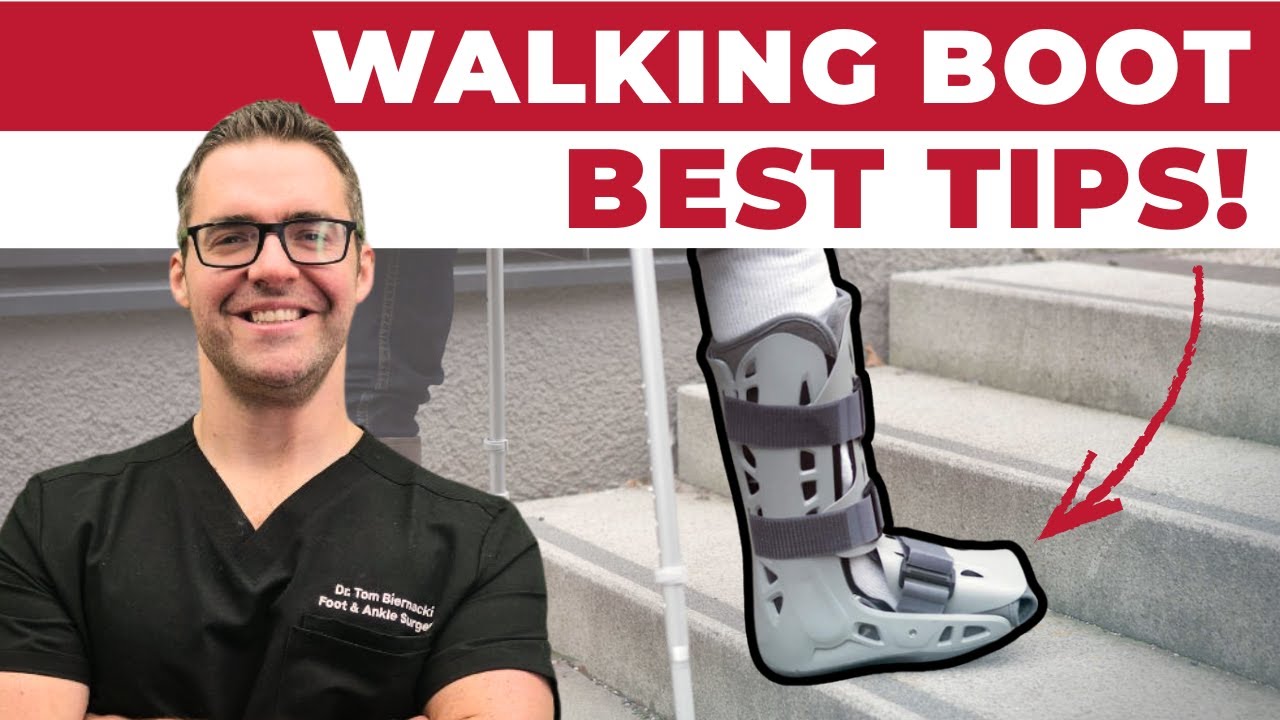
Ossur Rebound Air Walker Boot
⭐ Highly Rated
A pneumatic walking boot that provides significant ankle joint offloading for patients with ankle arthritis during activity flares. Reduces pain from bone-on-bone contact during rehabilitation and activity.
Dr. Tom says: “For ankle arthritis patients experiencing activity flares, a CAM boot provides valuable joint protection.”
Ankle arthritis patients during acute pain flares needing temporary joint protection
Daily long-term management — a brace or AFO is more appropriate for chronic use
Disclosure: We earn a commission at no extra cost to you.

Mueller Adjustable Ankle Stabilizer
⭐ Highly Rated
An adjustable figure-8 ankle brace that provides mediolateral stability and mild joint compression for ankle arthritis. A practical everyday support option for patients in the early to moderate stages of ankle arthritis.
Dr. Tom says: “Ankle bracing is one of the most effective conservative interventions for ankle arthritis pain during daily activity.”
Mild to moderate ankle arthritis patients needing everyday joint support
Severe or end-stage ankle arthritis — surgical intervention should be discussed
Disclosure: We earn a commission at no extra cost to you.
✅ Pros / Benefits
- Conservative management effective for mild to moderate disease
- Both fusion and replacement produce good outcomes in appropriate patients
- Modern ankle replacement preserves motion with 85–90% 10-year survival
- Bracing significantly reduces pain without surgery
❌ Cons / Risks
- Post-traumatic ankle arthritis often affects younger patients with higher demands
- Fusion eliminates ankle motion permanently
- Ankle replacement requires careful patient selection
- Adjacent joint arthritis may develop after fusion over time
Dr. Tom Biernacki’s Recommendation
Ankle arthritis is one of the most disabling lower extremity conditions I treat. Patients often have a long history — a bad fracture in their 20s or 30s that ‘healed fine’ and now, 20 years later, they’re bone-on-bone. My approach is to maximize conservative management as long as it’s working, and when it stops working, have an honest conversation about fusion versus replacement based on their specific situation.
— Dr. Tom Biernacki, DPM | Board-Certified Podiatric Surgeon | Balance Foot & Ankle
Frequently Asked Questions
What is the difference between ankle fusion and ankle replacement?
Ankle fusion permanently eliminates ankle motion but is very reliable and durable. Ankle replacement preserves motion with good 10-year outcomes but has a higher complication rate. Dr. Biernacki discusses both options based on each patient’s age, activity level, and anatomy.
How painful is end-stage ankle arthritis?
End-stage ankle arthritis causes constant pain with any weight-bearing activity, significant deformity, and often complete inability to walk normally. It is among the most painful and disabling musculoskeletal conditions.
Can ankle arthritis be treated without surgery?
Yes — bracing, custom orthotics, injections, and footwear modifications effectively manage mild to moderate ankle arthritis. Surgery is reserved for patients with severe disease that has failed conservative management.
How long does recovery from ankle fusion take?
Non-weight-bearing immobilization for 6–8 weeks, followed by gradual progressive weight-bearing. Most patients are walking in regular shoes by 12–16 weeks. Full recovery takes 6–12 months.
Michigan Foot Pain? See Dr. Biernacki In Person
4.9★ rated | 1,123 Reviews | 3,000+ Surgeries
Same-week appointments · Howell & Bloomfield Township
📞 (810) 206-1402 Book Online →⚕ Doctor Recommended
Doctor Hoy’s Natural Pain ReliefTopical relief for foot & ankle pain
View Product →In-Office Treatment at Balance Foot & Ankle
If home treatment isn’t providing relief for your ankle arthritis treatment options pain relief, our podiatry team at Balance Foot & Ankle can help with same-day evaluations and advanced in-office care.
OrthoInfo – AAOS: Arthritis of the Foot and Ankle
Ready to Get Relief?
Same-day appointments available in Howell & Bloomfield Township, MI
4.9★ | 1,123 Reviews | 3,000+ Surgeries
Or call: (810) 206-1402

Dr. Tom Biernacki, DPM is a board-certified foot & ankle surgeon (ABFAS & ABPM) at Balance Foot & Ankle Specialists in Southeast Michigan. With over a decade of clinical experience, he specializes in heel pain, bunions, diabetic foot care, sports injuries, and minimally invasive surgery. Dr. Biernacki is a member of the APMA and ACFAS, and his patient education content on MichiganFootDoctors.com and YouTube has made him one of the most-followed foot & ankle educators on YouTube.