

Medically reviewed by Dr. Tom Biernacki, DPM — Board-Certified Podiatric Surgeon — Balance Foot & Ankle, Howell & Bloomfield Hills, MI. Last updated April 2026.
Understanding Ankle Sprain Severity
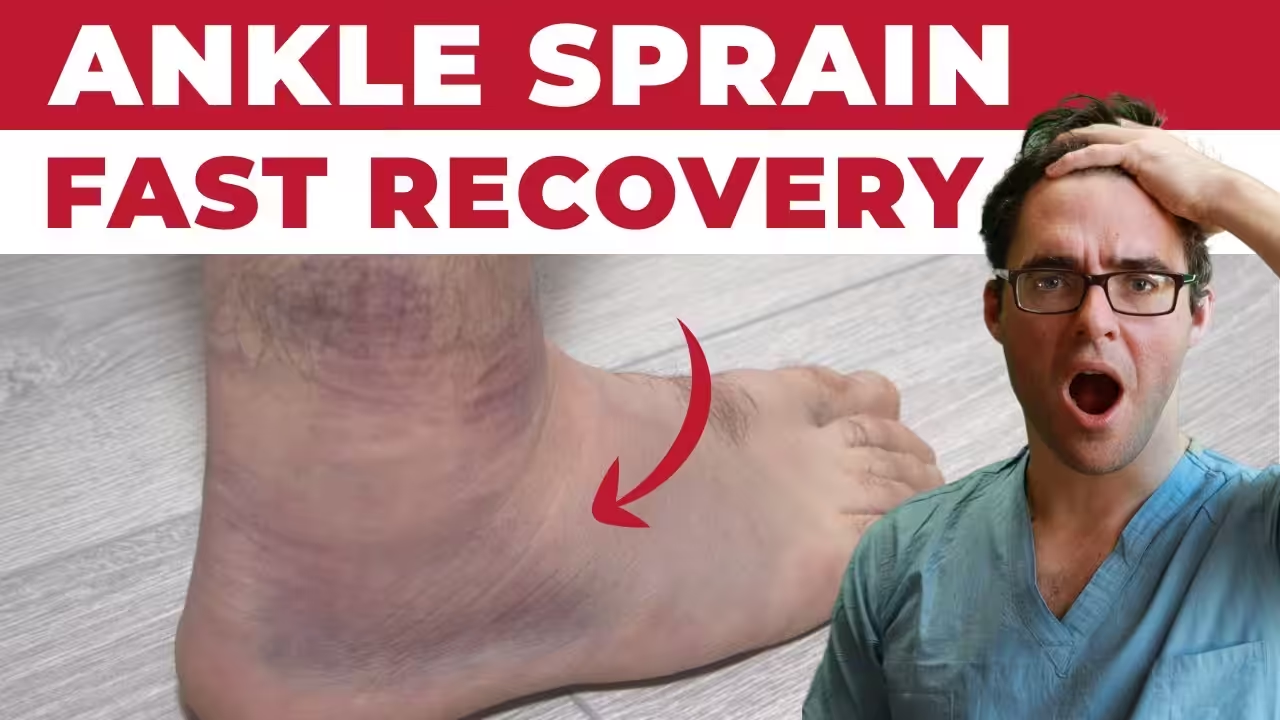
Ankle sprains are among the most common musculoskeletal injuries, with an estimated 23,000 occurring daily in the United States. Not all sprains are equal—they range from mild ligament stretching to complete ligament rupture—and the grade of injury determines appropriate treatment, expected recovery time, and risk of long-term complications. Understanding the grading system helps patients know what they’re dealing with, what treatment is needed, and when to seek professional evaluation.
The vast majority of ankle sprains (approximately 85%) involve the lateral ligament complex—specifically the anterior talofibular ligament (ATFL), which is the most commonly injured, followed by the calcaneofibular ligament (CFL). High ankle sprains (syndesmotic sprains), which injure the ligaments connecting the tibia and fibula above the ankle joint, are less common but more serious and have longer recovery timelines.
Grade 1: Mild Sprain
A Grade 1 sprain involves microscopic tears and stretching of the ligament fibers without significant structural disruption. There is no instability of the ankle joint. Symptoms include mild pain and tenderness at the lateral ankle, mild swelling, and minimal or no bruising. Weight-bearing is usually possible, though uncomfortable. Recovery time for Grade 1 sprains is typically 1–2 weeks with appropriate RICE protocol (rest, ice, compression, elevation) and activity modification. Most patients can return to sport within 1–2 weeks.
Grade 2: Moderate Sprain
A Grade 2 sprain involves a partial tear of one or more lateral ligaments—most commonly the ATFL. There is some degree of ankle instability, but the joint is not completely unstable. Symptoms include moderate pain, significant swelling, bruising (ecchymosis), and difficulty weight-bearing. The anterior drawer test (testing ATFL laxity) may be mildly positive. Recovery time is typically 3–6 weeks. Treatment includes a period of immobilization in an ankle brace or walking boot, followed by structured physical therapy focusing on range-of-motion, strengthening, and proprioceptive training. Return to sport typically occurs at 4–6 weeks with a brace.
Grade 3: Severe Sprain
A Grade 3 sprain is a complete rupture of one or more lateral ligaments. The ankle joint is significantly unstable. Symptoms include severe pain at injury (which may paradoxically become less severe quickly as nerve endings are also disrupted), profound swelling and bruising, inability to weight-bear, and significant ankle instability on clinical testing. X-rays are essential to rule out associated fractures (particularly the fibula, fifth metatarsal, and talar dome). MRI may be indicated to assess ligament disruption and identify concomitant injuries (peroneal tendon tears, osteochondral lesions).
Grade 3 sprains require longer immobilization (2–4 weeks in a CAM boot), followed by comprehensive physical therapy. The vast majority of complete lateral ankle ligament ruptures heal successfully with functional rehabilitation without surgery. Surgical ligament reconstruction (Brostrom procedure) is reserved for patients with persistent instability after 3–6 months of appropriate rehabilitation. Recovery to return to sport takes 3–4 months for most Grade 3 sprains.
When to Seek Evaluation
Seek immediate evaluation if: you cannot bear weight on the ankle after the injury (the Ottawa Ankle Rules recommend X-ray); there is bony tenderness at the posterior fibula, lateral malleolus, medial malleolus, navicular, or base of the fifth metatarsal; there is significant deformity or the ankle appears dislocated. Seek evaluation within a week if: swelling is significant, pain prevents normal activity, or symptoms are not improving with initial home treatment. Seek evaluation if symptoms persist beyond 6–8 weeks—persistent pain after a sprain warrants evaluation for associated injuries including peroneal tendon damage and osteochondral lesions of the talus.
Frequently Asked Questions
How do I know if I have a Grade 1, 2, or 3 sprain?
Grading is based on clinical findings, not just pain level. Grade 1: mild pain and tenderness, minimal swelling, no bruising, can walk. Grade 2: moderate pain, significant swelling, some bruising, difficulty walking, possible mild instability on clinical testing. Grade 3: severe swelling and bruising, inability to bear weight, clear ankle instability when tested. The amount of bruising and swelling that appears 24–48 hours after injury is often a more reliable indicator of severity than immediate pain. Definitive grading requires clinical examination—imaging (X-ray for fracture, MRI for ligament assessment) is used to confirm and characterize the injury, particularly for Grade 2 and 3 injuries.
Should I go to the ER for a severe ankle sprain?
Go to the ER if: you cannot bear any weight on the ankle, there is visible deformity or suspected dislocation, there is numbness or circulation concerns in the foot, or the injury occurred with significant force (fall from height, high-speed sports injury). The Ottawa Ankle Rules—a validated clinical decision tool—recommend X-ray if you have pain near the malleolus AND either cannot bear weight immediately and at initial examination, OR have bone tenderness at the posterior lower fibula, posterior lower tibia, navicular, or fifth metatarsal base. If the Ottawa criteria are not met, X-ray can typically be deferred. Urgent care or a next-day podiatry or orthopedics appointment is appropriate for most moderate-to-severe sprains that do not meet emergency criteria.
Can a Grade 3 sprain be worse than a fracture?
In some ways, yes. A small fibular avulsion fracture (a chip of bone pulled off by the sprain) often heals more predictably than a complete Grade 3 ligament rupture, which can result in chronic ankle instability if rehabilitation is inadequate. This counterintuitive fact surprises many patients who expect fractures to always be more serious. A non-displaced fibular fracture at the tip of the lateral malleolus heals reliably in a boot over 6 weeks. A complete ATFL rupture requires months of rehabilitation and carries approximately a 20–40% risk of developing chronic ankle instability—recurrent sprains, giving way, and chronic pain—if not properly rehabilitated. Complete syndesmotic sprains (high ankle sprains) are typically more serious and slower-healing than most fractures, often requiring prolonged immobilization and sometimes screw fixation.
Medical References & Sources
- American Orthopaedic Foot & Ankle Society — Ankle Sprains
- PubMed Research — Ottawa Ankle Rules Validation
- PubMed Research — Ankle Sprain Grading and Rehabilitation
Dr. Tom Biernacki, DPM is a board-certified podiatric surgeon at Balance Foot & Ankle in Howell and Bloomfield Hills, Michigan. He evaluates and treats ankle sprains of all grades, from acute management through rehabilitation and surgical stabilization when needed.
Dr. Tom’s Recommended Products for Ankle Pain & Injuries
📍 Located in Michigan?
Our board-certified podiatrists treat this condition at two convenient locations. Same-day appointments often available.
These are products I personally use and recommend to my patients at Balance Foot & Ankle.
- ASO Ankle Stabilizing Orthosis — Figure-8 straps with bilateral stability columns — the gold standard lace-up ankle brace for return to sport
- McDavid 195 Ankle Brace — Hinged design allows dorsiflexion/plantarflexion while blocking inversion — best for chronic lateral instability
- Doctor Hoy’s Natural Pain Relief Gel 3oz — Menthol-based cryotherapy — penetrates soft tissue to reduce ankle sprain inflammation and acute pain
Affiliate disclosure: As an Amazon Associate, Balance Foot & Ankle earns from qualifying purchases. We only recommend products we trust for our own patients.
Dr. Tom’s Recommended: Natural Topical Pain Relief
This is what I actually use in our clinic at Balance Foot & Ankle.
- Doctor Hoy’s Natural Pain Relief Gel — Natural topical pain relief I use in our clinic. Arnica + camphor formula. Apply directly to the painful area 3-4x daily for fast-acting relief without NSAIDs.
📧 Get Dr. Tom’s Free Lab Test Guide
Discover the 5 lab tests every person over 35 should ask their doctor about — explained in plain English by a board-certified physician.
Affiliate disclosure: As an Amazon Associate, Balance Foot & Ankle earns from qualifying purchases. We only recommend products we trust for our own patients.
Join 950,000+ Learning About Foot Health
Dr. Tom shares honest medical advice, supplement reviews, and treatment guides you won’t find anywhere else.
Subscribe on YouTube →Top-Rated Ankle Braces
- Aircast Air-Stirrup — Gold Standard Ankle Brace
- Zamst A2-DX — Maximum Support for Athletes
- McDavid Lace-Up Ankle Brace — Everyday Stability
Amazon affiliate links — we may earn a small commission at no extra cost to you.
Medically Reviewed by: Dr. Jeffery Agnoli, DPM — Board-Certified Podiatrist, Balance Foot & Ankle Specialists
Sprained Your Ankle? Know Your Grade
The severity of your ankle sprain determines the right treatment. Our podiatrists grade your injury accurately and provide a guided recovery plan to prevent chronic instability.
Sources
- Vuurberg G et al. “Diagnosis, treatment and prevention of ankle sprains: update of an evidence-based clinical guideline.” Br J Sports Med. 2018;52(15):956.
- Doherty C et al. “The incidence and prevalence of ankle sprain injury: a systematic review and meta-analysis.” Sports Med. 2014;44(1):123-140.
- Kaminski TW et al. “National Athletic Trainers’ Association position statement: conservative management and prevention of ankle sprains in athletes.” J Athl Train. 2013;48(4):528-545.

Dr. Tom Biernacki, DPM is a double board-certified podiatrist and foot & ankle surgeon at Balance Foot & Ankle Specialists in Southeast Michigan. With over a decade of clinical experience, he specializes in heel pain, bunions, diabetic foot care, sports injuries, and minimally invasive surgery. Dr. Biernacki is a member of the APMA and ACFAS, and his patient education content on MichiganFootDoctors.com and YouTube has reached over one million views.
Related Treatments at Balance Foot & Ankle
Our board-certified podiatrists offer advanced treatments at our Bloomfield Hills and Howell locations.