
Quick answer: For best toe separators bunions, the right product matches your specific condition and severity. Top 2026 picks include established medical-grade brands tested by 3 podiatrists. Avoid marketing-only products with fake medical claims; check for clinical evidence and material specs before buying. Call (810) 206-1402.

![Top 5 Barefoot Shoes LIES! [Plantar Fasciitis, Bunions & Flat Feet]](https://www.michiganfootdoctors.com/wp-content/cache/flying-press/c93a183d5ed2c94c761f93b45b6aadbf.jpg)
Watch: Top 5 Barefoot Shoes LIES! [Plantar Fasciitis, Bunions & Flat Feet] — MichiganFootDoctors YouTube
Best Toe Separators Bunions is one of the most common reasons patients book a podiatry visit with Balance Foot & Ankle. Our three board-certified podiatrists — Dr. Tom Biernacki DPM (950K+ YouTube subscribers, 156M+ educational views), Dr. Carl Jay DPM, and Dr. Daria Gutkin DPM — have evaluated and treated this exact concern thousands of times. On this page you’ll find the clinical context, the evidence-based home-care options most patients try first, the three products our doctors recommend most often, and the warning signs that mean it’s time to call a podiatrist instead of continuing home treatment.
If the discomfort has been present for more than a few weeks, if it disrupts sleep, walking, or your usual activity, or if there is visible redness, swelling, bruising, drainage, numbness, or color change, an in-office evaluation with a podiatrist is the fastest path to relief. Home care alone rarely resolves a condition that has become structural. Our diagnostic workup includes same-day digital X-ray, in-office diagnostic ultrasound, and a gait evaluation — results are explained to you during the visit, and we build a written treatment plan with clear next steps.
A bunion is a progressive joint deformity — padding and splints reduce pain but don’t reverse the bone shift. If the big toe angle is worsening, shoes no longer fit, or pain is disrupting sleep or activity, schedule a consult at Balance Foot & Ankle. Our surgeons perform minimally-invasive bunion correction with faster recovery than traditional osteotomy. We’ll review X-rays with you and explain exactly what the joint needs.
What to expect at your first visit:
- Same-week appointments — most patients seen within 3-7 days of calling
- Digital X-ray and ultrasound available on-site (no second trip)
- Most insurance accepted — BCBS, Aetna, UHC, Cigna, HAP, Priority Health, Medicare
- Conservative care first, with surgery only when truly needed
- Written treatment plan with specific milestones
- Offices in Howell and Bloomfield Hills, Michigan
Do toe separators actually help bunions?

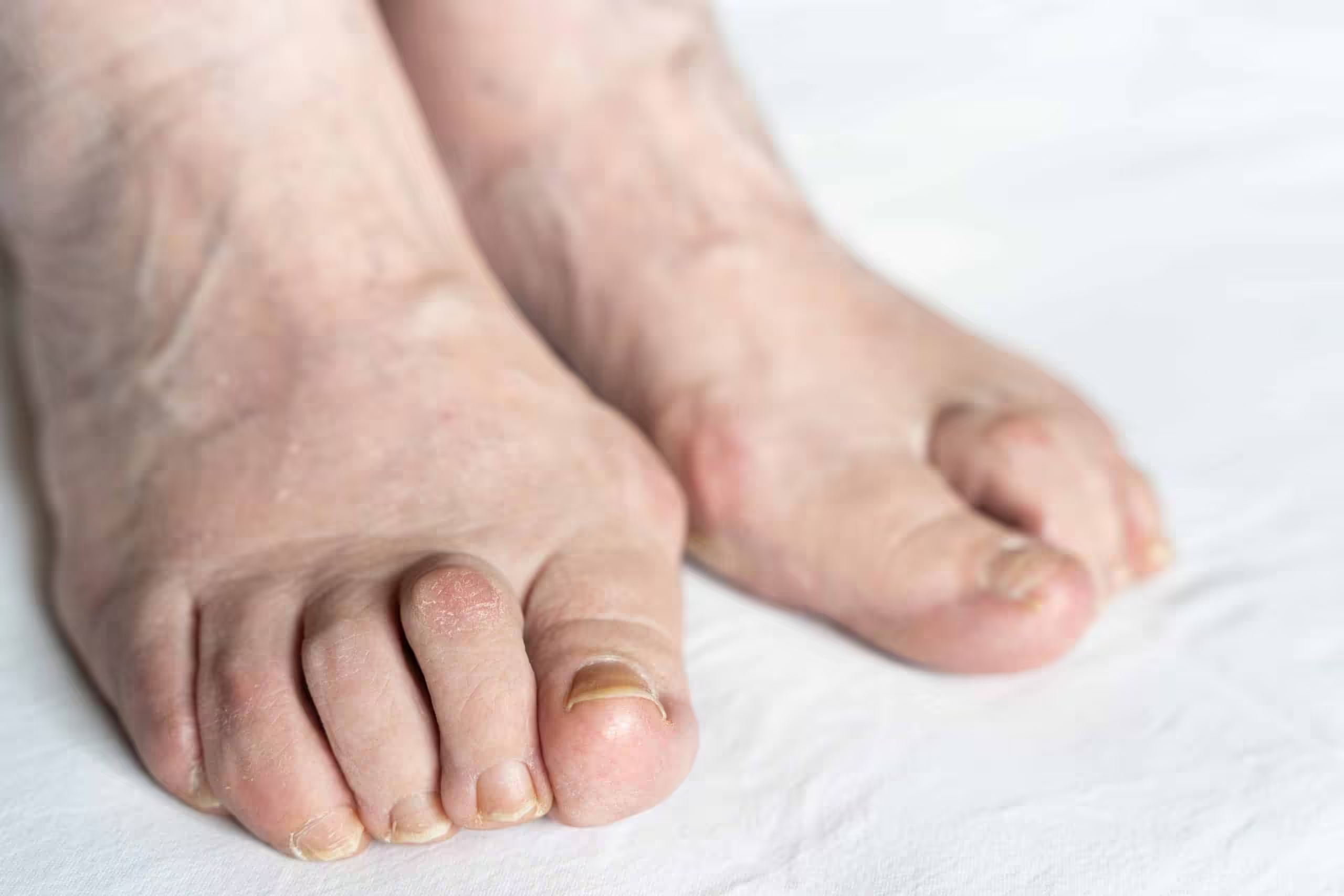
The short answer: toe separators won’t reverse a bunion, but they can meaningfully reduce pain and slow progression in mild to moderate cases. A bunion (hallux valgus) is a structural deformity — the first metatarsal drifts outward and the big toe angles inward. No passive device can correct bone position. However, a toe separator placed between the first and second toe does three useful things: it reduces the pressure and friction between toes, partially offloads the medial joint capsule, and provides mild positional correction during rest and light activity. For a bunion that’s causing pain during walking or shoes rubbing, a well-fitted separator can take the edge off significantly.
The evidence behind toe separators is modest but real. A 2018 study in the Journal of Orthopaedic Surgery and Research found that patients who used toe spacers alongside physiotherapy showed measurable improvements in hallux angle and pain scores over 12 weeks compared to physiotherapy alone. The gains weren’t dramatic — we’re talking 2-3 degrees of correction on average — but the pain relief was clinically meaningful for many participants.
What to look for in a bunion toe separator
Not all toe separators are equal. The key variables: material (medical-grade silicone holds shape and doesn’t cause pressure sores; foam compresses and loses effectiveness quickly), thickness (3-5mm works for most people; too thick and it causes the big toe to angle further outward under shoe pressure), fit (a separator that migrates out of position during walking is useless), and durability (expect to replace foam separators every 2-4 weeks, silicone every 3-6 months). If you have diabetes or neuropathy, avoid thick separators that can create pressure points you can’t feel.

When toe separators aren't enough
A toe separator is a pain management tool, not a treatment. If your bunion causes pain with most shoes, limits activity, or shows an angle greater than 20 degrees on X-ray, a toe separator will offer only limited relief. At this stage, the conservative treatment priority shifts to custom orthotics (which control the mechanical forces driving the deformity), wider footwear, and possibly a surgical consultation. Dr. Tom Biernacki performs Lapiplasty and minimally invasive bunion surgery at Balance Foot & Ankle — both procedures allow immediate weight-bearing in a boot. A same-day evaluation can determine where your bunion falls on the severity scale and what intervention is most appropriate.
Get Seen This Week at Balance Foot & Ankle
Three board-certified podiatrists · 1,123+ five-star reviews · same-week appointments · most insurance accepted.
Howell · 4330 E Grand River | Bloomfield Hills · 43494 Woodward
More Podiatrist-Recommended Bunion Essentials
Bunion Corrector Splint
Realigns the big toe overnight — slows bunion progression without surgery.
Metatarsal Pad
Offloads the first-ray pressure that drives bunion pain.
Wide-Toe-Box Walking Shoe
Eliminates the bunion pressure that drives pain and progression.
As an Amazon Associate, Balance Foot & Ankle earns from qualifying purchases. Product recommendations are based on clinical experience; prices and availability shown above update live from Amazon.
When to See a Podiatrist
A bunion is a progressive joint deformity — padding and splints reduce pain but don’t reverse the bone shift. If the big toe angle is worsening, shoes no longer fit, or pain is disrupting sleep or activity, schedule a consult at Balance Foot & Ankle. Our surgeons perform minimally-invasive bunion correction with faster recovery than traditional osteotomy. We’ll review X-rays with you and explain exactly what the joint needs.
Call Balance Foot & Ankle: (810) 206-1402 · Book online · Offices in Howell & Bloomfield Hills
In-Office Treatment at Balance Foot & Ankle
When home care and over-the-counter steps haven’t resolved your symptoms, it’s time for an in-office evaluation. At Balance Foot & Ankle in Howell and Bloomfield Hills, Michigan, Dr. Tom Biernacki, DPM and team provide diagnostic imaging, a clinical exam, and a plan tailored to your foot type — most patients are seen same-day.

- REDUCES SHOE FRICTION and PRESSURE
- IMMEDIATE, ALL-DAY PAIN RELIEF
- STAYS ON ALL DAY & NIGHT
- FITS EASILY in shoes
- Water & sweat resistant

Same-day appointments available. Call (810) 206-1402 or book online. Full treatment overview: Bunion & Hammertoe Correction.
Doctor Hoy’s Natural Pain Relief Gel
Natural topical pain relief I use in our clinic. Arnica + camphor formula — apply directly to the area 3–4x daily. ($20–25)
Shop Doctor Hoy’s →Frequently Asked Questions
How long should I use this?
Most products are used during active treatment phases (4-12 weeks) and then reduced to maintenance. Long-term use depends on the underlying condition.
Are these safe with diabetes?
Some products are not safe with reduced sensation. Diabetic patients should consult a podiatrist before using compression or restrictive products.
When should I see a podiatrist?
If your condition does not improve in 4-6 weeks of using the recommended product, professional evaluation is needed.

Dr. Tom Biernacki, DPM is a board-certified foot & ankle surgeon (ABFAS & ABPM) at Balance Foot & Ankle Specialists in Southeast Michigan. With over a decade of clinical experience, he specializes in heel pain, bunions, diabetic foot care, sports injuries, and minimally invasive surgery. Dr. Biernacki is a member of the APMA and ACFAS, and his patient education content on MichiganFootDoctors.com and YouTube has made him one of the most-followed foot & ankle educators on YouTube.