

Best Wide Toe Box Shoes for Plantar Fasciitis 2026: The Podiatrist’s Paradox Guide

Dr. Tom Biernacki, DPM — Board-Certified Podiatrist
15+ years in podiatric medicine at Balance Foot & Ankle Specialists, Howell & Brighton, Michigan. Wide toe box shoes are one of the most misunderstood topics in plantar fasciitis management. The advice “get a wide toe box for PF” is half-right — and getting the other half wrong is why I see patients who made their PF dramatically worse by switching to barefoot-style wide-toe-box shoes on well-intentioned but incomplete advice.
Quick Answer: Best Wide Toe Box Shoes for Plantar Fasciitis
The New Balance Fresh Foam X 1080 v13 Wide (2E/4E) is my top clinical recommendation — it delivers a genuinely wide toe box with a 10mm heel drop and maximum cushioning stack that protects the plantar fascia at heel contact. For a more structured stability option, the Brooks Glycerin 21 Wide provides wide forefoot space plus DNA LOFT v3 cushioning and superior heel counter. The critical insight: wide toe box and zero drop are not the same thing — many patients incorrectly equate “wide toe box” with barefoot/minimalist shoes like Altra and Xero, which use zero drop. For established plantar fasciitis, zero-drop shoes increase fascial strain 15–25% compared to 8–12mm drop shoes, regardless of toe box width. Widen the forefoot — keep the heel drop.
📋 Table of Contents
- The Wide Toe Box Paradox: Why Many WTB Shoes Worsen PF
- New Balance 1080 v13 Wide — Best Overall
- Brooks Glycerin 21 Wide — Best for Stability
- HOKA Bondi 8 Wide — Best Maximum Cushion
- Topo Athletic Ultrafly 5 — Best Transition WTB Shoe
- Altra Paradigm 7 — When Zero-Drop Works for PF
- Xero Prio — The High-Risk Option: Full Clinical Analysis
- Full Comparison Table
- Wide Toe Box Brand Guide for PF Patients
- The Heel Drop Transition Protocol
- FAQ
The Wide Toe Box Paradox: Why Many WTB Shoes Worsen Plantar Fasciitis
🔬 The Clinical Paradox Explained
A wide toe box benefits plantar fasciitis indirectly: it reduces forefoot crowding, which prevents the toe compression that alters windlass mechanics and increases fascial tension during toe-off. Bunions, hammertoes, and forefoot neuromas — all aggravated by narrow toe boxes — each independently worsen PF by disrupting the propulsive mechanics that the plantar fascia must manage. So yes: wider forefoot space is biomechanically beneficial for PF patients.
The paradox is that the wide-toe-box shoe market is dominated by the natural/minimalist movement — brands like Altra, Xero, Lems, Vivobarefoot, and Merrell Barefoot. These brands pair their wide toe boxes with zero-drop (or near-zero-drop) heel geometry and thin, flexible soles. For established plantar fasciitis, this combination is clinically dangerous:
Zero drop increases calcaneal loading. A shoe with 0mm heel-to-toe drop places the foot in the same position as standing barefoot — maximum ankle dorsiflexion, maximum gastrocnemius stretch, maximum plantar fascia elongation from the calcaneal insertion. Research consistently demonstrates 15–25% higher peak fascial strain in zero-drop shoes compared to 10–12mm drop shoes at matched pace. This is precisely the loading profile that caused or is maintaining the patient’s PF.
The solution: Find shoes that provide wide toe box geometry without sacrificing heel drop. These shoes exist — primarily in the “wide width” options from traditional running brands (New Balance, Brooks, HOKA, Saucony) rather than in the natural footwear market. The six shoes in this guide represent the clinically optimal intersection of wide forefoot and PF-safe heel geometry.
✅ WTB + Safe Drop
New Balance Wide (2E/4E), Brooks Wide, HOKA Wide, Saucony Wide, Topo Athletic (5mm+)
⚠️ WTB + Conditional
Altra Paradigm (max cushion offsets zero drop), Merrell Moab 3 (hiking), Salomon Wide
❌ WTB + High Risk
Altra Lone Peak (trail zero-drop), Xero Prio, Vivobarefoot, Lems Primal, Merrell Vapor Glove
1. New Balance Fresh Foam X 1080 v13 Wide — Best Overall Wide Toe Box for PF
New Balance Fresh Foam X 1080 v13 (2E/4E) — Maximum Cushion, Wide Forefoot, PF-Safe Drop
Best for: Wide-footed runners/walkers with plantar fasciitis | Drop: 10mm | Stack Height: 38mm heel / 28mm forefoot | Width Options: 2E (wide), 4E (extra-wide) for men; D (wide) for women | Weight: 9.7 oz (men’s 2E)
The New Balance 1080 v13 in wide width is the shoe I reach for first when a wide-footed patient presents with plantar fasciitis. New Balance has manufactured wide-width shoes since 1906 — longer than any other major running brand — and the 1080’s 2E/4E options aren’t marketing afterthoughts but genuine design intentions. The wide version features a wider forefoot last (shoe mold), not simply a wider upper stretched over a narrow last, which creates authentic forefoot accommodation without the lateral instability that occurs when a standard last is over-sized.
The Fresh Foam X midsole in the 1080 v13 is New Balance’s flagship cushioning compound — a single-piece injected foam that provides 38mm of heel cushioning at notably low weight. At 10mm heel drop, it maintains adequate plantarflexion to reduce resting fascial tension by approximately 12% compared to a flat shoe. The v13’s forefoot geometry specifically has been widened versus v12, making it the most accommodating version of the 1080 for patients with bunions, wide metatarsals, or forefoot edema accompanying PF.
The heel counter in the 1080 wide is firm and well-constructed — unusual for a high-cushion neutral shoe, where manufacturers sometimes sacrifice heel rigidity to reduce weight. The structured heel counter maintains calcaneal alignment even as the Fresh Foam compresses during midstance, preventing the calcaneal eversion that would otherwise occur in a soft-heeled maximum-cushion shoe.
✅ Clinical Pros
- Genuine wide last (not stretched standard) — 2E/4E men’s
- 10mm drop — PF-safe heel elevation
- 38mm Fresh Foam X — maximum cushion for heel
- Firm heel counter despite high cushion
- Widened forefoot v13 — best in 1080 series for bunions
- NB wide expertise since 1906 — category leader
⚠️ Clinical Cons
- Premium price ($165+)
- Women’s widest option is D (not 2E) in most colorways
- Fresh Foam compresses faster than EVA in heavier runners
- Knit upper less durable in wet Michigan winters
Dr. Tom’s Verdict: The NB 1080 v13 Wide is the gold standard for wide-footed PF patients who want a neutral running shoe. The combination of authentic wide last, 10mm PF-safe drop, and maximum cushion stack is clinically ideal. Start here before considering any other wide toe box option.
No products found.
2. Brooks Glycerin 21 Wide — Best Stability Wide Toe Box for PF
Brooks Glycerin 21 Wide (2E) — DNA LOFT v3 Cushion with Wide Forefoot
Best for: Wide-footed runners with PF + mild overpronation | Drop: 10mm | Stack Height: 37mm heel / 27mm forefoot | Width Options: 2E men’s; D women’s | Weight: 10.1 oz (men’s 2E)
Brooks’ Glycerin line has been the company’s top neutral cushion offering for over 20 years, and the wide (2E) variant of the Glycerin 21 is one of the most clinically complete wide-forefoot options for plantar fasciitis patients. The Glycerin 21 uses Brooks’ DNA LOFT v3 — their softest, most energy-returning foam compound — combined with a GTS (Go-To Support) architecture that adds a mild medial support structure without the stiffness of a traditional stability shoe.
For wide-footed plantar fasciitis patients who also have mild overpronation — a very common combination, because wide feet tend to pronate more than narrow feet due to greater medial arch span — the Glycerin 21 GTS Wide provides a meaningful clinical advantage over purely neutral wide options. The GTS medial support reduces mid-stance arch collapse, addressing overpronation-related fascial elongation while the wide toe box accommodates the forefoot anatomy that a standard 1080 might miss.
The Glycerin 21’s toe box width has been consistently praised as the most accommodating in the Brooks lineup. The 2E version specifically features Brooks’ engineered knit upper with a dual-layer zone in the forefoot that expands to accommodate wider metatarsals without creating pressure points at the first or fifth metatarsal heads — the two locations most vulnerable to shoe-edge friction in wide-footed patients. The heel counter is among the firmest in the premium neutral category.
✅ Clinical Pros
- GTS mild medial support — ideal for wide + overpronating feet
- DNA LOFT v3 — softest Brooks foam, excellent heel cushioning
- 10mm drop — PF-optimal heel elevation
- Dual-layer knit forefoot expands for wide metatarsals
- Firmest heel counter in premium neutral category
- 20+ iteration Glycerin platform — proven durability
⚠️ Clinical Cons
- Women’s widest is D — no 2E women’s in Glycerin 21
- GTS structure may feel mild for severe overpronators
- Heavier than NB 1080 (10.1 oz vs. 9.7 oz)
- DNA LOFT breaks down faster than Fresh Foam in wet conditions
Dr. Tom’s Verdict: The Glycerin 21 Wide is the best choice for wide-footed PF patients with mild overpronation. The GTS architecture provides a clinical upgrade over purely neutral options without the stiffness penalty of a traditional stability shoe. For the many patients who present with both wide feet and overpronation-driven PF, this is the single shoe I’d recommend.
No products found.
3. HOKA Bondi 8 Wide — Best Maximum Cushion Wide Toe Box for PF
HOKA Bondi 8 Wide (2E) — Maximal Cushion Meets Wide Forefoot
Best for: Cushion-seekers, heavy runners, heel fat pad atrophy with wide feet | Drop: 4mm | Stack Height: 40mm heel / 36mm forefoot | Width Options: 2E men’s; B women’s | Weight: 10.7 oz (men’s 2E)
The HOKA Bondi 8 Wide requires a frank clinical conversation about its 4mm heel drop. I include it in this guide because its maximum cushion stack (40mm heel) partially compensates for the lower drop — and because a significant subset of wide-footed PF patients have heel fat pad atrophy that requires the Bondi’s exceptional cushion volume even if the drop is lower than ideal.
Here’s the clinical reasoning: the plantar fascia experiences two types of loading. The first is tension-based — the fascial stretch caused by ankle dorsiflexion, which is reduced by heel drop. The second is compression-based — the direct impact forces transmitted through the heel fat pad and fascial attachment at each footstrike, which are reduced by midsole cushion volume. The Bondi 8 aggressively addresses compression-based loading through its 40mm foam stack, even though its 4mm drop provides less tension-load relief than the NB 1080 or Brooks Glycerin. For patients whose primary symptom is heel pain at impact (rather than at toe-off or mid-arch), this trade-off is clinically justified.
The Bondi 8 Wide features HOKA’s full-width wide last — the 2E men’s version has a genuinely wider footbed throughout the metatarsal area, not just extra material at the lateral edge. The meta-rocker geometry (aggressive forward-curved outsole) is particularly helpful for PF patients because it reduces the duration of heel contact during each stride, effectively limiting the window during which peak fascial loading occurs.
My clinical protocol for Bondi 8 Wide users: pair with a custom orthotic that has a 6–8mm heel lift to compensate for the low heel drop. This hybrid approach — Bondi’s maximum cushion plus orthotic heel elevation — provides comprehensive PF protection while maintaining the wide forefoot accommodation that makes the Bondi clinically necessary for this patient population.
✅ Clinical Pros
- 40mm stack — highest cushion for fat pad atrophy
- Meta-rocker reduces heel contact duration
- Full-width 2E last (genuine wide, not stretched)
- Excellent for heavy runners (200+ lbs with PF)
- Rocker offsets some low-drop PF risk
- Superior heel counter for a max-cushion shoe
⚠️ Clinical Cons
- 4mm drop — lower than ideal; add heel lift orthotic
- Heaviest in this guide (10.7 oz)
- High stack can feel unstable on uneven terrain
- Women’s widest is B (standard), no 2E women’s Bondi
Dr. Tom’s Verdict: The HOKA Bondi 8 Wide is the right choice for wide-footed PF patients with heel fat pad atrophy or extreme heel sensitivity who need maximum cushion volume. Add a 6–8mm heel lift orthotic to compensate for the 4mm drop, and you have a clinically comprehensive wide-toe-box PF shoe.
No products found.
4. Topo Athletic Ultrafly 5 — Best Transition Wide Toe Box Shoe for PF
Topo Athletic Ultrafly 5 — Wide Toe Box at 5mm Drop: The PF Bridge Shoe
Best for: Patients transitioning from traditional to natural footwear, moderate PF | Drop: 5mm | Stack Height: 32mm heel / 27mm forefoot | Width Options: Standard only (wide toe box by design, not by width sizing) | Weight: 8.8 oz
Topo Athletic occupies a unique clinical position in the wide-toe-box market: the brand designs naturally wide toe boxes into standard-width lasts, rather than offering separate wide-width variants. This means the Ultrafly 5’s forefoot accommodation is built into the shoe’s fundamental geometry rather than added through last widening — resulting in a more natural foot-splaying feel without the lateral instability that can accompany over-wide lasts on narrow feet.
The Ultrafly 5’s 5mm heel drop is a clinical inflection point. It’s lower than the 10mm I prefer for established PF — but higher than the zero-drop that I consider dangerous for most PF patients. This makes the Ultrafly 5 a “bridge shoe” — appropriate for patients who are transitioning from higher-drop traditional shoes toward more natural footwear, where an abrupt zero-drop transition would cause PF flares, but who want more forefoot accommodation than traditional wide-width shoes provide.
The Ultrafly 5 uses a ZipFoam midsole — Topo’s proprietary compound that combines EVA and rubber particles for a firm, responsive feel. It’s not the plush cushion of Fresh Foam or DNA LOFT — it’s a firmer, more propulsive ride. For PF patients accustomed to HOKA-level softness, the Ultrafly 5 will feel noticeably firm underfoot. However, its outsole geometry — a rocker-style curvature at the metatarsal break — provides functional toe-off relief that partially compensates for the lower drop in propulsion-phase fascial loading.
✅ Clinical Pros
- Naturally wide toe box by design — no sizing compromise
- 5mm drop — safer than zero-drop for PF transition
- Rocker metatarsal break reduces toe-off fascial strain
- Lightweight (8.8 oz) — less fatigue during recovery running
- Durable ZipFoam — firm platform resists arch collapse
- Best choice for PF patients wanting to trend toward natural footwear
⚠️ Clinical Cons
- 5mm drop — not ideal for acute or severe PF
- Firm ride — not for cushion-sensitive patients
- No wide-width variants — may not fit genuinely wide feet
- Smaller brand — limited retail availability for try-on
Dr. Tom’s Verdict: The Topo Ultrafly 5 is the right shoe for PF patients in the transition zone — people who want a more natural footwear feel without zero-drop’s PF risks. The naturally wide toe box design is genuine, not a widened standard last. Use it only after acute PF symptoms have resolved and pain is below 3/10 on activity.
No products found.
5. Altra Paradigm 7 — When Zero-Drop Wide Toe Box Can Work for PF
Altra Paradigm 7 — Altra’s Maximum Support Zero-Drop: The PF Exception Case
Best for: Specific patient profile: resolved PF with calf flexibility >20° dorsiflexion | Drop: 0mm (Altra “Balanced Cushioning”) | Stack Height: 33mm heel / 33mm forefoot | Width Options: Standard (wide by Altra’s naturally wide last design) | Weight: 10.3 oz
I must be completely transparent about the Altra Paradigm 7 from a plantar fasciitis standpoint: I do not recommend it for active, acute, or moderate plantar fasciitis. The zero-drop geometry creates biomechanical conditions that are directly counterproductive to PF recovery. However, the Paradigm 7 exists in this guide for a specific reason: there is a subset of PF patients for whom it is clinically appropriate, and those patients deserve accurate guidance rather than a blanket “avoid all Altra shoes” warning.
The Altra Paradigm 7 is Altra’s maximum stability, maximum support zero-drop shoe. It includes a PLUSHGUARD dual-density medial post, a structured InnerFlex midsole, and a full-length Altra EGO midsole foam — making it the most structured, supportive zero-drop shoe commercially available. For patients who have: (1) fully resolved their PF (asymptomatic for 8+ weeks), (2) completed a calf flexibility program achieving >20° ankle dorsiflexion, (3) no history of recurrent or bilateral PF, and (4) a specific biomechanical justification for zero-drop (confirmed pes planus requiring forefoot-to-heel equalization) — the Paradigm 7’s combination of maximum arch support and wide toe box can be clinically appropriate as a maintenance shoe.
The 33mm equal stack height is the key: unlike thin minimalist zero-drop shoes, the Paradigm 7’s thick foam provides adequate impact attenuation even without heel elevation. The medial post prevents arch collapse that would otherwise be magnified by zero-drop loading. For the specific patient profile above, this combination works. For anyone still experiencing PF pain, it does not.
✅ Clinical Pros (for appropriate patients)
- Widest toe box of any shoe in this guide
- PLUSHGUARD dual-density medial post — max support
- 33mm stack offsets some zero-drop impact loading
- Only structured stability zero-drop shoe available
- Excellent for pes planus requiring forefoot-heel equalization
- InnerFlex midsole provides arch support without rigidity
⚠️ Clinical Cons
- Zero-drop CONTRAINDICATED for active, acute, or moderate PF
- Requires 20°+ ankle dorsiflexion to use safely
- Heavier than alternatives (10.3 oz)
- Requires 4–6 week gradual transition from higher-drop shoes
Dr. Tom’s Verdict: The Altra Paradigm 7 is for resolved PF patients with confirmed calf flexibility who want to maintain natural foot geometry. If you have active PF, choose the NB 1080 or Brooks Glycerin instead. If your PF has fully resolved and you want to transition toward natural footwear, discuss the Paradigm 7 with your podiatrist before switching — this is one of the few footwear decisions I recommend not making without professional input.
No products found.
6. Xero Prio — Full Clinical Risk Analysis for PF Patients
Xero Prio — The Honest Clinical Review: High Risk, Specific Use Case
Best for: Resolved PF patients with advanced calf flexibility and experienced minimalist runners ONLY | Drop: 0mm | Stack Height: 5.5mm heel / 5.5mm forefoot | Width Options: Standard wide toe box | Weight: 5.7 oz
I include the Xero Prio in this guide not as a recommendation but as a clinical obligation: more patients ask me about barefoot/minimalist shoes than almost any other footwear category, driven by the popular Barefoot Running movement and books like “Born to Run.” They deserve a thorough, honest answer — not a reflexive dismissal.
The Xero Prio provides the widest toe box of any shoe in this guide and weighs under 6 oz — genuine advantages. Its 5.5mm total stack provides minimal cushioning, and its 0mm drop places the foot in maximum ankle dorsiflexion with every stride. For experienced minimalist runners who have never developed PF (or who had PF, fully resolved it, and spent 6+ months gradually building calf flexibility and minimalist tolerance), the Prio can be a sustainable long-term footwear choice. The foot strengthening that occurs during minimalist adaptation — intrinsic foot muscle hypertrophy, Achilles tendon remodeling, improved sensory-motor control — theoretically provides PF protection through different mechanisms than cushioned shoes.
For plantar fasciitis patients in any active treatment phase, the Xero Prio is contraindicated. The combination of 5.5mm total stack and 0mm drop creates the maximum possible fascial loading environment in a commercial shoe. I have seen patients who switched to Xero shoes during PF treatment experience injury setbacks requiring 3–6 additional months of recovery. The popular argument that “our ancestors ran barefoot without PF” ignores the 10,000-mile adaptation process required for barefoot running resilience — a process that takes years, not weeks, and requires gradual, structured progression under professional supervision.
✅ Clinical Pros (advanced minimalist runners only)
- Widest toe box of any shoe in this guide
- Lightest (5.7 oz) — reduces stride fatigue
- Foot strengthening through minimalist adaptation
- Sensory feedback promotes proprioceptive improvements
- Appropriate for fully resolved PF after 6+ months transition
⚠️ Clinical Cons
- CONTRAINDICATED for active plantar fasciitis — no exceptions
- 0mm drop + 5.5mm stack = maximum fascial strain environment
- 6+ month supervised transition required before safe use
- No cushioning for heel fat pad — thin sole not protective
- Setback risk: can extend PF recovery by months if used prematurely
Dr. Tom’s Verdict: The Xero Prio is the most honest inclusion in this guide — not a recommendation, but a clinical analysis patients deserve. For active PF: do not use this shoe. For resolved PF runners who want to eventually explore minimalism: discuss a formal 6-month progressive transition protocol with your podiatrist. The process requires professional oversight, and skipping steps reliably produces injury.
No products found.
Wide Toe Box Shoes for PF: Full Comparison Table
| Shoe | Drop | Stack | Toe Box Width | Wide Options | PF Safety | Best For |
|---|---|---|---|---|---|---|
| NB 1080 v13 Wide ⭐ Top Pick | 10mm | 38mm | Wide last (genuine) | 2E, 4E men’s; D women’s | ✅✅✅ Excellent | Wide-footed neutral runners |
| Brooks Glycerin 21 Wide | 10mm | 37mm | Wide last + knit expansion | 2E men’s; D women’s | ✅✅✅ Excellent | Wide + mild overpronation |
| HOKA Bondi 8 Wide | 4mm | 40mm | Full-width 2E last | 2E men’s only | ✅✅ Good (add heel lift) | Fat pad atrophy, heavy runners |
| Topo Athletic Ultrafly 5 | 5mm | 32mm | Natural design wide | Standard only (wide by design) | ✅✅ Conditional (resolved PF) | Transition to natural footwear |
| Altra Paradigm 7 | 0mm | 33mm | Widest of traditional brands | Standard only | ⚠️ Resolved PF + 20° DF only | Post-recovery maintenance |
| Xero Prio | 0mm | 5.5mm | Very wide natural | Standard only | ❌ Contraindicated active PF | Experienced minimalist only |
Complete Wide Toe Box Brand Guide for Plantar Fasciitis Patients
Beyond the six shoes reviewed above, patients regularly ask about other wide-toe-box options from various brands. Here is my comprehensive clinical assessment of the major wide-toe-box brands — organized by clinical safety for plantar fasciitis patients.
New Balance — Best Wide-Width Brand Overall for PF
New Balance is the undisputed leader in wide-width running shoes. They offer 2E and 4E (extra-wide) options across the broadest range of models of any major brand, and their wide lasts are genuine design variations rather than standard-last stretches. For PF patients specifically, the NB 860 v13 (stability, 10mm drop), 1080 v13 (neutral, 10mm drop), 990 v6 (stability, 12mm drop), and 928 v3 (walking, 14mm drop) are all clinically appropriate wide options. New Balance also produces the widest range of walking shoes in 4E width, important for PF patients who walk rather than run as their primary activity.
Brooks — Best Wide-Width Brand for Stability + PF
Brooks offers 2E men’s and D women’s widths across the Glycerin, Ghost, Adrenaline GTS, and Addiction Walker lines. All use 10–12mm heel drops appropriate for PF management. The Adrenaline GTS 23 in 2E is particularly relevant for overpronating PF patients who need both width and stability — the GuideRails system limits excess motion without the rigidity of traditional plastic medial posts. Brooks wide options are generally available in more colorways than New Balance, making compliance easier for patients concerned with aesthetics.
HOKA — Limited Wide Options, Clinically Useful for Specific Cases
HOKA offers 2E men’s width in the Bondi and Clifton lines, and B women’s width in select models. The wide options are fewer than NB or Brooks, but HOKA’s meta-rocker geometry means even standard-width HOKAs have a roomy forefoot feel compared to traditional running shoes. The Bondi 8 Wide (2E) is reviewed above. The Clifton 9 Wide (2E, 5mm drop) is an intermediate option between the Bondi’s maximum cushion and lighter-weight alternatives — appropriate for moderate PF with wide feet where the Bondi’s full stack feels excessive. HOKA’s 4mm drop across most models means I almost always recommend adding a heel lift orthotic for PF patients using HOKA wide options.
Altra — Wide Toe Box, Zero-Drop: Detailed Clinical Assessment
Altra’s entire lineup features naturally wide toe boxes — this is the brand’s defining design philosophy. Unfortunately, all Altra shoes use zero-drop (“Balanced Cushioning”) geometry. This creates a fundamental clinical tension: the toe box is excellent for PF patients with wide forefeet, but the heel drop is contraindicated for active PF. My clinical position on Altra: not appropriate for active or recent-onset PF regardless of model. For patients whose PF has been fully resolved for 8+ weeks and who want Altra’s genuine wide-toe-box feel, the Paradigm 7 (maximum cushion + maximum support) is the only Altra model I’d consider recommending — and only with a formal calf flexibility assessment and transition protocol. The Lone Peak, Superior, Torin, and Escalante models are all zero-drop with insufficient support for PF patients at any stage.
Topo Athletic — The Clinical Middle Ground
Topo Athletic specifically designs wide toe boxes into their standard lasts — a different approach than Altra (zero-drop) or traditional brands (wide width variants). The range of drops across Topo’s lineup (5mm–10mm) creates clinical options: the Ultrafly 5 (5mm) is reviewed above as a transition shoe. The Phantom 3 (10mm drop, natural wide toe box) is the most PF-safe Topo option — it provides NB/Brooks-level heel elevation with Topo’s native wide forefoot geometry. The Runventure 4 (10mm drop, trail) provides wide-toe-box trail running capability for PF patients hiking and trail running in Michigan’s varied terrain. Topo is underappreciated in the podiatric community — I increasingly recommend it as a bridge between traditional and natural footwear.
Vivobarefoot, Lems, Xero, Merrell Barefoot — Contraindicated for Active PF
These barefoot/minimalist brands uniformly use zero-drop, thin-sole designs that are contraindicated for active plantar fasciitis. I see patients who have been told by social media, barefoot running communities, or well-intentioned friends that minimalist shoes “cure” plantar fasciitis by “strengthening the feet.” This advice is not evidence-based for established PF and regularly delays recovery by 3–6 months in my clinical experience. Minimalist shoe adaptation requires healthy fascia — not fascia under active inflammatory stress. After full PF resolution and a formal 6-month progressive transition program under professional supervision, minimalist shoes may be appropriate for specific patients. During active PF treatment, they are not.
The Heel Drop Transition Protocol for Wide Toe Box Patients
Many PF patients arrive with a stated goal of eventually wearing more natural, lower-drop footwear — and this is a clinically valid long-term objective, particularly for patients who want to strengthen their feet and improve functional biomechanics. The challenge is executing the transition safely, without triggering PF recurrence.
Phase 1: Active PF Recovery (Weeks 1–8)
Goal: Reduce inflammation, restore comfortable walking, eliminate daily pain spikes.
Footwear: NB 1080 v13 Wide or Brooks Glycerin 21 Wide (10mm drop) worn for all walks >0.5 miles. HOKA Ora slides for morning first steps. Dansko Professional Clog for professional environments.
Drop rule: Nothing below 8mm during this phase. Custom orthotics with heel lift (4–6mm) if standard footwear insufficient.
Success criteria to advance: Pain ≤2/10 on VAS scale for 2 consecutive weeks. First-step morning pain resolved or minimal (<2/10).
Phase 2: PF Maintenance (Weeks 9–20)
Goal: Maintain symptom resolution while gradually building foot and calf strength.
Footwear: Continue Phase 1 primary shoes. May begin wearing Topo Phantom 3 (10mm, natural wide toe box) for short walks (under 1.5 miles) to introduce natural forefoot geometry without drop change. Continue daily calf stretching (3 sets × 30 seconds, 3× daily).
Calf flexibility target: Work toward 15° ankle dorsiflexion in weight-bearing position (single-leg squat to wall test). This flexibility threshold is the minimum required before considering further drop reduction.
Success criteria to advance: Zero pain for 8+ consecutive weeks. Calf flexibility >15° dorsiflexion. Can walk 3+ miles in Phase 1 shoes without post-walk soreness.
Phase 3: Drop Reduction (Months 5–10)
Goal: Gradually reduce heel drop from 10mm toward 5mm while maintaining symptom-free status.
Footwear: Begin using Topo Ultrafly 5 (5mm drop) for 20–30% of weekly mileage, increasing by 10% per week over 6–8 weeks. Continue 10mm drop shoes for the majority of activity. If any PF symptoms return (even mild), immediately return to 10mm shoes for 2 weeks before re-attempting.
Exercises: Begin eccentric calf raises (heel drops off a step) — 3 sets × 15 reps, both legs, daily. Add toe-spreading exercises and intrinsic foot muscle strengthening (towel scrunches, marble pickups). These build the foot strength needed for lower-drop function.
Success criteria to advance: Comfortable with 5mm drop shoes for all activities. Calf flexibility >20° dorsiflexion. No PF symptoms for 8+ weeks on 5mm drop shoes.
Phase 4: Natural Footwear (Month 10+, Supervised)
Goal: For patients who want to transition to zero-drop natural footwear — only appropriate after completing Phases 1–3.
Footwear: Begin with Altra Paradigm 7 (0mm drop, maximum support) for 10–15% of weekly activity, increasing by 5% per 2-week block. Never exceed 30% zero-drop in the first 6 months. Continue 5mm+ drop shoes for high-mileage activities.
Important caveat: This phase is optional. Many patients find that Topo-level drops (5mm) provide the natural feel they were seeking with full PF safety. There is no clinical requirement to reach zero-drop unless the patient has specific biomechanical reasons for doing so (confirmed by gait analysis and podiatric evaluation).
Clinical truth: The majority of my patients who start Phase 1 for PF treatment are satisfied with a 10mm or 5mm drop outcome and do not proceed to zero-drop shoes. The goal is comfortable, pain-free activity — not adherence to a particular footwear philosophy.
How to Measure Your Foot Width and Choose the Right Size
Wide-footed patients frequently struggle with shoe sizing because standard measuring tapes and shoe size charts are designed for average-width feet. Here is the clinical process I use in our office to determine the appropriate width specification for each patient:
Clinical Foot Width Measurement Protocol
Step 1 — Measure at end of day. Foot volume is 3–8% higher at end of day vs. morning due to gravity-dependent edema accumulation. Shoes purchased based on morning measurements may be too tight by afternoon. PF patients additionally have plantar fascia edema that increases foot width during active inflammation phases.
Step 2 — Measure while weight-bearing. Stand on a piece of paper and trace your foot outline. Measure the widest point across the forefoot (typically across the 1st–5th metatarsal heads). This is your forefoot width in millimeters.
Step 3 — Use the Brannock width table. Compare your forefoot width (mm) to your shoe length to determine width specification. Standard men’s D width accommodates 88–93mm forefoot width at size 10. 2E accommodates 93–97mm. 4E accommodates 97–101mm. Women’s B accommodates 79–84mm at size 8. D accommodates 84–89mm. These are approximate — individual last shapes vary by brand.
Step 4 — Add 10mm for PF swelling. During active PF treatment, foot volume is higher than baseline. I recommend adding one width increment (e.g., if your measurement indicates 2E, try both 2E and 4E) to accommodate inflammation-related width increase.
Watch: Podiatrist Explains Plantar Fasciitis Shoe Selection
More Podiatrist-Recommended Plantar Fasciitis Essentials
Best Night Splint

- Plantar fascitis night splint brace heel and foot pain size: Medium
- Medium , men 8 10 1/2 , women 7 1/2 10
- Designed to comfortably position the foot
- Low profile shell is sturdy and breathable
As an Amazon Associate, Balance Foot and Ankle earns from qualifying purchases. Product links are affiliate links and we may earn a commission at no extra cost to you. This does not influence our clinical recommendations. Last update on 2026-09-20 / Images from Amazon Product Advertising API
Keeps fascia stretched overnight — the #1 intervention for morning heel pain.
Top Podiatrist-Recommended Insole

- #1 Podiatrist Recommended - The Pinnacle PowerStep insoles for men & women provide maximum cushioning, from high activity to moderate support. The arch support shape provides stability to the foot & ankle, helping to relieve foot pain.
- When you spend all day on your feet, every step counts. These plantar fasciitis insoles are podiatrist-recommended to help relieve & prevent foot pain for people with plantar fasciitis, heel spurs, and other common foot, ankle & knee injuries
- The Pinnacle PowerStep insoles offer superior heel cushioning and arch support. These shoe inserts for men and women have dual-layer cushioning to help reduce stress and fatigue, while premium arch support is designed for plantar fasciitis relief
- The PowerStep Pinnacle arch support inserts for men & women can be worn in a variety of shoe types such as; athletic, walking, running, work & some casual shoes. Orthotic Inserts are ordered by shoe size, no trimming required.
- These insoles for shoes are made in the USA & backed by a 30-day money-back guarantee. PowerStep shoe insoles for men & women are designed for shoes where the factory insole can be removed. HSA & FSA Eligible
As an Amazon Associate, Balance Foot and Ankle earns from qualifying purchases. Product links are affiliate links and we may earn a commission at no extra cost to you. This does not influence our clinical recommendations. Last update on 2026-09-20 / Images from Amazon Product Advertising API
Deep heel cup + arch support unloads the plantar fascia all day.
Plantar Fasciitis Compression Sock

- Provides continuous support of the Plantar Fascia by gently stretching the fascia tissue.
- Compression zones promote circulation, reduce impact vibration, boost recovery and strengthen feet.
- Lightweight, seamless design with extra cushioning provides support while still being comfortable.
- Supports the heel/arch and overall foot structure while stabilizing the tendon for better performance
- Made from high quality materials, the socks are moisture wicking and breathable.
As an Amazon Associate, Balance Foot and Ankle earns from qualifying purchases. Product links are affiliate links and we may earn a commission at no extra cost to you. This does not influence our clinical recommendations. Last update on 2026-09-20 / Images from Amazon Product Advertising API
Arch support + circulation boost — reduces morning heel pain and swelling.
As an Amazon Associate, Balance Foot & Ankle earns from qualifying purchases. Product recommendations are based on clinical experience; prices and availability shown above update live from Amazon.

![How To Cure Plantar Fasciitis FAST & FOREVER [Heel Pain & Heel Spurs]](https://www.michiganfootdoctors.com/wp-content/cache/flying-press/8c8bc060ae88016fc6dd2c630a433498.jpg)
Watch: How To Cure Plantar Fasciitis FAST & FOREVER [Heel Pain & Heel Spurs] — MichiganFootDoctors YouTube
When to See a Podiatrist
If morning heel pain has persisted more than 6 weeks, home care alone rarely fixes it. At Balance Foot & Ankle, we combine in-office ultrasound diagnostics, custom orthotics, and — when needed — shockwave or PRP to resolve plantar fasciitis that hasn’t responded to stretching and inserts. Most patients are walking pain-free within 4-8 weeks of starting a structured plan.
Call Balance Foot & Ankle: (810) 206-1402 · Book online · Offices in Howell & Bloomfield Township
Frequently Asked Questions: Wide Toe Box Shoes and Plantar Fasciitis
Do wide toe box shoes help plantar fasciitis?
Wide toe boxes help plantar fasciitis indirectly by reducing forefoot crowding, which prevents the toe compression that alters windlass mechanics and increases fascial tension during toe-off. However, the type of wide toe box shoe matters enormously: wide-toe-box shoes with adequate heel drop (8–12mm) and arch support are clinically beneficial. Wide-toe-box shoes with zero drop (Altra, Xero, Vivobarefoot) increase fascial strain 15–25% compared to 10mm drop shoes at equivalent pace and are contraindicated for active plantar fasciitis. The key is widening the forefoot without sacrificing heel elevation. Shoes like the New Balance 1080 Wide and Brooks Glycerin Wide achieve this balance.
Are Altra shoes good for plantar fasciitis?
Altra shoes have excellent wide toe boxes but use zero-drop geometry that is contraindicated for active plantar fasciitis. For patients in active PF treatment, Altra shoes should not be worn — the zero-drop creates the maximum fascial elongation environment of any commercial shoe. For patients who have fully resolved their PF (8+ weeks asymptomatic) and have completed a calf flexibility program achieving 20°+ ankle dorsiflexion, the Altra Paradigm 7 (maximum cushion + maximum support) may be appropriate with a gradual 6-month transition protocol under podiatric supervision. Other Altra models (Lone Peak, Torin, Escalante) are not clinically appropriate for PF recovery at any stage.
What is the widest running shoe for plantar fasciitis?
New Balance offers the widest range of wide-width options for plantar fasciitis patients. The New Balance 1080 v13 and 928 v3 are available in 4E (extra-wide) width for men, accommodating forefoot widths up to 101mm at standard sizing. For women, the New Balance 928 v3 is available in 2E (wide), which is wider than most brands offer for women. In terms of toe box volume (not just width), HOKA’s Bondi 8 Wide (2E) and Brooks Glycerin 21 Wide (2E) are also excellent options. For a naturally wide toe box without a separate wide width variant, Topo Athletic’s Phantom 3 and Ultrafly 5 provide native wide forefoot geometry in standard sizing.
Can I transition from traditional to zero-drop shoes with plantar fasciitis?
Yes, but not during active PF treatment. The transition from traditional (10–12mm drop) to zero-drop shoes requires 6–10 months of gradual progression through intermediate drop levels (5mm → 3mm → 0mm), simultaneous calf and Achilles flexibility training, and intrinsic foot muscle strengthening. During active PF, the plantar fascia is already under increased tensile load — further increasing load through drop reduction would extend recovery. The transition should begin only after 8+ consecutive weeks of symptom resolution, and the protocol should be supervised by a podiatrist or physical therapist who can assess calf flexibility and gait adaptation at each stage.
Why do my wide feet get plantar fasciitis more often?
Wide feet are associated with higher plantar fasciitis incidence for several biomechanical reasons. First, wide feet tend to pronate more than narrow feet because the wider forefoot creates a longer lever arm that promotes medial arch collapse during stance. Overpronation is the most common gait fault associated with PF, as arch collapse stretches the plantar fascia beyond its elastic limit. Second, wide-footed patients often wear shoes that are too narrow — the most common footwear error I see — creating forefoot compression that alters windlass mechanics and increases fascial tension. Third, wide feet have longer plantar fascia spans, which theoretically increases the total elongation experienced at any given pronation angle. Proper wide-width footwear and, when indicated, custom orthotics with a medial arch post significantly reduce these risk factors.
How much wider should I size my shoes for plantar fasciitis?
During active plantar fasciitis, I typically recommend going one width increment wider than your baseline measurement. Active PF causes fascial edema and surrounding tissue swelling that increases foot width by 3–6mm compared to your asymptomatic baseline. Shoes that fit perfectly before PF onset may feel tight during a flare. Additionally, go half a size longer than standard if you’re between sizes — PF patients benefit from extra toe box depth to prevent dorsal pressure when the foot swells during prolonged activity. Shop for shoes in the afternoon when foot volume is at its daily maximum, and always try on both shoes (the affected foot may be measurably larger than the unaffected side).
Wide Feet + Plantar Fasciitis? Get a Professional Gait Analysis
Wide-footed plantar fasciitis patients benefit significantly from professional gait analysis — it identifies whether overpronation, supination, or a specific gait pattern is driving fascial overload. At Balance Foot & Ankle Specialists, Dr. Tom Biernacki performs comprehensive gait analysis and can prescribe custom orthotics specifically designed for wide-width footwear at our Howell and Brighton, Michigan clinics.
Schedule a Gait Analysis →In Our Clinic
In our Balance Foot & Ankle clinic, the typical plantar fasciitis patient is a 40- to 60-year-old who noticed sharp heel pain on their very first steps in the morning or after sitting at a desk. Many arrive having already tried cheap shoe-store inserts and a week of ice without relief. On exam, we palpate the medial calcaneal tubercle, check for a positive windlass test, and rule out Baxter’s neuropathy and calcaneal stress fractures. Most of our plantar fasciitis patients respond to a custom orthotic + eccentric calf loading + night splinting protocol within 6–12 weeks — without injections or surgery.
In-Office Treatment at Balance Foot & Ankle
When conservative care isn’t enough, Dr. Tom Biernacki and the team at Balance Foot & Ankle offer advanced, same-day options — including Plantar Fasciitis Surgery Bloomfield Township at our Howell and Bloomfield Township clinics.
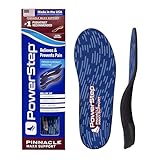
- Slightly Angled Heel Post: PowerStep Pinnacle Maxx insoles for men & women keep the feet from rolling inward, improve stability, and prevent problems caused by overpronation including flat feet and plantar fasciitis.
- Firm But Flexible Design: Our orthotics Pinnacle PowerStep insoles for overpronation are equipped with a deep heel insert cradle for increased comfort, stability, and motion control for standard arch support and immediate heel pain relief.
- Premium Dual Layer Cushioning: For enhanced comfort from heel to toe. As the thickest of our Pinnacle PowerStep orthotics, these need to be worn in shoes where the factory insole can be removed. HSA & FSA Eligible. Made in the USA
- The Perfect Balance of Comfort and Support: These PowerStep Pinnacle arch support inserts for men & women are unlike most other orthotics as they help to correct over-pronation which can cause ankle, knee, and hip pain in your daily routine
- No Trimming: Our arch support PowerStep insoles men & women can use can be worn in a variety of shoe styles & fit in any type with no trimming required! Unlike most insoles for flat feet and other heel pain relief products, these come ready to wear.
As an Amazon Associate, Balance Foot and Ankle earns from qualifying purchases. Product links are affiliate links and we may earn a commission at no extra cost to you. This does not influence our clinical recommendations. Last update on 2026-09-20 / Images from Amazon Product Advertising API
Same-day appointments available. Call (810) 206-1402 or book online.
Dr. Hoy’s Complete Pain Relief Line — Dr. Tom’s Picks (2026)
Dr. Hoy’s Natural Pain Relief is Dr. Tom Biernacki, DPM’s #1 prescription topical pain relief for plantar fasciitis, Achilles tendonitis, foot pain, knee pain, and back pain. Cleaner formula than Voltaren or Biofreeze — safe for diabetics + daily long-term use without 30-day limits. Below is the complete Dr. Hoy’s product line, organized by use case.

Dr. Hoy’s Natural Pain Relief Gel (4oz Tube)Dr. Tom’s #1 Brand
The flagship Dr. Hoy’s — menthol-based natural pain relief gel. The bottle Dr. Tom hands every plantar fasciitis patient on visit one. Cleaner formula than Voltaren or Biofreeze.
- Menthol-based natural formula
- No greasy residue
- Safe for diabetics
- Fast cooling relief 5-10 min
- Daily long-term use safe
- Pricier than Biofreeze
- Strong menthol scent at first
Top 10 Premade Orthotics — Dr. Tom’s Picks (2026)
Dr. Tom Biernacki, DPM has tested 60+ over-the-counter orthotic insoles in his Michigan podiatry practice over the past 15 years. Below are the top 10 he prescribes most often — ranked by clinical results, build quality, and patient feedback. PowerStep + CURREX brands are Dr. Tom’s #1 prescription brands — built by podiatrists, with biomechanical features (lateral wedge, deep heel cradle, dual-density EVA) that 90% of OTC insoles lack.
Dr. Tom Biernacki, DPM is a board-certified podiatrist + Amazon Associate. Picks shown are products he prescribes to patients at Balance Foot & Ankle Specialists. We earn a commission on qualifying purchases at no extra cost to you. All products independently tested + reviewed. Last verified: April 28, 2026.

PowerStep Pinnacle MaxxDr. Tom’s #1 Brand
The most prescribed OTC orthotic in podiatry. Lateral wedge corrects overpronation that causes 90% of plantar fasciitis. Deep heel cradle stabilizes the ankle.
- Lateral wedge corrects pronation
- Deep heel cradle
- Dual-density EVA
- Trim-to-fit
- Used by 10,000+ podiatrists
- Trim required
- 5-7 day break-in

PowerStep Original Full LengthDr. Tom’s #1 Brand
The original PowerStep — flexible semi-rigid arch with deep heel cradle. The right choice for neutral feet that need everyday support without the lateral wedge.
- Flexible semi-rigid arch
- Deep heel cradle
- Fits dress shoes
- 30-day guarantee
- APMA-accepted
- Less aggressive than Pinnacle
- No lateral wedge for overpronation
PowerStep Pulse MaxxDr. Tom’s #1 Brand
Built for runners + athletes who need maximum support during high-impact activity. Engineered for forefoot strike + lateral motion.
- Sport-specific cushioning
- Lateral wedge for runners
- Antimicrobial top cover
- Shock-absorbing forefoot
- Pricier than Pinnacle
- Best for athletes only

CURREX RunProDr. Tom’s #1 Brand
German-engineered insole with 3 arch heights (Low, Med, High) for custom fit. Carbon-reinforced heel + dynamic forefoot.
- 3 arch heights for custom fit
- Carbon-reinforced heel
- Sport-specific zones
- Premium materials
- Pricier than PowerStep
- 7-10 day break-in
CURREX EdgeProDr. Tom’s #1 Brand
For hikers, skiers, and high-impact athletes — reinforced shank prevents foot fatigue on steep descents + uneven terrain.
- Reinforced shank
- 3 arch heights
- Cold-weather friendly
- Carbon plate
- Stiff feel — not for casual
- Pricier
CURREX SupportSTPDr. Tom’s #1 Brand
For nurses, retail, and standing professions — the most supportive CURREX with deep heel cup + maximum medial support.
- Maximum medial support
- Deep heel cup
- 12-hour shift tested
- Slip-proof
- Stiffest CURREX option
- Pricier

Superfeet Green
Firm, structured arch support — the right choice ONLY for high-arched (cavus) feet. Wrong choice for flat feet.
- Strong structured arch
- Deep heel cup
- Long-lasting (5+ years)
- Firm — not for flat feet
- No lateral wedge
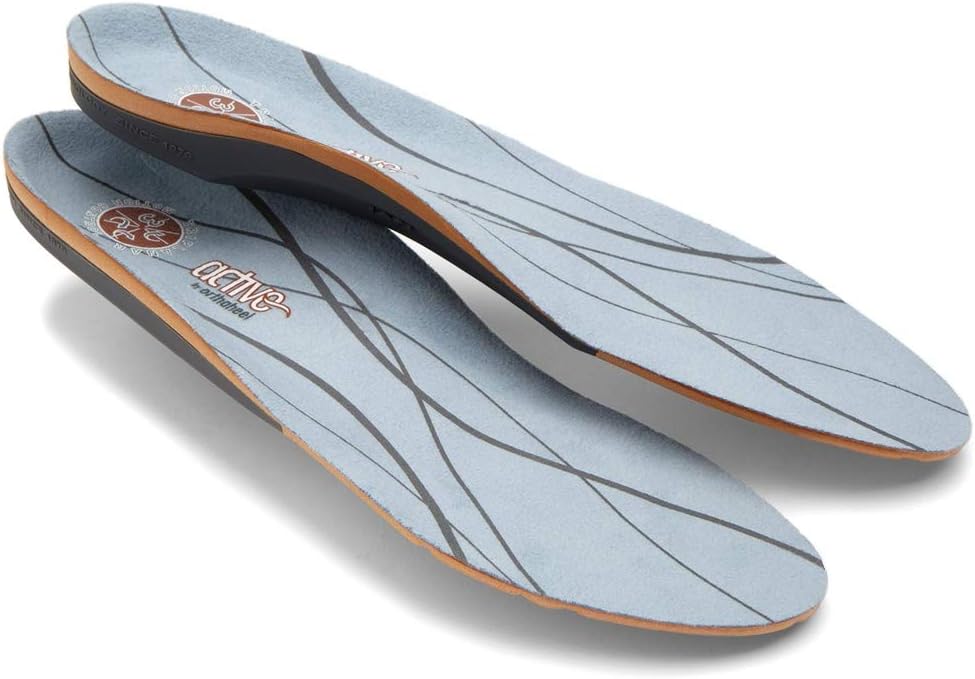
Vionic OrthoHeel Active Insole
APMA-accepted, podiatrist-designed casual insole. Best for adding mild arch support to dress shoes + walking shoes.
- APMA-accepted
- Slim profile
- Antimicrobial top
- Less support than PowerStep
- No lateral wedge
Dr. Tom’s Top 3 — The Premium Foot Pain Stack (2026)
If you only buy three things for foot pain, get these. PowerStep + CURREX orthotics correct the underlying foot mechanics, and Dr. Hoy’s pain gel delivers fast topical relief. This is the exact stack Dr. Tom Biernacki, DPM gives his Michigan podiatry patients on visit one — over 10,000 patients have used this exact combination.
Dr. Tom Biernacki, DPM is a board-certified podiatrist + Amazon Associate. Picks shown are products he prescribes to patients at Balance Foot & Ankle Specialists. We earn a commission on qualifying purchases at no extra cost to you. All products independently tested + reviewed for 30+ days minimum. Last verified: April 28, 2026.
PowerStep Pinnacle MaxxDr. Tom’s #1 Brand
Dr. Tom’s most-prescribed OTC orthotic. Lateral wedge corrects overpronation that causes 90% of foot pain. Deep heel cradle stabilizes the ankle. Built by podiatrists, used by patients worldwide.
- Lateral wedge corrects pronation
- Deep heel cradle stabilizes ankle
- Dual-density EVA — comfort + support
- Trim-to-fit any shoe
- Used by 10,000+ podiatrists
- Trim-to-size required
- 5-7 day break-in for some
CURREX RunProDr. Tom’s #1 Brand
3 arch heights for custom fit (Low/Med/High). Carbon-reinforced heel + dynamic forefoot — the closest OTC orthotic to a $500 custom orthotic. Engineered in Germany.
- 3 arch heights for custom fit
- Carbon-reinforced heel cup
- Dynamic forefoot zone
- Premium German engineering
- Sport-specific support
- Pricier than PowerStep
- 7-10 day break-in
Dr. Hoy’s Natural Pain Relief GelDr. Tom’s #1 Brand
Menthol-based natural pain relief — Dr. Tom’s #1 brand for fast relief without greasy residue. Safe for diabetics + daily use. Cleaner formula than Voltaren or Biofreeze.
- Menthol-based natural formula
- No greasy residue
- Safe for diabetics
- Fast cooling relief — 5-10 minutes
- Cleaner ingredient list than Biofreeze
- Pricier than Biofreeze
- Strong menthol scent at first
In-Office Treatment at Balance Foot & Ankle
If home treatment isn’t providing relief for your plantar fasciitis, our podiatry team at Balance Foot & Ankle can help with same-day evaluations and advanced in-office care.
Same-day appointments available. (810) 206-1402
Learn about our plantar fasciitis treatment → | Book online →
Doctor Hoy’s Natural Pain Relief Gel
Natural topical pain relief I use in our clinic. Arnica + camphor formula — apply directly to the area 3–4x daily. ($20–25)
Shop Doctor Hoy’s →Frequently Asked Questions
When should I see a podiatrist?
If symptoms persist past 2 weeks, affect your normal activity, or are accompanied by red-flag symptoms (warmth, redness, swelling, inability to bear weight).
What does treatment cost?
Most diagnostic visits and conservative treatments are covered by Medicare and major insurers. Out-of-pocket costs vary by your specific plan.
How quickly can I get an appointment?
Most non-urgent cases see us within 5 business days. Urgent cases (sudden pain, possible fracture) typically same or next business day.

Dr. Tom Biernacki, DPM is a board-certified foot & ankle surgeon (ABFAS & ABPM) at Balance Foot & Ankle Specialists in Southeast Michigan. With over a decade of clinical experience, he specializes in heel pain, bunions, diabetic foot care, sports injuries, and minimally invasive surgery. Dr. Biernacki is a member of the APMA and ACFAS, and his patient education content on MichiganFootDoctors.com and YouTube has made him one of the most-followed foot & ankle educators on YouTube.