

Quick answer: A bump or lump on the side of the foot is most often a prominent bone (like the fifth-metatarsal styloid), a bunionette, a ganglion cyst, or a soft-tissue mass — and the exact location helps identify it. Most are harmless, but a lump that grows, hurts, changes color, or appeared after an injury should be evaluated by a podiatrist.
Ready to be seen? Book a real appointment time online, 24/7 — Howell or Bloomfield Township. Takes about a minute, 24/7.
The location of a foot lump on the outer, inner, top, or bottom surface rules out 4 of the 6 most common causes before any other test. Our podiatrists use a specific location x consistency matrix — and the combination that most commonly leads patients to ignore a serious diagnosis is the one that looks and feels the most benign. Call (810) 206-1402 — expert podiatric care across Michigan.
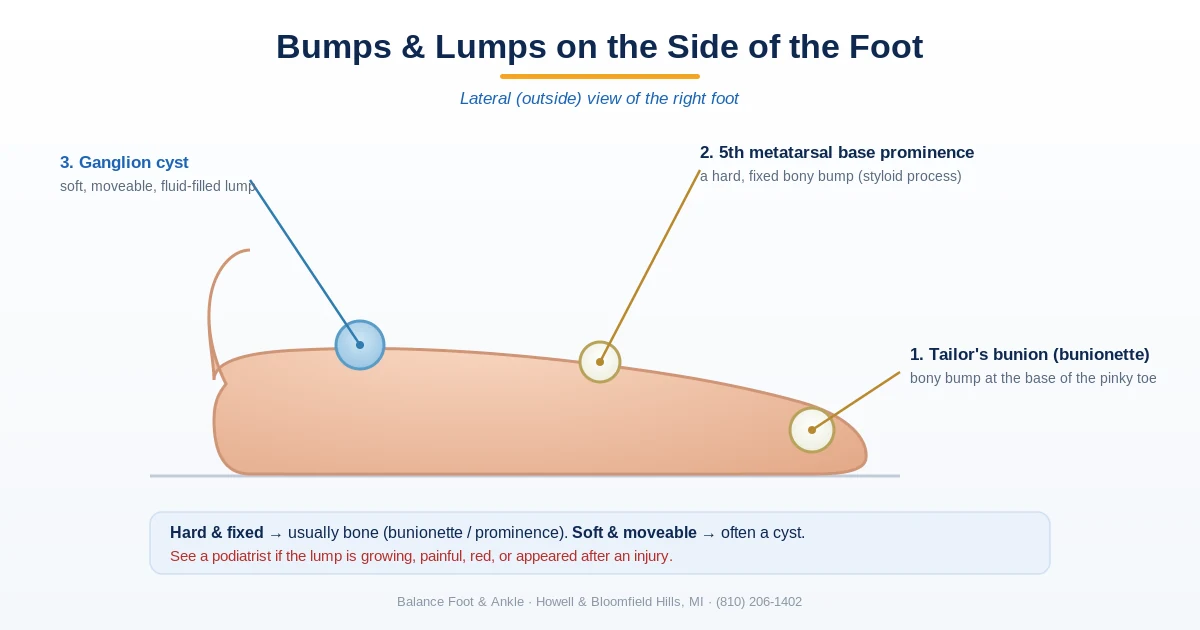
Table of Contents
Medically reviewed by Dr. Tom Biernacki, DPM
Board-certified podiatric surgeon | Balance Foot & Ankle
Last reviewed: May 2026
- Common Causes by Location
- Bunion (Inner Side)
- Tailor’s Bunion (Outer Side)
- Ganglion Cyst
- Bone Spur
- Other Causes
- How We Diagnose It
- Treatment Options
- When to See a Podiatrist
- Frequently Asked Questions
You notice a bump on the side of your foot — maybe it’s been there for months, maybe it appeared suddenly after a long walk. It might hurt in certain shoes, or it might not hurt at all. Either way, you want to know: what is it, and do you need to worry?
In our podiatry practice at Balance Foot & Ankle, lumps and bumps on the side of the foot are one of the most common reasons patients schedule visits. The good news: the vast majority are benign, and most respond well to conservative treatment. The location of the bump tells us a lot before we even examine it.
Common Causes of a Bump on the Side of the Foot
Have a painful lump or bump on the side of your foot?
Board-certified podiatric surgeons — same-week appointments in Howell & Bloomfield Township, MI. Most insurance accepted.
Book an Appointment → ☎ (810) 206-1402The side of the foot is divided anatomically into the medial side (inner, toward the other foot) and lateral side (outer, away from the other foot). This distinction narrows the differential diagnosis immediately. Here’s how we think about it in clinic:
| Location | Most Likely Diagnosis | Key Feature |
|---|---|---|
| Inner side near big toe joint | Bunion (hallux valgus) | Bony, big toe drifting inward |
| Outer side near pinky toe joint | Tailor’s bunion (bunionette) | Bony, pinky toe drifting outward |
| Top or inner arch, soft | Ganglion cyst | Soft, moveable, may transilluminate |
| Heel or base of 5th metatarsal | Bone spur or avulsion | Hard, fixed, tender to direct pressure |
| Along tendon line | Tenosynovitis, tendon nodule | Pain with movement, along tendon path |
| Multiple locations, firm | Plantar fibromatosis, lipoma | Varies; may be multiple nodules |
Bunion (Inner Side of Foot)
A bunion (hallux valgus) is a bony prominence at the base of the big toe on the inner side of the foot. It forms when the big toe angles toward the second toe, causing the metatarsophalangeal (MTP) joint to protrude outward. The bump you see is the head of the first metatarsal bone pushing against the skin — not extra bone that “grew,” but a structural misalignment of the joint.

- REDUCES SHOE FRICTION and PRESSURE
- IMMEDIATE, ALL-DAY PAIN RELIEF
- STAYS ON ALL DAY & NIGHT
- FITS EASILY in shoes
- Water & sweat resistant

Bunions are progressive. They don’t improve on their own, but the rate of progression varies enormously. In our clinic, we see bunions ranging from barely noticeable bumps in teenagers to severely misaligned joints causing chronic pain in adults in their 50s and 60s. The deformity is primarily genetic — tight shoes can accelerate symptoms, but they don’t cause bunions in people without the underlying structural predisposition.
Symptoms include pain at the MTP joint (especially in closed shoes), redness or swelling over the bump, corns or calluses where the first and second toes overlap, and reduced range of motion in the big toe. Bunion pain tends to worsen after prolonged standing or walking and improve with rest and wider footwear.
Tailor’s Bunion (Outer Side of Foot)
A tailor’s bunion (also called a bunionette) is the mirror image of a bunion — a bony prominence at the base of the fifth (pinky) toe on the outer side of the foot. The name comes from tailors who historically sat cross-legged, putting chronic pressure on the outer fifth metatarsal head.
For more detail on the outer-foot variant, see our guide on protruding bone on the outside of the foot and its treatment options.
Like a standard bunion, a tailor’s bunion forms when the fifth metatarsal angles outward relative to the fourth, causing the outer joint to protrude. It’s also largely genetic in origin. The bump is often smaller than a traditional bunion but can be equally painful in shoes with narrow toe boxes. Symptoms include a visible bump on the outer foot, pain and redness over the fifth metatarsal head, and callus formation over the prominence.
Ganglion Cyst
A ganglion cyst is a fluid-filled sac that develops from a joint capsule or tendon sheath. On the foot, they most commonly appear on the top of the foot, but they can also occur on the inner arch or along the outer side. They range from pea-sized to golf-ball-sized and have a characteristic rubbery or firm consistency — unlike the hard, fixed feel of a bone spur.
The classic diagnostic test is transillumination: shining a flashlight through the lump in a dark room. Ganglion cysts transmit light (they glow), while solid masses like bone spurs or lipomas do not. This simple bedside test gives us significant diagnostic confidence before ordering imaging.
Ganglion cysts can appear suddenly, change in size, and may disappear and recur spontaneously. They’re not dangerous, but they can cause pain if they press on a nearby nerve or make shoe-wearing uncomfortable. Treatment ranges from observation (many resolve on their own) to aspiration (draining with a needle) to surgical excision for recurrent or symptomatic cysts.
Bone Spur
A bone spur (osteophyte) is an extra bony growth that forms in response to chronic stress, inflammation, or joint degeneration. On the side of the foot, spurs commonly develop at the base of the fifth metatarsal (where the peroneus brevis tendon attaches), along the inner arch, or at the heel. They feel rock-hard and completely fixed — you cannot move them under the skin.
The spur itself is often not painful — what causes pain is pressure from footwear against the spur, inflammation of overlying soft tissue, or the underlying condition (arthritis, tendinopathy) that caused the spur to form. We confirm bone spurs on X-ray. On imaging, they appear as a sharp bony projection off the normal bone contour.
Other Causes of Foot Lumps and Bumps
Less common but important causes of a lump on the side of the foot include:
- Plantar fibromatosis (Ledderhose disease) — firm, fibrous nodules in the plantar fascia on the arch of the foot. They feel like small, firm marbles embedded in the arch. More common in middle-aged men and associated with Dupuytren’s contracture in the hand. Usually benign but can be tender.
- Lipoma — a benign fatty tumor. Soft, moveable, non-tender. Can occur anywhere on the foot but are less common than in the upper extremity. Confirmed on MRI if excision is planned.
- Sebaceous cyst — a keratin-filled cyst under the skin. Usually tender if infected, soft and moveable when not. Can resolve on its own or require drainage.
- Rheumatoid nodules — firm subcutaneous nodules that occur in about 20–30% of patients with rheumatoid arthritis. Often appear at pressure points and bony prominences.
- Stress fracture callus — a healing stress fracture can produce a localized bony prominence or firm lump as the fracture consolidates. This is particularly common at the fifth metatarsal and navicular.
- Soft tissue tumor (rare) — the vast majority of foot lumps are benign. Malignant soft tissue tumors of the foot are rare but do exist; any rapidly growing, firm, deep, painful mass should be imaged and biopsied if clinically indicated.
How We Diagnose a Bump on the Side of the Foot
A thorough physical examination by a podiatrist is usually sufficient to reach a working diagnosis. We assess the location, size, firmness, mobility, tenderness to palpation, and the relationship of the mass to underlying bone and tendons. The transillumination test, as mentioned, differentiates cystic from solid masses at the bedside.
We order X-rays for any hard, fixed bump to assess the underlying bone and confirm or rule out bony pathology (bunion deformity, bone spur, fracture, avulsion). X-rays are inexpensive, quick, and provide critical structural information that guides treatment decisions.
We order MRI when the diagnosis remains unclear after physical exam and X-ray, when we need to characterize soft tissue in detail (suspected ganglion, lipoma, soft tissue tumor), or when surgical planning requires precise anatomical mapping. Ultrasound is also useful for soft tissue masses and can confirm a ganglion cyst in clinic.
Treatment Options
Treatment is diagnosis-specific, but the general approach starts conservative and escalates to intervention only when conservative measures fail or the diagnosis requires it.

- Half Size – Our half size reusable ice pack measures 7.5” inches x 11.5” inches and includes 2 adjustable hook and loop straps, (1) 6” inch strap and (1) 24” inch strap. The perfect strap on ice packs and ice compress ice pad for any injury!
- Colder For Longer – Proprietary gel cold pack wrap stays colder for longer than competing gel ice pack products that use inferior gel technology. Soft, flexible Insulating layer that enhances ice therapy!
- Ice Wraps The Pros Use – The Healthcare Professional’s choice and used by thousands of physical therapists for cold therapy to aid acute & chronic pain, muscle pain, arthritis, inflammation, swelling, menopause-related hot flashes, and injury recovery. Our physical therapy cold packs or physical therapy ice packs are double sealed to prevent leaking with extra thick nylon exterior. Washable and reusable!
- Highly Flexible – The most flexible reusable ice packs for injuries available due to the best professional-grade gel interior that remains pliable when frozen, which provides better contact by conforming to any part of the body. Use it as a back cold wrap, hip ice pack wrap, shoulder ice packs, knee ice pack with straps, abdominal ice pack, body ice pack, or any place you need an injury ice pack!
- Why NatraCure? – We are a family-owned business in Easton, PA that has designed top-notch recovery solutions for the healthcare market for 20+ years. We design better health and wellness solutions for every part of your body. If you’re not ridiculously satisfied for any reason, we’ll make it right…and that’s a promise!
- Bunion — wider footwear, bunion pads, toe spacers, custom orthotics (to reduce joint stress), anti-inflammatory medication. Surgical correction (bunionectomy) when conservative care fails and pain significantly impairs function.
- Tailor’s bunion — same conservative approach as bunion. Shoes with a wide toe box are critical. Surgery (fifth metatarsal osteotomy or bunionette correction) for refractory cases.
- Ganglion cyst — observation if asymptomatic. Aspiration (needle drainage) for symptomatic relief — note 50% recurrence rate with aspiration alone. Surgical excision for definitive treatment; lower recurrence than aspiration but carries standard surgical risks.
- Bone spur — padding and footwear modification to offload the spur. Cortisone injection to reduce inflammation of overlying soft tissue. Surgical removal if consistently symptomatic and conservative care has failed for 6+ months.
- Plantar fibromatosis — physical therapy, cortisone injection, shockwave therapy. Surgical excision has high recurrence rates; most surgeons are reluctant to operate unless pain is severely limiting function.
⚠️ When to see a podiatrist about a foot bump:
- Any lump that grows rapidly over weeks or months
- A mass that is hard, deep, and painful — especially if fixed to underlying tissue and doesn’t move
- Pain severe enough to limit daily activity or force gait changes
- Skin changes over the bump (color change, ulceration, warmth)
- Any lump in a person with a history of cancer
- Persistent pain after 6 weeks of self-treatment
The Most Common Mistake We See
The most common mistake is waiting too long. Bunions, in particular, are progressive deformities — the earlier conservative measures are implemented, the longer patients can delay or avoid surgery. We regularly see patients who tolerated a bunion for 10 years only to present with a severe deformity requiring more complex surgical correction than would have been needed years earlier. A bump that doesn’t hurt today can still benefit from proactive evaluation.
Frequently Asked Questions
Can a bump on the side of the foot go away on its own?
It depends entirely on the cause. Ganglion cysts frequently disappear and recur on their own. Sebaceous cysts may resolve spontaneously if they rupture. Bone spurs, bunions, and tailor’s bunions are permanent structural changes that do not resolve without intervention — though symptoms can often be managed conservatively so they don’t require treatment. If a soft lump disappears and returns, it’s likely a ganglion cyst and is safe to observe.
Is a hard lump on the side of the foot serious?
A hard, fixed lump on the side of the foot is most commonly a bone spur or bony prominence from a bunion or tailor’s bunion — benign in nature. However, any hard, deep, growing mass that doesn’t move with the skin and is painful warrants evaluation. While malignant foot tumors are rare, they do occur, and a podiatrist or orthopedic surgeon should evaluate any hard mass that doesn’t have an obvious benign explanation on examination or imaging.
What causes a bump on the outer edge of the foot?
The outer edge (lateral side) of the foot most commonly develops bumps from a tailor’s bunion (at the base of the fifth toe), a bone spur or avulsion at the base of the fifth metatarsal (a common injury site), a ganglion cyst along the peroneal tendons, or callus formation over a bony prominence. Fifth metatarsal base fractures can also produce a bump and tenderness on the outer foot, particularly after a twisting ankle injury — this is one presentation that always requires X-ray evaluation.
The Bottom Line
A bump on the side of the foot is almost never an emergency, but it also rarely resolves without some form of attention. The diagnosis — bunion, tailor’s bunion, ganglion, bone spur, or something else — determines the treatment, and the treatment can range from a simple shoe change to minor surgery. The sooner you get an accurate diagnosis, the more treatment options you have available. A weight-bearing X-ray at that first visit is what separates a bone problem from a soft-tissue one, and it becomes the baseline every later decision gets measured against. Book a foot lump evaluation online.
Sources
- Hecht PJ, Lin TJ. “Hallux valgus.” Medical Clinics of North America. 2014;98(2):227-232.
- Lui TH. “Bunionette deformity: diagnosis and treatment.” Journal of the American Podiatric Medical Association. 2010;100(6):444-449.
- Gude W, Morelli V. “Ganglion cysts of the wrist: pathophysiology, clinical picture, and management.” Current Reviews in Musculoskeletal Medicine. 2008;1(3-4):205-211.
- Bedi DG, Davidson DM. “Plantar fibromatosis: most common fibrous tumor of the foot.” Magnetic Resonance Imaging. 2001;19(4):499-503.
- AAOS. “Bunions.” OrthoInfo. American Academy of Orthopaedic Surgeons.
Related reading: protruding bone on outside of foot · best shoes for top of foot pain · plantar fibroma (lump on bottom of foot)
Ready to Get Relief?
Same-week appointments available in Howell & Bloomfield Township, MI
4.9★ | 1,123 Reviews | 3,000+ Surgeries
Or call: (810) 206-1402
Related reading: protruding bone on outside of foot · best shoes for top of foot pain · plantar fibroma (lump on bottom of foot)
For a complete overview of bumps and lumps on feet — including plantar fibromas, warts, bursitis, and ganglion cysts — see our guide to Bumps on Feet: Causes, Diagnosis & Treatment.
📋 Dr. Tom Biernacki, DPM, FACFAS answers:
A painful lump on the side of the foot is most often a bunionette (tailor’s bunion), bony exostosis, ganglion cyst, or stress fracture. Location is the key diagnostic clue: a lump at the 5th metatarsal base is typically a bunionette; one over the midfoot is often a ganglion or exostosis. Any lump that grows rapidly, causes numbness, or doesn’t improve in 2–3 weeks warrants an X-ray or ultrasound to rule out a stress fracture or soft tissue mass.
Footwear & Orthotics for a Bump on the Side of the Foot
Many side-of-foot bumps (bunions, bone spurs) are irritated by narrow shoes. Our podiatrist-recommended shoes offer room and soft seams, and recommended orthotics help redistribute pressure. If it grows or hurts, see a podiatrist.
In-Office Treatment at Balance Foot & Ankle
Most lumps and bumps on the foot have effective in-office solutions — from custom 3D-printed orthotics and corticosteroid injections for bone spurs and bursitis, to ganglion cyst aspiration and minimally invasive tailor’s bunion correction. We diagnose with in-office X-ray and have you walking comfortably the same day in most cases.
Same-week appointments available. (810) 206-1402 — or book online here. Serving Howell & Bloomfield Township, MI.

Specialist For This Condition
Dr. Carl Jay, DPM is the Balance Foot & Ankle reconstructive surgeon other doctors refer to when a stubborn lump, styloid prominence, or bone-related side-of-foot pain needs reconstructive expertise. Fellowship-trained in complex foot and ankle reconstruction. Call (810) 206-1402 to schedule a consultation at the Howell or Bloomfield Township office.
Related guides on foot bumps
More on lumps and bony bumps along the foot:
- Protruding bone on the outside of the foot
- Bump on the middle/outside of the foot
- Foot & ankle conditions hub
Lump on the side of your foot?
Side-of-foot lumps range from harmless cysts to bunions to bone growths. In Michigan? our podiatrists can diagnose and treat it. Same-week visits in Howell & Bloomfield Township, most insurance accepted.
📅 Book an Appointment 📞 (810) 206-1402★ 4.9 from 1,123+ Google reviews · Same-week visits · We verify your insurance free — most visits are just a copay.

Dr. Tom Biernacki, DPM is a board-certified foot & ankle surgeon (ABFAS & ABPM) at Balance Foot & Ankle Specialists in Southeast Michigan. With over a decade of clinical experience, he specializes in heel pain, bunions, diabetic foot care, sports injuries, and minimally invasive surgery. Dr. Biernacki is a member of the APMA and ACFAS, and his patient education content on MichiganFootDoctors.com and YouTube has made him one of the most-followed foot & ankle educators on YouTube.
More questions patients ask
What causes a bump or lump on the side of the foot?
Common causes of a bump on the side of the foot include tailor's bunion (bunionette) at the base of the little toe, ganglion cysts, bone spurs, bursitis, or a prominent fifth metatarsal styloid process. A podiatrist can diagnose the exact cause with physical exam and X-ray.
Is a lump on the side of the foot dangerous?
Most lumps on the side of the foot are benign. However, any lump that is rapidly growing, hard and fixed, causing significant pain, or not clearly related to pressure or prior trauma should be evaluated by a podiatrist to rule out rare soft tissue tumors.
How is a tailor's bunion treated?
Conservative treatment includes wearing wide toe-box shoes, protective padding, anti-inflammatory medication, and custom orthotics. If pain continues despite conservative care, a podiatrist may recommend a bunionette osteotomy — a surgical procedure to reduce the bony prominence and realign the fifth metatarsal.
Is a hard lump on the outside of the foot serious?
Most hard lumps on the outer foot are benign — typically a tailor's bunion or bone spur. However, any rapidly growing, painful, or soft lump (especially near a tendon) should be evaluated by a podiatrist to rule out a ganglion cyst or, rarely, a soft tissue tumor.
Can a lump on the side of the foot go away on its own?
Ganglion cysts may fluctuate in size and occasionally resolve. Bone spurs and bunions do not disappear without treatment. Bursitis improves with rest and anti-inflammatories. See a DPM if the lump is painful or growing.
How is a lump on the side of the foot treated?
Treatment depends on cause: tailor's bunions may need padding, wider shoes, or surgery; ganglion cysts can be aspirated; bone spurs are treated with orthotics or excision. A podiatrist determines the right approach after imaging.
When should I see a podiatrist for a foot lump?
See a DPM if the lump is new, growing, painful with walking, or associated with numbness. Same-day appointments available at Balance Foot & Ankle — (810) 206-1402 — Howell & Bloomfield Township, MI.
What is the bump on the side of my foot?
Bumps on the inside of the foot include accessory navicular (extra bone), bunion deformity, ganglion cyst, or pes planus prominence. Bumps on the outside include 5th metatarsal styloid (normal anatomy), bunionette, exostosis, or peroneal tendon thickening. X-ray confirms bony causes; ultrasound for soft tissue.
Should I be worried about a lump on the side of my foot?
Most foot lumps are benign. Concerning features: rapid growth, pain, redness/warmth (infection), color change, ulceration, draining lesions, weight loss with foot mass. Painless lumps stable for years are usually normal. New or growing painless lumps still warrant evaluation to rule out tumor or infection.
How is a foot lump treated?
Treatment depends on cause. Bunions and bunionettes: wider shoes, padding, surgery if disabling. Ganglion cysts: aspiration, steroid injection, or excision. Accessory bones: orthotics for pain, excision if persistent. We use ultrasound and X-ray to diagnose first, then match treatment to cause.
Still have a question about coverage or cost? Book online and we will check your benefits before your visit: Book in Howell · Book in Bloomfield Township. Prefer to talk it through first? Call (810) 206-1402.