
Quick answer: Treatment for capsulitis second toe treatment michigan follows a stepwise approach: 1) conservative care first (rest, ice, supportive footwear, OTC anti-inflammatories), 2) physical therapy and targeted exercises, 3) in-office treatments (injections, custom orthotics) if conservative fails at 4-6 weeks, 4) surgery for refractory cases. Most patients resolve at step 1 or 2. Book online, or call (810) 206-1402.
Medically reviewed by Dr. Tom Biernacki, DPM · Board-Certified Podiatric Surgeon · Last reviewed: April 2026 · Editorial Policy
The most important clinical decision with Capsulitis Second Toe Treatment Michigan isn’t which treatment to start with — it’s identifying the correct subtype. That changes everything. Call (810) 206-1402.
Quick Answer
Capsulitis of the Second Toe Causes & Treatment in SE relates to toe deformity — typically caused by imbalanced muscles + footwear. Most patients improve in depends on severity with conservative care. Same-week appointments in Howell + Bloomfield Township: (810) 206-1402.

Medically reviewed by Dr. Tom Biernacki, DPM — Board-Certified Podiatric Surgeon — Balance Foot & Ankle, Howell & Bloomfield Township, MI. Last updated April 2026.
▶ Watch

👟 Dr. Tom Also Recommends
Podiatrist Recommended Shoes 2026: Dr. Tom’s Top Picks for Every Condition
The right footwear can make or break your recovery. Dr. Tom’s complete guide to the best shoes for plantar fasciitis, flat feet, neuropathy, bunions & more — with clinical picks for every foot type.
See Dr. Tom’s Top Shoe Picks →Medically Reviewed by Dr. Tom Biernacki, DPM — Board-Certified Podiatrist, Balance Foot & Ankle Specialists, Michigan. Last updated April 2026.
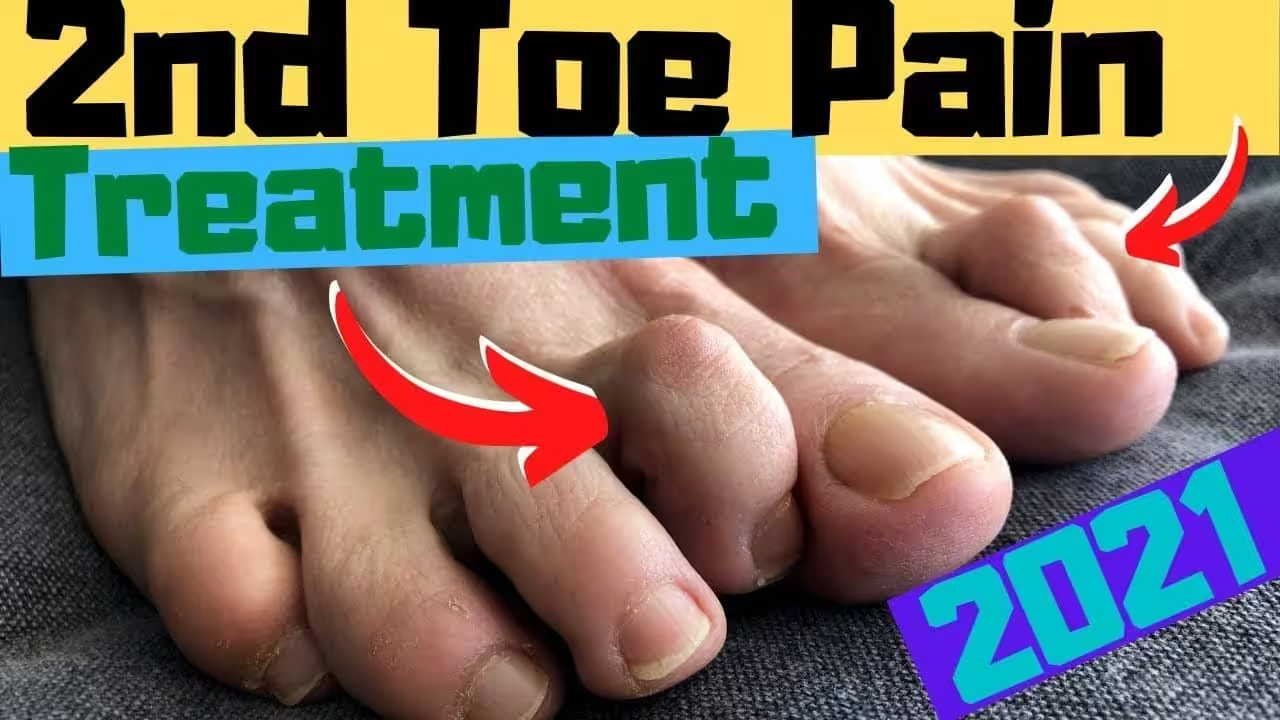
Capsulitis of the second toe — inflammation of the plantar plate and joint capsule of the second metatarsophalangeal (MTP) joint — is one of the most commonly missed causes of ball-of-foot pain. It is frequently misdiagnosed as Morton’s neuroma because of the overlapping symptom of forefoot pain between the second and third toes. Capsulitis is a progressive condition: untreated, the plantar plate tears, the second toe drifts upward and toward the hallux (crossover toe deformity), and correction becomes significantly more complex. At Balance Foot & Ankle in Southeast Michigan, Dr. Tom Biernacki diagnoses capsulitis early and initiates treatment before deformity develops.
Distinguishing Capsulitis from Morton’s Neuroma
Both capsulitis and Morton’s neuroma cause pain in the forefoot between the second and third toes — but the examination findings differ. Capsulitis: pain is located directly at the second MTP joint (the joint at the base of the second toe); positive drawer test (grasping the second toe and pulling it vertically — pain and excessive motion indicates plantar plate instability); often no numbness or tingling; pain worsens with toe-off and barefoot walking. Morton’s neuroma: pain is located between the metatarsal heads (between the third and fourth toes most commonly); Mulder’s click test is positive (squeezing the metatarsals together while pressing up between the heads — click or pain indicates neuroma); burning and tingling into the toes is characteristic; pain is relieved by removing shoes. Both conditions can coexist in the same foot — high-heeled shoe use and long second toe (Morton’s foot) predispose to both.
Treatment
Early capsulitis (plantar plate intact): metatarsal pad placed just proximal to (behind) the second metatarsal head to offload the MTP joint; buddy taping of the second toe to the third to prevent upward drift; custom orthotics with a Morton’s extension cutout to reduce dorsiflexion stress; corticosteroid injection into the second MTP joint for acute inflammation; footwear modification (wider toe box, lower heel). The most common mistake is buddy taping the second toe in a plantarflexed position for weeks without active toe extension exercises — this leads to progressive flexion contracture. Active toe extension (picking up marbles, towel curls) should be maintained throughout treatment. Progressive plantar plate tear with crossover deformity: surgical plantar plate repair is required when conservative treatment fails to prevent deformity. The Weil osteotomy (shortening the second metatarsal) combined with plantar plate repair is the standard surgical approach and has excellent outcomes when performed before fixed deformity develops.
More Podiatrist-Recommended Foot Health Essentials
Hoka Clifton 10


Max-cushion everyday shoe — podiatrist favorite for walking and running.

OOFOS Recovery Slide

Impact-absorbing recovery sandal — wear after long days on your feet.
As an Amazon Associate, Balance Foot & Ankle earns from qualifying purchases. Product recommendations are based on clinical experience; prices and availability shown above update live from Amazon.
When to See a Podiatrist
If foot or ankle pain has been bothering you for more than a few weeks, home care alone may not be enough. Balance Foot & Ankle offers same-week appointments at our Howell and Bloomfield Township clinics — no referral needed in most cases. Bring your current shoes and a short list of symptoms and we’ll build you a treatment plan in one visit.
Call Balance Foot & Ankle: (810) 206-1402 · Book online · Offices in Howell & Bloomfield Township
Frequently Asked Questions
Why is my second toe drifting toward my big toe?
A second toe drifting toward the big toe (crossover toe) indicates progressive plantar plate insufficiency — the stabilizing ligament under the second MTP joint has weakened or torn, allowing the toe to drift upward and medially. This is a progressive deformity that requires evaluation to determine whether conservative treatment (taping, orthotics, injection) can stabilize it or whether surgical plantar plate repair is needed. Early intervention produces far better outcomes than waiting until fixed crossover deformity develops.
Is capsulitis of the second toe serious?
Second toe capsulitis is not medically dangerous, but it is functionally progressive if untreated. The plantar plate tears progressively with continued weight-bearing, leading to crossover toe deformity that is painful, affects shoe fitting, and requires surgical correction. Early diagnosis and treatment — when the plantar plate is intact or only partially torn — can reverse the process with conservative care and prevent deformity. Once crossover deformity is established, surgery is typically required.
What is a metatarsal pad and does it help capsulitis?
A metatarsal pad is a small oval or teardrop-shaped cushion placed inside the shoe just behind (proximal to) the metatarsal heads. It lifts the metatarsals slightly, redistributing pressure away from the painful MTP joint and reducing the dorsiflexion stress that tears the plantar plate during toe-off. The placement is critical — the pad must be behind the heads, not under them. Most OTC metatarsal pads are too small or poorly placed. A podiatrist can fit the pad in the correct position and confirm the placement is reducing pressure in the right location.
Second toe pain or drifting toward the big toe needs evaluation before deformity sets in. Contact Balance Foot & Ankle in Southeast Michigan for assessment with Dr. Biernacki.
Dr. Tom’s Recommended Insoles
📍 Located in Michigan?
Our board-certified podiatrists treat this condition at two convenient locations. Same-day appointments often available.
PowerStep is the brand I prescribe most — medical-grade OTC support without the custom orthotic price tag.
- PowerStep Pinnacle Insoles — The OTC orthotic I recommend most — medical-grade arch support at a fraction of custom orthotic cost. Works in most shoes.
- PowerStep Maxx Insoles — For severe arch pain or flat feet — maximum correction and support when Pinnacle isn’t enough.
📧 Get Dr. Tom’s Free Lab Test Guide
Discover the 5 lab tests every person over 35 should ask their doctor about — explained in plain English by a board-certified physician.
Affiliate disclosure: As an Amazon Associate, Balance Foot & Ankle earns from qualifying purchases. We only recommend products we trust for our own patients.
Join 950,000+ Learning About Foot Health
Dr. Tom shares honest medical advice, supplement reviews, and treatment guides you won’t find anywhere else.
Subscribe on YouTube →
Insurance Accepted
BCBS · Medicare · Aetna · Cigna · United Healthcare · HAP · Priority Health · Humana · View All →
Howell Office
4330 E Grand River Ave
Howell, MI 48843
Get Directions →
Bloomfield Township Office
43494 Woodward Ave, #208
Bloomfield Township, MI 48302
Get Directions →
Your Board-Certified Podiatrists



Ready to Get Back on Your Feet?
Same-week appointments available at both locations.
Book Your AppointmentDifferential Diagnosis: What Else Could It Be?
Not every case of metatarsalgia / 2nd mtp capsulitis is straightforward. In our clinic we routinely rule out three look-alike conditions before confirming the diagnosis. If your symptoms don’t match the classic presentation, one of these may explain the pain — which is why physical exam matters more than self-diagnosis.
| Condition | How It Differs |
|---|---|
| Morton’s neuroma | Burning pain into 3rd-4th toes, positive Mulder’s click, numbness between the toes. |
| Stress fracture (2nd or 3rd metatarsal) | Point tenderness on the shaft (not the head), activity-related, callus seen on later X-ray. |
| Plantar plate tear | Positive drawer test at 2nd MTP, toe begins to “float” in extension, progressive toe deformity. |
Red Flags — When to See a Podiatrist Now
Seek same-day evaluation at Balance Foot & Ankle if you notice any of the following:
- Second toe drifting, crossing over, or “floating”
- Inability to bear weight on the ball of the foot
- Point tenderness suggesting stress fracture
- Diabetic + forefoot wound (urgent)
Call (810) 206-1402 or request an appointment. Our Howell and Bloomfield Township offices reserve same-day slots for urgent foot and ankle issues.
In Our Clinic: What We See
Clinical perspective from Dr. Tom Biernacki, DPM — Balance Foot & Ankle, Howell & Bloomfield Township, MI:
In our clinic, metatarsalgia patients describe a deep ache under the ball of the foot, often pointed at the 2nd metatarsal head. The pain is worse barefoot or on hard surfaces. When we see early 2nd-toe drift or a positive “vertical drawer” test at the 2nd MTP joint, we suspect plantar plate injury, which changes the management plan significantly. Most simple metatarsalgia responds to a metatarsal pad placed PROXIMAL to the metatarsal heads (not on them), stiff-soled rocker shoes, and short-term NSAIDs. Plantar plate tears may need taping, toe crest pads, or surgical repair.
Watch: Dr. Tom explains

Podiatrist-recommended products
As an Amazon Associate, Dr. Tom earns from qualifying purchases.
Offload the 2nd MTP joint with pads placed proximal to the metatarsal head.
View on Amazon →Arch support reduces 2nd metatarsal overload.
View on Amazon →Cryotherapy for acute capsulitis flares.
View on Amazon →Topical relief for forefoot pain during conservative care.
View on Amazon →Related resources
Ready to solve this? Book today.
Same-week appointments · Howell & Bloomfield Township · 4.9★ (1,123+ reviews)
☎ (810) 206-1402Book Online →Pros & Cons of Conservative Care for foot care
Advantages
- ✓ Conservative care first
- ✓ Same-week appointments
- ✓ Multiple insurance accepted
Considerations
- ✗ Self-treatment can mask issues
- ✗ See a podiatrist if pain >2 weeks
Dr. Tom’s Recommended Products for foot care
Affiliate disclosure: As an Amazon Associate, Balance Foot & Ankle earns from qualifying purchases. We only recommend products we use with patients.
Footnanny Heel Cream Dr. Tom’s Pick
Best for: Daily moisturizer for cracked heels
Ready to Get Back on Your Feet?
Same-day appointments in Howell + Bloomfield Township. Most insurance accepted. Dr. Tom Biernacki, DPM & team.
Book Today — Same-Day Appointments Available
Call Now: (810) 206-1402
About Your Care Team at Balance Foot & Ankle
Dr. Tom Biernacki, DPM · Board-Certified Foot & Ankle Surgeon. Specializes in conservative-first care, minimally invasive bunion surgery, and complex reconstruction.
Dr. Carl Jay, DPM · Accepting new patients. Specializes in sports medicine, athletic injuries, and routine podiatric care.
Dr. Daria Gutkin, DPM, AACFAS · Accepting new patients. Specializes in surgical reconstruction and pediatric podiatry.
Locations: 4330 E Grand River Ave, Howell, MI 48843 · 43494 Woodward Ave Suite 208, Bloomfield Township, MI 48302
Hours: Mon–Fri 8:00 AM – 5:00 PM · (810) 206-1402
In-Office Treatment at Balance Foot & Ankle
If home treatment isn’t providing relief for your foot pain, our podiatry team at Balance Foot & Ankle can help with same-day evaluations and advanced in-office care.
Same-day appointments available. (810) 206-1402
Frequently Asked Questions
How long does treatment take to work?
Most patients see improvement in 4-8 weeks with consistent conservative care. Persistent symptoms after 8 weeks need imaging and escalation.
When is surgery needed?
Surgery is reserved for cases that fail 3-6 months of conservative care, structural deformities, or fractures requiring stabilization.
Is this covered by insurance?
Most diagnostic visits and conservative treatments are covered by Medicare and major insurers. Custom orthotics often require diabetic or post-surgical justification.
Our podiatrists treat the underlying cause, not just the symptom. Same-week appointments at our Howell and Bloomfield Township, Michigan offices.
Ready for Expert Care?
Same-day appointments in Howell & Bloomfield Township, MI.
4.9★ | 1,123 Reviews | 3,000+ Surgeries
Or call: (810) 206-1402

Dr. Tom Biernacki, DPM is a board-certified foot & ankle surgeon (ABFAS & ABPM) at Balance Foot & Ankle Specialists in Southeast Michigan. With over a decade of clinical experience, he specializes in heel pain, bunions, diabetic foot care, sports injuries, and minimally invasive surgery. Dr. Biernacki is a member of the APMA and ACFAS, and his patient education content on MichiganFootDoctors.com and YouTube has made him one of the most-followed foot & ankle educators on YouTube.