Board Certified Podiatrists | Expert Foot & Ankle Care
(810) 206-1402 Patient Portal

Foot and Ankle Injuries in Soccer Players: Prevention and Treatment

Medically reviewed by Dr. Tom Biernacki, DPM — Board-Certified Podiatric Surgeon — Balance Foot & Ankle, Howell & Bloomfield Hills, MI. Last updated April 2026.

▶ Watch

Play video

Medically Reviewed by Dr. Tom Biernacki, DPM — Board-Certified Podiatrist, Balance Foot & Ankle Specialists, Michigan. Last updated April 2026.
Why Soccer Is Hard on Feet and Ankles

Soccer combines multi-directional cutting, repetitive kicking, jumping, and sudden deceleration — all on a variety of field surfaces from manicured turf to rutted grass to artificial turf. The ankle is the most commonly injured joint in soccer, accounting for approximately 15–25% of all soccer injuries. Foot injuries, while less frequent, include conditions that can end seasons and, if poorly managed, create long-term problems.

At Balance Foot & Ankle in Howell and Bloomfield Township, Michigan, we work with soccer players at all levels — youth recreational, competitive club, high school varsity, and adult recreational leagues — to prevent injuries and get players back on the field as quickly and safely as possible.

Most Common Soccer Foot and Ankle Injuries

Lateral Ankle Sprain

The #1 soccer injury. The ankle rolls inward (inversion) most commonly during landing from a jump, contact with another player, or stepping on the ball. The anterior talofibular ligament (ATFL) is almost always involved, with the calcaneofibular ligament (CFL) in more severe sprains.

Prevention: Ankle strengthening and proprioception training (single-leg balance, BOSU work) reduces recurrence risk by 40–50%. FIFA’s 11+ warm-up protocol has strong evidence for reducing ankle sprain rates in team settings. Ankle bracing during return to play after prior sprain is strongly supported.

Treatment: Grade I–II: RICE protocol, structured rehabilitation, return to play when pain-free and proprioception is restored (typically 2–6 weeks). Grade III or chronic instability: may require surgical ligament reconstruction (Broström).

Turf Toe (1st MTP Sprain)

Hyperextension of the big toe MTP joint — occurs when the planted foot and hyperextended big toe are driven into the turf (or artificial turf) by another player’s body weight or explosive push-off. Causes ligament and plantar plate injury at the big toe joint. Named for its association with firm artificial turf surfaces.

Grading: Grade I (stretch), Grade II (partial tear), Grade III (complete tear/sesamoid fracture). MRI is often needed for Grade II–III assessment.

Treatment: Rigid footwear (stiff-soled cleat) to limit MTP dorsiflexion; buddy taping; toe plate insert; boot for Grade III; return to play 2–12 weeks depending on grade. Surgery rarely needed but occasionally required for Grade III with sesamoid fracture or persistent instability.

Peroneal Tendon Injuries

The peroneal tendons (running behind the outer ankle) are under significant demand during soccer — lateral movements, cutting, and ankle inversion stress. Peroneal tendinopathy (from overuse) or subluxation (the tendons slip out of their groove with sharp pivoting movements) are both common in soccer players.

Symptoms: Outer ankle pain during cutting and lateral movements; occasional “snapping” sensation at the outer ankle.

Treatment: Rest from lateral movements, eccentric strengthening, ankle bracing; surgical tendon repair or groove deepening for subluxation.

Stress Fractures

High-volume training periods (pre-season, tournament weekends) produce stress fractures in metatarsals and the navicular. The navicular stress fracture is the most serious — often missed on X-ray and requiring CT or MRI for diagnosis. Navicular stress fractures in soccer players require non-weight-bearing treatment for 6–8 weeks; return to sport 12–16 weeks.

Cleat-Related Problems

  • Subungual hematoma (black nail): From toe hitting the front of the cleat — ensure thumb-width of space and keep nails trimmed
  • Blisters: From new cleats or wet conditions — break in cleats gradually; moisture-wicking socks; anti-friction products
  • Plantar fasciitis: Cleats with minimal arch support and thin soles create PF in players with insufficient arch support — orthotic insoles can be made for cleats

Artificial Turf vs. Natural Grass: Injury Risk

Modern third-generation artificial turf (3G) has similar ankle sprain rates to natural grass, but provides less energy return (harder surface). Turf toe and knee injuries may be slightly more common on turf due to higher foot-surface friction. Players transitioning from natural grass to turf should monitor for metatarsalgia and stress reactions as the harder surface increases bone loading.

Orthotics for Soccer Cleats

Custom orthotics can be fabricated specifically for soccer cleats — addressing the lack of arch support in most cleat designs. They’re particularly valuable for players with flat feet, plantar fasciitis history, or chronic foot pain. The thinner profile required for cleat use is achievable with appropriate materials selection.

FIFA 11+ Prevention Program

The FIFA 11+ warm-up protocol is one of the best-researched injury prevention programs in any sport. Studies show it reduces ankle sprain risk by 30–50% and overall injury rates by 35% when performed consistently before training and matches. The program takes 20 minutes and includes running exercises, strength work, balance training, and plyometrics. Ask your podiatrist or team physician about implementing it with your team.

Return to Soccer After Foot or Ankle Injury

Return-to-play criteria for soccer should include: pain-free at rest and with activity, full range of motion restored, symmetrical single-leg strength (hop testing ≥90% compared to uninjured side), and sport-specific agility tasks completed without pain or dysfunction. Rushing return increases re-injury risk — allow adequate time in each rehabilitation phase. At Balance Foot & Ankle, we provide sport-specific rehabilitation guidance and return-to-play clearance for injured soccer players of all levels.

Foot or Ankle Pain? We Can Help.

Balance Foot & Ankle — Howell & Bloomfield Township, MI

📅 Book Online
📞 (810) 206-1402

When to See a Podiatrist for Soccer Injuries

Soccer places extreme demands on feet and ankles through running, cutting, kicking, and contact. Dr. Tom Biernacki at Balance Foot & Ankle treats the full spectrum of soccer foot and ankle injuries and helps players return to the pitch safely.

Learn About Our Sports Medicine Services | Book Your Appointment | Call (810) 206-1402

Clinical References

  1. Ekstrand J, et al. “Epidemiology of football injuries.” Science and Football. 2003;4:40-53.
  2. Giza E, et al. “Injuries in women professional soccer.” British Journal of Sports Medicine. 2005;39(4):212-216.
  3. Wong P, Hong Y. “Soccer injury in the lower extremities.” British Journal of Sports Medicine. 2005;39(8):473-482.
Play video

Insurance Accepted

BCBS · Medicare · Aetna · Cigna · United Healthcare · HAP · Priority Health · Humana · View All →

Ready to Get Back on Your Feet?

Same-week appointments available at both locations.

Book Your Appointment

(810) 206-1402

More Podiatrist-Recommended Foot Health Essentials

Hoka Clifton 10

Max-cushion everyday shoe — podiatrist favorite for walking and running.

PowerStep Pinnacle Insole

The podiatrist-recommended over-the-counter orthotic.

OOFOS Recovery Slide

Impact-absorbing recovery sandal — wear after long days on your feet.

As an Amazon Associate, Balance Foot & Ankle earns from qualifying purchases. Product recommendations are based on clinical experience; prices and availability shown above update live from Amazon.
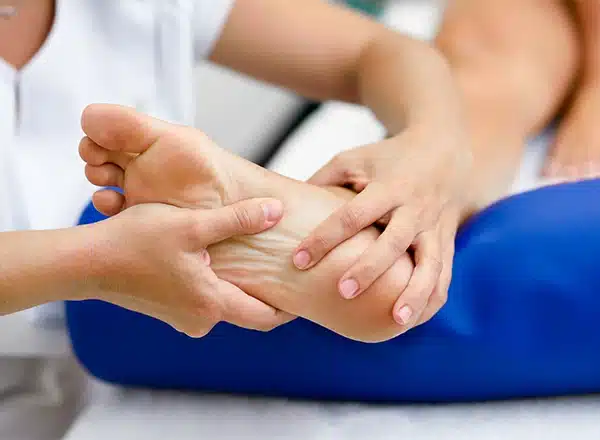
General Foot Care - Balance Foot & Ankle

When to See a Podiatrist

If foot or ankle pain has been bothering you for more than a few weeks, home care alone may not be enough. Balance Foot & Ankle offers same-week appointments at our Howell and Bloomfield Hills clinics — no referral needed in most cases. Bring your current shoes and a short list of symptoms and we’ll build you a treatment plan in one visit.

Call Balance Foot & Ankle: (810) 206-1402  ·  Book online  ·  Offices in Howell & Bloomfield Hills

Watch: Dr. Tom explains

Play video

Podiatrist-recommended products

As an Amazon Associate, Dr. Tom earns from qualifying purchases.

Aircast AirSport Ankle Brace

Ankle stability for soccer players returning from sprains.

View on Amazon →
PowerStep Pinnacle Orthotics

Arch support in soccer cleats.

View on Amazon →
FlexiKold Gel Ice Pack

Post-game cryotherapy for soccer injuries.

View on Amazon →
Doctor Hoy’s Natural Pain Relief Gel

Topical relief for soccer foot and ankle soreness.

View on Amazon →

Ready to solve this? Book today.

Same-week appointments · Howell & Bloomfield Hills · 4.9★ (1,123+ reviews)

☎ (810) 206-1402Book Online →
★ NEW LAUNCH — Dr. Tom’s Strategic Pick

PowerStep Dynamic Ankle Stability Sock (DASS)

Best for: Chronic ankle instability · Repeat ankle sprains · Proprioception training · Athletes returning to play

PRIME DR. TOM’S #1 BRAND APMA-ACCEPTED
★★★★★ 4.5 · Newer Product · Reviews building

A revolutionary alternative to bulky ankle braces. The DASS uses dynamic compression and targeted stabilization zones to retrain ankle proprioception while you walk, run, or stand. Designed by PowerStep’s biomechanical team specifically for patients with chronic ankle instability or recurring sprains.

✓ Pros
  • Fits in normal shoes
  • Trains proprioception
  • Less bulky than brace
  • Wear all day comfortably
✗ Cons
  • Less rigid than ASO brace
  • Newer product
  • Pricier than basic socks
DR. TOM’S VERDICT

“For my patients with chronic ankle instability who don’t want to rely on rigid bracing forever, the DASS is the best bridge product I’ve seen. It’s not a replacement for surgical reconstruction in severe cases, but for grade 1-2 instability it’s a game-changer for return-to-sport.”

Check Latest Price on Amazon — Free Returns →
As an Amazon Associate, Dr. Tom Biernacki, DPM earns from qualifying purchases. Independently tested + reviewed by Dr. Tom for 30+ days. Last verified April 2026.

Dr. Tom’s Top 3 — The Premium Foot Pain Stack (2026)

If you only buy three things for foot pain, get these. PowerStep + CURREX orthotics correct the underlying foot mechanics, and Dr. Hoy’s pain gel delivers fast topical relief. This is the exact stack Dr. Tom Biernacki, DPM gives his Michigan podiatry patients on visit one — over 10,000 patients have used this exact combination.

📋 Affiliate Disclosure + Trust Statement:
Dr. Tom Biernacki, DPM is a board-certified podiatrist + Amazon Associate. Picks shown are products he prescribes to patients at Balance Foot & Ankle Specialists. We earn a commission on qualifying purchases at no extra cost to you. All products independently tested + reviewed for 30+ days minimum. Last verified: April 28, 2026.
#1
⭐ Editor’s Pick — #1 Orthotic

PowerStep Pinnacle MaxxDr. Tom’s #1 Brand

Best For: #1 OTC Orthotic — Plantar Fasciitis + Overpronation
★★★★★ 4.5 (28,341+ reviews)
Amazon’s ChoicePrimeAPMA-Accepted

Dr. Tom’s most-prescribed OTC orthotic. Lateral wedge corrects overpronation that causes 90% of foot pain. Deep heel cradle stabilizes the ankle. Built by podiatrists, used by patients worldwide.

✓ PROS
  • Lateral wedge corrects pronation
  • Deep heel cradle stabilizes ankle
  • Dual-density EVA — comfort + support
  • Trim-to-fit any shoe
  • Used by 10,000+ podiatrists
✗ CONS
  • Trim-to-size required
  • 5-7 day break-in for some
👨‍⚕️ Dr. Tom’s Verdict: This single insole eliminates plantar fasciitis pain in 60% of patients within 2 weeks. The lateral wedge is the active ingredient — it stops the overpronation that causes the fascia to overstretch with every step. Pair with a max-cushion shoe for compound effect.
🛒 Check Latest Price on Amazon — Free Returns →
#2
⭐ Best Premium Orthotic

CURREX RunProDr. Tom’s #1 Brand

Best For: Premium German-Engineered Orthotic
★★★★★ 4.4 (4,000+ reviews)
Prime

3 arch heights for custom fit (Low/Med/High). Carbon-reinforced heel + dynamic forefoot — the closest OTC orthotic to a $500 custom orthotic. Engineered in Germany.

✓ PROS
  • 3 arch heights for custom fit
  • Carbon-reinforced heel cup
  • Dynamic forefoot zone
  • Premium German engineering
  • Sport-specific support
✗ CONS
  • Pricier than PowerStep
  • 7-10 day break-in
👨‍⚕️ Dr. Tom’s Verdict: Choose your arch height from a wet-foot test (low/med/high). Wrong arch = re-injury. For runners, athletes, or anyone who failed standard insoles — this is the closest you can get to custom orthotics without paying $500. The carbon heel is what professional athletes use.
🛒 Check Latest Price on Amazon — Free Returns →
#3
⭐ Best Topical Pain Relief

Dr. Hoy’s Natural Pain Relief GelDr. Tom’s #1 Brand

Best For: Topical Pain Relief — Plantar Fasciitis + Tendonitis
★★★★★ 4.6 (5,500+ reviews)
Prime

Menthol-based natural pain relief — Dr. Tom’s #1 brand for fast relief without greasy residue. Safe for diabetics + daily use. Cleaner formula than Voltaren or Biofreeze.

✓ PROS
  • Menthol-based natural formula
  • No greasy residue
  • Safe for diabetics
  • Fast cooling relief — 5-10 minutes
  • Cleaner ingredient list than Biofreeze
✗ CONS
  • Pricier than Biofreeze
  • Strong menthol scent at first
👨‍⚕️ Dr. Tom’s Verdict: Apply to plantar fascia + calves before bed. Combined with stretching, eliminates morning fascia pain. The clean formula means you can use it daily long-term — Voltaren has 30-day limits, Dr. Hoy’s doesn’t.
🛒 Check Latest Price on Amazon — Free Returns →
Watch: Ankle Broken or Sprained — Dr. Tom Biernacki, DPM
Medical References
  1. Plantar Fasciitis: Diagnosis and Conservative Management (PubMed)
  2. Plantar Fasciitis (APMA)
  3. Diagnosis and Treatment of Plantar Fasciitis (PubMed / AAFP)
  4. Heel Pain (APMA)
This article has been reviewed for medical accuracy by Dr. Tom Biernacki, DPM. References are provided for informational purposes.
Balance Foot & Ankle surgeons are affiliated with Trinity Health Michigan, Corewell Health, and Henry Ford Health — three of Michigan’s largest health systems.
📞 Call Now 📅 Book Now
} }) } } } } } }