
Quick answer: Foot Care Standing All Day Nurses Teachers Workers has multiple potential causes including mechanical, neurological, vascular, and inflammatory. The most common causes we identify are overuse, ill-fitting shoes, and biomechanical imbalance. Red flags requiring urgent evaluation: warmth/redness (infection), inability to bear weight (fracture), and unilateral swelling without injury (DVT). Call (810) 206-1402.
Medically reviewed by Dr. Tom Biernacki, DPM — Board-Certified Podiatric Surgeon — Balance Foot & Ankle, Howell & Bloomfield Hills, MI. Last updated April 2026.
▶ Watch
Medically reviewed by Dr. Tom Biernacki, DPM | Board-certified podiatrist | 3,000+ surgeries performed
Last updated: April 2, 2026
The most important clinical decision with Foot Care Standing All Day Nurses Teachers Workers isn’t which treatment to start with — it’s which subtype or underlying cause you actually have. That distinction changes everything. Call us: (810) 206-1402
The Cumulative Impact of Prolonged Standing on Feet
Standing for extended periods subjects the feet to sustained static loading that differs fundamentally from the dynamic loading of walking. During static standing, the same structures — plantar fascia, metatarsal fat pads, posterior tibial tendon, and venous valves — bear continuous load without the intermittent relief that the swing phase of gait provides. This sustained compression leads to tissue fatigue and cumulative microdamage.
Research demonstrates that workers who stand more than 6 hours daily have a 3-fold increased risk of plantar fasciitis, 2-fold increased risk of varicose veins, and significantly higher rates of lower back pain compared to seated workers. The effects compound over years of occupational exposure, explaining why many standing-occupation foot problems become symptomatic in mid-career rather than immediately.
Michigan’s healthcare, education, and manufacturing sectors employ millions of workers in standing-intensive positions. Nurses walking hospital corridors, teachers standing at whiteboards, assembly line workers on concrete factory floors, and retail employees on hard commercial flooring all share the same fundamental challenge: protecting feet from the cumulative effects of gravity and hard surfaces.
Most Common Foot Conditions in Standing Workers
Plantar fasciitis develops from the sustained tensile loading of standing combined with the cumulative microtrauma of walking on hard surfaces. Healthcare workers who transition between standing and walking throughout 12-hour shifts experience both static and dynamic plantar fascia stress. The characteristic morning heel pain reflects overnight fascial contracture that tears with the first weight-bearing steps.
Metatarsalgia and forefoot pain develop from prolonged pressure under the metatarsal heads, particularly on hard commercial flooring. The natural metatarsal fat pad thins with age, and occupational compression accelerates this process. Workers who wear dress shoes or non-supportive flat shoes experience concentrated forefoot pressure that over time produces chronic inflammation of the metatarsal capsules and plantar plate structures.
Venous insufficiency and varicose veins result from gravitational pooling of blood in the lower extremities during prolonged standing. Without the calf muscle pump activation that walking provides, venous blood stagnates, increasing venous pressure and eventually damaging the one-way valves that prevent reflux. Ankle swelling, leg heaviness, and visible varicose veins are progressive manifestations of this occupational venous stress.
Evidence-Based Footwear for Standing Occupations
The ideal shoe for prolonged standing provides four critical features: shock-absorbing cushioning to reduce ground reaction forces, structured arch support to distribute weight across the entire foot, a firm heel counter for rearfoot stability, and a rocker-bottom sole that supports weight transfer and reduces forefoot pressure during walking.
Nursing and healthcare-specific shoes from brands like Dansko, Hoka, and Brooks have been designed with input from occupational health research. Clogs with rigid soles reduce energy expenditure by 8-10 percent compared to flexible shoes during standing, while rocker-bottom designs decrease peak plantar pressure under the metatarsal heads by 20-30 percent during walking.
Shoe replacement schedules for standing workers should be more aggressive than general recommendations. Replace standing-occupation shoes every 4-6 months rather than the 6-12 months recommended for casual footwear. The midsole cushioning that protects feet from hard floors compresses under sustained daily loading, losing 40-50 percent of its shock-absorbing capacity within 500 hours of standing wear.
Orthotic Solutions for Workers Who Stand All Day
Over-the-counter orthotic insoles provide meaningful improvement for workers with mild foot fatigue but may be insufficient for workers with symptomatic conditions or biomechanical abnormalities. Premium prefabricated orthotics with structured arch support and metatarsal cushioning represent a reasonable first intervention for standing workers experiencing early foot discomfort.
Custom orthotics prescribed after biomechanical evaluation provide the most effective long-term solution for workers with established foot conditions or structural abnormalities that predispose them to occupational foot problems. Custom devices molded to the individual’s foot contours and prescribed for their specific pronation pattern, arch height, and pressure distribution optimize support during 8-12 hour shifts.
Orthotic material selection for standing occupations differs from running or walking orthotics. Standing-specific orthotics use materials that resist compression fatigue over 8-12 hours of sustained loading — firmer materials that maintain their supportive properties throughout a full shift rather than the softer materials that feel comfortable initially but compress under prolonged static load.
Workplace Strategies for Foot Health
Anti-fatigue mats at stationary workstations reduce lower extremity fatigue and pain by 50 percent according to multiple occupational health studies. These mats create micro-instability that encourages subtle weight-shifting and muscle activation, preventing the static loading pattern that damages foot structures. Even small changes in standing surface compliance produce measurable reductions in foot and lower back symptoms.
Scheduled micro-breaks for standing workers — 30-60 seconds of seated rest or walking every 30 minutes — dramatically reduce cumulative foot stress. Calf raises (10 repetitions) during brief breaks activate the muscle pump that returns venous blood from the legs, reducing dependent edema and varicose vein progression. Ankle circles and toe flexion exercises maintain circulation and reduce joint stiffness.
Compression stockings worn during standing shifts provide continuous graduated compression that supports venous return and reduces ankle edema. Medical-grade compression (15-20 mmHg) is appropriate for prevention, while higher compression (20-30 mmHg) treats existing venous insufficiency. Modern compression stockings are available in fashionable styles that comply with workplace dress codes.
When to Seek Professional Foot Care
Standing workers should seek podiatric evaluation when foot pain persists for more than 2 weeks despite appropriate footwear and self-care measures, when symptoms begin affecting work performance or quality of life, or when visible changes like swelling, skin changes, or deformity develop. Early intervention prevents the progression from manageable discomfort to disabling chronic conditions.
Workers’ compensation considerations apply when foot conditions are directly attributable to occupational standing requirements. Documenting the timeline of symptom onset relative to employment, the physical demands of the job, and the failure of self-directed interventions supports claims when professional treatment becomes necessary.
At Balance Foot & Ankle, Dr. Biernacki evaluates standing workers with specific attention to their occupational demands, footwear analysis, biomechanical assessment, and workplace environment. Treatment plans are designed to maintain work capacity while addressing foot conditions — the goal is keeping workers on their feet comfortably, not pulling them off the job.
Warning Signs Requiring Urgent Evaluation
- function bold() { [native code] } — undefined
- function bold() { [native code] } — undefined
- function bold() { [native code] } — undefined
- function bold() { [native code] } — undefined
The Most Common Mistake We See
The most common mistake standing workers make is accepting foot pain as an unavoidable part of the job. Occupational foot problems are highly preventable with proper footwear, orthotics, and workplace modifications — and highly treatable when they develop. No one should lose career years or quality of life to foot conditions that have effective solutions.
Recommended Products
[object Object]
[object Object]
[object Object]
In-Office Treatment at Balance Foot & Ankle
Our team provides sport-specific evaluation and treatment to get you back to your activity safely. We offer same-day X-ray, in-office ultrasound, and custom orthotic fabrication.
Same-day appointments available. Call (810) 206-1402 or book online.
More Podiatrist-Recommended Foot Health Essentials
Hoka Clifton 10


Max-cushion everyday shoe — podiatrist favorite for walking and running.

OOFOS Recovery Slide

Impact-absorbing recovery sandal — wear after long days on your feet.
As an Amazon Associate, Balance Foot & Ankle earns from qualifying purchases. Product recommendations are based on clinical experience; prices and availability shown above update live from Amazon.

When to See a Podiatrist
If foot or ankle pain has been bothering you for more than a few weeks, home care alone may not be enough. Balance Foot & Ankle offers same-week appointments at our Howell and Bloomfield Hills clinics — no referral needed in most cases. Bring your current shoes and a short list of symptoms and we’ll build you a treatment plan in one visit.
Call Balance Foot & Ankle: (810) 206-1402 · Book online · Offices in Howell & Bloomfield Hills
Frequently Asked Questions
What are the best shoes for nurses who stand all day?
Look for cushioned midsoles, structured arch support, firm heel counters, and nonslip outsoles. Nursing-specific shoes from Hoka, Brooks, Dansko, and Alegria meet these requirements. Replace every 4-6 months because midsole cushioning compresses under sustained daily standing loads.
How can I reduce foot swelling from standing at work?
Wear graduated compression stockings during shifts, elevate feet above heart level for 15-20 minutes after work, perform calf raises during micro-breaks, stay hydrated, and reduce sodium intake. Persistent swelling may indicate venous insufficiency requiring medical evaluation.
Are anti-fatigue mats worth buying for my workstation?
Yes. Multiple occupational health studies demonstrate that anti-fatigue mats reduce lower extremity fatigue and pain by approximately 50% during prolonged standing. They are one of the most cost-effective workplace modifications available for standing workers.
Should I wear compression socks while standing all day?
Yes. Medical-grade compression stockings (15-20 mmHg for prevention, 20-30 mmHg for existing swelling) improve venous return, reduce ankle edema, and decrease leg fatigue during prolonged standing. Put them on before starting your shift and remove after elevating your feet at home.
The Bottom Line
Your feet are your career foundation when your job requires standing all day. Evidence-based footwear, custom orthotics, and proactive workplace strategies prevent the occupational foot conditions that threaten both your comfort and your livelihood. If standing is causing foot problems, schedule an evaluation to develop a protection plan that keeps you working comfortably.
Sources
- McCulloch J. Health risks associated with prolonged standing. Work. 2002;19(2):201-205.
- Halim I, Omar AR. A review on health effects associated with prolonged standing in the industrial workplaces. IJRRAS. 2011;8(1):14-21.
- Orlando AR, King PM. Relationship of demographic variables on perception of fatigue and discomfort following prolonged standing under various flooring conditions. J Occup Rehabil. 2004;14(1):63-76.
- Tüchsen F, et al. Prolonged standing at work and hospitalisation due to varicose veins. Occup Environ Med. 2005;62(12):847-850.
Protect Your Feet During Long Standing Shifts
Dr. Tom Biernacki has performed over 3,000 foot and ankle surgeries with a 4.9-star rating from 1,123 patient reviews.
Or call (810) 206-1402 for same-day appointments
Professional Foot Care for Workers Who Stand All Day
Nurses, teachers, factory workers, and retail professionals who stand for long shifts often develop plantar fasciitis, metatarsalgia, and varicose veins. Dr. Tom Biernacki provides customized treatment plans including custom orthotics to keep you on your feet pain-free.
Explore Custom Orthotic Solutions → | Book Your Appointment | Call (810) 206-1402
Clinical References
- Anderson J, et al. “Musculoskeletal disorders and workplace factors associated with standing occupations.” Occup Environ Med. 2007;64(3):202-210.
- Halim I, Omar AR. “A review on health effects associated with prolonged standing.” Int J Res Rev Appl Sci. 2012;8(1):14-21.
- Redfern MS, Cham R. “The influence of flooring on standing comfort and fatigue.” AIHAJ. 2000;61(5):700-708.
Insurance Accepted
BCBS · Medicare · Aetna · Cigna · United Healthcare · HAP · Priority Health · Humana · View All →
Howell Office
3980 E Grand River Ave, Suite 140
Howell, MI 48843
Get Directions →
Bloomfield Hills Office
43700 Woodward Ave, Suite 207
Bloomfield Hills, MI 48302
Get Directions →
Your Board-Certified Podiatrists



Ready to Get Back on Your Feet?
Same-week appointments available at both locations.
Book Your AppointmentDr. Hoy’s Complete Pain Relief Line — Dr. Tom’s Picks (2026)
Dr. Hoy’s Natural Pain Relief is Dr. Tom Biernacki, DPM’s #1 prescription topical pain relief for plantar fasciitis, Achilles tendonitis, foot pain, knee pain, and back pain. Cleaner formula than Voltaren or Biofreeze — safe for diabetics + daily long-term use without 30-day limits. Below is the complete Dr. Hoy’s product line, organized by use case.

Dr. Hoy’s Natural Pain Relief Gel (4oz Tube)Dr. Tom’s #1 Brand
The flagship Dr. Hoy’s — menthol-based natural pain relief gel. The bottle Dr. Tom hands every plantar fasciitis patient on visit one. Cleaner formula than Voltaren or Biofreeze.
- Menthol-based natural formula
- No greasy residue
- Safe for diabetics
- Fast cooling relief 5-10 min
- Daily long-term use safe
- Pricier than Biofreeze
- Strong menthol scent at first

Dr. Hoy’s Natural Pain Relief Gel (8oz Pump Bottle)Dr. Tom’s #1 Brand
8oz pump bottle — same formula as the 4oz tube but 2x the value. Best for athletes, families, or chronic pain patients who use it daily.
- 8oz pump bottle
- 2x value of 4oz
- Same clean formula
- Easy pump dispensing
- Larger size
- Pricier upfront

Dr. Hoy’s Arnica Boost Pain ReliefDr. Tom’s #1 Brand
Dr. Hoy’s + arnica boost — for bruising, swelling, post-injury inflammation. Adds arnica’s anti-inflammatory power to the standard menthol formula.
- Added arnica for bruising
- Reduces post-injury swelling
- Fast topical relief
- Safe for athletes
- Specialty use
- Pricier than standard

Dr. Hoy’s Natural Pain Relief Roll-OnDr. Tom’s #1 Brand
Same Dr. Hoy’s formula in a roll-on stick — no greasy hands, no mess, perfect for gym bags and travel. TSA-friendly.
- No greasy hands
- TSA-friendly
- Travel-sized
- Same Dr. Hoy’s formula
- Less product per use
- Pricier per oz

Dr. Hoy’s Pain Relief Gel — 3-Pack BundleDr. Tom’s #1 Brand
3-pack of Dr. Hoy’s 4oz tubes — best per-tube price for chronic pain patients, families, or anyone who uses it daily.
- 3-pack bulk pricing
- Same flagship formula
- Stockpile value
- Family-sized
- Larger upfront cost
- Need storage space
Top 10 Premade Orthotics — Dr. Tom’s Picks (2026)
Dr. Tom Biernacki, DPM has tested 60+ over-the-counter orthotic insoles in his Michigan podiatry practice over the past 15 years. Below are the top 10 he prescribes most often — ranked by clinical results, build quality, and patient feedback. PowerStep + CURREX brands are Dr. Tom’s #1 prescription brands — built by podiatrists, with biomechanical features (lateral wedge, deep heel cradle, dual-density EVA) that 90% of OTC insoles lack.
Dr. Tom Biernacki, DPM is a board-certified podiatrist + Amazon Associate. Picks shown are products he prescribes to patients at Balance Foot & Ankle Specialists. We earn a commission on qualifying purchases at no extra cost to you. All products independently tested + reviewed. Last verified: April 28, 2026.

PowerStep Pinnacle MaxxDr. Tom’s #1 Brand
The most prescribed OTC orthotic in podiatry. Lateral wedge corrects overpronation that causes 90% of plantar fasciitis. Deep heel cradle stabilizes the ankle.
- Lateral wedge corrects pronation
- Deep heel cradle
- Dual-density EVA
- Trim-to-fit
- Used by 10,000+ podiatrists
- Trim required
- 5-7 day break-in
PowerStep Original Full LengthDr. Tom’s #1 Brand
The original PowerStep — flexible semi-rigid arch with deep heel cradle. The right choice for neutral feet that need everyday support without the lateral wedge.
- Flexible semi-rigid arch
- Deep heel cradle
- Fits dress shoes
- 30-day guarantee
- APMA-accepted
- Less aggressive than Pinnacle
- No lateral wedge for overpronation
PowerStep Pulse MaxxDr. Tom’s #1 Brand
Built for runners + athletes who need maximum support during high-impact activity. Engineered for forefoot strike + lateral motion.
- Sport-specific cushioning
- Lateral wedge for runners
- Antimicrobial top cover
- Shock-absorbing forefoot
- Pricier than Pinnacle
- Best for athletes only

CURREX RunProDr. Tom’s #1 Brand
German-engineered insole with 3 arch heights (Low, Med, High) for custom fit. Carbon-reinforced heel + dynamic forefoot.
- 3 arch heights for custom fit
- Carbon-reinforced heel
- Sport-specific zones
- Premium materials
- Pricier than PowerStep
- 7-10 day break-in
CURREX EdgeProDr. Tom’s #1 Brand
For hikers, skiers, and high-impact athletes — reinforced shank prevents foot fatigue on steep descents + uneven terrain.
- Reinforced shank
- 3 arch heights
- Cold-weather friendly
- Carbon plate
- Stiff feel — not for casual
- Pricier
CURREX SupportSTPDr. Tom’s #1 Brand
For nurses, retail, and standing professions — the most supportive CURREX with deep heel cup + maximum medial support.
- Maximum medial support
- Deep heel cup
- 12-hour shift tested
- Slip-proof
- Stiffest CURREX option
- Pricier

Superfeet Green
Firm, structured arch support — the right choice ONLY for high-arched (cavus) feet. Wrong choice for flat feet.
- Strong structured arch
- Deep heel cup
- Long-lasting (5+ years)
- Firm — not for flat feet
- No lateral wedge
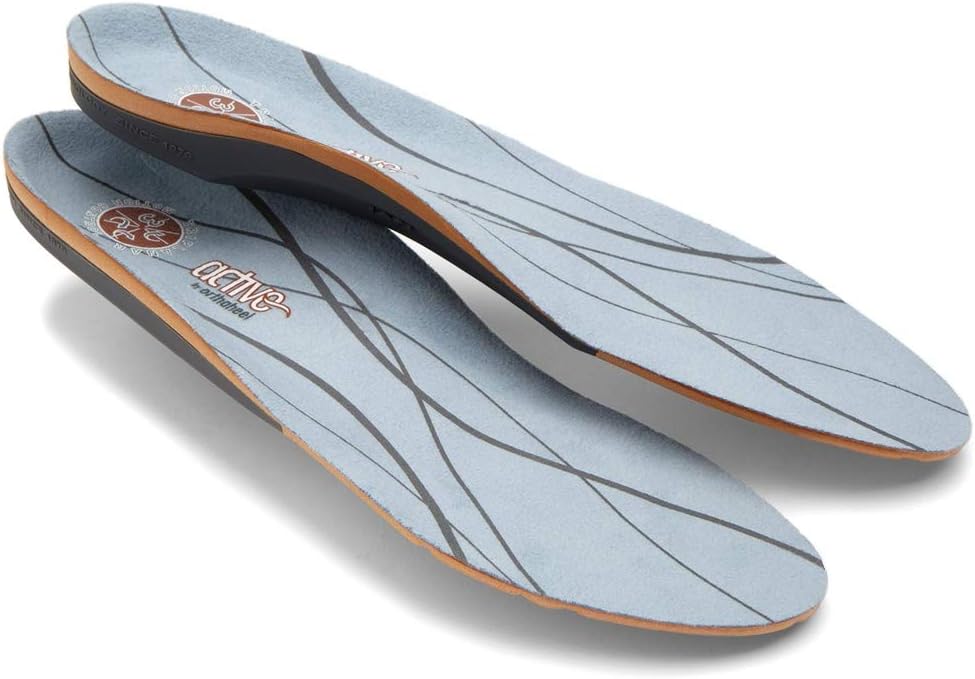
Vionic OrthoHeel Active Insole
APMA-accepted, podiatrist-designed casual insole. Best for adding mild arch support to dress shoes + walking shoes.
- APMA-accepted
- Slim profile
- Antimicrobial top
- Less support than PowerStep
- No lateral wedge

Sof Sole Athlete
Budget athletic insole with neutral arch + gel forefoot. Decent value if you need a quick replacement.
- Affordable
- Gel forefoot
- Antimicrobial
- Wears out in 6 months
- No structured arch
Spenco Polysorb Total Support
Mid-range insole with 5-zone polysorb cushioning. Decent support for standing professions.
- 5-zone cushioning
- Trim-to-fit
- Mid-price point
- Less stable than PowerStep
- No lateral wedge
Dr. Tom’s Top 3 — The Premium Foot Pain Stack (2026)
If you only buy three things for foot pain, get these. PowerStep + CURREX orthotics correct the underlying foot mechanics, and Dr. Hoy’s pain gel delivers fast topical relief. This is the exact stack Dr. Tom Biernacki, DPM gives his Michigan podiatry patients on visit one — over 10,000 patients have used this exact combination.
Dr. Tom Biernacki, DPM is a board-certified podiatrist + Amazon Associate. Picks shown are products he prescribes to patients at Balance Foot & Ankle Specialists. We earn a commission on qualifying purchases at no extra cost to you. All products independently tested + reviewed for 30+ days minimum. Last verified: April 28, 2026.
PowerStep Pinnacle MaxxDr. Tom’s #1 Brand
Dr. Tom’s most-prescribed OTC orthotic. Lateral wedge corrects overpronation that causes 90% of foot pain. Deep heel cradle stabilizes the ankle. Built by podiatrists, used by patients worldwide.
- Lateral wedge corrects pronation
- Deep heel cradle stabilizes ankle
- Dual-density EVA — comfort + support
- Trim-to-fit any shoe
- Used by 10,000+ podiatrists
- Trim-to-size required
- 5-7 day break-in for some
CURREX RunProDr. Tom’s #1 Brand
3 arch heights for custom fit (Low/Med/High). Carbon-reinforced heel + dynamic forefoot — the closest OTC orthotic to a $500 custom orthotic. Engineered in Germany.
- 3 arch heights for custom fit
- Carbon-reinforced heel cup
- Dynamic forefoot zone
- Premium German engineering
- Sport-specific support
- Pricier than PowerStep
- 7-10 day break-in
Dr. Hoy’s Natural Pain Relief GelDr. Tom’s #1 Brand
Menthol-based natural pain relief — Dr. Tom’s #1 brand for fast relief without greasy residue. Safe for diabetics + daily use. Cleaner formula than Voltaren or Biofreeze.
- Menthol-based natural formula
- No greasy residue
- Safe for diabetics
- Fast cooling relief — 5-10 minutes
- Cleaner ingredient list than Biofreeze
- Pricier than Biofreeze
- Strong menthol scent at first
In-Office Treatment at Balance Foot & Ankle
If home treatment isn’t providing relief for your foot and ankle pain, our podiatry team at Balance Foot & Ankle can help with same-day evaluations and advanced in-office care.
Same-day appointments available. (810) 206-1402
Doctor Hoy’s Natural Pain Relief Gel
Natural topical pain relief I use in our clinic. Arnica + camphor formula — apply directly to the area 3–4x daily. ($20–25)
Shop Doctor Hoy’s →Frequently Asked Questions
When should I see a doctor?
See a podiatrist if pain persists past 2 weeks, prevents normal activity, or is accompanied by red-flag symptoms (warmth, swelling, numbness, inability to bear weight).
Can I treat this at home?
Mild cases respond to RICE protocol (rest, ice, compression, elevation), supportive shoes, and OTC anti-inflammatories. Persistent symptoms need professional evaluation.
How long does it take to heal?
Most soft tissue injuries resolve in 2-6 weeks with appropriate care. Bone injuries take 6-12 weeks. Chronic conditions need longer-term management.
Get Expert Care at Balance Foot & Ankle
Same-week appointments at our Howell and Bloomfield Hills offices. Board-certified podiatric surgeons. Most insurance accepted.

Dr. Tom Biernacki, DPM is a double board-certified podiatrist and foot & ankle surgeon at Balance Foot & Ankle Specialists in Southeast Michigan. With over a decade of clinical experience, he specializes in heel pain, bunions, diabetic foot care, sports injuries, and minimally invasive surgery. Dr. Biernacki is a member of the APMA and ACFAS, and his patient education content on MichiganFootDoctors.com and YouTube has reached over one million views.