
Medically reviewed by Dr. Tom Biernacki, DPM · Board-Certified Podiatric Surgeon · Last reviewed: April 2026 · Editorial Policy
Quick Answer
Foot Drop: Causes, Diagnosis & Ankle-Foot Orthosis Trea relates to foot pain — typically caused by overuse, footwear, or biomechanics. Most patients improve in 6-12 weeks with conservative care. Same-week appointments in Howell + Bloomfield Twp: (810) 206-1402.

Medically reviewed by Dr. Tom Biernacki, DPM — Board-Certified Podiatric Surgeon — Balance Foot & Ankle, Howell & Bloomfield Hills, MI. Last updated April 2026.
▶ Watch

Medically Reviewed by Dr. Tom Biernacki, DPM — Board-Certified Podiatrist, Balance Foot & Ankle Specialists, Michigan. Last updated April 2026.
Foot drop — the inability to lift the front part of the foot during the swing phase of walking — is a symptom, not a diagnosis, and it can result from a variety of neurological, muscular, and structural causes. Patients with foot drop characteristically lift their knee higher than normal to clear the dragging toe, producing a “steppage gait” that significantly increases fall risk and reduces walking efficiency. Understanding the cause is essential because treatment varies dramatically based on etiology.
What Is Foot Drop?
Normal walking requires active dorsiflexion — lifting the forefoot upward — during the swing phase so the toes clear the ground. Foot drop occurs when dorsiflexion weakness or paralysis prevents this motion, causing the foot to drag or slap the ground. The underlying problem may be in the nerve, the muscle, or the structural connections between them.
Causes of Foot Drop
Peroneal Nerve Palsy (Most Common)
The common peroneal nerve — which wraps around the fibular head just below the knee — is the most frequently injured nerve in the lower extremity and the most common cause of foot drop. Compression from habitual leg crossing, prolonged squatting, direct knee trauma, knee surgery, or a fibular head fracture can damage this nerve and cause sudden or gradual foot drop. Recovery depends on the severity of nerve injury (neurapraxia vs. axonotmesis vs. neurotmesis).
Lumbar Radiculopathy (L4–L5)
A herniated disc or foraminal stenosis at the L4–L5 level compresses the nerve root supplying the tibialis anterior and peroneals, producing foot drop that is often accompanied by low back pain radiating down the leg. This is one of the most common spinal causes of foot drop in middle-aged adults.
Stroke and Central Nervous System Causes
Stroke, multiple sclerosis, Parkinson’s disease, and cerebral palsy can all produce foot drop through upper motor neuron injury. Post-stroke foot drop is often accompanied by spasticity, making management more complex than peripheral nerve causes.
Charcot-Marie-Tooth Disease
CMT is a hereditary peripheral neuropathy that progressively affects peroneal nerve function, producing bilateral gradual foot drop along with a high-arched (cavus) foot deformity. CMT-related foot drop is managed long-term with custom AFOs and, in severe cases, tendon transfer surgery.
Other Causes
Anterior compartment syndrome, diabetic neuropathy affecting the peroneal nerve, sciatic nerve injury, and tumors or masses compressing the peroneal nerve can all produce foot drop.
Diagnosis
Accurate diagnosis of foot drop requires identifying the level and cause of the neurological lesion. Dr. Biernacki at Balance Foot & Ankle performs a clinical assessment of peroneal nerve function and coordinates with neurology for electromyography (EMG) and nerve conduction studies (NCS), which localize the lesion precisely. MRI of the lumbar spine, knee, or leg may be ordered when compressive pathology is suspected.
Ankle-Foot Orthosis (AFO): The Cornerstone of Foot Drop Management
For most patients with foot drop — regardless of cause — a custom ankle-foot orthosis (AFO) is the most effective immediate intervention. An AFO holds the foot in a neutral or slightly dorsiflexed position during walking, eliminating the slap and trip hazard while restoring a more normal gait pattern.
Several AFO designs are available depending on the degree of drop and patient activity level:
- Posterior leaf spring AFO — a thin, flexible polypropylene shell that provides passive dorsiflexion assistance with minimal resistance to plantarflexion; ideal for mild to moderate foot drop in active patients
- Solid ankle AFO — a rigid design that provides maximum control; used for severe drop or when mediolateral ankle stability is also needed
- Articulated AFO — allows some sagittal plane motion at the ankle while controlling drop; used when the patient retains some dorsiflexion movement
- Carbon fiber dynamic AFO — lightweight and energy-storing; preferred by active patients who want minimal bulk
Dr. Biernacki fabricates custom AFOs from a plaster or digital 3D scan of the patient’s leg to ensure precise fit and optimal biomechanical correction.
Surgical Options for Foot Drop
When foot drop does not recover with conservative management, surgery may restore function. Options include:
- Nerve decompression or repair — for peroneal nerve entrapment at the fibular head, surgical decompression can restore function in carefully selected patients
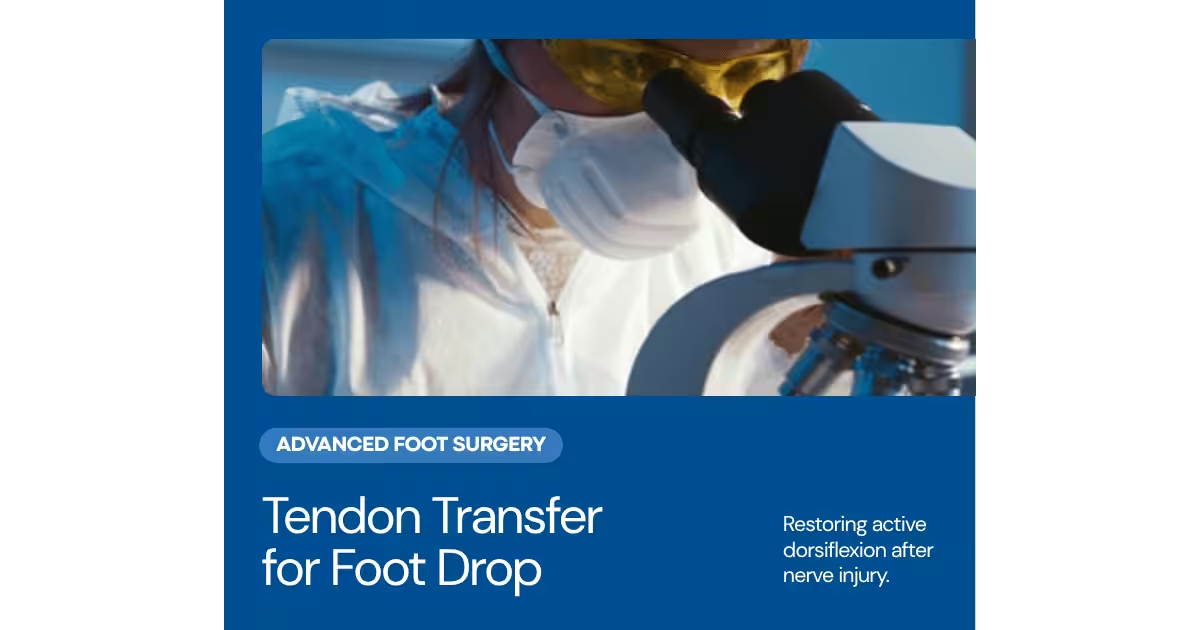
- Tendon transfer — the posterior tibialis tendon is transferred to the dorsum of the foot to provide active dorsiflexion when the peroneal nerve is permanently damaged; an excellent option for younger active patients with complete foot drop
- Ankle and hindfoot fusion — for severe cases with associated deformity, fusion procedures stabilize the foot in a functional position
Foot Drop Evaluation and Custom AFO Fabrication
Dr. Biernacki at Balance Foot & Ankle evaluates foot drop and fabricates custom ankle-foot orthoses at our Bloomfield Hills and Howell offices. Medicare and most insurance accepted.
📞 (810) 206-1402 |
📧 Get Dr. Tom’s Free Lab Test Guide
Discover the 5 lab tests every person over 35 should ask their doctor about — explained in plain English by a board-certified physician.
📍 Located in Michigan?
Our board-certified podiatrists treat this condition at two convenient locations. Same-day appointments often available.

Insurance Accepted
BCBS · Medicare · Aetna · Cigna · United Healthcare · HAP · Priority Health · Humana · View All →
Howell Office
3980 E Grand River Ave, Suite 140
Howell, MI 48843
Get Directions →
Bloomfield Hills Office
43700 Woodward Ave, Suite 207
Bloomfield Hills, MI 48302
Get Directions →
Your Board-Certified Podiatrists



Ready to Get Back on Your Feet?
Same-week appointments available at both locations.
Book Your AppointmentMore Podiatrist-Recommended Foot Health Essentials
Top-Rated Arch Support Insole
Universal podiatrist-recommended insert for pain relief and prevention.
Foot Massage Ball
Daily 3-minute roll reduces most forms of foot and heel pain.
Moisture-Wicking Sock
Prevents fungus, blisters, and odor — the basics matter.
As an Amazon Associate, Balance Foot & Ankle earns from qualifying purchases. Product recommendations are based on clinical experience; prices and availability shown above update live from Amazon.
When to See a Podiatrist
If foot or ankle pain has been bothering you for more than a few weeks, home care alone may not be enough. Balance Foot & Ankle offers same-week appointments at our Howell and Bloomfield Hills clinics — no referral needed in most cases. Bring your current shoes and a short list of symptoms and we’ll build you a treatment plan in one visit.
Call Balance Foot & Ankle: (810) 206-1402 · Book online · Offices in Howell & Bloomfield Hills
Pros & Cons of Conservative Care for foot care
Advantages
- ✓ Conservative care first
- ✓ Same-week appointments
- ✓ Multiple insurance accepted
Considerations
- ✗ Self-treatment can mask issues
- ✗ See a podiatrist if pain >2 weeks
Dr. Tom’s Recommended Products for foot care
Affiliate disclosure: As an Amazon Associate, Balance Foot & Ankle earns from qualifying purchases. We only recommend products we use with patients.


Footnanny Heel Cream Dr. Tom’s Pick
Best for: Daily moisturizer for cracked heels
Ready to Get Back on Your Feet?
Same-day appointments in Howell + Bloomfield Twp. Most insurance accepted. Dr. Tom Biernacki, DPM & team.
Book Today — Same-Day Appointments Available
Call Now: (810) 206-1402
About Your Care Team at Balance Foot & Ankle
Dr. Tom Biernacki, DPM · Board-Certified Foot & Ankle Surgeon. Specializes in conservative-first care, minimally invasive bunion surgery, and complex reconstruction.
Dr. Carl Jay, DPM · Accepting new patients. Specializes in sports medicine, athletic injuries, and routine podiatric care.
Dr. Daria Gutkin, DPM, AACFAS · Accepting new patients. Specializes in surgical reconstruction and pediatric podiatry.
Locations: 4330 E Grand River Ave, Howell, MI 48843 · 43494 Woodward Ave Suite 208, Bloomfield Twp, MI 48302
Hours: Mon–Fri 8:00 AM – 5:00 PM · (810) 206-1402

Dr. Tom Biernacki, DPM is a double board-certified podiatrist and foot & ankle surgeon at Balance Foot & Ankle Specialists in Southeast Michigan. With over a decade of clinical experience, he specializes in heel pain, bunions, diabetic foot care, sports injuries, and minimally invasive surgery. Dr. Biernacki is a member of the APMA and ACFAS, and his patient education content on MichiganFootDoctors.com and YouTube has reached over one million views.
- Diagnosis and Treatment of Plantar Fasciitis (PubMed / AAFP)
- Heel Pain (APMA)
- Hallux Valgus (Bunions): Evaluation and Management (PubMed)
- Bunions (Mayo Clinic)