

You are in the right place. Dr. Tom Biernacki, DPM, FACFAS — board-certified foot & ankle surgeon with 3,000+ surgeries — explains exactly what hammertoe surgery options means and what actually works. Book online or call (810) 206-1402 for a same-day appointment at our Howell or Bloomfield Township office.
Medically Reviewed by Dr. Tom Biernacki, DPM — Board-Certified Podiatrist, Balance Foot & Ankle Specialists, Michigan. Last updated April 2026.
Understanding Hammertoe Deformity
Hammertoe is a progressive flexion deformity of the proximal interphalangeal joint (PIPJ) — the middle joint of the lesser toes — that causes the toe to curl downward into a hammer-like shape. In early stages, the deformity is flexible: the toe can be passively straightened by the examiner. In advanced stages, the joint capsule and collateral ligaments contract, producing a rigid deformity that cannot be passively corrected. The dorsal prominence of the bent PIPJ creates painful pressure against shoe uppers; the tip of the toe may develop painful callus from downward pressure against the shoe sole.
Conservative management — accommodative footwear with adequate toe box height and width, silicone toe caps, and protective padding — addresses symptoms in flexible deformities and delays progression. When rigid deformity produces persistent pain that conservative care cannot adequately manage, surgical correction is indicated. Two primary surgical techniques are available: proximal interphalangeal joint arthroplasty and proximal interphalangeal joint arthrodesis.
PIPJ Arthroplasty (Joint Resection)
What It Is
PIPJ arthroplasty — also called Keller-type arthroplasty or condylectomy — corrects hammertoe by resecting (removing) the head of the proximal phalanx and the base of the middle phalanx, creating a gap at the PIPJ that fills in with fibrous tissue as it heals. The fibrotic ‘pseudarthrosis’ that forms is not a true joint (hence the term ‘arthroplasty’ is slightly misleading) but rather a flexible fibrous connection that allows the toe to straighten without creating a bone-to-bone fusion.
Surgical Technique
PIPJ arthroplasty is performed through a dorsal elliptical skin incision over the PIPJ. The extensor tendon and joint capsule are incised longitudinally. The condyles of the proximal phalanx head are excised with bone-cutting forceps or a small oscillating saw; the articular base of the middle phalanx is similarly resected, creating a gap of approximately 5–6mm. The toe is held in corrected alignment with a smooth Kirschner wire (K-wire) driven through the pulp of the toe, across the PIPJ site, and into the medullary canal of the proximal phalanx. The K-wire remains in place for 3–4 weeks while the fibrous union develops, then is removed in office without anesthesia.
Advantages of Arthroplasty
- Preserves some toe flexibility — the pseudarthrosis is not as rigid as a fusion
- Technically faster than arthrodesis in experienced hands
- Appropriate for elderly patients or those with poor bone quality where fusion healing is uncertain
- No risk of non-union (there is no bone-to-bone healing required)
Disadvantages of Arthroplasty
- Toe may be floppy and unstable after K-wire removal — ‘floating toe’ or ‘cock-up’ deformity risk
- Toe shortening may be more pronounced than with arthrodesis
- Higher recurrence rates compared to arthrodesis in some series
- May not provide adequate correction for severe or complex deformities
PIPJ Arthrodesis (Joint Fusion)
What It Is
PIPJ arthrodesis fuses the proximal and middle phalangeal bones across the PIPJ, creating a rigid permanent correction. Rather than resecting bone to create a mobile gap, arthrodesis prepares the joint surfaces for bone healing and holds them in corrected position until solid fusion occurs. The result is a permanently straight, somewhat rigid toe — but one with excellent stability and predictable correction.
Surgical Technique
The PIPJ joint surfaces are accessed through a dorsal incision as in arthroplasty. The articular cartilage of both the proximal phalangeal head and the middle phalangeal base is removed with a rongeur or burr until bleeding cancellous bone is exposed on both surfaces. The toe is then positioned in slight plantarflexion (5–10 degrees below neutral) — the optimal fusion position that allows the toe tip to contact the ground during walking without excessive pressure. Fixation options include:
- Single smooth Kirschner wire: simple, inexpensive, removed at 4–6 weeks; slightly higher recurrence and malunion risk
- Absorbable PIPJ fusion implants (Arthrex StayFuse, Integra Smart Toe): pre-bent titanium or nitinol implants that passively straighten to apply corrective force during healing, remain in place permanently
- Bone-fixation headless screws: provide compression across the fusion site, retained permanently
Advantages of Arthrodesis
- More durable correction with lower recurrence rates compared to arthroplasty
- Better toe stability — no risk of ‘floating toe’ deformity
- Implant-based fusion devices eliminate K-wire removal burden and may improve patient comfort during the healing period
- Preferred for younger, more active patients where long-term correction durability is a priority
Disadvantages of Arthrodesis
- Risk of non-union (fibrous union without solid bone healing) — occurs in approximately 5–10% of cases; most non-unions are asymptomatic
- Toe is permanently rigid at the PIPJ — no flexibility preserved
- Implant-retained devices carry small risk of implant-related complications (migration, infection)
Choosing Between the Two: Decision Framework
The choice between arthroplasty and arthrodesis depends on: patient age and activity level (younger, more active patients generally benefit from arthrodesis durability); deformity severity and rigidity (more severe deformities are better corrected with arthrodesis); associated conditions (diabetes or vascular disease may impair bone healing, making arthroplasty safer); and surgeon experience and preference.
Recovery
Both procedures allow immediate weight-bearing in a surgical shoe post-operatively. Transition to regular footwear occurs at 3–4 weeks for arthroplasty (after K-wire removal) and 4–6 weeks for arthrodesis (pending fusion progress). Return to athletic activity typically occurs at 6–8 weeks for simple hammertoe correction in otherwise healthy patients.
Ready to Resolve Your Foot Pain?
Board-certified podiatrists across Southeast Michigan — same-week appointments available.
Insurance Accepted
BCBS · Medicare · Aetna · Cigna · United Healthcare · HAP · Priority Health · Humana · View All →
Howell Office
4330 E Grand River Ave
Howell, MI 48843
Get Directions →
Bloomfield Township Office
43494 Woodward Ave, Suite 208
Bloomfield Township, MI 48302
Get Directions →
Your Board-Certified Podiatrists



Ready to Get Back on Your Feet?
Same-week appointments available at both locations.
Book Your AppointmentWatch: Hammertoe Surgery: Arthroplasty vs Arthrodesis
Dr. Tom on hammertoe surgery — PIPJ arthroplasty (resection) vs arthrodesis (fusion), K-wire vs implant fixation, 4-6 week recovery, floating toe risk, revision rate.
Post-Hammertoe Surgery Kit
Structured toe recovery. Dr. Tom’s kit:
As an Amazon Associate, Balance Foot & Ankle earns from qualifying purchases. This supports our free patient education content.
Weeks 1-4 protection.
Alignment + pressure relief.
Weeks 4-12 return-to-shoe.
Topical forefoot relief.
Related: Hammertoe Care · Surgery Services · Book Hammertoe Consult
In Our Clinic
Hammertoes come to our clinic in two flavors: flexible (the toe still passively straightens) and rigid (it doesn’t). For flexible hammertoes we use gel toe crests, roomier toe boxes, custom orthotics to address the underlying instability, and sometimes night splints. Rigid hammertoes with a corn on top of the PIP joint, or a callus under the metatarsal head, usually need a minor outpatient procedure (PIP arthroplasty or fusion) to straighten the toe. The patients who wait too long develop fixed deformities and skin breakdown — we would much rather address a flexible hammertoe early.
More Podiatrist-Recommended Hammertoe Essentials
Extra-Depth Orthopedic Shoe
Orthofeet Sprint — tall toe box prevents hammertoe rubbing and friction.
Wide-Toe-Box Walking Shoe
New Balance 990v6 — accommodates curled toes without pressure.
Supportive Insole


![How to Fix Hammer Toes at Home [Overlapping & Crossover Toes]!](https://www.michiganfootdoctors.com/wp-content/cache/flying-press/7ea0260b79509af610220599744e2c56.jpg)
Watch: How to Fix Hammer Toes at Home [Overlapping & Crossover Toes]! — MichiganFootDoctors YouTube
PowerStep Pinnacle — reduces forefoot pressure that drives hammertoe.
As an Amazon Associate, Balance Foot & Ankle earns from qualifying purchases. Product recommendations are based on clinical experience; prices and availability shown above update live from Amazon.
When to See a Podiatrist
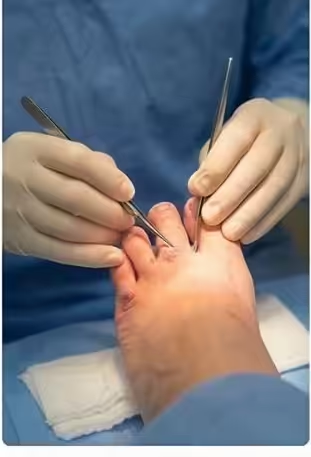
Rigid hammertoes don’t reduce with splinting alone — the tendon and capsule have contracted. If the toe no longer straightens passively, surgical correction restores alignment in one short outpatient visit. Call Balance Foot & Ankle to see whether your deformity is still flexible (and responsive to the conservative tools above) or if it’s time for a 20-minute in-office correction.
Call Balance Foot & Ankle: (810) 206-1402 · Book online · Offices in Howell & Bloomfield Township
In-Office Treatment at Balance Foot & Ankle
When conservative care isn’t enough, Dr. Tom Biernacki and the team at Balance Foot & Ankle offer advanced, same-day options — including Hammertoe Treatment Michigan at our Howell and Bloomfield Township clinics.
Same-day appointments available. Call (810) 206-1402 or book online.
In-Office Treatment at Balance Foot & Ankle
If home treatment isn’t providing relief for your hammertoes, our podiatry team at Balance Foot & Ankle can help with same-day evaluations and advanced in-office care.
Same-day appointments available. (810) 206-1402
Frequently Asked Questions
Which is better for plantar fasciitis?
The shoe with more cushioning and a stronger rocker typically wins for plantar fasciitis. See full comparison for our specific verdict.
Which lasts longer?
Both options typically last 300-500 miles for runners or 9-12 months for daily walkers. Material durability varies; check our detailed comparison.
Which is better for flat feet?
Flat feet need stability or motion control. The neutral option is not ideal unless paired with a custom orthotic.
Ready to fix this for good?
Reading goes only so far. The fastest path to relief is a 30-minute office visit with Dr. Biernacki — same-day Howell or Bloomfield Township. Book online or call (810) 206-1402 or use our online booking.
Get Expert Care at Balance Foot & Ankle
Same-week appointments at our Howell and Bloomfield Township offices. Board-certified podiatric surgeons. Most insurance accepted.

Dr. Tom Biernacki, DPM is a board-certified foot & ankle surgeon (ABFAS & ABPM) at Balance Foot & Ankle Specialists in Southeast Michigan. With over a decade of clinical experience, he specializes in heel pain, bunions, diabetic foot care, sports injuries, and minimally invasive surgery. Dr. Biernacki is a member of the APMA and ACFAS, and his patient education content on MichiganFootDoctors.com and YouTube has made him one of the most-followed foot & ankle educators on YouTube.
More questions patients ask
What is a hammertoe?
A hammertoe is a deformity where the toe bends abnormally at the middle joint, creating a hammer-like appearance. It typically affects the second through fifth toes and results from muscle imbalance, tight shoes, genetics, or underlying conditions like arthritis. Without treatment, flexible hammertoes become rigid and may require surgical correction. Dr. Biernacki offers both conservative and surgical treatment options.
Can hammertoes be fixed without surgery?
Flexible hammertoes (those that can still be straightened manually) often respond to conservative treatment including toe splints, padding, shoe modifications, custom orthotics, and stretching exercises. Once a hammertoe becomes rigid, surgery may be necessary. Early intervention provides the best outcomes for non-surgical management.
What does hammertoe surgery involve?
Modern hammertoe correction typically involves a minimally invasive approach where Dr. Biernacki releases the contracted tendon and removes a small bone segment through a tiny incision. Recovery involves wearing a surgical shoe for 3-4 weeks with most patients returning to regular shoes within 6 weeks. Success rates exceed 90% with low recurrence rates.
Still have a question about coverage or cost? Book online and we will check your benefits before your visit: Book in Howell · Book in Bloomfield Township. Prefer to talk it through first? Call (810) 206-1402.